

The fantasy of a “flexible” gap year dies fast when you’re on a visa.
If your immigration status is shaky or limited, you don’t have a normal gap year problem. You have a legal survival problem that happens to overlap with career planning.
Let’s deal with it like adults.
This is for you if:
- You’re an IMG or US-IMG on a visa or abroad, not in a position to just “take time off and figure it out.”
- Your current status (or lack of it) seems to block most typical research or clinical options.
- You’re worried that a visa gap will kill your match chances as much as any exam score.
Good. You should worry. But you also have more paths than people tell you about—if you’re strategic and completely honest about constraints.
Step 1: Get Brutally Clear on Your Actual Visa Box
You cannot plan anything until you know your exact legal sandbox. “I’m on a visa” is useless. You need specifics.
Here’s what matters in real life:
- What country are you physically in right now?
- What is your exact immigration status?
- When does it expire?
- Are you allowed to:
- Work? For whom?
- Volunteer? In what context?
- Study? Full-time or part-time?
- Get paid from outside the country you’re in?
If you don’t know, that’s your first task. Not another practice question. Not another personal statement line.
You go:
- To your school’s international office (if you’re in the US on F-1, J-1, etc.).
- Or to a real immigration attorney with health-care/academic experience (if you’re outside or on a work visa).
- Or to the official government resources (USCIS, IRCC, UKVI, etc.) and read the sections that apply to you.
Do not rely on:
- WhatsApp groups.
- Seniors who “did the same thing.”
- Reddit threads from 2017.
Those stories are useful for ideas, not for legal boundaries.
To give you a mental map, here’s how different common statuses affect your gap year practicality in the US:
| Status | Work in US | Research in US | Study in US | Paid Work Abroad While in US |
|---|---|---|---|---|
| F-1 (no OPT/CPT) | No | Maybe (unpaid, limited) | Yes (if enrolled) | Very risky / usually no |
| F-1 with OPT | Yes (field-related, with EAD) | Yes | Yes (sometimes) | Generally no |
| J-1 Research Scholar | Yes (for sponsor) | Yes (for sponsor) | Sometimes | No (usually) |
| B1/B2 Visitor | No | Very limited, no patient care | No | Maybe, if for foreign entity |
| Outside US (no US status) | N/A | Possibly remote | Possibly remote | Yes, if legal in your country |
You’re not trying to become an amateur immigration expert. You’re trying to answer one question:
What can I do without committing immigration fraud or blowing my chance at a future visa?
Write your constraints down in one blunt sentence. Example:
“I am an F-1 graduate with no OPT, still in the US, not allowed to work for pay, limited to unpaid volunteer/research roles that do not violate status.”
Or:
“I’m an IMG in India with no US visa, so all my activities must be done abroad or remotely for US institutions that accept remote work.”
Once that sentence is clear, you can start being creative instead of paralyzed.
Step 2: Separate What Programs Value From What You Think You Need
Most people in your situation make the same mistake: they chase what looks “impressive” instead of what fits their legal box and actually matters for residency.
For residency programs, a gap year is judged on three main things:
- Did you stay productively engaged in something related to medicine or health?
- Is your story coherent? (Not random bouncing)
- Does it help them trust you? (Reliability, commitment, communication, understanding of US system)
Within your legal constraints, the work you choose should ideally tick at least two of these:
- Clinical exposure or at least clinical adjacency
- US system familiarity (guidelines, documentation, team culture)
- Research productivity (abstracts, posters, manuscripts)
- Evidence of commitment to your chosen specialty
- Clear continuity (not disappearing for 12 months)
You can’t fix everything—maybe you’re stuck outside the US with no direct patient contact. Fine. Then you double down on what you can do: remote projects, publications, guideline work, QI data, teaching.
Step 3: If You’re Stuck Outside the US (No Visa, No Entry)
This is one of the most common and least talked-about situations.
You finished med school. You didn’t get a visa. Or you had one, it expired, you left. Now you’re outside the US trying not to let your CV rot.
Here’s the template that works.
3.1. Anchor Yourself at One Primary Institution (even remotely)
Programs don’t like chaos. They like continuity.
Your best move is to build a stable relationship with one or two institutions or mentors for the year.
Examples:
- Remote research assistant for a US academic attending (chart review, literature synthesis, data entry, manuscript drafting)
- Longitudinal involvement in one lab/project abroad with a strong PI, ideally with US collaboration
- Year-long non-US clinical + data/QI work in a teaching hospital
Your line on the CV needs to look like: “Research fellow, Department of X, Y University, Remote / Country (Month Year – Month Year)”
Not: “Various short research tasks for different people over WhatsApp.”
3.2. Lean Hard Into Remote Research (Legally Clean)
If you’re abroad, you’re usually allowed to work for foreign entities (including US-based ones) as long as:
- You’re physically outside their jurisdiction; and
- You follow your own country’s laws and tax rules.
US immigration law mostly cares what you do on US soil. If you’re in Pakistan, Brazil, Nigeria, India—your activities for a US mentor are not “US work” in the visa sense.
Good targets:
- Retrospective chart review (if IRB and local rules allow remote access)
- Literature reviews / meta-analyses
- Manuscript preparation and revision
- Data cleaning and basic stats (with supervision)
- Creating protocols, surveys, or educational materials
You present it honestly:
“I worked remotely from [country] with Dr. X at [US institution] on [projects]. We communicated weekly via Zoom; my role included data collection, analysis, drafting abstracts and manuscripts.”
Programs know this is increasingly common. If the output is real (posters, papers, accepted abstracts), they respect it.
Step 4: If You’re Inside the US but Cannot Legally Work
Common scenario: you’re on F-1 after graduation without OPT, or on some status that doesn’t let you do paid employment.
The instinct is to panic and either:
- Do illegal under-the-table work, or
- Sit at home studying and call it “dedication.”
Both are bad.
4.1. Target Legitimate Unpaid or Limited Roles
What you want are roles that:
- Don’t violate your status conditions
- Are clearly educational/volunteer
- Let you build real relationships and letters
Examples that can work (depending on your exact status and school rules):
Volunteer research assistant at a university lab
You’re not “employed.” You’re gaining educational experience. Get this in writing as a volunteer/trainee, not as staff.Volunteer clinical observer
No direct patient care, no billing, no EMR orders. Shadowing plus maybe QI/project work in the background.Volunteer coordinator / patient navigator in a hospital-supported program
Sometimes allowed; must align with your status and not be “employment.”
You don’t decide this on your own. You get the international office (if you still have one) or legal to confirm:
“Is this okay given my F-1/B1/etc. status if I’m unpaid and defined as a volunteer/trainee?”
Document everything. If a CBP officer or consular official someday asks: “What were you doing during this year?” you need clean, consistent paperwork and a straight story.
4.2. Make It a Structured “Scholarly Year,” Not a Lost Year
Call it what it is on your CV and in your application:
- “Scholarly Year in Clinical Research”
- “Academic Enrichment Year – Cardiology Outcomes Research”
- “Non-degree Clinical Research Fellowship (Volunteer)”
Then build structure:
- Fixed weekly schedule (e.g., M/W/F research, T/Th self-study + online coursework)
- Clear deliverables: 2 abstracts, 1 manuscript, 1 poster, regular presentations
Step 5: If You Can Work in Your Home Country But Not in the US
This is where many IMGs waste the opportunity.
They think: “If it’s not in the US, programs won’t care.” Wrong.
Programs like:
- Responsibility
- Continuity
- Evidence you function in a real health system
So build a hybrid year:
Clinical Base in Your Country
- Government hospital position, residency year, junior doctor job
- Or supervised clinical position with meaningful patient load
Overlay US-Conscious Work on Top
- Remote research with a US mentor
- Remote QI project that aligns with US guidelines (e.g., implementing sepsis protocols)
- Tele-education activities (MCQs creation, case conferences with US groups)
When you write this up:
“I worked as a junior doctor in internal medicine at [Hospital], managing [types of patients]. Concurrently, I collaborated remotely with Dr. Y at [US institution] on a retrospective study about [topic], resulting in [outputs].”
That shows maturity and initiative. Not passivity.
Step 6: Using Study and “Student” Status as a Legal Tool
Sometimes, your best legal move is to become a student again—strategically.
6.1. One-Year Master’s / MPH / MS as a Bridge
If:
- You can afford some tuition, and
- You can enter as a student (F-1 in the US, for example),
A one-year program can:
- Give you legal status
- Allow campus research work (sometimes paid)
- Open CPT/OPT options for related work
- Plug you into a network and a PI who can sponsor letters
The danger: random, unrelated degrees that look like stalling.
What works better:
- MPH with strong outcomes/epidemiology
- MS in Clinical Research, Biostatistics, or Health Outcomes
- Specialty-aligned degrees (e.g., MS in Nutrition if going for IM/endocrine, MS in Biomedical Imaging if radiology-focused)
Frame it clearly:
“I used this year to gain formal training in research methodology and biostatistics, which strengthened the quality of my clinical research and my ability to interpret evidence in practice.”
6.2. Non-degree Coursework + Research
At some institutions you can:
- Enroll in non-degree or certificate programs
- Use student status to access institutional resources and possibly volunteer or paid roles on campus (within the rules)
This is very context-specific, but I’ve seen it save people who otherwise had no legal way to stay connected.
Step 7: Remote, Cross-Border Work That Programs Actually Respect
Let’s get concrete. Here are realistic, legal gap-year options when your visa is limiting, that I’ve seen lead to interviews and matches.
7.1. Remote Research Fellow (US or Europe-Based Mentor)
You:
- Sit in your home country (or wherever you’re legal)
- Join a team as a remote research fellow
- Have standing weekly meetings, clear tasks, and visible output
Your work:
- Data abstraction from de-identified datasets
- Systematic reviews/meta-analyses
- Writing sections of manuscripts
- Preparing conference posters/presentations
You want:
- Your name on abstracts and papers
- A strong, specific letter from your PI
- A clear start and end date on your CV
7.2. Specialty-Focused Guideline + Education Work
You can build a portfolio around:
- Summaries of major guidelines (ACC/AHA, IDSA, ASN, etc.)
- Creating teaching slides or sessions for med students/interns
- Running remote journal clubs with US contacts or your own cohort
This isn’t “extra fluff” if you do it right.
I’ve seen candidates explicitly discuss:
“During my gap year, I led a weekly online journal club with other IM applicants, where we critically appraised new guidelines and landmark trials. This sharpened my ability to rapidly synthesize evidence and communicate it clearly.”
Program directors like applicants who can teach and communicate. This is how you prove it without breaking visa rules.
7.3. Remote Quality Improvement or Data Projects
If you can:
- Access hospital data (at home institution)
- Work with a US mentor on project design
You can:
- Implement or analyze a sepsis bundle
- Track readmission rates and intervention impact
- Design a documentation improvement project
Again, you’re not pretending this is US clinical experience. You’re showing you understand systems, QI, and evidence-based practice.
Step 8: How to Explain a Visa-Limited Gap Year in Applications
You cannot just hide this. You need a clean, confident explanation in:
- Your personal statement (briefly)
- The “gap” or “leaves of absence” section
- Interviews
The formula:
- One line on the visa constraint
- Three to four lines on what you did despite it
- One line on what you learned / how it shaped you
Example:
Due to visa limitations after graduation, I was unable to remain in the United States for in-person clinical work. I returned to [country], where I worked as a junior doctor in internal medicine at a tertiary hospital while collaborating remotely with a cardiology outcomes group at [US institution]. During this year, I contributed to two retrospective studies on heart failure readmissions and co-authored three abstracts accepted to national meetings. This experience taught me to adapt within constraints while remaining fully committed to my long-term goal of practicing internal medicine in the United States.
You’re not apologizing. You’re demonstrating competence under constraints.
Step 9: Avoid the Moves That Will Actually Hurt You
Let me be blunt. These are the big mistakes.
Illegal Work in the US
Paid employment without authorization. Cash jobs. Off-the-books clinical work. If this ever surfaces, you’re done.Mislabeling Observerships as “Clinical Experience”
Especially with B1/B2. If you so much as hint that you saw patients independently, wrote notes, or touched orders, you create visa red flags.Completely Empty Year with Only “Studying for Step”
One dedicated exam period is fine. A full year with nothing but “study” and no structured commitment looks weak, unless you had severe health/family issues (in which case you explain).Chaotic 2–3 Month Hops With No Anchor
A bunch of random online courses, occasional observerships, and scattered small projects. Hard to explain, hard to recommend.
You want one or two anchors: a main role or institution that defines your year, plus secondary supporting activities.
Step 10: Build a One-Page Gap Year Plan That You Can Actually Execute
Stop keeping it in your head. Write a concrete one-page plan for the next 6–12 months.
Sections:
Legal Status Box
- Country:
- Status:
- End Date:
- Permitted:
- Prohibited:
Primary Gap Year Role
- Position title (what you’ll put on ERAS)
- Institution
- Supervisor/PI
- Start–end dates
- Expected outputs (publications, letters, skills)
Secondary Activities
- Online coursework (Coursera, university certificates, etc.)
- Teaching/tutoring roles (if legal)
- Structured self-study goals (with milestones)
Residency Application Integration
- Target specialty and how each activity supports it
- Plan for obtaining at least 2–3 strong letters from your year
- Dates for exam attempts, OET, etc., if pending
Then reality-check it with:
- A senior who has successfully matched
- An advisor at your institution
- If possible, an immigration-aware attorney or international office
Visualizing a Typical Visa-Limited Gap Year Structure
Here’s what a “salvaged but strong” year might look like if you’re outside the US, no visa, applying in the upcoming cycle:
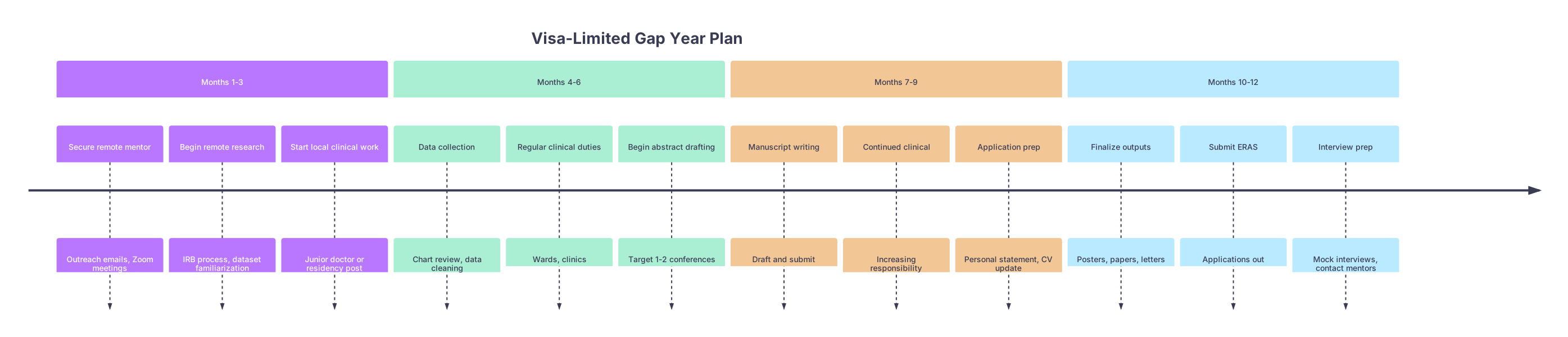
| Period | Event |
|---|---|
| Months 1-3 - Secure remote mentor | Outreach emails, Zoom meetings |
| Months 1-3 - Begin remote research | IRB process, dataset familiarization |
| Months 1-3 - Start local clinical work | Junior doctor or residency post |
| Months 4-6 - Data collection | Chart review, data cleaning |
| Months 4-6 - Regular clinical duties | Wards, clinics |
| Months 4-6 - Begin abstract drafting | Target 1-2 conferences |
| Months 7-9 - Manuscript writing | Draft and submit |
| Months 7-9 - Continued clinical | Increasing responsibility |
| Months 7-9 - Application prep | Personal statement, CV update |
| Months 10-12 - Finalize outputs | Posters, papers, letters |
| Months 10-12 - Submit ERAS | Applications out |
| Months 10-12 - Interview prep | Mock interviews, contact mentors |
This is not theoretical. This is exactly how I’ve seen people in constrained situations still build matchable profiles.
One Example of Productivity vs. Status
To hammer home why structured work matters more than location, compare these:
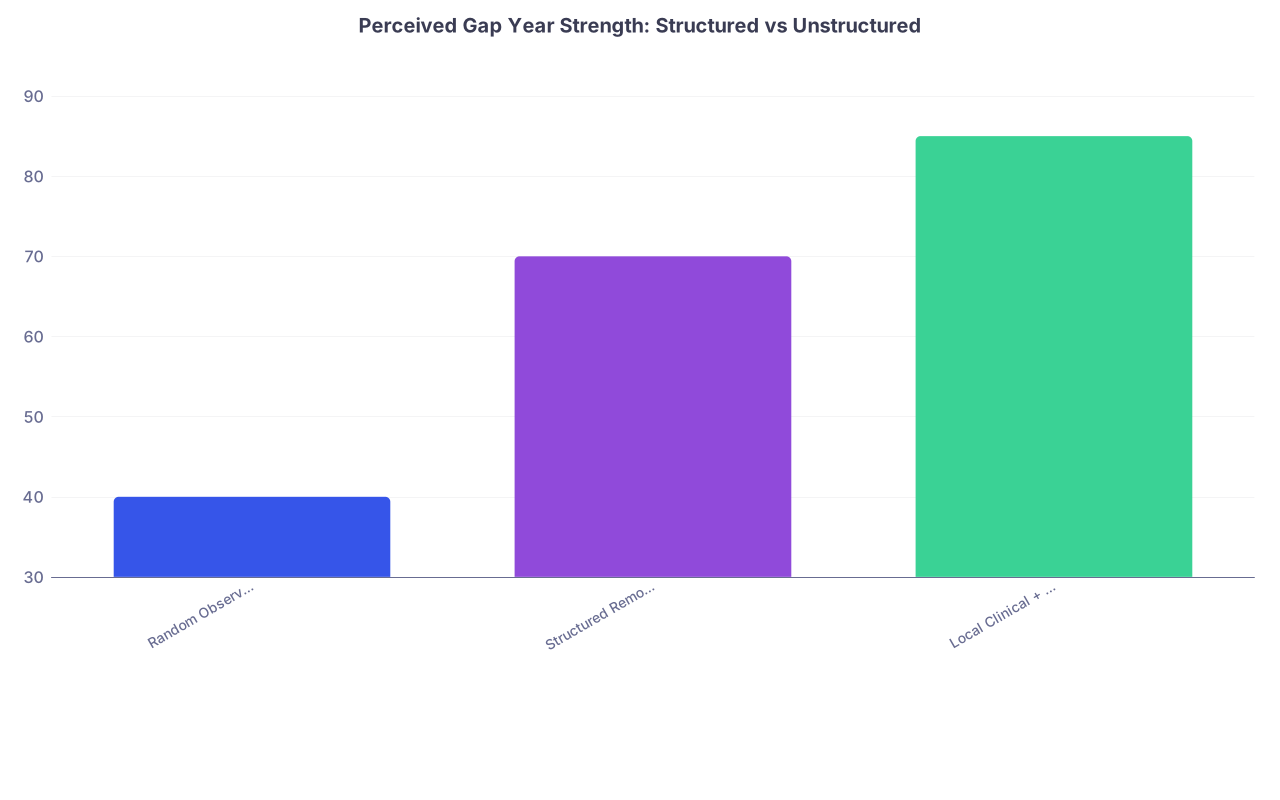
| Category | Value |
|---|---|
| Random Observerships in US | 40 |
| Structured Remote Research Abroad | 70 |
| Local Clinical + Remote Research | 85 |
That bar chart isn’t “official data.” It’s reality as many program directors perceive it.
Shiny US hospital with no real responsibility or output? Less impressive than serious, continuous work—wherever it happens.
Your Next Move
Do not “think about this later.” If your visa status is limiting your gap year options, procrastination is what will actually kill your match chances.
Today—literally today—do this:
Open a blank document and write a single, honest sentence:
“Given my current visa status, I am legally allowed to _______ but not allowed to _______ from now until _______.”
Then list three specific roles that fit in the allowed space:
- One primary (research / clinical / degree)
- Two secondary (online coursework, teaching, structured study, guideline/education work)
If you can’t fill that sentence without guessing, your first email or appointment needs to be with an international office or immigration lawyer. Until your legal box is clear, every other “plan” is fantasy.


