

It’s June. Your friends are posting Match photos and PGY-1 orientation pics. You’re sitting at your kitchen table staring at an email that says what you already know: you failed your board exam. You are not starting residency this year. You have a forced gap year and a massive hit to your confidence.
Everyone is asking, “So what are your plans?” and you want to scream because you’re not even sure how you’ll explain this on ERAS, let alone in an interview.
Here’s the reality: you have a problem, but it’s a solvable one—if you treat this year like a strategic damage-control operation, not a random timeout.
I’m going to walk you through exactly what to do with this gap year: how to fix the academic side, what to put on your application, how to talk about it, and what traps to avoid.
Step 1: First 2–4 Weeks – Stabilize and Get Your Facts Straight
You’re probably tempted to jump straight into “I’ll just study harder.” That’s how people end up failing twice.
Use the first few weeks to do three things: emotional triage, fact-finding, and initial planning.
1. Emotional triage (brief, but necessary)
You do not have to “be okay” immediately, but you do need to function. Give yourself a defined window to react—cry, rant, disappear for a weekend, whatever. Then put a date on your calendar: “Start plan on X date.” After that, every day is part of the fix.
If you’re spiraling (sleep gone, appetite gone, can’t focus at all), that’s not “being hard on yourself,” that’s impairment. Talk to someone licensed. Not Instagram therapy. Real therapy. If you’re worried about mandatory reporting, you can literally say, “I need help functioning after failing an exam,” and keep it at that.
2. Get objective data on what went wrong
You can’t fix “I just choked.” That’s vague. You need specifics.
Do this:
- Pull your score report and break it down by content area and question type.
- Write out:
- Which sections you underperformed in
- Any severe timing issues (e.g., guessed on last 10 questions)
- How many weeks you studied, what resources you used, how many Qs you did
Then answer, bluntly:
- Did you actually finish content review?
- Did you do enough questions? (for most big board exams, “enough” is usually 2,000+ targeted questions, not 400 random ones)
- Did you take multiple full-length practice tests under timed conditions?
- Did you work during prep in a way that made real studying impossible?
You’ll probably see a pattern. Common ones I’ve seen:
- “I used too many resources and didn’t master any.”
- “I did tons of passive studying (videos, Anki) and almost no timed questions.”
- “I underestimated X subject because I thought I was strong in it.”
- “I was working 50–60 hours a week and tried to study ‘around’ that.”
Write this down. You’ll use it both for your study redesign and later, in interviews.
3. Clarify the logistical reality of your situation
You need to know:
- What are your school’s or state’s policies about retaking?
- When’s the earliest you can sit again?
- Does passing by a certain date matter for the next Match cycle?
- Do you need to be “within X years of graduation” for licensing or visa reasons?
Talk to:
- Your dean’s office / academic affairs
- If IMG: your school and ECFMG (and a visa advisor if relevant)
You’re not “bothering them.” They deal with this. Ask their experience with others who failed and then matched—what they did with their year.
Step 2: Set the Core Objective of This Gap Year
You don’t have 20 goals. You have one main goal and a few supporting ones.
The main goal is always:
Pass the exam on the next attempt with a solid, confidence-restoring performance.
Supporting goals (in this order):
- Repair your application narrative (show maturity, resilience, direction).
- Stay clinically or academically connected to medicine.
- Protect your mental and financial health enough that you can actually study and function.
Do not get cute and overload this year with six part-time jobs, three research projects, an MPH, and 8 hours/day of studying. That’s how people fail again.
Step 3: Build a Ruthless Re-Take Study Plan
This part is non-negotiable. You’ll structure the rest of the year around it.
1. Decide your timeline backward from the next Match
You want your passing score available early enough that programs see it and feel reassured.
Typical pattern:
- Retake exam: 2–4 months before ERAS applications open (for US grads) or before you’ll submit.
- That usually means 3–6 months of serious prep.
Use a rough timeline:
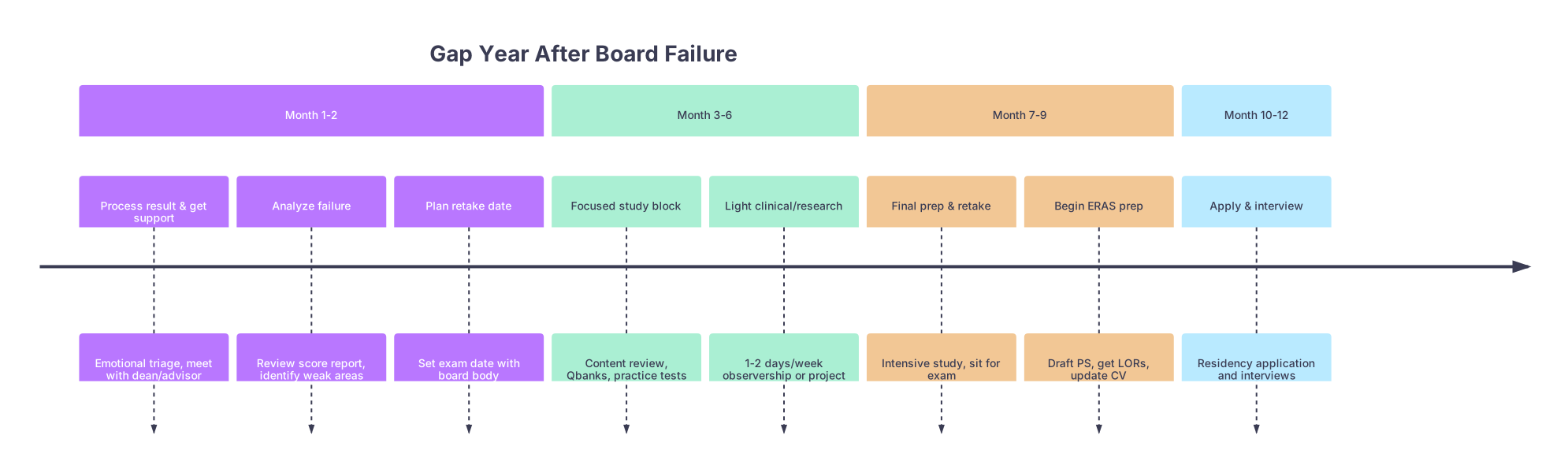
| Period | Event |
|---|---|
| Month 1-2 - Process result & get support | Emotional triage, meet with dean/advisor |
| Month 1-2 - Analyze failure | Review score report, identify weak areas |
| Month 1-2 - Plan retake date | Set exam date with board body |
| Month 3-6 - Focused study block | Content review, Qbanks, practice tests |
| Month 3-6 - Light clinical/research | 1-2 days/week observership or project |
| Month 7-9 - Final prep & retake | Intensive study, sit for exam |
| Month 7-9 - Begin ERAS prep | Draft PS, get LORs, update CV |
| Month 10-12 - Apply & interview | Residency application and interviews |
This will shift based on your specific exam and application year, but you get the idea.
2. Redesign your strategy, not just your schedule
If your last prep was:
- Video-heavy
- Untimed questions
- Last-minute cramming
- Or “study when you can”
…then your new prep should be the opposite.
For a serious retake, your skeleton plan should look like:
- 4–6 hours/day of active study (Qs, explanations, spaced repetition, mixed blocks)
- 5–6 days/week
- At least one full-length timed practice exam every 1–3 weeks in the latter half
- A primary Qbank + maybe a secondary if you truly exhaust the first
You should be tracking:
- Number of questions/day
- % correct (but more importantly: what you’re getting wrong and why)
- Time spent per question block
- Weak content areas to be reviewed separately
Do not re-watch 200 hours of videos “for comfort.” That’s procrastination in disguise.
3. Make your environment boringly pro-success
You are not a monk. But while you’re rebuilding, you cannot act like this is a normal relaxed year off.
Basic rules:
- Stable daily wake-up and start time (even if you’re not a morning person).
- One defined, distraction-minimal study space.
- Phone not within arm’s reach during question blocks.
- One day per week free of studying to prevent burnout.
If you have to work (financially non-optional), structure it so that studying still has protected blocks. Night shifts plus board prep is usually a disaster unless you’re extremely disciplined.
Step 4: Decide What Else You’ll Do This Year (Strategically)
This is where people either repair their application or quietly trash it.
You have three main lanes: clinical, research, and “other” productive activities. You don’t need all three. You need a coherent story.
1. Clinical involvement (if you can get it)
Best options:
- Formal post-grad clinical fellowship year (for some IMGs)
- Observerships / externships
- Working as a clinical assistant, scribe, or in a related role
- Prelim year if you already had an offer and can still start after retaking (rare but happens)
What you want from any clinical thing:
- A letter writer who actually saw you work.
- Evidence that you stayed engaged in patient care.
- A way to anchor your “I grew from this” story.
Bad idea: random disjointed shadowing in five specialties completely unrelated to your intended field, just to fill a CV line.
2. Research / academic work
Good if:
- You’re going for competitive specialties.
- You can get a genuine role (not fake authorship).
- You have the bandwidth alongside studying.
Think:
- Joining a faculty member’s ongoing projects at your med school or local academic center.
- Quality improvement or outcomes projects tied to your intended specialty.
- Systematic review or retrospective chart review that can realistically be submitted/presented within the year.
Less helpful:
- Extremely long basic science projects that won’t produce anything visible for years.
- Getting your name buried as author #14 on a paper where you barely participated.
3. Nonclinical but clearly productive work
Sometimes you need money. Or you can’t get a clinical slot easily (especially some IMGs).
Acceptable—if well-framed:
- Working in public health, medical education, or healthcare administration.
- Teaching (MCAT, USMLE, nursing students, etc.).
- Tech or data jobs that you can connect to medicine (e.g., clinical data analysis).
If you go this route: you must still leave enough time and mental energy for exam prep. If you burn out for a paycheck, you’ll just stack another failure on top.
Step 5: Structuring Your Week During the Gap Year
Let me make this practical. This is the kind of weekly pattern that works.
Example if you’re mostly focused on studying + light clinical:
| Day | Morning (3–4 hrs) | Afternoon (3–4 hrs) | Evening (optional) |
|---|---|---|---|
| Mon | Qbank mixed blocks | Review + targeted content | Light reading / rest |
| Tue | Clinical/observership | Clinical/observership | 1–2 hrs Anki/review |
| Wed | Qbank + weak topics | Practice test review | Exercise / rest |
| Thu | Research / project work | Qbank timed blocks | Social / rest |
| Fri | Qbank mixed + content gaps | Planning + targeted review | Free |
| Sat | Full-length practice exam | Exam review | Free |
| Sun | Off | Off | Off |
Adjust the slots, but you get the picture: defined roles for each day, not vague intentions.
If you have to work, carve out at least:
- 2–3 hours of focused study on work days
- 5–6 hours on off days
Any schedule that says “I’ll study when I have time” is code for “I’ll study when I have energy,” which during a demoralizing year is “almost never.”
Step 6: Fixing the Narrative for ERAS and Interviews
You can do everything right this year and still tank your chances if you talk about it badly.
You need a clean, non-defensive story.
1. How to frame the failure
You are aiming for: Accountability + Insight + Action + Result.
Something like:
- “I sat for [exam] during a period when I misjudged how much structured practice I needed. I relied too heavily on passive review and didn’t build in enough timed questions. The result was a disappointing score and a failure to pass.”
Then:
- “Over the following year, I completely rebuilt my approach. I created a disciplined question-based schedule, took regular full-length practice exams, and sought guidance from faculty and peers who had succeeded. I passed on my next attempt with a score that reflects my true understanding.”
You don’t have to over-confess, but you also can’t pretend it was a random cosmic event.
If you had a genuine major life event (illness, family crisis), say so briefly:
- “I had a significant family medical emergency during my dedicated period. I underestimated how much it would affect my focus. That experience forced me to reconsider my limits and how I plan around major responsibilities.”
Then pivot to what changed.
2. Where this goes on the application
- Personal Statement: One short, focused paragraph at most. Do not make your entire PS a letter about failure. The main story should still be: who you are as a future [specialty] physician.
- ERAS “Education” / “Exams” section: Just the facts. Don’t editorialize there.
- Additional Information box (if needed): A concise, structured explanation if you failed multiple times or had a long delay.
- LORs: If you have a close mentor who can allude to your resilience and growth, that can help—without making the whole letter about the failure.
3. How to handle the question in interviews
You will get: “I see there was a gap year / a delay between graduation and residency. Can you tell me about that?”
Your answer should be:
- 20–60 seconds
- Calm, rehearsed but not robotic
- Ending on a positive note
Example skeleton:
- Brief description of what happened
- What you learned about your study habits / limits / needs
- Concrete changes you made
- The outcome and how it affects your readiness now
If you’re tempted to give a 5‑minute monologue with your life story, stop. That signals you’re still stuck there.
Step 7: Financial and Practical Realities
A gap year often hits your wallet harder than your ego.
Be realistic:
- Make a budget based on your actual income/savings.
- Decide early: Do you need part-time work? Full-time? Support from family? Loans?
- Don’t sign up for a dozen expensive courses because they’re marketed as “high-yield.” The exam is passed by consistent work with solid primary resources, not by throwing money at new subscriptions every week.
If you’re an IMG or on a visa:
- Double-check your status requirements.
- Be very clear about where you’re allowed to work or volunteer.
- Document everything you do—programs like specifics and immigration people like paper trails.
Step 8: Common Pitfalls That Wreck This Year
I’ve seen people in your position end up in worse shape after the gap year. Same exam, now with more baggage. Here’s what they did wrong:
- They went dark. Didn’t talk to deans, mentors, or advisors. No feedback, no reality-checks.
- They treated the failure like a moral flaw instead of a data problem. Lots of shame, no strategy.
- They over-packed the year. Full-time job, heavy research, family duties, and “I’ll study late at night.” It never happens.
- They repeated the exact same study style. Same videos, same passive review, same Qbank pattern.
- They told a messy story on ERAS. Long excuses, blaming the test, blaming circumstances, no ownership.
- They isolated socially. No one to check in on them. Easier to drift.
Do not be that person. You’re allowed one board failure. Programs have seen it. Two failures with no explanation and no visible growth? That’s a lot harder to recover from.
Step 9: Tracking Progress So You Don’t Lie to Yourself
During the year, keep simple, objective metrics:
- Weekly:
- Hours of active study
- Question blocks completed and performance
- Content areas covered and re-reviewed
- Monthly:
- Practice exam score trend
- Sleep schedule consistency
- Burnout level (subjective, but be honest)
Use something visual:
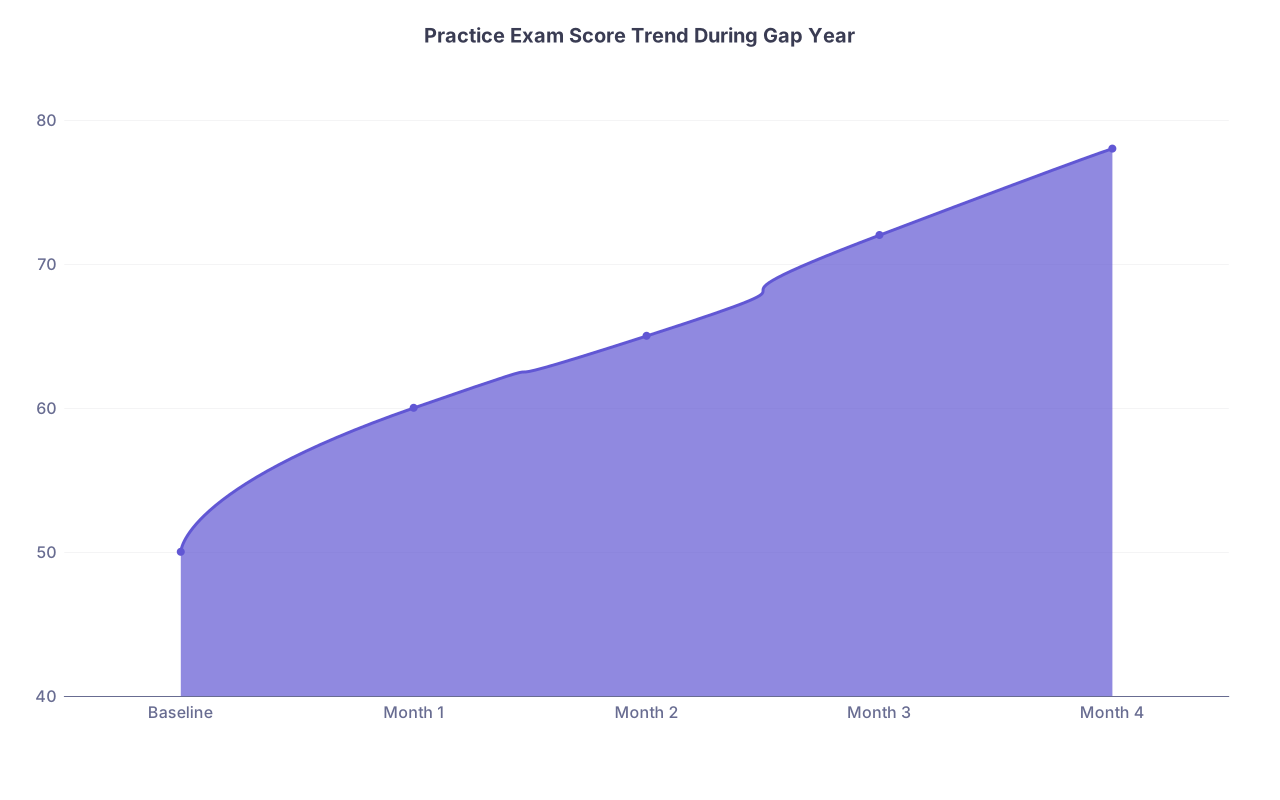
| Category | Value |
|---|---|
| Baseline | 50 |
| Month 1 | 60 |
| Month 2 | 65 |
| Month 3 | 72 |
| Month 4 | 78 |
You want to see upward movement, even if it’s slow. If your scores are flat or dropping after 6–8 weeks of “studying,” that’s a sign to change approach, not just “try harder.”
Step 10: When You’re Close to the Retake
The final 4–6 weeks before the exam:
- Shift focus to:
- Timed mixed blocks that mirror the real exam
- Reviewing high-yield weak areas
- Building stamina with full-length days
- Start tapering anything extra (research, work hours) if you can.
- Treat your practice tests like dress rehearsals: wake at exam time, eat what you’ll eat, obey timing rules.
If your practice scores are nowhere near passing two weeks before the exam, you have a hard choice:
- Push the date (if allowed) and sacrifice some of your Match timeline
or - Take it anyway and risk a second fail
I’ll be blunt: one failure + solid eventual pass is manageable. Two failures is a major red flag. If you must choose, prioritize a pass over “perfect timing” for the Match.
What This Year Should Look Like From a Program’s Point of View
By the time you apply again, an attentive PD should see:
- A clear failure followed by a clear pass, with a believable jump in performance.
- A year that wasn’t wasted: some mix of clinical exposure, research, teaching, or relevant work.
- Letters from people who know you in this “post-failure” phase and can say, “Yes, they’re reliable and ready.”
- An applicant who talks about this setback with maturity, not shame, denial, or overcompensation.
Your job this year is to make that story true.
Bottom Line: Your Damage Control Plan
Keep it simple:
- Own the failure and dissect it like a case. What exactly went wrong—content, timing, anxiety, life events—and how will you change your strategy?
- Design the year around passing on the next attempt. Everything else—work, research, clinical stuff—fits around that, not the other way around.
- Craft a clean narrative and live up to it. This gap year should look like resilience, structure, and growth—not drifting.
You’re not the first one to be here, and you won’t be the last. What matters now is whether this becomes a permanent dent in your trajectory or a one-year detour you can explain in two calm sentences.


