

It’s late March. Your NRMP email says “We are sorry to inform you…” and your stomach drops. SOAP is over, you’re unmatched, and now your loan servicer emails are hitting just as hard as the rejection. Grace period ending. Autopay reminders. You open your bank account and it is…not impressive.
You’re sitting there doing the math: “I need to pay rent, buy food, and somehow not destroy my future as a physician. How the hell am I supposed to do that in a gap year with no residency salary?”
This is that situation. Let’s structure this properly so you do not spiral, and you do not burn the year.
Step 1: Stabilize the Financial Bleeding in the Next 30 Days
You don’t start with “finding your passion” or “reframing this as an opportunity.” You start with: how do I not default on my loans and get evicted.
1. Get your loan facts straight (this week)
Log in to every servicer account. No avoiding it.
Write down, in one place:
| Item | Example |
|---|---|
| Total Federal Loans | $265,000 |
| Total Private Loans | $40,000 |
| Federal Grace End | 11/15/2026 |
| Private Grace End | 07/01/2026 |
| Standard Monthly Pmt | $2,150 |
| Lowest Income-Driven | $260 (REPAYE / SAVE) |
If you do not know these numbers, you are planning in the dark.
2. Move every federal loan you can to income-driven repayment (IDR)
If you’re in the US with federal loans, and you’re not in residency and not earning big money, you probably should not be paying the standard 10‑year amount.
Do this now:
- Go to studentaid.gov
- Consolidate if needed (esp. if you can get everything under one servicer)
- Apply for an income-driven plan (SAVE / PAYE / IBR depending on your situation)
Your “income” might be last year’s (which could be $0 or very low). That can make your monthly payment tiny, sometimes literally $0. That buys you time.
Private loans: call them. Don’t be shy. Use this exact script:
“I just graduated from medical school and did not match into residency this year. My income is currently $X/month. I want to avoid delinquency. What hardship forbearance, graduated payment, or temporary interest-only options do you have?”
Push. Ask if they can:
- Extend your grace
- Offer temporary reduced payments
- Switch to interest-only for 6–12 months
Some will say no, some will say yes. But you ask.
3. Figure out your real monthly survival number
You need a bare‑bones budget. Not “comfortable life.” Survival that you could live with for 12 months without hating yourself.
List:
- Rent / housing
- Utilities / internet
- Food (be honest, but not fantasy-restaurant level)
- Transportation (car payment, insurance, gas, transit pass)
- Phone
- Minimum loan payments (after IDR/negotiation)
- Health insurance (more on that later)
Add 10–15% cushion for random life problems.
That number is your target monthly net income. Write it in big letters.
If that number is unrealistic relative to obvious jobs, your next step might be: move home, get a roommate, or cut housing costs now. Do that calculation before you start applying for work.
Step 2: Decide Your Gap-Year Identity: Income-First, CV-First, or Hybrid
You can’t optimize for everything: big money, tons of research, tons of clinical experience, and a fully refreshed soul. That’s a fantasy.
You choose a priority stack.
Broadly, you’re one of three people:
Income-First
You’re drowning in private loans, family can’t help, cost of living is high. If you do not make money, you are in real trouble. You still keep one eye on the next match, but cash flow dominates.CV-First
You missed match because your application was weak for competitive fields (e.g., derm, ortho, plastics) or you had red flags. You can live cheaply, family can support, or your loans are mostly federal and can be pushed lower. You optimize for research, clinical experience, and repair.Hybrid
You need money, but not massive; you also need to fix or strengthen your application. You split your time deliberately.
Be honest with yourself. If your required monthly nut is $3,000+ and your parents can’t bail you out, you are not CV-first. You are hybrid at minimum.
Step 3: Realistic Income Streams for an Unmatched Grad
Let me be direct: the highest consistent income right away is not glamorous. And a lot of “medical adjacent” stuff pays worse than you think.
Here are the big buckets, with how they fit into a gap year.
1. Clinical-adjacent roles (good for hybrid / CV-first)
These won’t make you rich, but they keep you near medicine and can help your application story.
Clinical Research Coordinator / Research Assistant
Hospitals, academic centers, and large practices.
Typical pay: $38–65k/year depending on region.
Upside:- Letters from faculty
- Publications/posters possible
- Easy narrative for “what I did this year”
Medical Scribe (in-person or remote)
Pay: $12–22/hr depending on area/company.
Upside: steady, you stay in clinical workflow, can impress attendings you might later ask for letters.
Downside: ceiling is low, and hours can be rough.Clinical Trials Associate / Regulatory support
Pay: similar to research coordinator, sometimes better in industry/contract orgs.
Upside: good for those leaning toward academic/industry crossover.
These roles pair decently with moonlighting-type income (tutoring, shifts on weekends, etc.).
2. High-hour, modest-skill jobs (income-first)
You’ll see people do:
Overnight hospital tech / monitor tech / ED tech (if allowed by local rules)
Your MD makes you overqualified but not automatically accepted; some places like having “almost doctors.”
Pay: $15–25/hr, good differentials for nights/weekends.Call center for health systems or insurers
Not glamorous. Good training in dealing with bureaucracy and patient anger.
Pay: $17–25/hr with possible overtime.Pharmacy tech / phlebotomist / MA (if you have or can quickly get certification)
Pay: roughly similar range. Often more structured than random gig work.
These won’t impress anyone content-wise, but they solve the rent problem.
3. Actually decent side income that won’t wreck your CV
Stop thinking “side hustle influencer.” Think boring, repeatable.
MCAT / USMLE / premed tutoring
If you scored decently (e.g., MCAT >510, Step 1 pass early, good shelf scores), you can work with companies (Blueprint, Kaplan, Altius, MedSchoolCoach) or go private.
Pay:- Companies: $25–60/hr
- Private: $50–100+/hr, but slower to build
Works beautifully with part-time research or scribing.
Adjunct or TA-type work at local college/community college
With an MD, you can sometimes teach anatomy/physiology/biology.
Pay: not huge per course, but decent hourly and flexible.Remote medical writing / content creation
Companies always want medically trained people to write patient education, blog posts, or review content.
Pay: $25–80/hr depending on experience and niche.
Build a simple portfolio (even 3–4 sample articles) and start pitching.
You combine 10–15 hours/week of this kind of work with a 32–40 hour/week main job and now you’re at a survivable income.
Step 4: Build a Weekly Structure That Doesn’t Kill Your Future Match
If you’re reapplying, you cannot act like this is a random gap from college. The calendar matters.
Your year has three broad phases:
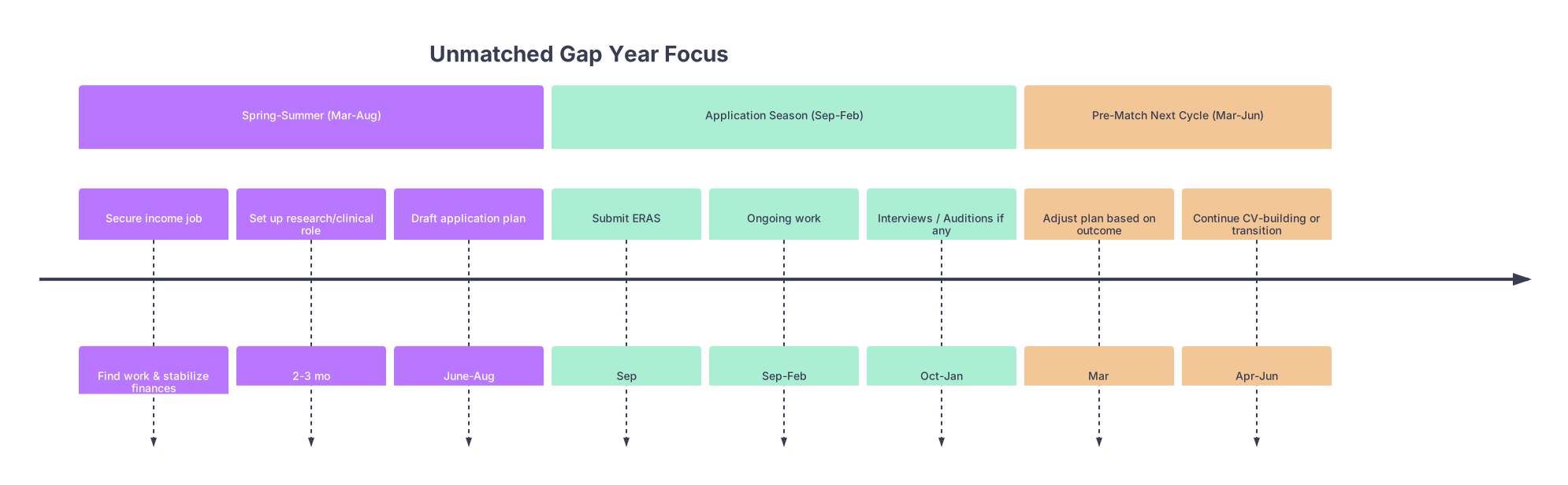
| Period | Event |
|---|---|
| Spring-Summer (Mar-Aug) - Secure income job | Find work & stabilize finances |
| Spring-Summer (Mar-Aug) - Set up research/clinical role | 2-3 mo |
| Spring-Summer (Mar-Aug) - Draft application plan | June-Aug |
| Application Season (Sep-Feb) - Submit ERAS | Sep |
| Application Season (Sep-Feb) - Ongoing work | Sep-Feb |
| Application Season (Sep-Feb) - Interviews / Auditions if any | Oct-Jan |
| Pre-Match Next Cycle (Mar-Jun) - Adjust plan based on outcome | Mar |
| Pre-Match Next Cycle (Mar-Jun) - Continue CV-building or transition | Apr-Jun |
So how do you structure a week?
Sample hybrid schedule (you need ~$3k/month take-home)
Let’s assume:
- Clinical research coordinator: 32 hours/week @ $22/hr (~$2,500/month net)
- Tutoring: 8–10 hours/week @ $40/hr (~$1,200–1,600/month before taxes)
Weekly:
- Mon–Thu: 8–4 research job
- Two evenings: 2–3 hours tutoring
- Friday: half-day work + 3–4 hours for your application work (personal statement, contacting letter writers, studying for a possible Step re-take, whatever is weakest)
- Saturday: flexible – interviews, extra tutoring, or rest
- Sunday: 2 hours weekly planning + rest
You don’t need to be a machine, but you can’t treat every day like a post-exam Netflix coma either. One dedicated “application block” per week is non-negotiable if you’re reapplying.
Step 5: Match Strategy Has to Be Baked Into the Job You Choose
Working “some job” for a year and then hitting submit with the same weak application is how people end up unmatched twice.
You need a story. And evidence.
Look at why you didn’t match
Be brutally honest:
- Too few programs applied to?
- Low Step 2 or failed exam?
- Weak letters?
- No meaningful U.S. clinical experience (for IMGs)?
- Aiming too high or only to one specialty?
Your gap-year plan has to directly hit those issues.
Examples:
You’re an IMG with almost no U.S. experience; want IM/FM
Priority: U.S. clinical or research role with face time with attendings.
Strategy: Volunteer or paid research in internal medicine; observerships; scribe in a primary care clinic. Make sure you can get 1–2 new, strong U.S. letters.You failed Step 1 once but passed; then had okay Step 2; applied to competitive specialty and got nothing
Priority: Show academic recovery, broaden target field.
Strategy: Take Step 3 if advised, crush it; get research and mentorship in a slightly less competitive but aligned field (e.g., PM&R or IM instead of ortho), and pick a job that lets you study.You had decent stats but weak personal statement, shallow experiences, and small program list
Priority: Depth and narrative.
Strategy: Job where you can actually grow (research, teaching, long-term clinical experience), broaden applications next time (more programs, maybe more specialties).
Step 6: Don’t Ignore Health Insurance and Licensure
Unsexy but critical.
Health insurance
You are leaving student coverage or you just lost it.
Options:
- Parent’s plan (if you’re under 26 in the U.S.)
- Spouse’s plan
- Marketplace / ACA plan – if your income is modest this year, subsidies can make this surprisingly affordable
- Employer coverage – some research/clinical jobs offer this after 60–90 days
Do not go uninsured “for a few months.” One ED visit can nuke whatever savings you’re building.
Licensure / legal issues
If you’re planning to take Step 3, explore where you might want to be licensed eventually. Some states let you sit for Step 3 without residency if you meet certain criteria; that can be strategic.
If you’re doing anything quasi-clinical (like telehealth triage scripts, etc.), make sure you are not misrepresenting yourself as a licensed physician. Be very clear: “medical school graduate” or “MD, unlicensed.”
Step 7: Geographic Choices: Stay Put, Move Home, or Go Where the Work Is
Here’s the math:
- Big city with $1,800 rent vs moving home and paying $0–$500
- That’s $1,300+ a month → $15,600/year
- That’s the difference between mandatory second job vs one solid job and breathing room.
Ask yourself:
- Can I move home without losing key opportunities (research, mentors, observerships)?
- Are there academic centers near home where I could work?
- Is my current city giving me something I cannot replicate (specific mentor, research line, strong letter)?
If your current city is just “where med school was” and offers no unique advantage anymore, and your parents’ basement cuts your cost of living by half, you at least run that calculation seriously.
Step 8: Concrete Job Hunt Tactics for This Specific Situation
This is not a broad “how to find a job” guide. You’re a fresh MD without residency. You’re weirdly overqualified and under-credentialed at the same time. Some hiring managers will not know what to do with you.
Target specifically:
- Academic hospital websites: “research coordinator,” “clinical research,” “project assistant,” “quality improvement analyst”
- Scribe companies: ScribeAmerica, ProScribe, etc. (mention your MD, but don’t act like you’re slumming it)
- Tutoring companies: “MCAT tutor,” “USMLE tutor”
- LinkedIn: filter for “medical writer,” “medical reviewer,” “clinical data abstractor”
When they ask, “Why are you not in residency?” your answer is tight and not defensive:
“I applied to [X specialty] this cycle and did not match. I reflected on my application and realized I need stronger [clinical experience/research/letters]. I’m taking this year to contribute meaningfully in a clinical/research role, solidify my skills, and reapply. In the meantime, I’m committed to doing excellent work here for at least a year.”
No apologies. No over-explaining. Calm, matter-of-fact.
Step 9: Guardrails Against Wasting the Year
You need three guardrails.
Quarterly check-in with someone who will be honest
Mentor, advisor, or brutally honest friend in residency.
Every 3 months, ask:- “Is my application actually getting stronger?”
- “Am I on track to submit a better ERAS this fall?”
Adjust if the answer is no.
At least one concrete output by June
Examples:- Submitted abstract or manuscript
- New strong letter from an attending you worked closely with
- Documented teaching with good feedback
- Step 3 score if that’s part of your strategy
A hard decision deadline about specialty / scope
By, say, May–June, you decide: same specialty with stronger app, broaden to related specialty, or pivot more substantially. Don’t drift into another September still “thinking about it.”
Step 10: Mental Framework So You Don’t Turn Bitter and Checked Out
Let me be blunt: I’ve seen people use an unmatched year to quietly self-destruct. Too much shame, too much comparison to classmates in residency, and they disappear into low-effort jobs plus gaming/Netflix.
Do not be that story.
A few simple anchors:
- You failed a process, not a personhood test. The Match is a numbers game, not a final judgment on your worth.
- You’ll be explaining this year in future interviews. Act now like you’ll have to tell this story to a PD you respect.
- One solid, disciplined year can completely flip your trajectory. I’ve seen people go from no interviews to multiple offers after focused gap years. It’s not rare.
Document what you do. Keep a simple log of:
- Projects
- Responsibilities you took on
- Skills learned
- Positive feedback
- Anything that can be turned into bullets on ERAS
This log becomes your future CV, personal statement material, and answer bank for interview questions.
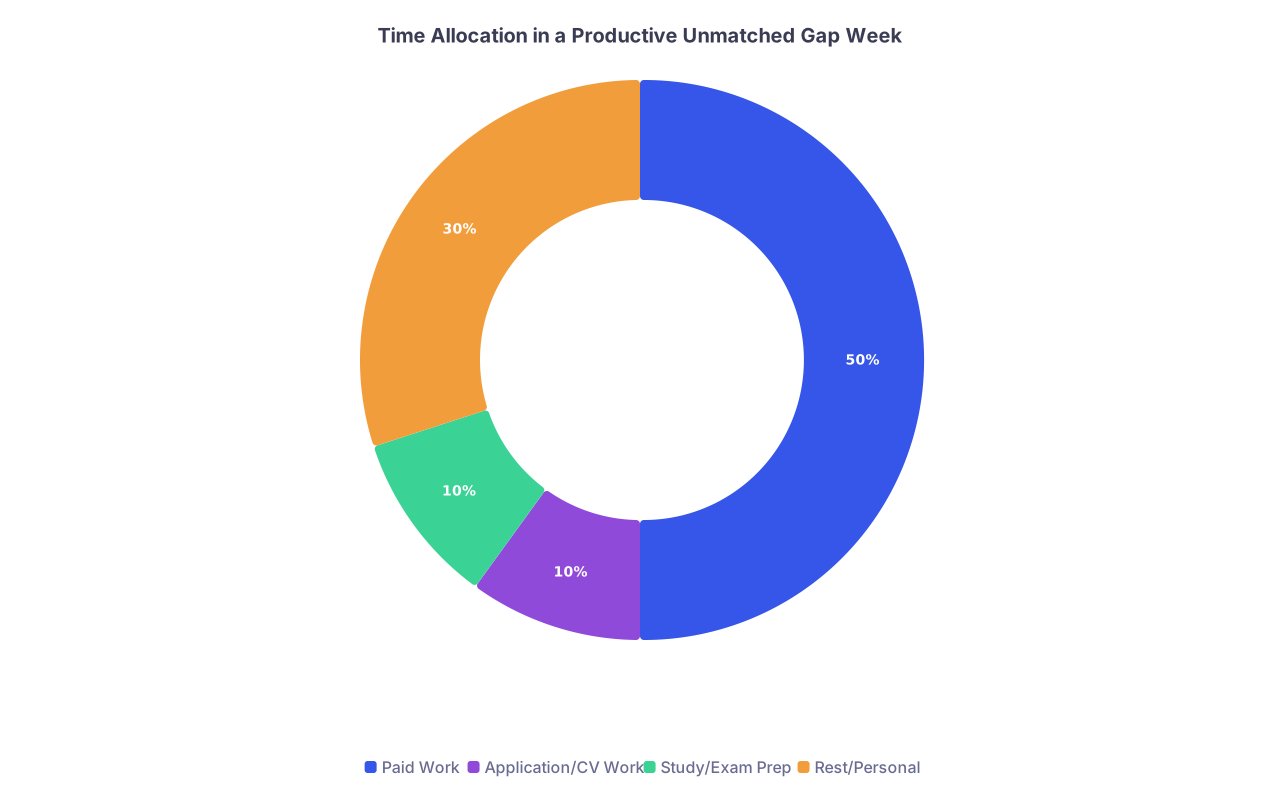
| Category | Value |
|---|---|
| Paid Work | 50 |
| Application/CV Work | 10 |
| Study/Exam Prep | 10 |
| Rest/Personal | 30 |


