

It’s late August. Your contract at your current job ends in six weeks. Your lease is up in two months. ERAS opens in days. You’re staring at a US map with your family on one coast, your current apartment on the other, and an interview season that could have you flying all over the place—or sitting on Zoom in your childhood bedroom.
You’re trying to do three hard things at once: apply for residency, move cross‑country, and not completely wreck your finances or your sanity. Nobody in your med school had a mandatory lecture titled “How to Not Lose Your Mind While Moving During Interview Season.” So you’re improvising.
Let’s stop improvising and turn this into a plan.
Step 1: Decide Where You’ll Actually Live During Interview Season
Do this first. Before you pack a single box.
You basically have four realistic setups:
- Stay where you are until Match.
- Move “home” (family or cheaper city) before interview season.
- Move to your target residency region before Match.
- Go semi‑nomadic (storage + short‑term housing / sublets).
Here’s the comparison stripped of fluff:
| Option | Best If | Main Risk |
|---|---|---|
| Stay put | Stable job, good internet, decent rent | Wasting money if you know you’re leaving |
| Move "home" | Free/cheap housing, strong support | Crowded space, distractions |
| Move to target region | Confident about geography | You don’t match there |
| Semi-nomadic | Very flexible, light belongings | Logistically annoying, unstable |
If you’re reading this in August–September, do not drag this decision out for weeks. Give yourself a 48–72 hour window to pick a base and commit.
Questions I’d ask you if we were on a call
- Are you keeping your current job through at least January?
- Do you have genuinely free housing with family or friends?
- Do you have a clear geographic preference cluster for residency (e.g., “Northeast” or “Pacific Northwest”), or are you spraying apps everywhere?
- Do you have dependents (partner, kids, pets) who need stability more than you do?
Blunt guidance:
- If your job is good and remote‑friendly: Stay put until Match or at least until rank list submission.
- If you’re bleeding cash on rent and can live with family: Move home and accept the ego hit.
- If you know you want to end up in, say, the Midwest and you have some savings: Moving closer can make sense—but only if you’re okay staying there even if you match elsewhere.
- If you hate your current location, your lease is up, and your stuff is minimal: Storage + flexible short‑term housing is not insane.
Pick a base. That base determines everything else: timing, storage, what you sell, what you ship, and how you set up for interviews.
Step 2: Build a Realistic Timeline Around ERAS and Interviews
Your move cannot ignore the actual residency calendar. You know the big pieces, but let’s align them with moving logistics.
Typical (approximate) timeline:
- Early Sept: ERAS opens for submission.
- Late Sept: Programs start downloading.
- October–January: Interviews.
- Late Feb: Rank list due.
- Mid‑March: Match Week and Match Day.
Now overlay your move.
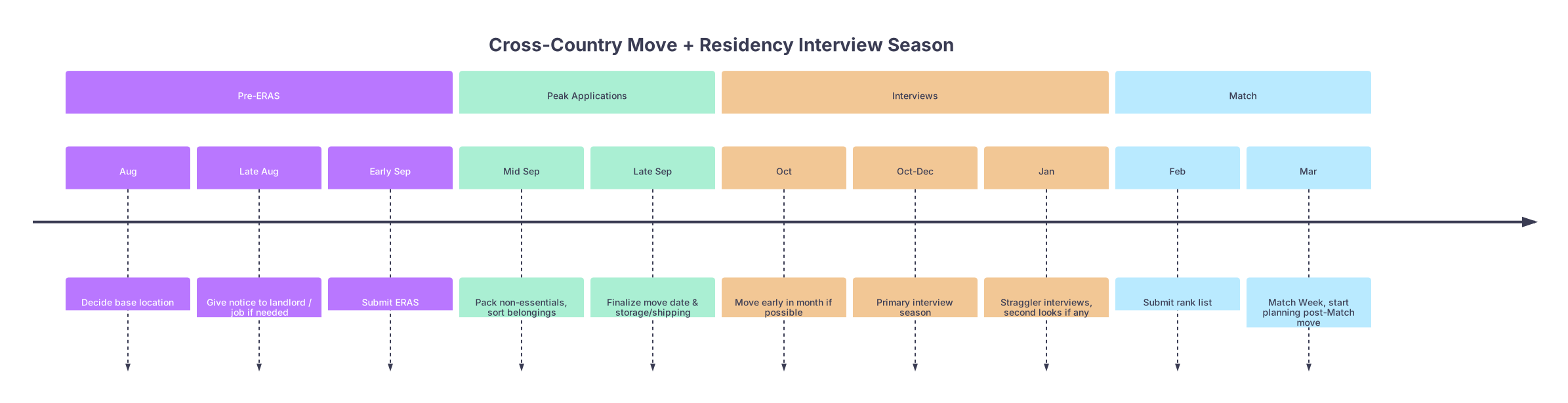
| Period | Event |
|---|---|
| Pre-ERAS - Aug | Decide base location |
| Pre-ERAS - Late Aug | Give notice to landlord / job if needed |
| Pre-ERAS - Early Sep | Submit ERAS |
| Peak Applications - Mid Sep | Pack non-essentials, sort belongings |
| Peak Applications - Late Sep | Finalize move date & storage/shipping |
| Interviews - Oct | Move early in month if possible |
| Interviews - Oct-Dec | Primary interview season |
| Interviews - Jan | Straggler interviews, second looks if any |
| Match - Feb | Submit rank list |
| Match - Mar | Match Week, start planning post-Match move |
If at all possible, move before the chaos really starts—ideally early October at the latest. You do not want to be:
- On a plane,
- With your belongings on a truck,
- Dealing with lost boxes,
- And getting an interview email that wants you there (or on Zoom) in 48–72 hours.
If you must move mid‑interview season, protect a quiet, Wi‑Fi‑stable window for 5–7 days around your move. Tell your references and any job you have: “I will be partially unavailable this week for a cross‑country move but reachable by email for urgent scheduling.”
Do not schedule your move date on a Monday or Friday. Those are peak interview days. Aim for Wednesday/Thursday and avoid the first week of November if you can—lots of programs love early November.
Step 3: Set Up a Stable Interview Environment Before You Pack
Whether you’re moving or not, you need one thing non‑negotiable: an interview setup that doesn’t fail.
You need:
- Reliable high‑speed internet.
- A quiet space with a door that closes.
- Neutral background + decent lighting.
- A setup that can be replicated in a hotel / AirBnB / relative’s house if needed.
Do this now, not the night before your first interview.
Practical moves:
- Buy a cheap hard Ethernet cable and an adapter if your laptop needs one. Wi‑Fi is great until the router decides to restart in the middle of your PD interview.
- Get a basic ring light or desk lamp. Overhead lighting only = raccoon eyes.
- Test sound in Zoom with a friend on different networks. Internal mic is often fine; bad room acoustics are not. A simple wired headset can fix a lot.
If you’re moving in with family:
- Pick your interview room now. Claim it. Set expectations: “On X, Y, Z mornings, this room is a no‑go zone.”
- Write the schedule on a visible calendar for them. Don’t assume they’ll remember.
If you’re going semi‑nomadic:
- Assemble a “portable interview kit”: laptop, charger, Ethernet cable, small mic or earbuds, ring light, neutral shirt/jacket. This travels with you in a carry‑on. Never in checked luggage. Never in a moving truck.
Step 4: Decide What To Do With Your Stuff (Storage vs. Shipping vs. Selling)
Here’s where people waste money.
You’re moving cross‑country during a gap year. You don’t know exactly where you’ll be in July 1 when residency starts. That means hauling your entire apartment to your “temporary” location is usually dumb unless:
- You have very little stuff, or
- You’re committing to staying there even if you match elsewhere.
Most people in your situation should think in three piles:
- Keep with you.
- Store.
- Sell / donate / trash.
1. Keep With You: The Non‑Negotiables
This is what you physically bring into your new base location:
- Documents: Passport, Social Security card, birth certificate, med school diploma, immunization records, Step scores, contracts, financial docs.
- Tech: Laptop, backup drive, phone, chargers, interview kit.
- 2–3 weeks of clothes, including full interview outfit(s).
- Basic bedding and kitchenware if not provided (or buy cheap on arrival).
This should fit in 1–2 checked bags + 1 carry‑on + a backpack, max.
2. Store: The “Future Resident” Pile
Use storage near where you’re leaving if you might never return? Questionable. Often better to store somewhere cheap and central to your long‑term plans (e.g., near family who can help deal with it after Match).
Think of storage as “what I will actually care about a year from now”:
- Sentimental items (photos, letters, a few key books).
- Quality furniture you’d hate to rebuy (real wood desk, good mattress, not your $40 IKEA lamp).
- Seasonal items you truly use.
Small storage units (5x5 or 5x10) are usually enough if you’re ruthless. You do not need a 10x20 for one person’s belongings unless you’re hoarding.
Get climate control if you’re storing:
- Electronics,
- Wood furniture in humid climates,
- Important documents (keep critical docs with you anyway).
3. Sell / Donate / Trash Aggressively
You are not a homeowner with a 30‑year mortgage. You are a trainee in a transient phase. Live like it.
If selling something cross‑country costs >60–70% of replacement cost, you’re probably better off selling it and rebuying after you match. Old couch? Sell. Particleboard bookshelf? Sell or donate. That extra set of mismatched dishes you got in M2? Donate.
Set hard rules:
- If you haven’t used it in a year, it goes.
- If you wouldn’t pay to ship it, you probably shouldn’t store it either.
Step 5: Budget for the Move + Interview Season Together
Treat the move and interview season as one combined financial project. Don’t silo them.
Your big buckets:
- Moving costs (truck, shipping, storage, flights/driving).
- Interview costs (travel if any in‑person, clothes, tech, applications).
- Living costs (double rent, deposits, gap weeks without income).
Lay it out roughly:
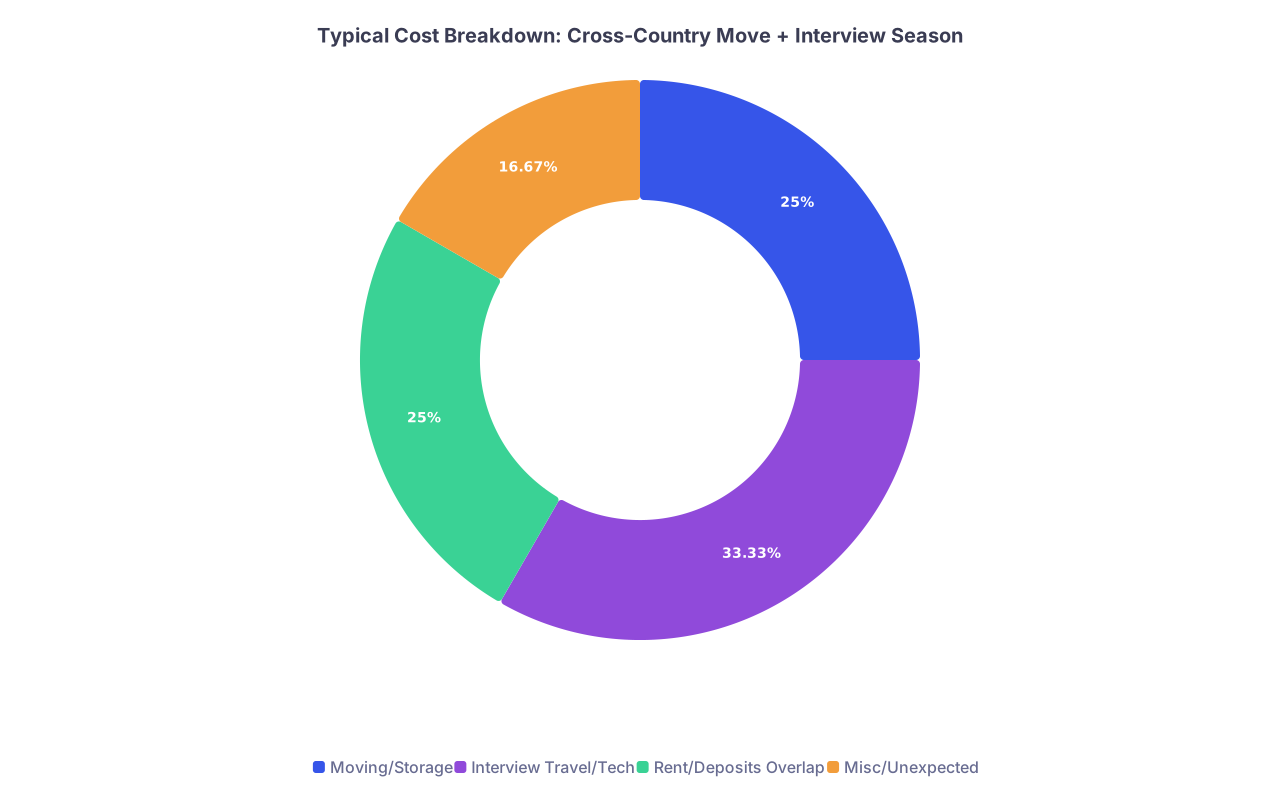
| Category | Value |
|---|---|
| Moving/Storage | 1500 |
| Interview Travel/Tech | 2000 |
| Rent/Deposits Overlap | 1500 |
| Misc/Unexpected | 1000 |
Those numbers are not exact; they’re the order of magnitude I see all the time.
Then decide what levers you can pull:
- Move date: Can you avoid a double‑rent month?
- Housing: Family vs studio vs room‑share?
- Interviews: Are you realistically going to have a lot of in‑person? (Many specialties still heavily virtual.)
- Job: Can you maintain part‑time/remote work through at least January to cover ongoing costs?
If you’re cash‑tight:
- Prioritize: application fees + stable housing + tech over fancy furniture or non‑essential travel.
- Use points/miles smartly if you have them—for last‑minute flights to in‑person interviews.
- Ask programs about travel support; some specialties and community programs quietly reimburse or offer hotel deals.
Also: do not forget the second move. Post‑Match, you’re likely moving again to your residency city. Keep some emergency money back for that. A lot of people blow everything on the gap‑year move and interviews, then panic in April when they realize they have another cross‑country move coming.
Step 6: Coordinate With Work, Landlords, and Family Like an Adult
You’re in a weird in‑between phase: not a student, not a resident, half‑employed, half‑interviewing. People around you won’t automatically get that.
You need to over‑communicate.
With your employer
Be clear about:
- Your likely interview window (Oct–Jan).
- Your need for short‑notice days off or half days.
- Your end date relative to your move.
If possible, negotiate:
- Reduced hours during peak interview season,
- Or a project‑based/remote setup where interviews can be woven in.
What doesn’t work: being vague and then suddenly taking eight random weekdays off in November.
With your landlord
Lock in:
- Move‑out date.
- Penalties (or lack thereof) for breaking lease if date changes.
- Clean‑out expectations (so you don’t lose your deposit).
If you think you might need a 2–4 week extension, bring it up early: “My current plan is to move around October 5–10, but interview scheduling could push that slightly. Would a month‑to‑month extension be possible if needed?”
With family / roommates
Do not assume they understand “interview season.” Spell it out:
- “I may get emails with 24–48 hours’ notice where I have to pick interview slots.”
- “I’ll have X number of virtual interviews, usually early morning to early afternoon.”
- “During those times, I need quiet, no vacuuming, no yelling at the dog outside my door.”
You’re not asking permission. You’re setting boundaries so the process isn’t sabotaged by well‑meaning chaos.
Step 7: Build Systems To Handle Chaotic Interview Scheduling
Interview invites don’t care if you’re on a plane, in a U‑Haul, or standing in a Target aisle buying hangers.
You need systems that work even on moving day.
Here’s what that looks like:
- A single calendar (Google, Outlook—pick one) that has:
- All application deadlines.
- All potential move windows.
- Any known blackout days (travel, weddings, etc.).
- Email filters:
- Create a label/folder: “Residency Invitations”.
- Filter common keywords (Interview, Invitation, ERAS, Program) into it.
- Turn on push notifications for that label on your phone.
- A response template:
- Draft a short, professional reply you can quickly edit:
- “Thank you for the invitation to interview with [Program]. I am excited for the opportunity. I am available on [X, Y, Z dates]. Please let me know which works best.”
- Or for scheduling links: a quick note of thanks plus “I’ve scheduled for [date]. Looking forward to speaking with you.”
- Draft a short, professional reply you can quickly edit:
On moving day:
- Make someone else drive for at least part of it if you’re on a long car trip. You sit passenger with your phone and triage emails.
- If you’re flying, assume you’ll land to 1–3 new emails. Before boarding, make sure your phone is charged and your calendar is updated.
You will miss a “perfect” date sometimes. That’s fine. What matters is that you don’t miss the invite entirely.
Step 8: Manage Your Headspace So You Don’t Implode
You’re stacking stressors: career uncertainty + housing instability + financial strain. Anyone would feel fried.
Don’t pretend you’re above it. Build protections.
Concrete moves:
- Keep one part of your life boring and consistent. Ideally: sleep schedule and basic meals. If your bed is moving, replicate your routine quickly in the new place—same wake‑up, same coffee, same pre‑interview breakfast.
- Create a “no residency talk” friend or two. Someone you can call to talk about anything other than applications when you’re surrounded by people obsessing over scores and invites.
- Time‑box the logistics. Give yourself specific blocks for move tasks (e.g., “Tonight 7–9 pm: list furniture for sale and pack two boxes”). The rest of the time, you’re not allowed to doom‑scroll apartment or U‑Haul sites.
And stop comparing your path to the person who stayed in the same city for med school and residency with their parents paying rent. Different game. Different rules.
Step 9: Plan the Post‑Match Move While You Still Have Brain Space
This is the part people leave until Match Week and then panic.
You already know you’ll almost certainly move again in June. Don’t obsess over the exact city now, but set up a basic framework:
- Decide if you’ll:
- Drive your car to the new city (and where it will live until then), or
- Sell your car and restart post‑Match.
- Keep a running list in a notes app:
- “Things I’ll need to handle after Match” (license, car, housing, moving company, etc.).
- Rough‑estimate the second move budget and protect that money. You might be able to put large moving charges on a credit card temporarily, but don’t assume you’ll suddenly have cash in May.
This way, when you do match, you’re dropping a city into a pre‑built plan instead of starting from zero during one of the most emotional weeks of your life.
Quick Specialty‑Specific Notes (Because It Does Matter)
Not every specialty’s interview season behaves the same.
- Competitive specialties (Derm, Ortho, ENT, some surgical subs): More travel, more last‑minute invites, more pressure to show up if in‑person becomes a thing again. If you’re in this group, bias toward stability in your living situation. Don’t decide to live on a friend’s couch in a loud apartment.
- Primary care (FM, IM, Peds, Psych): Often more virtual, more structured timelines, more geographic clustering. You have slightly more flexibility to move and still keep your interview environment predictable.
- Couples match: Double everything. Double the number of invites to coordinate. Double the chance of overlapping interviews. If you’re both moving cross‑country, seriously consider:
- Storage + long‑term sublet rather than two parallel full‑scale moves, or
- Delaying the big cross‑country move until after rank list submission if housing is tolerable.
What To Do Today
Do not try to overhaul your entire life in one sitting. Pick one concrete move that shifts you out of vague anxiety and into action.
Do this right now:
Open your calendar and block off a 30‑minute slot in the next 48 hours labeled: “Decide Interview Season Base + Move Window.”
That 30 minutes isn’t for packing or scrolling Zillow. It’s for making one decision: where you’ll live from October through Match, and roughly when you’ll move. Once that’s set, everything else—storage, budget, interview setup—can be built around it, step by step.


