

Caring for a Sick Family Member in Your Gap Year: Framing It for ERAS
What do you do when your “unexplained” gap year is actually you bathing your dad, managing meds, and arguing with insurance at 2 a.m.—and now you have to fit that into one line on ERAS?
I’ve seen this exact scenario more times than you’d think. A student disappears for a year. Faculty assume research, burnout, maybe visa issues. Then the ERAS draft hits my inbox and I see: “Family responsibilities” and blank space. Translation to many program directors: “Red flag, unknown problem.”
You can do better than that. And you have to.
This is about turning a real, heavy, very human year into something clear, professional, and respectable on an application. Not sugar-coated. Not melodramatic. Just honest, adult, and match-safe.
Let’s break it down.
Step 1: Get Clear On Your Actual Story
Before you touch ERAS, you need to understand your own timeline and role. If you’re vague in your head, you’ll be vague on paper and in interviews.
Ask yourself, and answer in writing:
- Who was sick? (No names, just relationship: parent, sibling, grandparent, spouse, child.)
- What was the diagnosis or general category? (E.g. “advanced cancer,” “progressive neurologic disease,” “acute trauma and rehab,” “end-stage organ failure.”)
- What was the time span? (Month/year to month/year.)
- What was your actual role day-to-day?
- Primary caregiver 40+ hrs/week?
- Living at home coordinating appointments and logistics?
- Flying back and forth while doing per diem work?
- What else did you do during that period?
- Part-time work?
- Research?
- Courses?
- Volunteer work?
- Step studying?
Get brutally specific. For example:
“July 2023 – June 2024: Lived at home as primary caregiver for my mother with metastatic ovarian cancer. Managed medications, transportation to chemo and procedures, coordinated home health services, supervised home PT, discussed goals of care with her and the team. Worked per diem as a medical assistant 1–2 days/week and completed an online palliative care course.”
That’s the level of clarity you need.
If right now your brain is just going, “It was a blur and it sucked,” that’s fair. But you still have to extract a coherent explanation out of that blur.
Step 2: Decide Where It Goes on ERAS
You have three main places to deal with this:
- Education/Training Dates & CV timeline
- Experiences section
- Personal statement and/or secondary essays (if applicable)
The rule of thumb:
If it was substantial and structured (months of consistent commitment), treat it like an experience. If it was mostly a reason you didn’t do much else, acknowledge it briefly and cleanly.
A. If it’s a full-time or near full-time caregiving year
This belongs in the Experiences section.
You’re going to:
- Give it a clear, neutral title
- List it like a job
- Describe responsibilities and skills without oversharing medical details
Sample titles:
- “Primary Caregiver for Ill Family Member”
- “Full-Time Family Caregiver”
- “Family Caregiving and Care Coordination”
Do not write “Family Issues,” “Personal Problems,” or anything cryptic. That just invites suspicion.
B. If it’s a partial-year or part-time role
If you were, say, doing research 60% of the time and caregiving 40%, focus your primary ERAS entry on the research. The caregiving can be:
- A second Experience entry, if it rose to the level of a real commitment
or - A 1–2 sentence explanation in your personal statement or “gap” explanation, depending on the specialty/platform
C. If you took a leave during medical school or training
This is trickier and higher-stakes. You’ll need:
- The leave documented in your MSPE or dean’s letter (it often is)
- A consistent story between:
- What your school says
- Your ERAS timeline
- Your personal statement (if you address it)
- What you say in interviews
You don’t need to spill emotional details. But you absolutely cannot make it look like you disappeared mysteriously.
Step 3: How to Write the ERAS Experience Entry
This is where most people either undersell (one vague line) or overshare (intimate medical drama). You want a middle path: professional, clear, and human.
Structure:
- Position/Title
- Organization: “Family residence” or “Home-based caregiving – [City, State]”
- Time period
- Average hours/week
- 2–4 bullet-style sentences in the description box (ERAS allows paragraph format; I’d use short paragraphs or numbered items mentally, even if not literally numbered)
Here’s a strong example.
Experience Title: Primary Caregiver for Ill Family Member
Organization: Home-based caregiving – Chicago, IL
Time Period: 07/2023 – 06/2024
Hours/Week: 40
Description (ERAS text box):
Served as primary caregiver for a close family member with advanced cancer during intensive treatment and end-of-life care. Coordinated medical appointments, transportation, medication administration, and communication between multiple specialists. Worked closely with home health, palliative care, and hospice teams to support symptom management and goals-of-care discussions. Gained firsthand perspective on caregiver burden, home-based medicine, and the impact of serious illness on patients and families.
Notice what this does:
- Protects privacy: “close family member,” not “my mom with stage IV ovarian cancer with malignant ascites”
- Sounds like a professional describing responsibilities, not a diary entry
- Explicitly signals: This wasn’t “unemployed and hanging around” — it was organized, demanding work
Another variant, if you did part-time other work:
Experience Title: Family Caregiver and Medical Assistant
Organization: Home-based caregiving and Community Clinic – Houston, TX
Time Period: 08/2022 – 07/2023
Hours/Week: 50
Description:
Provided 30–35 hrs/week of caregiving for a family member with progressive neurologic disease, including assisting with ADLs, managing appointments, and coordinating with PT/OT and neurology teams. Concurrently worked 15–20 hrs/week as a medical assistant in a primary care clinic, where I took vitals, roomed patients, and supported chronic disease management. This year strengthened my time management, communication with multidisciplinary teams, and understanding of how illness affects both patients and their support systems.
Step 4: How Much Detail About the Illness?
You owe programs clarity, not your family’s entire medical history.
Safe level of detail:
- Relationship: “parent,” “sibling,” “grandparent,” “spouse,” “child,” or “close family member”
- General category:
- Advanced cancer
- Terminal illness
- Progressive neurologic disease
- Severe traumatic injury
- End-stage organ failure
- Clinical context, not specifics:
- Required intensive treatment and frequent appointments
- Required full-time care at home
- Involved prolonged hospitalization and rehabilitation
- Included end-of-life and hospice care
You do NOT need:
- Exact diagnosis name
- Staging, complications, specific procedures
- Emotional blow-by-blow
If pressed in an interview, you can say something like:
“I was the primary caregiver for a first-degree relative with a progressive neurologic condition that required daily assistance and frequent appointments. I prefer not to go into more specific medical details to protect their privacy, but I’m happy to describe how I balanced that responsibility with preparing for residency.”
If someone pushes for more detail after that, that’s a them problem.
Step 5: Addressing It in Your Personal Statement (Or Not)
You do not have to mention caregiving in the personal statement. This is not a confessional. But sometimes it helps tie your story together.
When you should mention it
- The gap year would otherwise look like a weird blank interval
- Your caregiving experience genuinely shaped your specialty choice or approach to patients
- You had a leave or delay in training that needs adult, composed explanation
When you should skip or minimize it
- You’re sorely tempted to write a grief essay
- You already have major non-traditional elements to explain (career change, prior degree, remediation)
- The specialty is hyper-competitive, and you need your PS to be laser-focused on fit, not life story
If you include it, keep it tight and purposeful. Here’s a structure that works:
One calm sentence acknowledging the year:
- “Between my third and fourth years of medical school, I took a leave of absence to serve as the primary caregiver for a close family member with a terminal illness.”
One to two sentences on what you learned that’s relevant to being a resident in this field:
- “Being on the other side of the hospital door taught me how much patients and families rely on clear communication, realistic expectations, and clinicians who are present even when they are busy. That experience deepened my interest in internal medicine, particularly in caring for patients with complex, chronic conditions over time.”
Then move on. Don’t park there for three paragraphs.
Step 6: Preparing for Interview Questions About It
If you list caregiving as an experience, expect at least some programs to ask:
- “Tell me about this gap year.”
- “I see you were a caregiver for a family member. How did that affect you?”
- “How do you think this experience will influence you as a resident?”
You need a 60–90 second answer that is:
- Calm
- Past-tense
- Forward-looking
Bad answers are either:
- Overly clinical and cold (“Yes, my mother succumbed to metastatic carcinoma, I administered medications”)
or - Emotionally raw and disorganized (“It was horrible, I still haven’t processed it, I cry when I see that chemo unit”)
You want something like:
“After graduation, I planned to start residency directly, but a close family member developed a serious illness that required full-time care. I moved home and spent about a year as their primary caregiver—managing medications, coordinating appointments, and working with home health and hospice teams. It was challenging, but it gave me a very different view of what chronic illness and end-of-life care feel like for families. I also learned a lot about communicating with clinicians and how small acts from the care team can make a big difference. They’re now deceased, and I’m in a good place to fully commit to residency and bring that perspective into my work with patients and families.”
If the family member is still alive and still ill, you have to address the obvious question: Will this conflict with residency?
Be direct:
“They’re now stable with a solid support plan in place, and I won’t have caregiving responsibilities during residency. That was a major factor in my decision about when to reapply.”
If that’s not true, you have a logistical problem, not just a narrative one—and you need a real plan before you match.
Step 7: What Program Directors Actually Think About This
Let me be blunt.
Most program directors are not anti-family. They’re anti-mystery and anti-ongoing-chaos.
Caregiving during a gap year can be seen as:
- Neutral: “Life happens. Glad it’s resolved.”
- Slight positive: “They’ve seen what serious illness looks like from the family side. That’s helpful.”
- Sometimes a real positive: especially in fields like IM, FM, peds, psych, palliative care, geriatrics
It turns negative when:
- Your timeline doesn’t match your story
- It seems like you’re still overwhelmed and not ready
- You come across as bitter, resentful, or stuck
- It looks like a convenient cover for other issues (failed exams, professionalism problems) that you’re not disclosing
Programs are trying to answer three questions:
- Is this person reliable and ready to show up as an intern?
- Will this issue recur or interfere with training?
- Does this experience give them any added maturity or insight?
Your application and your interviews should quietly answer “yes / no / yes.”
Step 8: Handling Scores, Delays, or Weak Spots Tied to Caregiving
Sometimes the caregiving year overlaps with:
- A failed Step attempt
- A delayed graduation
- Weak clinical evaluation during the lead-up
Do not try to make caregiving retroactively responsible for everything. That reads as excuse-making.
Better approach:
- Own the performance issue
- Contextualize, not blame
- Show the fix
Example for a failed Step 2 during that time:
“I took Step 2 during a period when I had substantial caregiving responsibilities and significantly underestimated the impact on my study capacity. My initial score does not reflect my usual performance. After that experience, I stepped back from test-taking until my situation stabilized, then set up a structured study plan with NBME benchmarks and passed comfortably on my next exam. The caregiving responsibilities are now completed, and my more recent performance is a better reflection of how I’ll function in residency.”
Short, direct, responsible. That’s the tone you want.
Step 9: Common Tactical Questions
Here are quick answers to things people always ask me:
Should I get a letter of recommendation about my caregiving?
Usually no. The letter writers that matter are attendings, research mentors, or job supervisors in medicine. A social worker or hospice nurse letter can be meaningful, but only as a third-tier letter, not a replacement for core clinical letters.Can I say “ill parent” specifically, or is “family member” safer?
Saying “parent” or “child” is fine. It humanizes you and doesn’t violate privacy. Just stop before naming diagnoses and complications.What if I also worked some random non-medical job during that year (retail, tutoring, etc.)?
Include it if it was substantial and helps explain your time. Focus your ERAS description on responsibility, reliability, and any people-facing skills. It’s not glamorous, but it’s better than unexplained emptiness.
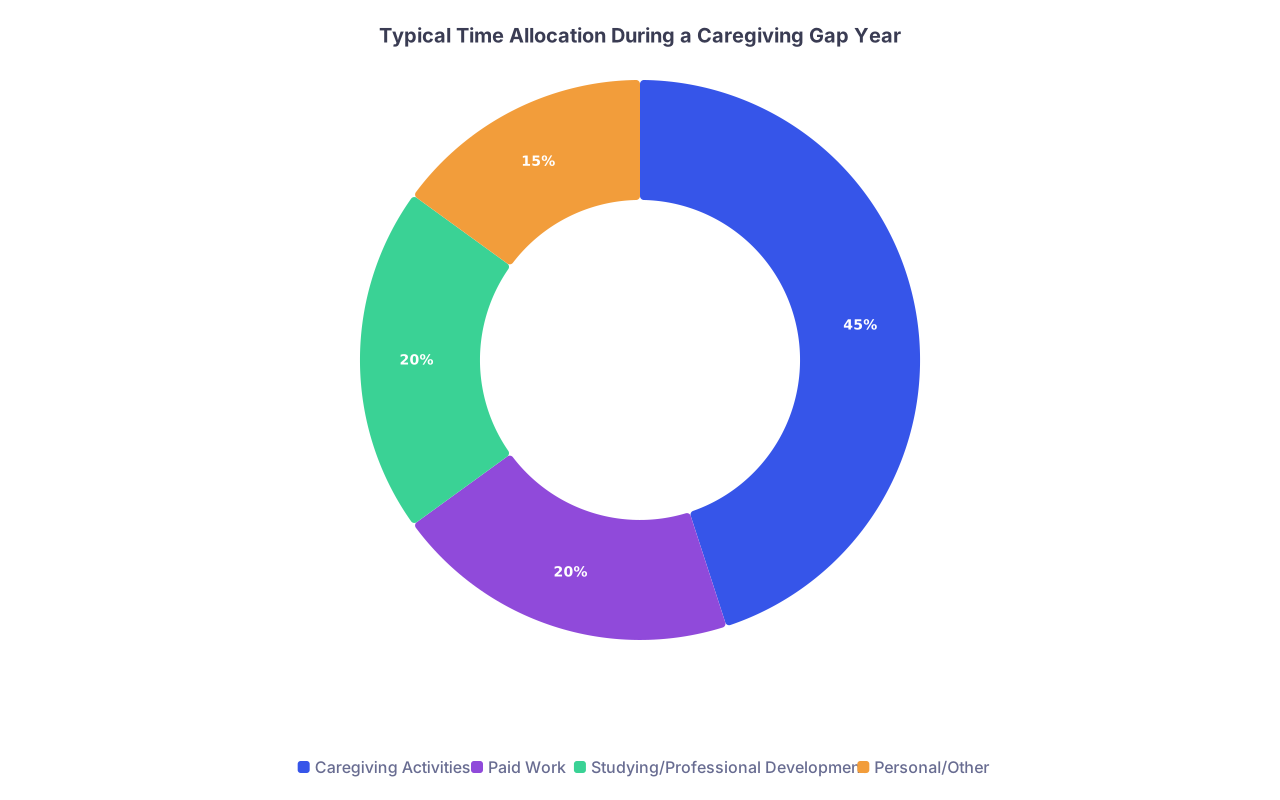
| Category | Value |
|---|---|
| Caregiving Activities | 45 |
| Paid Work | 20 |
| Studying/Professional Development | 20 |
| Personal/Other | 15 |
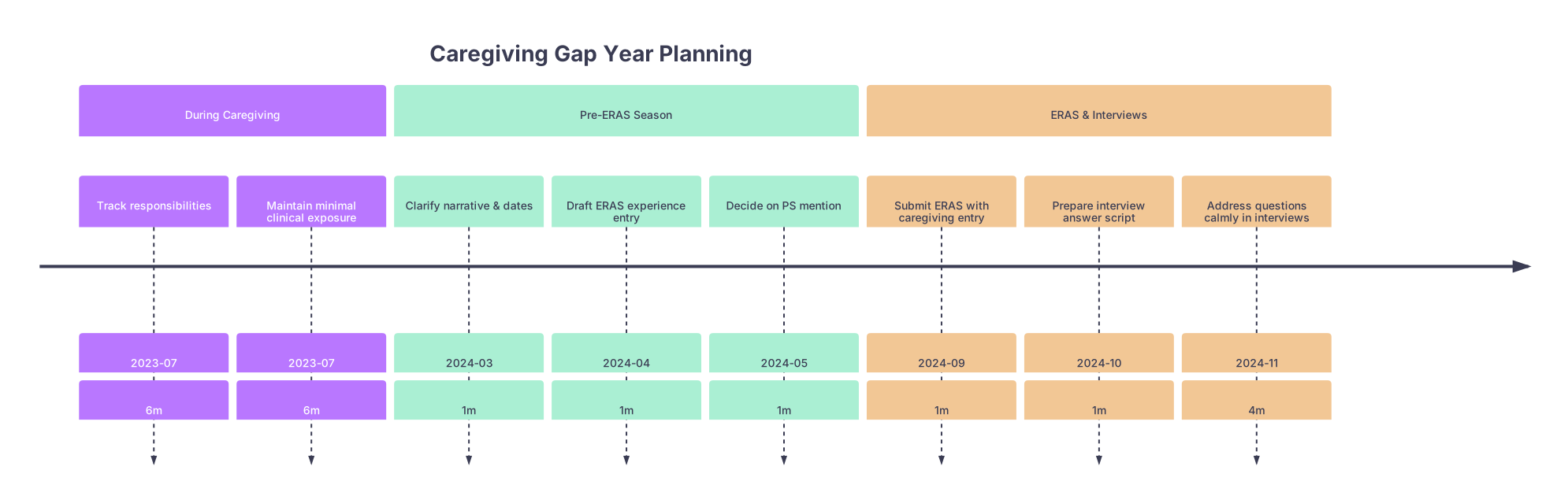
| Period | Event |
|---|---|
| During Caregiving - Track responsibilities | 2023-07 |
| During Caregiving - Maintain minimal clinical exposure | 2023-07 |
| Pre-ERAS Season - Clarify narrative & dates | 2024-03 |
| Pre-ERAS Season - Draft ERAS experience entry | 2024-04 |
| Pre-ERAS Season - Decide on PS mention | 2024-05 |
| ERAS & Interviews - Submit ERAS with caregiving entry | 2024-09 |
| ERAS & Interviews - Prepare interview answer script | 2024-10 |
| ERAS & Interviews - Address questions calmly in interviews | 2024-11 |
| Scenario | Concise ERAS Experience Title |
|---|---|
| Full-time care, no other work | Primary Family Caregiver |
| Caregiving + part-time clinical job | Family Caregiver and Medical Assistant |
| Caregiving + research | Research Assistant and Family Caregiver |
| Short-term, high-intensity caregiving | Short-Term Primary Caregiver |
| Overlapping with school leave | Leave of Absence for Family Caregiving |
FAQs
1. What if I honestly did very little besides caregiving and resting—will programs see that as laziness?
No, not if you frame it correctly and the situation clearly demanded your time. A year of full-time caregiving for a seriously ill first-degree relative is work. You don’t need to pretend you also did a full-time research fellowship on the side. Spell out the responsibilities and the hours in your ERAS entry. Where people get dinged is when they have a vague “family stuff” line and nothing else; that looks like they’re hiding something, not like they stepped up in a crisis.
2. My family member is still ill and I’m scared programs will think I’ll be distracted. Do I downplay it?
You don’t lie, but you do draw a clear line between past and present. You need a realistic plan: who is providing care now, what your role will be during residency, and whether any contingencies exist. Then you can say, “They continue to have health issues, but the caregiving is now handled by [other supports]. I no longer have day-to-day responsibilities and I’m fully able to commit to residency.” If you can’t truthfully say that, fix the logistics first.
3. Can I talk about this experience as a strength without sounding like I’m exploiting my family’s illness?
Yes, if you focus on your growth and behavior, not the tragedy itself. Emphasize what you learned about communication, coordinating care, being reliable under stress, and understanding patients’ families. Avoid dramatizing their suffering to score points. Keep the tone matter-of-fact, almost understated. The story is powerful on its own—you don’t need to dress it up.
Key points to remember:
- Make your caregiving year explicit, structured, and professional on ERAS—don’t leave a mysterious blank.
- Give enough clinical and logistical detail to show it was real work, but protect your family’s privacy and keep the focus on your growth.
- In interviews, be calm, concise, and forward-looking: this was a serious responsibility, you handled it, and now you’re ready to be fully present as a resident.


