

The match system does not care why you disappeared. It only cares what you did with the time.
If you are on a forced academic leave and staring at an unplanned gap year before residency, you’re not “ruined.” You are on the clock. You have 12–18 months to build a story that convinces a PD: “I want this person on my team, and this issue is handled.”
Let’s walk through exactly how to do that.
1. Get Clear on What Happened — In Writing, Not Just in Your Head
You cannot fix what you will not name. Programs will see the gap, the leave, the extra year. They will ask.
So first step: brutally honest clarity.
Sit down and answer these questions on paper:
- Why were you forced to take academic leave?
Academic failure? Step failures? professionalism concern? Health issue? Personal/family crisis? Misconduct investigation? - What was your role in it?
Be specific. “I wasn’t prepared for clerkships” is lazy. “I didn’t ask for help when I was failing my first two rotations because I was embarrassed” is specific. - What changed since then?
Skills? Habits? Treatment? Insight? Concrete actions.
You’re creating the raw material for your future “red flag” explanation. Programs are not looking for a perfect life. They’re looking for:
- Ownership
- Insight
- Course correction
- Evidence the problem is unlikely to recur
Write a one‑paragraph “brutally honest” version for yourself. Do not show this to programs. Do not show it to anyone yet. This is your diagnostic, not your public statement.
Then, write a second version: a professional, 4–6 sentence summary that:
- States the issue clearly
- Takes responsibility where appropriate
- Explains what you did to address it
- Ends on stability and readiness
This will evolve into your ERAS explanation, PS paragraph, and interview soundbite.
You are not ready to plan your gap year until this piece is at least roughly formed. The plan has to match the story.
2. Understand How This Looks from a PD’s Chair
Let me be blunt. When a PD or APD sees “forced academic leave,” here’s what runs through their mind:
- Is this person safe to put in front of patients?
- Will they finish the program? Or will I be managing another remediation, another leave, another disciplinary process?
- Will they drag down the team?
- Can they handle stress without imploding, disappearing, or lashing out?
- Is the risk worth the rank slot?
They are not being cruel. They’re protecting patients and residents.
So your gap year has one core job: lower perceived risk.
You do that by accumulating evidence in a few domains:
- Reliability over time
- Clinical competence (or at least clinically relevant engagement)
- Professionalism (people willing to vouch for you, in writing and on the phone)
- Stability in the area that went wrong (academic, mental health, professionalism, etc.)
That’s your design brief. Anything you put into your gap year that does not serve one of those buckets is probably a luxury, not a priority.
3. Choose the Right Gap-Year Structure for Your Specific Red Flag
Your situation dictates your strategy. Do not copy what your classmate with a different problem did.
Let me break it down by common reasons for forced leave and what a strong gap year can look like in each case.
| Primary Issue | Top Priority Focus | Ideal Setting Type |
|---|---|---|
| Academic Failure | Demonstrated academic mastery | Research + structured study |
| Step/COMLEX Failure | Exam remediation and retake | Dedicated study + tutoring |
| Mental Health Burnout | Stable functioning over time | Light clinical/research role |
| Professionalism Issue | Long-term supervised work | Longitudinal clinical job |
| Conduct/Boundary | Trust + monitored environment | Close mentorship setting |
Now let’s get specific.
A. If your leave was for academic difficulty / Step failure
Your story must prove: “I can handle the cognitive demands, I’ve passed the key milestones, and my study system works.”
Your year should include:
Exam clean-up first
If you still need to pass Step 2 / Level 2 or a re‑take:- Get a structured remediation plan from your school or an outside board review course.
- Treat studying as a full‑time job (8–10 hours/day, 5–6 days/week) until the retake.
- Use tutoring if you’ve already failed once. Failing twice without changing your approach is a terrible look.
Academically flavored productivity second
After the exam is done and passed:- Join a research group in your target specialty or in hospital medicine, quality improvement, or outcomes.
- Aim for tangible output: abstracts, posters, manuscripts, or at least data collection roles with your name attached.
- Even 1–2 posters or a submitted manuscript becomes “I used my extra year to deepen my academic engagement.”
Letters that explicitly mention your improvement
You want at least one letter writer who can say:- “They had academic struggles, addressed them directly, and I watched their performance improve substantially.” That sentence, in some form, is gold for you.
B. If your leave was for mental health / burnout
Programs are absolutely seeing more of this. Some are understanding. Some are not. You cannot control that.
Your story must prove: “The crisis is resolved/managed, I have stable functioning over time, and I have coping mechanisms other than self-destruction or disappearing.”
Your year should include:
Treatment continuity
Therapy, psychiatry, support groups — whatever is clinically indicated. And keep going.
You do not need to disclose every detail. But in an interview, being able to say, “I engaged in ongoing treatment and have been stable for X months while working in Y role,” is powerful.Moderate, consistent workload
This is where people mess up. They either:- Hide and do nothing “to protect my mental health” (reads as unstable/avoidant), or
- Overcompensate with 80‑hour weeks (reads as denial; also can crash you again).
Better:
- A full‑time job with normal hours (40ish/week) in a clinically adjacent role: clinical research coordinator, medical scribe, care coordinator, telehealth support, etc.
- Or 2 part‑time roles you can sustain.
The key: show you can show up, week after week, for many months, without a new crisis.
One supervisor who will actually pick up the phone
Have at least one supervisor or attending who:- Knows your history at least broadly.
- Has watched you function well over 6–12 months.
- Is willing to write a letter and talk to PDs: “Yes, they had a mental health crisis. Yes, they are stable now. Yes, I’d take them in my own program.”
C. If your leave was for professionalism / conduct
This is the hardest category. Not impossible, but you have to be deliberate.
Your story must prove: “This behavior was addressed, I understand exactly why it was a problem, and it will not happen again.”
Your year should include:
Working directly under supervision in a clinical or clinical-adjacent environment
Not remote work. Not purely lab research where you hide in a corner.
Think:- Clinical research with patient interaction
- Scribing in an ED or outpatient clinic
- MA or medical assistant roles (if allowed/feasible)
- Case manager / care coordinator
Clear behavioral changes
Depending on what happened:- If it was boundary issues: strong mentorship and explicit feedback about professionalism.
- If it was anger / conflict: coaching, maybe even formal communication or professionalism courses.
- If it was dishonesty: long-term role where you handle data, documentation, and are monitored.
Letters that explicitly address the concern
You cannot fix a professionalism red flag with vague, generic “hard worker” letters.
You want something like:
“I was aware of their prior professionalism concern. Over the past year in my research group/clinic, their behavior has been exemplary: punctual, honest in documentation, receptive to feedback, and a positive team presence.”
If you are not sure how big your professionalism problem is in the eyes of programs, ask a dean you trust: “If you were a PD reading my file, how nervous would you be, and what would you need to see to be reassured?” Force them to answer.
4. Concrete Gap-Year Options That Actually Help You
Let’s get specific. These are realistic things you can do in 6–18 months that improve your application rather than just filling time.
Clinical-adjacent jobs
- Clinical research coordinator in your desired specialty or hospital medicine
- Medical scribe (ED, inpatient, or outpatient — ED especially shows pace and team work)
- Care coordinator / case manager in a hospital system
- Quality improvement fellow / assistant in a department that has active QI projects
- Telemedicine support (chart prep, follow-ups, triage under supervision)
What these give you:
- Daily exposure to clinical reasoning and documentation
- Supervisors in academic environments
- Potential for authorship on QI or research projects
- Proof you can function on a team and handle responsibility
Research-heavy year
Great if:
- You’re aiming for a competitive specialty; or
- You had academic struggles and need to show intellectual engagement.
Look for:
- Year‑long research fellowships (many large departments have them; some are informal and built around an attending’s lab or outcomes group).
- Projects that involve writing, data analysis, and presentations, not just data entry.
Set goals early:
- X abstracts
- Y posters
- At least one manuscript submitted, ideally as first or second author.
Structured remediation / academic rebuild
If you have a serious academic problem, your “job” for part of the year is school:
- Retaking failed clerkships or sub‑Is
- Doing formal board prep
- Attending school-provided remediation programs
You still want at least 6 months of something you can list as work/research. But do not shortchange the remediation to chase shiny CV items. Passing the exam or successfully completing remediation is non-negotiable.
5. Build a Daily and Monthly Structure (So You Don’t Drift)
The biggest hidden risk of a forced gap year is not optics. It is that you lose structure and slowly fall apart.
Fix that before it happens.
Daily
- Fixed wake time, fixed start time to your day.
- Core anchor blocks:
- Work / research / study block
- Exercise / physical activity
- Admin block for applications, emails, logistics
Treat this like internship lite. If you can’t be on time for your own life, that will show.
Monthly
At the end of each month, write down:
- What concrete things did I complete? (e.g., “submitted 1 abstract, collected data on 30 patients, finished 2 UWorld blocks per week”)
- What can I point to on ERAS from this month?
- Did I move the needle on my main liability (academics, mental health, professionalism)?
If your monthly list has nothing but “worked, existed,” you’re on a path to a weak narrative. Not a disaster, but fixable if you notice early.
6. Document the Comeback as You Go
Do not wait until ERAS opens and try to remember what you did.
Create a simple tracking system now:
A spreadsheet with:
- Date
- Activity (clinic, research, study, remediation)
- Hours or concrete tasks
- Any outcomes (poster submitted, abstract accepted, exam passed, feedback received)
A one-page “gap year running draft” where you periodically write 2–3 sentences about what you’re learning, what’s changed in you, and any feedback you’ve received.
When it’s time to write your personal statement and update your CV, you’ll have a pile of raw material instead of a foggy memory.
Also: save emails of praise or positive feedback. These can remind you, in a low moment, that you’re actually making progress.
7. How to Explain the Forced Leave on Paper and in Interviews
You will need three versions of your explanation. They must be consistent but not identical.
Version 1: ERAS / application text (factual, concise)
Usually 3–5 sentences:
- One sentence: what happened.
- One sentence: concise ownership.
- 1–2 sentences: what you did about it (actions, treatment, studying, remediation).
- One sentence: current status and why you’re ready.
Example, academic failure:
During my third year, I was placed on an academic leave after failing two clerkships and struggling with Step 1 preparation. I underestimated the volume and pace of clinical learning and delayed asking for help. Over the subsequent year, I worked with my school’s learning specialist, established a structured study system, and successfully remediated both clerkships and passed Step 2 CK on the first attempt. I now feel confident in my ability to manage the academic demands of residency and to seek support early when needed.
Tight, direct, no drama.
Version 2: Personal statement paragraph (context + growth)
This can be a short paragraph embedded in the middle or near the end.
You add more human context and link it to your motivation / maturity.
Example, mental health leave:
Midway through my third year, I took a medical leave for severe depression that had been building throughout my clinical rotations. For years I coped with stress by isolating and overworking, and in clerkship this finally collapsed. During my leave, I began consistent therapy and treatment, learned to set boundaries around work, and gradually returned to structured clinical work as a research coordinator in internal medicine. Functioning reliably in that role for the past year has shown me that I can manage my illness, ask for help early, and still be the kind of present, steady physician I aspire to be.
You’re not auditioning for a memoir. Brief and pointed is enough.
Version 3: Interview soundbite (60–90 seconds)
This is your live version. Practice it out loud until it feels natural.
Structure:
- Short label of the issue
- 1–2 sentences of context
- 2–3 sentences of action / fix
- 1–2 sentences of evidence of stability
If you ramble, you’ll come across as unresolved. If you’re defensive, you’ll come across as risky. Aim for “calm, direct, done the work.”
8. Letters: The Quiet Deciders in Your Comeback
Your gap year does not “count” until someone with a title is willing to vouch for you on letterhead.
You need:
- At least one strong clinician letter from the gap year or post‑leave clinical work (even if research-based, they should see you with patients or in a clinical team).
- At least one dean’s letter or school letter that does not hide your issue but frames it in a “problem addressed” light.
During your gap year, behave every day like your supervisor is writing your letter. Because eventually, they will be.
Practical moves:
Around 4–6 months into your role, ask directly:
“I know I’ve had obstacles in my training. If, after working with me longer, you feel comfortable writing me a strong letter for residency, I would be very grateful. If not, I’d appreciate honest feedback so I can improve.”Do not chase “famous names” who barely know you. A mid-level faculty who can say, “I watched them for a year, this is who they are now,” is more valuable.
9. Targeting Programs Realistically
Forced leave plus a gap year does not automatically mean you only apply to bottom-tier anything. But it does mean you have to be strategic.
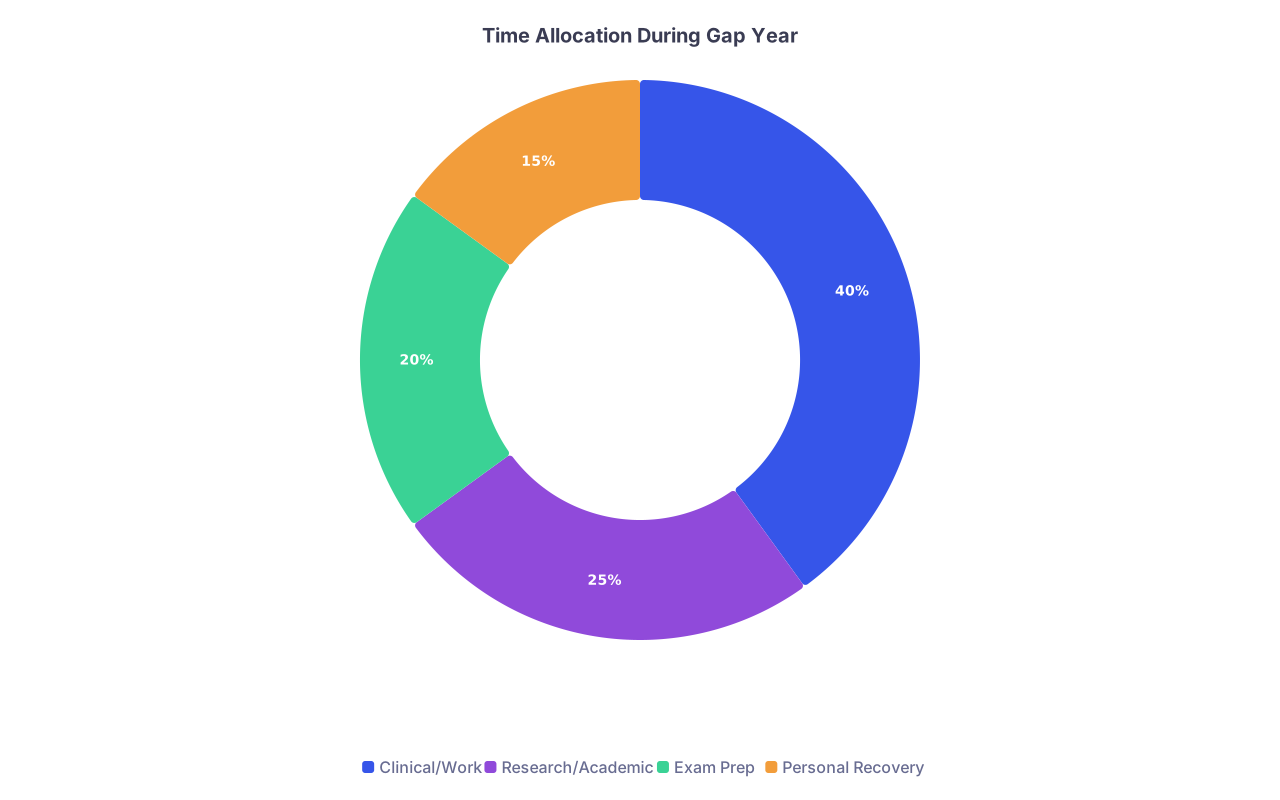
| Category | Value |
|---|---|
| Clinical/Work | 40 |
| Research/Academic | 25 |
| Exam Prep | 20 |
| Personal Recovery | 15 |
If your goal is a moderately competitive specialty (EM, anesthesia, psych in some regions), consider:
- Broad list including:
- Community programs
- Newer programs
- Programs in less desirable geographic locations (from a typical applicant’s viewpoint)
If your original dream was ultra-competitive (derm, ortho, plastics) and your record now has multiple red flags, you need a brutally honest conversation with someone who matches applicants in that field every year. Some doors close. It’s better to pivot intentionally than to burn 10k on hopeless applications.
Either way:
- Emphasize programs that have a track record of taking “nontraditional” or red‑flag applicants. Often:
- Community-based
- Safety-net hospitals
- Programs that explicitly say they holistically review.
And apply broadly. Very broadly. Your file likely goes into the “discuss” pile, not the “auto-interview” pile. You need volume.
10. The Psychological Piece: How to Survive the Year Without Self-Destructing
Let’s not pretend this is just logistics. Forced leave is a hit to your identity. It feels humiliating. Watching your classmates match while you’re on the sidelines is brutal.
You cannot wish that away, but you can avoid making it worse.
A few non-negotiables:
- Do not isolate completely. Have at least one friend, partner, therapist, or mentor who knows the whole story and can tolerate hearing it again.
- Stay physically active. You don’t need to become a marathoner. But stagnation makes everything worse.
- Limit toxic comparisons. Mute or avoid the endless “Got my first interview!” group chats if they send you into a spiral.
- Keep some non-medical life alive. A hobby, a class, something that reminds you you’re not just an application.
This is not “wasted” time if it produces a more stable, self-aware version of you who can actually survive and grow in residency.
11. What a “Comeback” Actually Looks Like in the End
A successful turnaround after forced academic leave usually doesn’t end with some cinematic redemption. It looks more like this:
- You pass the needed exams and finish required remediation.
- You spend 6–18 months doing unglamorous but steady work in a clinical or research role.
- A few people in authority quietly decide, “Yes, I trust this person now.”
- You write a clean, direct explanation.
- You apply broadly.
- You get fewer interviews than your classmates, but enough.
- At least one PD hears your story and says, “They’ve done the work. Let’s give them a spot.”
Then one day in July, you’re in orientation, wearing a short white coat, printing your first progress note. And no one there really cares how circuitous your path was — they just care how you show up now.
That’s what you’re working toward.
You’re in a hard spot, but you’re not stuck in it. Design this gap year like it’s your probationary first year of being the doctor you want to become. If you do that, you’ll walk into the next match cycle not as the person who was forced out, but as the person who came back stronger.
And once you’ve secured that spot and made it through intern year, there’s a different set of problems to solve — surviving and growing inside residency. But that’s a situation for another day.
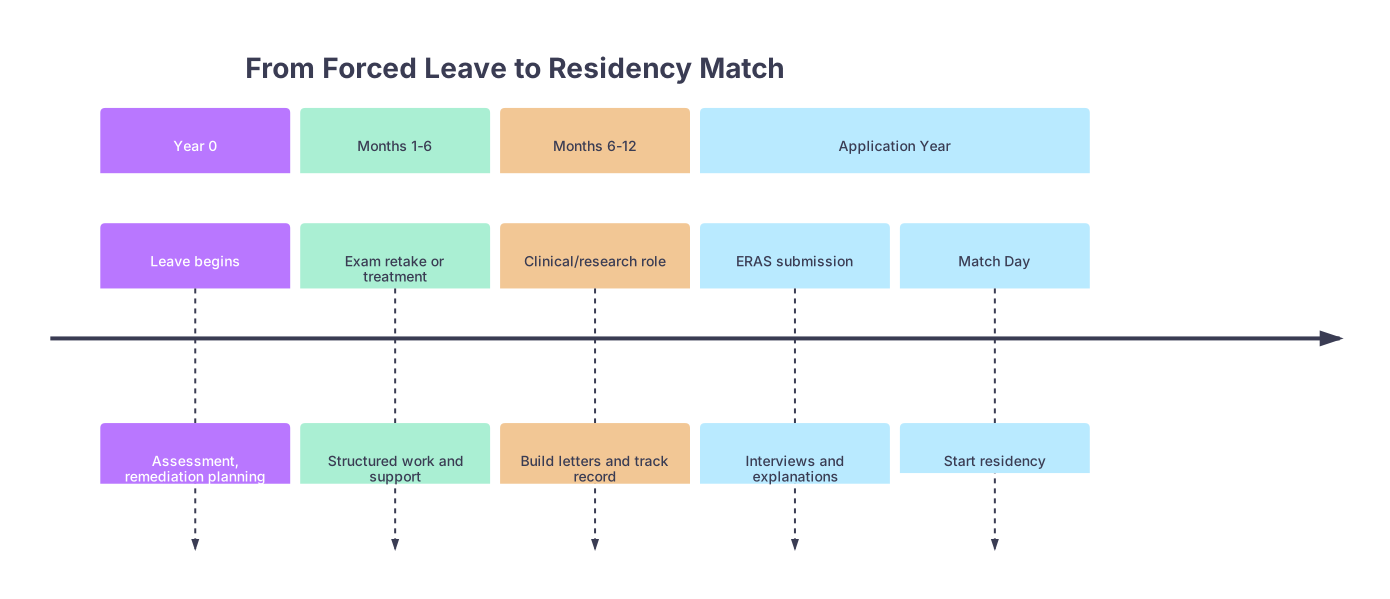
| Period | Event |
|---|---|
| Year 0 - Leave begins | Assessment, remediation planning |
| Months 1-6 - Exam retake or treatment | Structured work and support |
| Months 6-12 - Clinical/research role | Build letters and track record |
| Application Year - ERAS submission | Interviews and explanations |
| Application Year - Match Day | Start residency |


