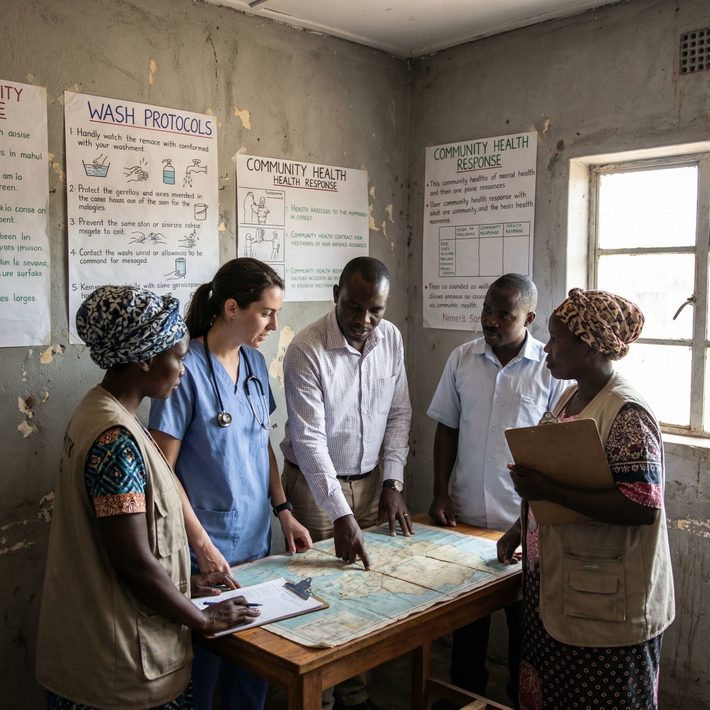
You signed the contract. You got the acceptance email from the global health org. Flights are booked. Your apartment is sublet. Your mom has already told her entire book club you're going to Rwanda.
And then? Silence. Then an email: "Your credentialing packet is incomplete. Start date delayed."
I've seen this exact scenario derail more first missions than malaria prophylaxis side effects. You're ready to deploy, but your paperwork isn't. That packed luggage in the corner? It'll sit there for another three weeks while three different offices take their time verifying you graduated from medical school.
Here's the real cost: every week your start gets pushed, the program loses $2,000-5,000 in grant-covered clinical time, and the local team you were supposed to support stays stretched thin. This isn't just an admin headache. It's a patient care problem.
Credentialing delays are not random. They're predictable. And preventable. Here's how to fix them.
This information is for educational purposes only and is not financial advice, not legal advice, and not tax advice. All figures vary based on location and organization, so consult a qualified professional for guidance specific to your situation.
For a detailed timeline on scheduling these steps around your residency application cycle, see our guide on timing overseas licensing and credentialing before ERAS submissions.
Hurdle 1: Primary Source Verification Bottlenecks
This is the big one. Primary source verification means someone has to contact your med school, your residency, your fellowship, directly, and get them to confirm you actually trained there. No shortcuts.
Why does it take forever? Because you're at the mercy of a registrar's office that might respond in 3 days or 3 months. I once watched a mission to Ghana get delayed 11 weeks because a U.S. residency program had a single staffer on sabbatical who handled verifications.
The Fix, Start on Day Zero:
Make sure you're prepared for common pitfalls by reviewing our checklist for your first humanitarian deployment.
- Day you sign: Email every institution yourself. Don't wait for the credentialing company. Subject line: "URGENT - Primary Source Verification Request for Global Health Deployment - [Your Name]".
- Parallel processing, always. Send requests to your medical school, residency, ECFMG, ABMS all at the same time. Never sequentially.
- Pay for speed. If a verification service offers expedited for $75, pay it. Your lost time costs more.
- Call, don't just email. After 7 days of silence, call the registrar directly. Phone calls clear queues that emails sit in for weeks.
Hurdle 2: Medical License and Certification Delays
Your California license means nothing in Uganda. Or even in Texas, if your mission is domestic.
State boards take 2-8 weeks on a good day. International licenses are worse, they often require your diploma, license, and good standing letter all be authenticated first. That's a chain of dependencies. One missing link and the whole thing stops.
The Fix:
- 60-day rule. Identify the destination license type on week one. Temporary, volunteer, observer, full? Ask the host organization to send you the exact checklist from the ministry of health. Not their summary. The real document.
- Ask for the visitor route. Most countries have a short-term humanitarian license that's 50% faster than a full license. It exists. People just forget to ask for it.
- Triple-check expiration dates. Your ACLS, BLS, board certification, if any expire within 3 months of your mission, renew now. A board will reject you over a card expiring in 60 days.
Hurdle 3: Background Check Complexities
FBI fingerprint? State check? Local police clearance from every place you've lived in 7 years? Depends on the host.
International background checks are where people get burned. Some countries want an FBI check with an apostille. Getting the apostille adds another 10-15 business days after you get the FBI result. If you didn't plan for that, you're stuck.
The Fix:
- Start this at Day 15, no later than 45 days before departure. FBI channeler results come in 3-5 days vs. 12-14 weeks direct.
- Get ink fingerprints and Live Scan if possible. Some countries won't accept digital only.
- Build a redundancy folder: Have 3 certified copies of everything. One in your carry-on, one in checked luggage, one in cloud storage. When an embassy loses your original, you hand them copy #2 and keep moving.
Hurdle 4: Immunization and Health Clearance Backlogs
Occupational health is understaffed everywhere. That's the reality. And travel vaccines aren't sitting at every CVS. Yellow fever is often on shortage. Typhoid injectable? Good luck finding it same-week in February.
Plus, you need titers. Many global health sites require documented immunity to measles, mumps, rubella, varicella, hepatitis B. If your Hep B titer comes back non-immune, that's a 3-dose series over 6 months. Or an accelerated series with documentation headaches.
The Fix:
- Draw titers on Day 1. Seriously. The same day you sign. If you're non-immune, you need time to remediate.
- Don't rely on your memory. "I had chickenpox as a kid" doesn't count. Get the lab.
- Carry the yellow card. Keep your WHO International Certificate of Vaccination and a digital scan in your phone's offline files. Customs will ask. Clinics will ask. Have it.
Hurdle 5: Malpractice Insurance Verification Gaps
Here's the question nobody asks until it's too late: Does your occurrence-based policy cover you in Malawi? Or does your claims-made policy have a gap when you leave?
Most U.S. policies don't cover international clinical work. Period. Host countries often require you to buy local coverage or be added to their policy, and that verification takes time. I've seen providers cleared for everything else, then denied privileges because their liability letter said "worldwide except..."
The Fix:
- 30 days before you go, get written confirmation, not verbal. You need a letter stating: your name, policy type (occurrence vs. claims-made), coverage dates that fully bracket your mission dates (+2 weeks buffer), limits, and geographic coverage.
- Ask specifically: "Does this policy cover clinical activities in [Country X]?" Get that answer in writing.
- If there's a gap, ask your global health org about tail coverage or the host's indemnity program. Fix it early. Don't assume.
Hurdle 6: Hospital Privileging Process Length
Each hospital has a privileging committee. That committee might meet weekly. Or biweekly. Or monthly, on the second Tuesday, if there's quorum. Miss that meeting by one day because your TB test wasn't back? Wait another month.
Credentialing by proxy can help, where your home institution vouches for you, but it's not universal. Most low-resource sites still want their own full review.
The Fix:
- Submit a perfect packet. 90% of delays are incomplete packets. The committee won't review until it's 100% complete. Use a checklist and have someone else double-check it.
- Ask for the committee schedule up front. "When is your next privileging meeting?" Then back-calculate. If meetings are the 15th and you submit on the 16th, you just added 30 days.
- Request parallel privileging. Ask if your procedural privileges (e.g., central line, ultrasound) can be processed at the same time as core privileges, not after.
Hurdle 7: Document Translation and Authentication
Your diploma is in English. Great. But does the Ministry need it officially translated into French for Senegal? Probably. Does it need an apostille from the Secretary of State? Almost certainly.
Certified translation isn't Google Translate. It's a translator who will swear in court this is accurate. And apostille requirements vary wildly by whether both countries are Hague Convention members.
The Fix:
- Use a translation service that specializes in medical credentials. A generic translator will mistranslate "Doctor of Osteopathic Medicine" and cause a rejection.
- Call the destination embassy in Washington D.C. not the website, the actual human at the consular desk, and ask: "What authentication do you require for a U.S. medical diploma for a 3-month volunteer license?" Write down their name and date you called.
- Get your diplomas notarized first, then apostilled. That order matters. Wrong order = restart.
Summary: Your Credentialing Acceleration Protocol
Look, credentialing feels like bureaucracy for bureaucracy's sake. It is. But you can't fight it. You can only outrun it.
The pattern is clear: the things that delay you longest are the things you started last. So flip it.
Your 60-90 Day Launch Protocol:
- Day 0-2 (Contract Signed): Start primary source verification and titer draws. Today. Not next week.
- Day 3-7: Initiate license applications, FBI background check, and identify translation/apostille requirements.
- Day 8-21: Submit health clearance, confirm malpractice coverage in writing, assemble full privileging packet.
- Day 30: Your packet should be 100% complete and sitting in someone's inbox before the committee meeting.
- Every week: One follow-up call per pending item. Polite. Brief. Persistent. The squeaky wheel gets credentialed.
And get an accountability partner. Someone not your mom. A colleague, coordinator, or mentor who will ask you every Friday: "Where are we on verification?" Because this process punishes procrastination harshly.
Missions don't start when you want them to. They start when your paperwork says you can.