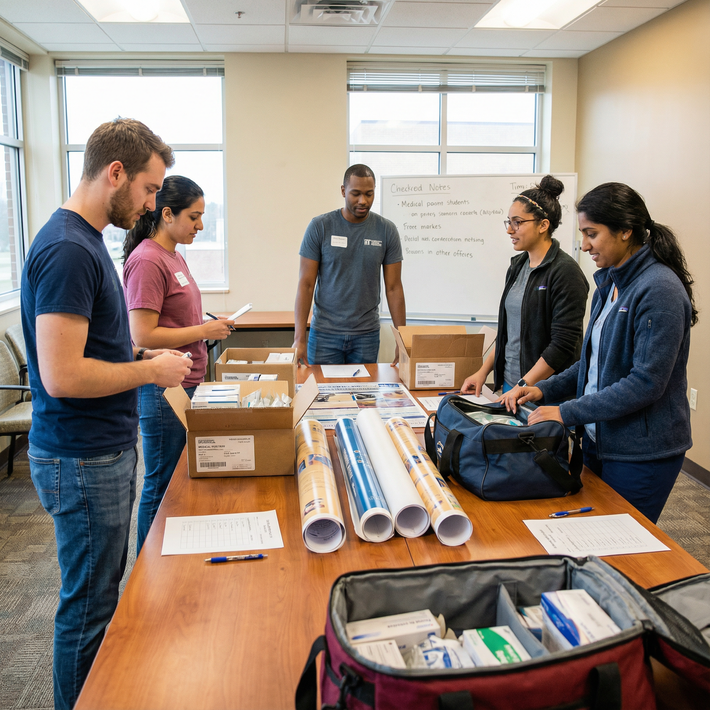
Here's the mistake: you book the mission trip, get your vaccines, pack your stethoscope, and assume your malpractice coverage will just follow you overseas. That assumption wrecks people. I've seen clinicians do all the hard things right medically and still leave themselves dangerously exposed because they never read the territorial language in their policy.
Educational disclaimer: This article is for education only and is not legal, insurance, financial, tax, or individualized risk-management advice. Coverage language, local law, contract terms, licensure rules, and claim outcomes vary widely, so get your own insurer, broker, risk manager, and qualified attorney involved before you rely on any policy abroad.
Domestic malpractice coverage is not a magic shield. Not abroad. Not on volunteer trips. Not when you're supervising outside your usual role. And definitely not when the claim lands in a court your insurer never agreed to defend. A lot of good people confuse "I have malpractice insurance" with "I am protected for this exact mission, in this exact country, doing these exact tasks." Those are not the same thing. Not even close.
The trap is usually hidden in boring policy language: territorial limits, jurisdiction exclusions, volunteer activity carve-outs, claims-made notice requirements, and consent-to-settle rules that get messy fast when the care happened in one country, the sponsoring organization sits in another, and the clinician lives in the U.S. or Canada. Add telemedicine follow-up across borders and improvised low-resource workflows, and you have a perfect setup for a coverage dispute at exactly the moment you need a defense.
This article is for educational purposes only. It is not financial advice, not legal advice, and not tax advice. Figures vary by individual circumstances, consult a qualified professional before acting.
The Hidden Coverage Gaps That Break Mission Trips Overseas
The most common mission-trip insurance error is embarrassingly simple: assuming your regular job coverage automatically extends to short-term volunteer work overseas. It often doesn't.
Start with the obvious problem. Many malpractice policies define covered professional services very narrowly. They cover you as an employee of a named group, hospital, or practice. That means your nice, noble volunteer clinic in rural Guatemala, Kenya, or Haiti may not count as covered employment at all. If the policy only covers acts performed "within the scope of duties for the named insured," your mission work may sit completely outside the fence.
Then there's geography. A policy may mention broad territory, but the exclusions do the real talking. Don't make the rookie mistake of stopping at the phrase "worldwide coverage." I've read policies where "worldwide" sounded reassuring until the exclusions stripped out foreign claims, certain countries, telemedicine, volunteer services, or any suit brought in a non-U.S. court. That's not broad protection. That's marketing language with handcuffs.
Common failure points I see again and again:
- Volunteer work isn't defined as covered practice
- The country where care is delivered isn't actually covered
- Cross-border telemedicine follow-up is excluded
- You're doing procedures or supervision beyond your insured scope
- Low-resource improvisation creates care circumstances outside what the policy contemplated
That last one matters more than people admit. Mission medicine is messy. You may be working without imaging, with limited labs, with medications substituted, and with follow-up that's uncertain at best. If your policy was priced and written around standard outpatient U.S. practice, don't assume it embraces high-variability field care.
And watch the "consent-to-settle" issue. Some clinicians think this clause protects them because the insurer can't settle without their permission. Abroad, though, the problem may come earlier: if the insurer disputes that the claim belongs under the policy at all, your supposed settlement rights don't help much. No defense, no leverage. Bad place to be.
The blunt rule: if your policy doesn't clearly say your mission country, mission role, mission dates, and mission services are covered, you should act as though you are not covered.
Where Coverage Usually Fails: Policy Language, Venue, and Local Law
The fine print is where good intentions go to die.
Here are the policy clauses that cause the most damage:
- Geographic exclusions: Entire countries or regions may be carved out.
- Volunteer activity exclusions: Charity care may not be covered unless specifically endorsed.
- Claims-made reporting windows: If notice isn't timely, coverage can evaporate.
- Prior acts limits: Earlier care, pre-trip consultations, or post-trip follow-up may fall outside coverage dates.
- Travel notification requirements: Some insurers expect advance disclosure before international work.
Local law is the part many clinicians never even think about. They should. A claim may emerge where the care occurred, where the patient resides, where the NGO is incorporated, or where records and follow-up crossed borders. Your domestic carrier may insure you for certain acts but refuse to defend in a foreign venue. That distinction is brutal.
Mission settings also make otherwise defensible care harder to defend. Why?
- Limited diagnostics
- Delayed or absent follow-up
- Translation errors
- Unclear documentation standards
- Improvised triage and workflow
- Different local expectations of informed consent
I've seen a seemingly straightforward pediatric dehydration case turn into a nightmare because the original evaluation happened in a temporary clinic, follow-up advice was translated by a volunteer with no medical background, and later communication continued by WhatsApp after the team went home. That's not just a clinical story. It's a coverage story.
How to Fix It Before You Leave: A Pre-Departure Coverage Audit
If you do one thing after reading this, do this: run a real coverage audit before departure. Not a vibe check. Not a hallway conversation with someone in admin. A documented audit.
Start with the full policy. Not the certificate of insurance. Certificates are shorthand summaries; they are not where the real exclusions live. You need the actual policy, endorsements, declarations, and any international riders.
Use this checklist:
Request the full policy package
- Declarations page
- Coverage form
- Endorsements
- Exclusions
- Definitions
Ask direct questions in writing
- Is the exact country covered?
- Are the exact travel dates covered?
- Are volunteer/mission services covered?
- Are the exact clinical duties and procedures covered?
- Is supervision of trainees or local staff covered?
- Is telemedicine or post-trip remote advice covered?
- Are you covered if a claim is filed in a foreign court?
- Do you need to notify the insurer before travel?
- Is there tail coverage for claims reported after the trip?
Match policy language to your real role
- Primary clinician?
- Consultant only?
- Surgeon?
- Proceduralist?
- Supervisor?
- Telehealth follow-up contact?
Verify the host organization's protection
- Does it provide malpractice or only general liability?
- Is its coverage primary or secondary?
- Does it cover individual clinicians by name?
- Will it pay for defense in local courts?
- Can you get this in writing?
Document everything
- Save emails
- Save policy endorsements
- Save the itinerary and role description
- Save credentialing approvals
- Save the insurer's written confirmation

Now the part people skip because they're in a hurry: operational safeguards. These matter because insurance doesn't rescue sloppy systems.
Before you leave, set rules for the trip:
- Practice within a deliberately limited scope
- Define supervision clearly
- Use documented informed consent appropriate to language and literacy
- Create referral pathways for escalation
- Set up incident reporting
- Know evacuation procedures
- Clarify record retention and who owns the chart
- Plan how, or whether, post-trip follow-up will occur
This is where ethics and self-protection overlap. Good mission medicine isn't cowboy medicine. If the setting pushes you into doing work you'd never be privileged to do at home, stop and think hard. Hero fantasies create terrible legal records.
What to Do If You Already Have a Gap: Damage Control Without Panicking
If you've already booked the flights and just discovered the policy problem, don't spiral. But don't minimize it either.
Immediate steps:
- Stop assuming you're protected
- Notify your insurer in writing
- Describe the exact countries, dates, services, and roles
- Ask for a written coverage position
- Pause any activity not clearly covered
That last step is the one people resist. They say, "But the team is counting on me," or "Everyone else is going." That's how clinicians end up practicing in uncovered roles because social pressure beat common sense. Don't make that mistake.
Backup options may include:
- Mission-specific supplemental malpractice coverage
- Host organization liability protection
- Travel medical and evacuation coverage
- Local counsel or cross-border legal review
- Role reduction to non-procedural or advisory duties only
Three mistakes make a bad situation worse fast:
- Relying on verbal assurances
- If it isn't written, it doesn't protect you.
- Ignoring exclusions because "everyone does it"
- Group recklessness is still recklessness.
- Continuing to practice after discovering the mismatch
- Once you know there's a problem, pretending otherwise looks terrible later.
I've seen clinicians cling to a coordinator's casual "You should be fine." No. Coordinators are not your insurer. They are not your defense counsel. They will not be the one personally named when the claim arrives.
Bottom Line: Don't Let a Preventable Exclusion Turn Into a Career-Level Problem
Here's the truth. Malpractice coverage on paper is not the same as real-world defensible coverage during international mission care. Too many clinicians find that out after an adverse event, when the chart is messy, the venue is unfamiliar, the language barriers are obvious, and the insurer starts pointing to exclusions.
The safe mindset is simple:
- Verify
- Document
- Escalate questions early
- Refuse vague assurances
- Don't practice first and clarify later
You are not being difficult by asking hard questions before a mission trip. You are being responsible. Protective. Ethical. Frankly, more professional than the people waving you through without checking the details.
Audit your policy now. Contact your insurer now. Get written confirmation now. And if the answer is fuzzy, buy mission-specific supplemental coverage or change your role before you leave. Fix it before the plane takes off. That's the cheap moment. After something goes wrong, it's too late.