
The biggest mistake US clinicians make doing short-term international work is assuming their malpractice coverage “probably” follows them. It usually does not. And when something goes wrong overseas, you find that out in the worst possible way.
You want to help. You want to go for 1–4 weeks, do good work, and come home. I’m going to walk through how to do that without gambling your license, your assets, or your sanity.
This is the playbook I wish people saw before they bought a cheap flight and clicked “I agree” on a volunteer waiver they didn’t read.
1. First Reality Check: Your US Coverage Probably Stops at the Border
Let me start bluntly: your usual malpractice policy is not a magic force field that works everywhere.
Most US physicians in these categories:
- Employed by a hospital/health system with claims-made coverage
- Covered under a group practice policy
- Covered by a university / teaching hospital plan
…have zero or very limited protection once they start treating patients outside the US (and often Canada).
Here’s what typically happens when you call your risk management or your carrier:
- “We don’t cover care provided outside the US or Canada.”
- “Coverage applies only to patients seen in our facilities or telehealth linked to them.”
- “Humanitarian work is excluded unless endorsed specifically in writing.”
Not verbally. In writing.
So before you touch a single patient overseas, you need to know exactly what you already have and what you absolutely don’t.
Action Steps: Verify Your Baseline
Do this before you book your trip:
- Pull your malpractice policy (or get it from credentialing/HR).
- Look for:
- “Territory” or “Coverage Territory”
- “Professional Services” definition
- “Exclusions” around international work, missionary work, or volunteer work
- Then talk to:
- Your carrier’s underwriter, or
- Your hospital risk management / legal, or
- Your group’s practice administrator who handles insurance
Ask very specific questions, like you’re cross-examining them:
- “If I see patients in [Country X] for 2 weeks under a short-term volunteer/locum/NGO arrangement, am I covered for malpractice arising from that care?”
- “Is that answer the same if I am paid vs. unpaid?”
- “Is there any endorsement I can purchase that would extend coverage?”
If the answer is anything but a clear, written yes, treat it as a no.
Now let’s talk about what you actually need.
2. Know Your Exact Scenario: They’re Not All the Same
Short-term international work is not one thing. The legal and insurance situation depends heavily on how you’re going, why, and who’s organizing it.
Here are the four most common situations I see.
| Scenario Type | Pay Status | Typical Risk Profile |
|---|---|---|
| NGO/mission trip (1–4 weeks) | Unpaid | Medium legal risk, high logistical confusion |
| Short-term locum (private hospital overseas) | Paid | Higher legal/financial risk |
| Academic / training visit (teaching only) | Usually paid/per diem | Lower clinical risk, but still exposure if supervising |
| Disaster response (WHO, MSF, large NGO) | Usually stipend | Risk moderate but often better-structured coverage |
Scenario A: Short-Term Volunteer / Mission / NGO Trip
You’re joining:
- A faith-based mission
- An NGO medical camp
- A university-sponsored global health trip
- A small non-profit running a clinic abroad
Risk patterns I’ve actually seen:
- The organization says “we cover you” but cannot produce a policy or certificate.
- They have general liability (slip-and-fall, etc.) but no professional liability.
- Their coverage only applies in their country of incorporation (e.g., US), not the host country.
- They ask you to sign a waiver releasing them from liability. That doesn’t protect you.
If you’re in this group, you’re the classic person this article is for.
Scenario B: Paid Short-Term Locums Overseas
You’re being recruited for:
- A 1–3 month contract at a private hospital in the Caribbean, Middle East, or Asia
- A telemedicine-plus-short-visit situation where you go occasionally
Here the questions shift:
- Does the hospital’s policy cover you fully?
- Is that policy adequate by US standards? (Often not.)
- Is there local legal exposure in their courts? Yes.
You rarely get sued in US courts for care delivered entirely abroad—but “rarely” is not “never,” especially if the patient is a US citizen.
Scenario C: Academic / Educational Visit
You’re:
- Going with your medical school / residency program
- Primarily teaching, supervising, or observing
- Maybe doing some direct clinical work
You might have partial coverage through:
- University malpractice
- Government indemnity (for some public institutions)
But there are landmines:
- If you step outside your defined role (e.g., performing procedures solo), coverage may not apply.
- If local law treats you as an independent practitioner, you could be personally named.
Scenario D: Disaster / Humanitarian Emergency Response
You’re with:
- MSF / Doctors Without Borders
- IFRC, WHO, or a major international organization
- A large, well-structured NGO with a formal deployment program
These groups usually have better systems:
- Often they provide primary malpractice/indemnity for field staff
- Sometimes they also handle legal defense and local licensing
Still: don’t assume. Ask for details.
3. The Core Toolbox: Short-Term Malpractice Solutions That Actually Work
You have three main levers you can pull. You may need one, two, or all three depending on your situation.
3.1. Rely on Host or Sponsoring Organization Coverage – But Only If It’s Real
If an NGO or hospital says “you’re covered,” that’s a starting point, not the finish line.
You need to see:
- A certificate of insurance naming the organization, with:
- Policy type: professional liability / malpractice
- Territory: explicitly including the country where you’ll work
- Limits: per claim and aggregate
- Written confirmation:
- That you’re an insured or additional insured
- That your role (physician, surgeon, anesthetist, etc.) is included
- That it applies to the dates and locations you’ll work
Ask directly:
- “Can you send the malpractice policy declarations and wordings, and a certificate listing me as covered during my deployment?”
If they:
- Dodge the question
- Send only general liability docs
- Say “we’ve never had a problem”
…then you don’t have a real solution yet.
3.2. Buy a Short-Term International Malpractice Policy
Yes, these exist. They’re less standardized than domestic policies, but there are specialty brokers and underwriters who do this routinely.
They go by phrases like:
- “Short-term international medical malpractice”
- “Humanitarian / mission trip liability”
- “Locum tenens abroad coverage”
What they usually provide:
- Claims-made coverage for a defined trip (dates, location, scope)
- Territory limited to specific country/region
- Limits often lower than your US coverage, but non-zero is much better than nothing
- Sometimes defense costs and legal expenses in local jurisdiction
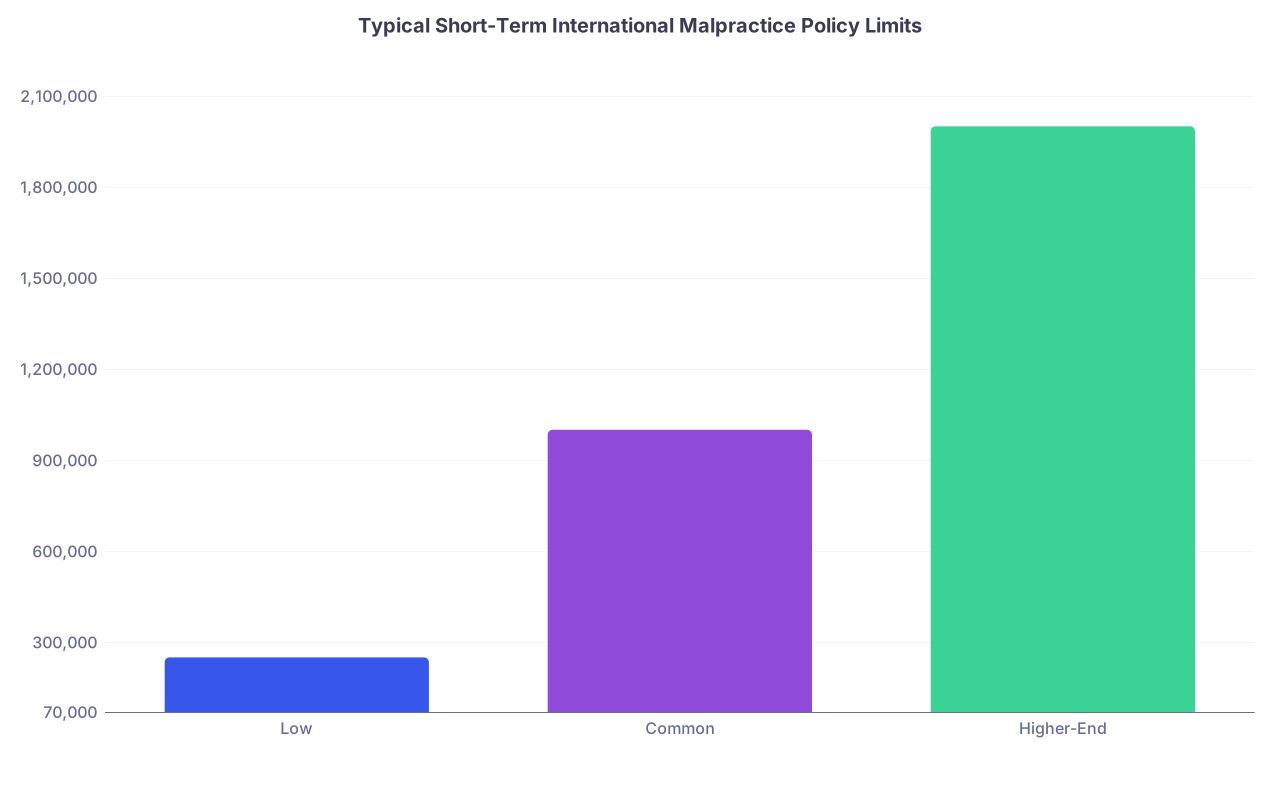
| Category | Value |
|---|---|
| Low | 250000 |
| Common | 1000000 |
| Higher-End | 2000000 |
You should be very clear on:
- Claims-made vs occurrence: Most short-term specialty policies are claims-made, meaning:
- The claim must be made while the policy is active
- You often need tail coverage or an extended reporting period, especially for OB, surgery, or pediatrics
Questions to ask the broker:
- “Is this claims-made or occurrence?”
- “If claims-made, what are my options for tail, and for how long?”
- “Does this cover telemedicine follow-up after I return home?”
- “In what courts could I be sued and defended under this policy?”
- “Does your policy exclude treatment of certain conditions (OB, HIV, trauma surgery, anesthesia)?”
If you’re doing procedures, deliveries, or high-risk interventions, don’t accept vague answers.
3.3. Use a Specialized Mission-Trip / Group Policy
If you’re part of a group going abroad together—church mission, residency group, hospital-sponsored trip—there are insurers who will write group mission policies that:
- Cover multiple clinicians on a single policy
- Are tailored to a specific trip (dates, country, activities)
- Sometimes bundle:
- Professional liability
- General liability
- Emergency evacuation / repatriation
This can actually be cheaper and better-structured than everyone buying their own solo policy.
So if your group leader seems overwhelmed by this topic, be the adult in the room:
- “We need to talk to a broker about a group mission malpractice policy. Can I help coordinate that?”
4. Country Law, Licensing, and What Actually Happens When Things Go Wrong
People obsess over US lawsuits and ignore where the real risk lives: the country where you’re working.
4.1. Local Licensing and Registration
You need to ask:
- “Under what authority am I allowed to practice here?”
- “Do I hold a temporary license? Am I working under the license of the local physician?”
Scenarios:
- Some countries issue short-term volunteer licenses. Good.
- Some let you work under the sponsoring facility’s license. Messier, but common.
- Some basically look the other way. That’s legally fragile.
If a serious complication occurs:
- Local authorities may investigate: medical board equivalent, police, ministry of health.
- If you weren’t properly authorized, everything gets more complicated—insurance, defense, and even your ability to leave the country on time.
So insist on clarity:
- Documentation of your local registration or the legal framework under which you’re allowed to work
- Contact information for the local medical director or legal representative who will stand with you if something happens
4.2. How Lawsuits and Complaints Actually Arise Abroad
Short version: It varies wildly.
In some countries:
- Formal malpractice lawsuits are rare, but criminal negligence charges are possible.
- Monetary damages are lower than US, but reputational and criminal risk is higher.
In others:
- Civil lawsuits are routine, similar to US-style litigation.
- Courts may give significant weight to local standards of care, not US guidelines.
You’re not going to become an expert in each jurisdiction. But your insurance provider should be.
So ask your international carrier:
- “Do you have panel counsel or local legal partners in [country]?”
- “If a complaint is filed with the local authorities, do you provide legal representation or just indemnity for judgments?”
If they say, “We only reimburse damages, you find your own lawyer,” that’s not ideal for a short-term trip.
5. Practical Checklist: What To Do 2–12 Weeks Before You Go
This is where we get very concrete. Do this in order.
Step 1: Clarify Your Role and Risk
Write down:
- Country and facility
- Dates of travel and days you’ll actually be practicing
- What you’ll actually do:
- Clinic only?
- Surgery?
- OB?
- Anesthesia?
- ICU?
Your risk profile changes massively if you’re doing C-sections instead of hypertension follow-up.
Step 2: Verify Existing Coverage (Yours and Theirs)
On your side:
- Talk to your current malpractice carrier. Get a written answer about international coverage.
On their side: - Ask the sponsoring organization for:
- Certificates of insurance for professional liability
- Confirmation you’re an insured for the trip and role
If you can’t get solid documentation, assume you are not covered.
Step 3: Contact a Broker Who Actually Does International/Medical Work
Not just your cousin’s auto/home agent. Someone who knows this niche.
Tell them:
- Your specialty and typical procedures
- Exact destination country
- Dates and approximate weekly hours of clinical work
- Whether you’ll be paid or fully volunteer
Ask them to propose:
- Individual short-term policy
- Or group policy if you’re part of a defined team
Compare:
- Limits: at least something like $250k–$1M per claim if you can
- Claims-made vs occurrence
- Tail coverage options

Step 4: Tighten Scope and Consent on the Ground
Once you’re there, even with insurance, you still want to reduce the chance you’ll ever use it.
Practical risk controls:
- Stay in your lane. Don’t perform procedures you’re not current and comfortable with just because “no one else is here.”
- Use clear, honest consent. Work with local staff to explain:
- Who you are
- That you’ll likely leave after a short period
- How follow-up will be handled
- Document in a way locals can understand. If you’re writing English notes in a non-English environment, pair them with local language when possible.
You’re not going to rebuild the documentation system in 2 weeks. But you can leave a trail that shows you were thoughtful and safe.
6. Common Myths That Get People in Trouble
Let me knock out a few wrong ideas I hear constantly.
Myth 1: “They can’t sue me in the US for work I do overseas.”
Not completely true.
Factors that increase US legal risk:
- Patient is a US citizen or resident
- Care was arranged through a US-based organization
- Marketing or recruitment occurred in the US
- Follow-up or telemedicine was done while you were back in the US
Is it common? No. Is it impossible? No.
Good international policies often cover suits brought in multiple jurisdictions (or at least defend you), but you have to ask.
Myth 2: “I’m a volunteer, so I can’t be liable.”
The law does not care that you didn’t get a paycheck. Courts look at:
- Duty
- Breach
- Causation
- Damages
If you act as a physician, you’re held to a physician standard, not a “nice volunteer” standard.
Some countries have specific volunteer protections or Good Samaritan laws. Many do not. You cannot assume.
Myth 3: “Our university/global health office said they’ve never had a problem.”
That’s not data. That’s survivorship bias.
Also:
- Institutions sometimes under-appreciate individual practitioner risk.
- Policies change quietly over time; what was covered 10 years ago may not be now.
You’re not being difficult by asking for documentation. You’re acting like a professional.
7. Money, Costs, and How To Keep This Affordable
Everyone worries this is going to be insanely expensive and then doesn’t look into it. Then they fly uninsured.
Let’s be more rational.
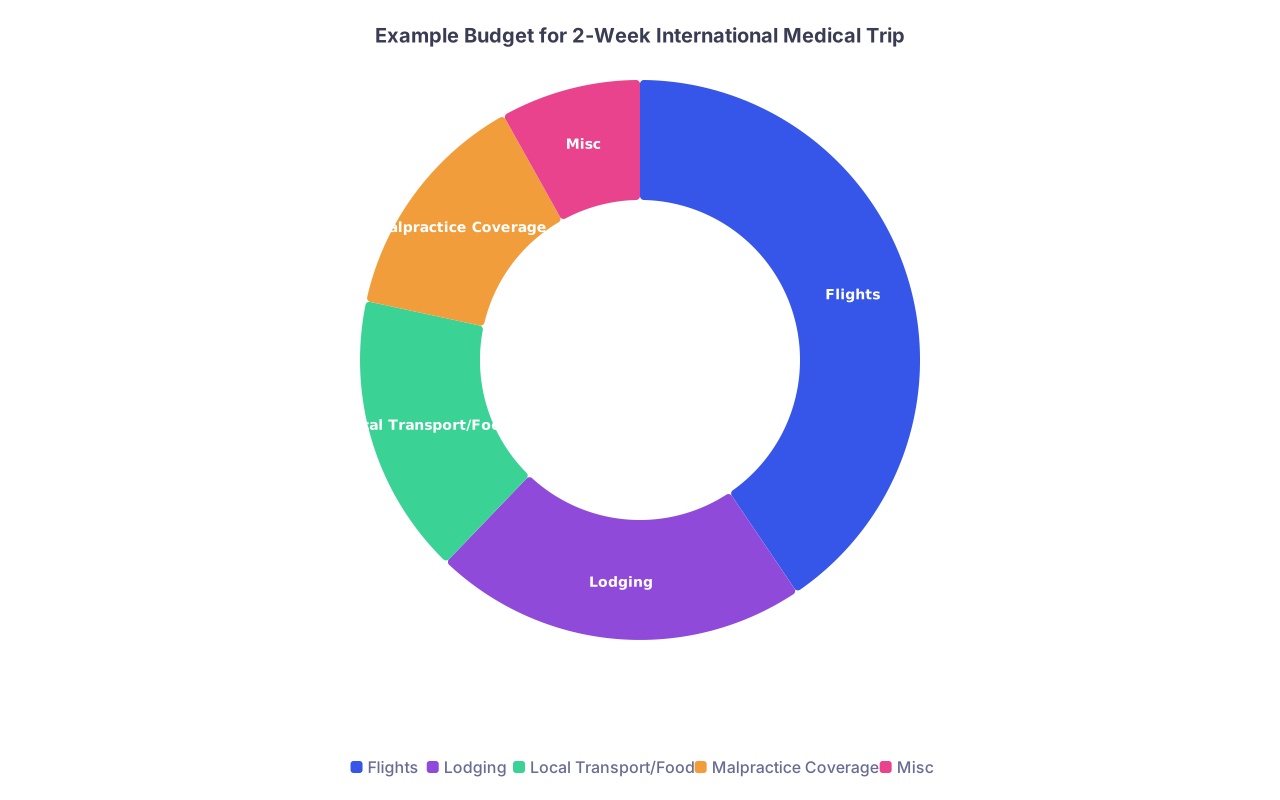
Typical ranges for short-term international malpractice (very rough, varies wildly):
- 1–4 weeks, low-risk primary care scope: a few hundred dollars
- 2–4 weeks, surgical / OB / anesthesia: higher, but still usually under what you spend on the flight and lodging
This is where people’s priorities get backwards. You’ll happily drop $1,500 on plane tickets and $800 on gear but hesitate over $600 in coverage that protects your license and house.
Try to:
- Get your sponsoring organization to share the cost or pay for a group policy
- Ask your hospital or academic department if they’ll subsidize coverage for approved trips
If money is truly a barrier, then adjust your scope:
- Do teaching only
- Observe rather than operate
- Stick to lower-risk clinic work
You can still do meaningful work without doing the highest-risk procedures.
| Category | Value |
|---|---|
| Flights | 1500 |
| Lodging | 800 |
| Local Transport/Food | 600 |
| Malpractice Coverage | 500 |
| Misc | 300 |
8. A Simple Decision Flow: Do You Need Extra Coverage?
Use this as a rough decision tool.

| Step | Description |
|---|---|
| Step 1 | Planning short term international work |
| Step 2 | Lower risk - check for academic/teaching coverage only |
| Step 3 | Verify host country licensing and proceed |
| Step 4 | Review limits and territory. Consider top up coverage if weak |
| Step 5 | Contact broker for short term international malpractice |
| Step 6 | Ensure adequate limits and tail |
| Step 7 | Basic short term policy may suffice |
| Step 8 | Any direct patient care? |
| Step 9 | Does current policy confirm written coverage abroad? |
| Step 10 | Host organization provides written malpractice? |
| Step 11 | High risk specialty or procedures? |

9. What To Do If Something Actually Goes Wrong Overseas
Let’s be realistic. Bad outcomes happen even when you do everything right. If you have a serious complication, death, or angry family situation:
- Stabilize and document.
- Focus on care first. Then chart carefully and factually.
- Notify local leadership immediately.
- Medical director, project lead, or NGO coordinator.
- Contact your insurer as soon as practical.
- Follow their instructions on what to say and not say from a legal standpoint.
- Avoid solo negotiations or promises.
- Don’t make guarantees about compensation, transport, or legal responsibility out of guilt or pressure.
- Preserve records.
- Copies of charts, imaging reports, communications—according to local law and your organization’s policies.
This is another reason you want a real policy and a real organization behind you. Self-insuring a catastrophe in a foreign legal system is not a game you want to play.
10. Bottom Line: How To Be Generous and Not Reckless
You don’t have to pick between doing good and protecting yourself. You just have to be slightly more deliberate than most people are.
The key moves:
- Assume your US malpractice doesn’t follow you until proven otherwise in writing.
- Treat “you’re covered” as noise until you see actual policies, territories, and limits.
- If coverage is unclear or absent, get a short-term international policy or push for a group mission policy—and scale your clinical risk to match your protection.
Do that, and you can get on the plane knowing you’re not betting your entire career on a handshake and a waiver you barely remember signing.