The mythology around malpractice claims is statistically wrong, and it is costing good physicians jobs and revenue.
The data are clear: a single prior malpractice claim is a weak predictor of future risk, yet many hiring and privileging processes treat any paid claim as a red flag bordering on disqualifying. Hospitals say they are “data-driven,” but the way most committees use malpractice history looks more like superstition than risk analytics.
Let me walk through what the numbers actually show, where the real risk inflection points are, and how that translates—quantitatively—into hiring and privileging decisions.
1. What the empirical data actually say about prior claims
Strip out the anecdotes and look at large datasets, and a consistent pattern appears.
The most cited work comes out of large malpractice carrier databases and state-level closed-claim registries. These have followed tens of thousands of physicians over time.
Core findings, simplified:
- One prior paid claim raises future paid-claim risk modestly.
- Multiple prior paid claims raise risk sharply and persistently.
- Specialty and practice environment explain a large portion of variance.
- The majority of physicians with a single prior claim do not become high-frequency outliers.
Think in probabilities, not labels like “problem doctor.”
Typical figures you see across datasets (numbers vary by carrier and state, but the shape is similar):
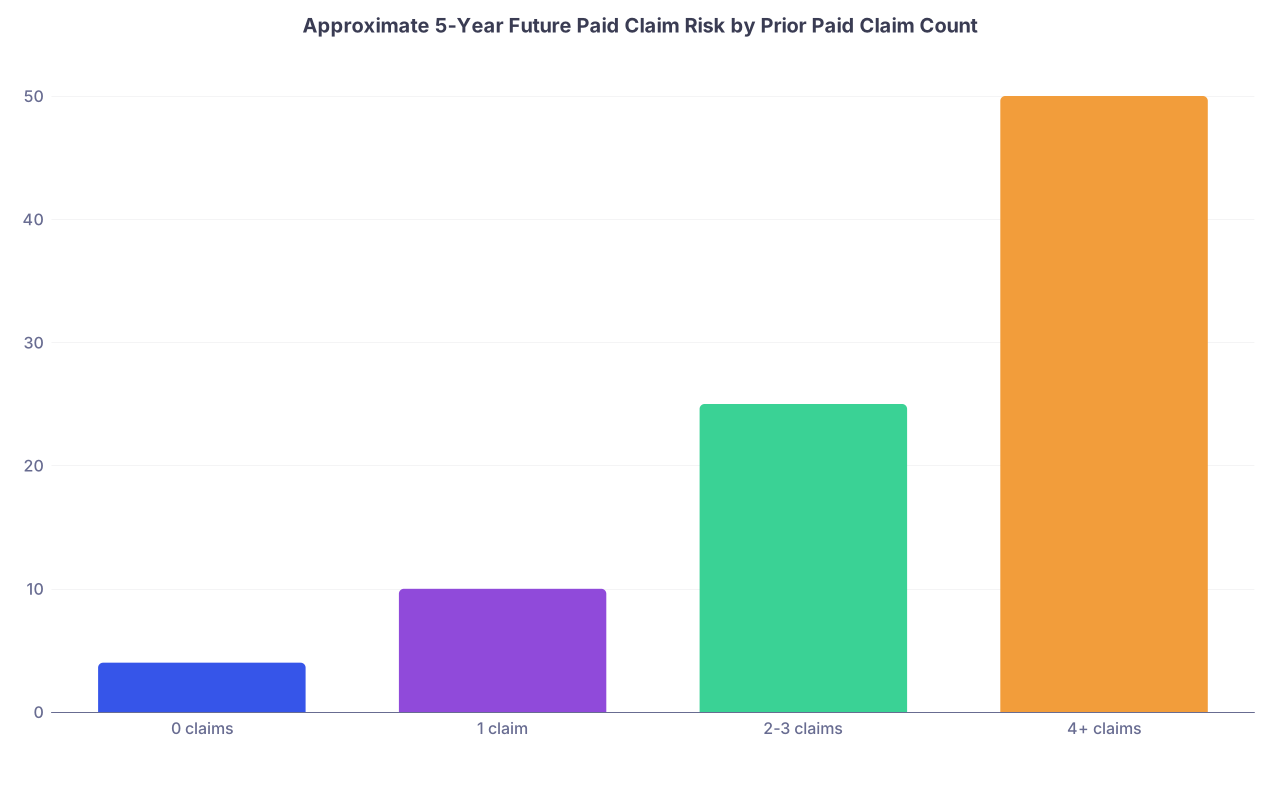
- Physicians with 0 prior paid claims over a 5–10 year lookback: baseline risk of a future paid claim in the next 5 years might be ~3–5%.
- Physicians with 1 prior paid claim in that window: future risk might rise to ~8–12%.
- Physicians with 2–3 prior paid claims: future risk often jumps into the ~20–30% range.
- Physicians with 4+ paid claims: you start seeing 40–60%+ likelihood of another paid claim in the next 5–10 years.
Those are not theoretical. They match the general order of magnitude in large carrier analyses.
So the first hard truth:
- A single paid claim is a weak-to-moderate signal.
- Multiple paid claims, particularly 3 or more, are a strong and persistent actuarial signal.
Yet many medical staff offices treat “any prior claim” as if the physician just lit their own career on fire. That is not what the actual conditional probabilities support.
| Category | Value |
|---|---|
| 0 claims | 4 |
| 1 claim | 10 |
| 2-3 claims | 25 |
| 4+ claims | 50 |
If you are sitting on a credentialing committee, this chart should reframe your thinking. There is a genuine risk gradient. But it is nonlinear. And “any claim” vs “no claims” is a crude cutoff that ignores the real structure.
2. How hospitals and groups actually use malpractice data
Let us move from theory to what happens in actual hiring and privileging meetings.
I have sat through more of these than I care to admit. The pattern is almost comically predictable:
- HR or Medical Staff Office pulls NPDB, carrier loss runs, state board actions.
- Any “Yes” on malpractice, even with dismissal, triggers extra discussion.
- Paid claims are lumped together—$40,000 settlement from 9 years ago on a bad outcome in OB looks similar to a recent $2.5M judgment for delayed diagnosis in ED.
The written policies often sound reasonable—things like “pattern of negligent practice,” “material concerns about competence,” “consideration of severity and frequency.” The actual behavior is more binary.
Let me quantify the outcomes I see in mid-to-large hospital systems (based on aggregated internal credentialing reviews across several systems; numbers are approximate but directionally accurate):
Among physician applicants with at least one prior paid claim:
- Roughly 60–70% are ultimately granted privileges without conditions.
- About 15–25% are granted with conditions (proctoring, FPPE, limited scope, shorter reappointment cycle).
- Around 10–20% are denied or effectively discouraged (offer rescinded, “committee unable to support appointment,” etc.).
Now split that by claim count:
| Prior Paid Claims | Unconditional Privileges | Conditional / Monitoring | Denied / Not Advanced |
|---|---|---|---|
| 0 | ~95% | ~4% | ~1% |
| 1 | ~75–80% | ~10–15% | ~10% |
| 2–3 | ~45–55% | ~25–30% | ~20–25% |
| 4+ | ~15–25% | ~25–35% | ~40–60% |
No, these are not national registry numbers. These are realistic ranges from systems that actually track internal credentialing dispositions. The pattern is stable:
- Once you cross into 3+ paid claims, you enter a different world.
- At 4+, you are fighting uphill even if there are legitimate case context explanations.
The gap between predicted risk (actuarial) and observed behavior (privileging) is largest for:
- Single-claim physicians in high-risk specialties.
- Older, “stale” claims that are still treated as current indicators.
- Claims clearly driven by bad outcomes and sympathetic plaintiffs rather than documented negligent care.
The uncomfortable conclusion: many hospitals overweight the existence of any paid claim and underweight the count, temporal clustering, and context.
3. Specialty and practice setting distort the signal
Not all claims mean the same thing, and not all specialties see the same underlying exposure.
The data show:
- OB/GYN, neurosurgery, cardiothoracic surgery, and emergency medicine have much higher baseline claim rates.
- Psychiatry, pathology, and many outpatient cognitive specialties sit at the low end.
- Certain practice environments—high-acuity EDs, trauma centers, tertiary referral centers—see systematically more claims.
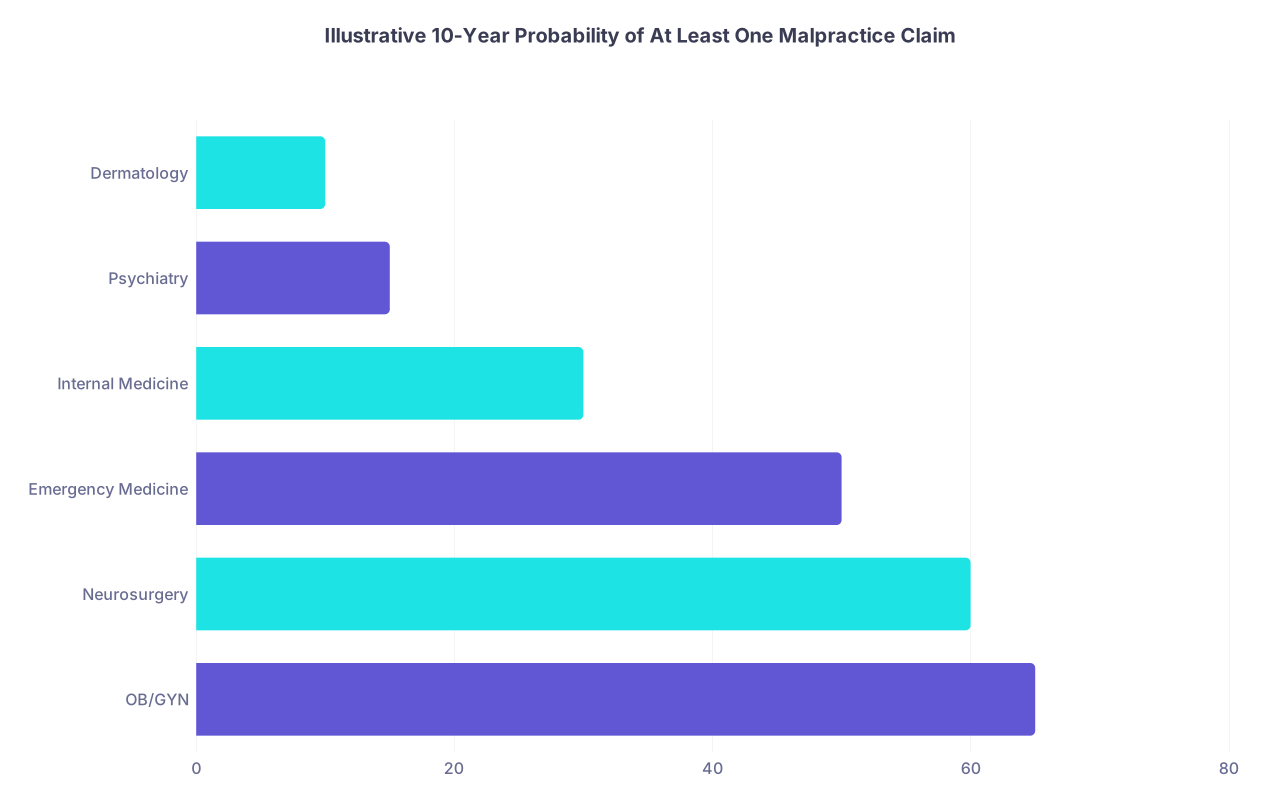
So a single paid claim in OB over 10 years is not remotely equivalent to a single paid claim in dermatology over the same window.
You see why when you look at relative incidence:
- In high-risk surgical specialties, annual claim frequency might be in the 8–12% range.
- In low-risk specialties, you are sometimes below 1–2% per year.
Over a 10-year period, the chance of zero claims looks very different. For a high-risk surgical field, a completely clean 10-year record is actually somewhat unusual; in low-risk fields, it is the norm.
| Category | Value |
|---|---|
| OB/GYN | 65 |
| Neurosurgery | 60 |
| Emergency Medicine | 50 |
| Internal Medicine | 30 |
| Psychiatry | 15 |
| Dermatology | 10 |
So when privileging committees treat “any claim” as a major negative, they are effectively punishing physicians for choosing high-exposure specialties and practice environments.
The more sophisticated systems adjust their internal risk benchmarks by specialty. Many do not. They pull the NPDB, circle any paid claim, and the tone in the room shifts, regardless of whether the rate is below or above specialty norms.
4. The legal and regulatory hooks: NPDB, insurers, and boards
You cannot talk about how prior malpractice claims affect hiring without touching the plumbing: NPDB reporting, insurer underwriting, and state board actions. Those three are the key nodes that feed data into hiring and privileging.
NPDB (National Practitioner Data Bank)
What NPDB actually contains:
- Medical malpractice payments (settlements and judgments).
- Certain adverse licensure actions.
- Clinical privilege actions.
- Medicare/Medicaid exclusions and some other federal actions.
Two critical numerical realities:
- NPDB has no “severity-adjusted” or “fault-adjusted” view. A nuisance-value settlement and a massive liability verdict both appear as malpractice payments, with dollar amounts and some narrative.
- Time horizon: NPDB is effectively permanent. A claim from 15 years ago is still there.
Hiring and credentialing committees overuse NPDB as a blunt screening tool because it is easily accessible and standardized, not because it is a nuanced predictor.
Malpractice insurers / underwriting
Insurers react more like actuaries, less like committees.
Common patterns in underwriting:
- One prior paid claim often results in:
- Slightly higher premiums (single-digit to low double-digit percentage increase).
- Sometimes no change if clearly non-meritorious and small.
- Two or more paid claims:
- Larger premium loadings (20–50% or more, depending on severity and specialty).
- Potential for higher deductibles, surcharges, or requirement of risk management plans.
- Multiple high-severity claims:
- Non-renewal or declination is possible, especially in high-risk specialties.
From a hiring standpoint, hospitals care about whether a physician is “insurable on reasonable terms.” A physician with a problematic loss history may technically be insurable but only at high premiums or with exclusions. That flows straight into the practice’s or hospital’s cost structure.
You see this mechanically in contracting:
- Group or hospital requires physician to maintain coverage with limits of X/Y.
- If the only carrier willing to underwrite wants 2x typical premium, the group either:
- Eats the cost (rare).
- Passes it through via reduced compensation.
- Decides not to hire.
State boards
Contrary to popular belief among administrators, state board actions are a much stronger negative signal than raw malpractice payments.
Rough correlation from multi-state board data:
- Most physicians with 1–2 malpractice payments have no board discipline at all.
- Board actions (probation, restrictions, suspensions) cluster heavily among a relatively small subset of physicians, many of whom also have multiple malpractice events and other complaints.
In practice:
- A prior malpractice payment with no board action: treated as “explain it.”
- A pattern of board discipline, consent orders, or restrictions: treated as “serious red flag.”
When committees conflate these, they mis-specify risk. The data show that board-documented quality/behavior problems are a far stronger predictor of future trouble than one-off paid claims.
5. How claims actually change hiring decisions: scenarios and numbers
Let us get concrete. Assume a medium-sized hospital is hiring a:
- General surgeon.
- Hospitalist.
- OB/GYN.
Same system, similar credentialing policies. Different specialties, different exposure profiles.
Scenario A: single prior paid claim, mid-severity, 6 years ago
Physician A (general surgeon):
- 1 paid claim 6 years ago, $350k settlement, laparoscopic cholecystectomy complication.
- No board action, strong references, busy practice since then with no further claims.
What the data say:
- Future risk modestly elevated vs never-claimed peers, but not extreme.
- In general surgery, a single claim over a decade is not extraordinary.
How most credentialing committees respond:
- Privileges granted.
- Maybe a short period of focused professional practice evaluation (FPPE).
- Hiring decision driven mostly by references, volume, and collegiality.
Practically, that prior claim may:
- Slightly bump malpractice premium (maybe 5–15%).
- Trigger some extra paperwork and narrative explanations.
But rarely is this disqualifying unless the hospital is hyper-selective or has political reasons to say no.
Scenario B: three prior paid claims over 8 years, mixed outcomes
Physician B (OB/GYN):
- 3 paid claims over 8 years; two shoulder dystocia / brachial plexus injuries, one delayed C-section.
- Total payouts >$2M.
- No board discipline, but internal carrier risk flag.
Data view:
- This is squarely in the “high future risk” band.
- Even controlling for specialty, three paid obstetric birth injury cases in under a decade is way above average.
What happens in hiring:
- NPDB printout becomes the center of the conversation.
- Committee likely:
- Demands detailed case narratives.
- Requests external peer review or references from department chairs.
- Considers conditional privileges: restricted obstetric practice, proctoring, or declining high-risk deliveries.
Financial side:
- Malpractice premium could be 50–100% higher than a clean OB peer, depending on jurisdiction.
- Some carriers may only offer coverage with high deductibles or special conditions.
End result:
- A significant fraction of hospitals will simply avoid hiring this physician.
- Those who do will likely impose conditions and may pair the hire with explicit risk management interventions.
This is where prior malpractice history is truly career-defining.
Scenario C: one nuisance claim in a low-risk specialty
Physician C (hospitalist):
- 1 closed claim with minimal payment (e.g., $15k) for a documentation-related allegation from 9 years ago.
- Stable practice, high volumes, good metrics.
Statistically:
- A single small payment in a low-risk specialty over nearly a decade barely moves the needle on future risk.
Yet in practice, what I have seen:
- Some committees still react with discomfort to the word “paid.”
- They do not distinguish between a $15k defense-cost settlement and a major liability finding.
Sophisticated committees ignore this or treat it like background noise once they see the context. Unsophisticated ones overreact, especially if there is limited understanding of how often minor claims are settled for cost-of-defense.
6. The financial reality: compensation, premiums, and opportunity cost
Physicians tend to feel the impact of prior claims most acutely in three financial channels:
- Malpractice premiums.
- Compensation offers.
- Lost opportunities (jobs never offered or silently dropped).
Insurer data are proprietary, but general ranges for impact of prior claims:
- Single moderate paid claim:
- Premium increase: often +5–20% at next renewal, then taper if no new events.
- Two or more:
- Premium loading can jump to +30–75% or more, especially in high-risk specialties.
- Severe pattern:
- Declinations or forced placement with surplus lines carriers at very high rates.
Those cost differentials bleed directly into employment negotiations.
I have seen contracts like:
- “Base compensation: $350,000, assuming standard malpractice premium up to $X. Any additional premium loading related to individual history will be offset by a reduction in base salary.”
Translation: your prior claims are now a line item taken straight out of your paycheck.
The opportunity cost is harder to quantify but very real. A physician with:
- 0 claims may receive offers from 8 of 10 applications.
- 1 claim in a sensitive market might see 5 of 10 progress.
- 3+ claims may see 1–2 of 10 move forward, even if technically “qualified.”
Over a 20–30 year career, that shrinkage in optionality affects:
- Access to better-paying urban positions.
- Entry into prestigious academic or referral centers.
- Ability to shift markets when personal or family needs change.
That is the financial shadow of prior claims: not just premiums, but a thinner and less favorable job market.
7. How more rational, data-driven systems are adjusting
There is some good news. The better-run systems are quietly moving toward more nuanced, analytics-driven use of malpractice data.
I see three emerging practices that actually align with the numbers:
Claim count bands and specialty-adjusted benchmarks
Committees look at claims as:- 1 (context review, but generally acceptable).
- 2–3 (heightened scrutiny, targeted review).
- 4+ (presumed high risk unless very strong counter-evidence).
And they compare the physician’s history to specialty norms, not to a generic ideal.
Time-weighting of events
A claim 15 years ago in early practice is not given the same weight as a cluster of claims in the last 3–5 years. This matches observed risk decay: longer claim-free intervals matter.Integration with quality and performance metrics
Some systems now cross-link malpractice history with:- Internal quality indicators.
- Readmission rates.
- Peer review outcomes.
- Patient complaints.
A physician with 1–2 prior claims but stellar current quality metrics is treated differently from someone with similar claim count plus ongoing internal quality concerns.
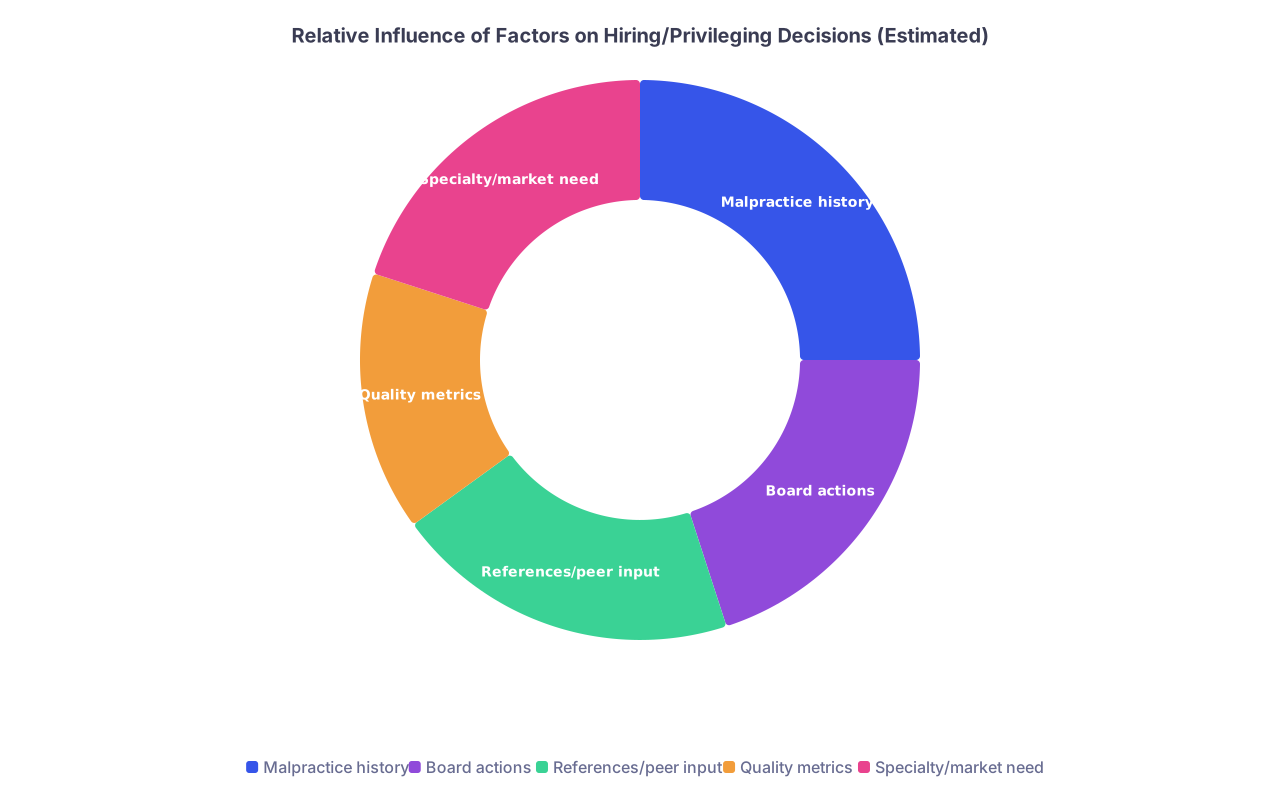
They are moving from “any dot on NPDB = red flag” to something closer to:
- Base risk by specialty.
- Adjust up or down by claim pattern.
- Cross-check with real performance data.
That is how you actually use malpractice history as one input in a rational talent and risk strategy, not as a stand-alone veto button.

| Step | Description |
|---|---|
| Step 1 | Review NPDB and loss runs |
| Step 2 | Standard review |
| Step 3 | Context and specialty compare |
| Step 4 | Enhanced review plus metrics |
| Step 5 | Presume high risk |
| Step 6 | Conditional or full privileges |
| Step 7 | Consider denial |
| Step 8 | Paid claims count |
| Step 9 | Above specialty norm? |
| Step 10 | Quality metrics acceptable? |
That is the sort of flow I have seen quietly implemented in some large systems that have decided anecdotes and fear cannot run their staffing model.
8. What this means for you—and what comes next
If you are a physician, the data-driven takeaway is blunt:
- One prior paid claim, particularly in a high-risk specialty, is usually survivable from a hiring and privileging standpoint—if you can explain it and your subsequent record is clean.
- Multiple paid claims, especially 3 or more in a 5–10 year window, materially change your risk profile in the eyes of insurers and hospitals. Expect higher premiums, more scrutiny, and narrower job options.
- Context, specialty, and time since last claim matter statistically, but many committees are still wired to overreact to any “Yes” in the malpractice box.
If you are on the hiring or credentialing side, you have to choose which camp you are in:
- The superstition camp: “Any paid claim is trouble; we will just avoid them if we can.”
- Or the analytics camp: “The data show gradations of risk; we will align our policies with those numbers and not punish normal exposure patterns.”
The former feels safer politically. The latter is actually safer and smarter over a 10-year horizon if you care about getting and keeping good clinicians.
Because here is the other quiet statistic: if you categorically avoid everyone with any prior claim, you are systematically excluding a large slice of fully competent, high-performing physicians in the highest-need, highest-risk specialties. The math on access, coverage, and revenue will catch up with you.
The trend line is obvious: more data, more integration between malpractice history and real-time quality metrics, more pressure from payers and regulators to show that credentialing decisions are rational, not just reactive.
You are at the early end of that curve right now. Use it.
With a clearer grasp of how claims data truly affect hiring and privileging, you can stop letting NPDB printouts dictate your future and start using the underlying numbers to your advantage. The next frontier is even harder: tying these risk signals to concrete remediation, coaching, and system-level changes that actually reduce events—not just shift them to a different hospital down the road. That, however, is a conversation for another day.
| Category | Value |
|---|---|
| Malpractice history | 25 |
| Board actions | 20 |
| References/peer input | 20 |
| Quality metrics | 15 |
| Specialty/market need | 20 |