
The most expensive mistakes physicians make with malpractice coverage usually do not happen in court. They happen quietly when they pick the wrong policy type and only discover the gap ten years later. The data is very clear: if you do not understand occurrence vs claims-made outcomes, you are effectively gambling with a multi-six-figure tail risk.
The core difference in one sentence
Occurrence coverage ties protection to when the care happened. Claims-made coverage ties protection to when the claim is reported.
Everything else—pricing, risk of uncovered years, tail endorsements, retro dates—flows from that simple distinction. And the loss data behaves very differently under each structure.
How claims actually emerge over time
Let us start with the timeline, because most bad decisions ignore it.
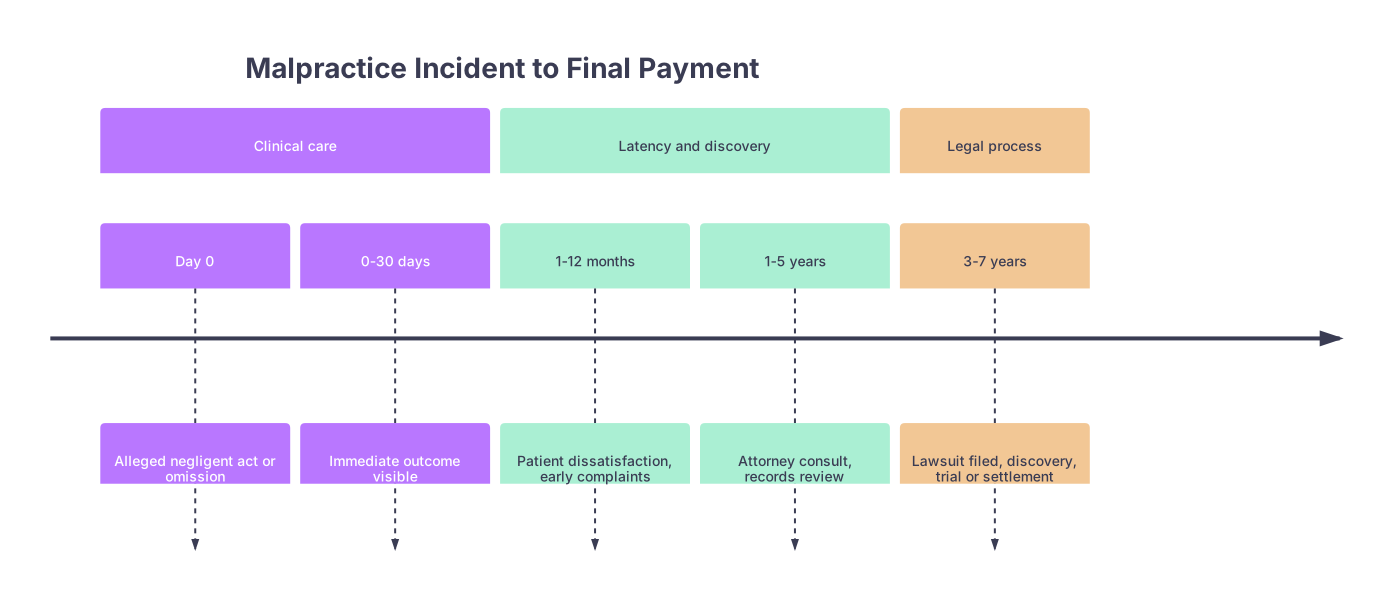
| Period | Event |
|---|---|
| Clinical care - Day 0 | Alleged negligent act or omission |
| Clinical care - 0-30 days | Immediate outcome visible |
| Latency and discovery - 1-12 months | Patient dissatisfaction, early complaints |
| Latency and discovery - 1-5 years | Attorney consult, records review |
| Legal process - 3-7 years | Lawsuit filed, discovery, trial or settlement |
Malpractice is a long-tail line. Industry-wide data from carriers and reinsurers typically shows:
- A substantial portion of claims are filed 1–3 years after the care.
- A non-trivial share appear 4–7 years later.
- High-severity pediatric and obstetric claims can surface 10+ years after the event, with payments even later.
This lag structure is what makes the choice of occurrence vs claims-made economically meaningful.
How the two policy types “see” that timeline
Occurrence policy: “Was I your insurer when you treated the patient?”
If yes, the claim is covered—even if it is reported decades later.Claims-made policy: “Was I your insurer when the claim was made and reported?”
If yes, it is covered—but only for incidents back to your retroactive date.
That difference drives two very measurable effects:
- The pattern of incurred but not reported (IBNR) reserves on the insurer’s books.
- The pattern of uncovered claim risk on the physician’s side if tail is not purchased.
Quantifying loss emergence: occurrence vs claims-made
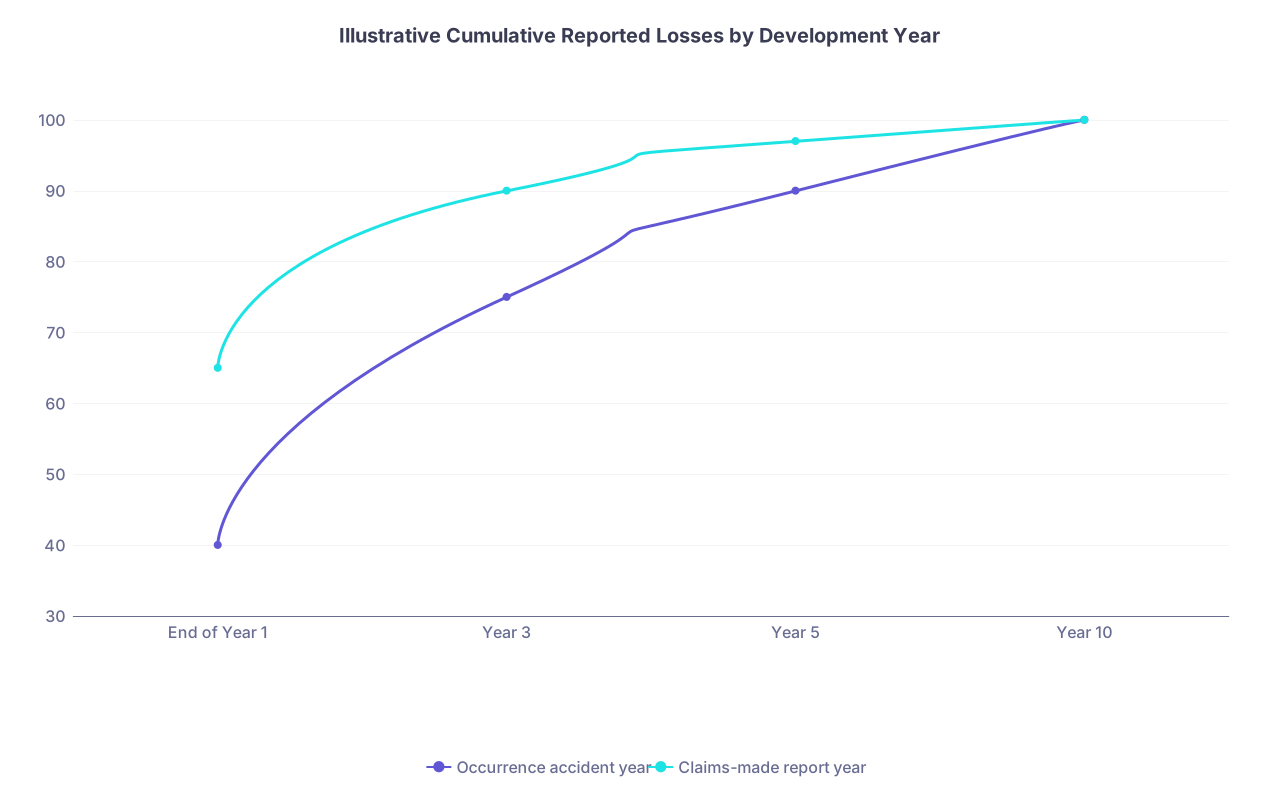
Claims companies track cumulative reported losses over time from a given “accident year” (occurrence) or “report year” (claims-made). A simplified pattern from many books of med-mal business looks like this:
| Category | Occurrence accident year | Claims-made report year |
|---|---|---|
| End of Year 1 | 40 | 65 |
| Year 3 | 75 | 90 |
| Year 5 | 90 | 97 |
| Year 10 | 100 | 100 |
Interpretation:
- Under an occurrence structure, only about 40% of ultimate losses are visible at 12 months, and roughly 75% by year 3.
- Under a mature claims-made structure (once prior acts are fully “on risk”), more loss emerges earlier—about 65% by year 1 and 90% by year 3—because claims are tied to report date, and by definition they have already surfaced.
This faster emergence under claims-made is why insurers can reduce risk capital per dollar of premium after the early years. It is also why the first few years of claims-made are underpriced if you do not understand the maturity curve.
The pricing curve: why claims-made starts “cheap”
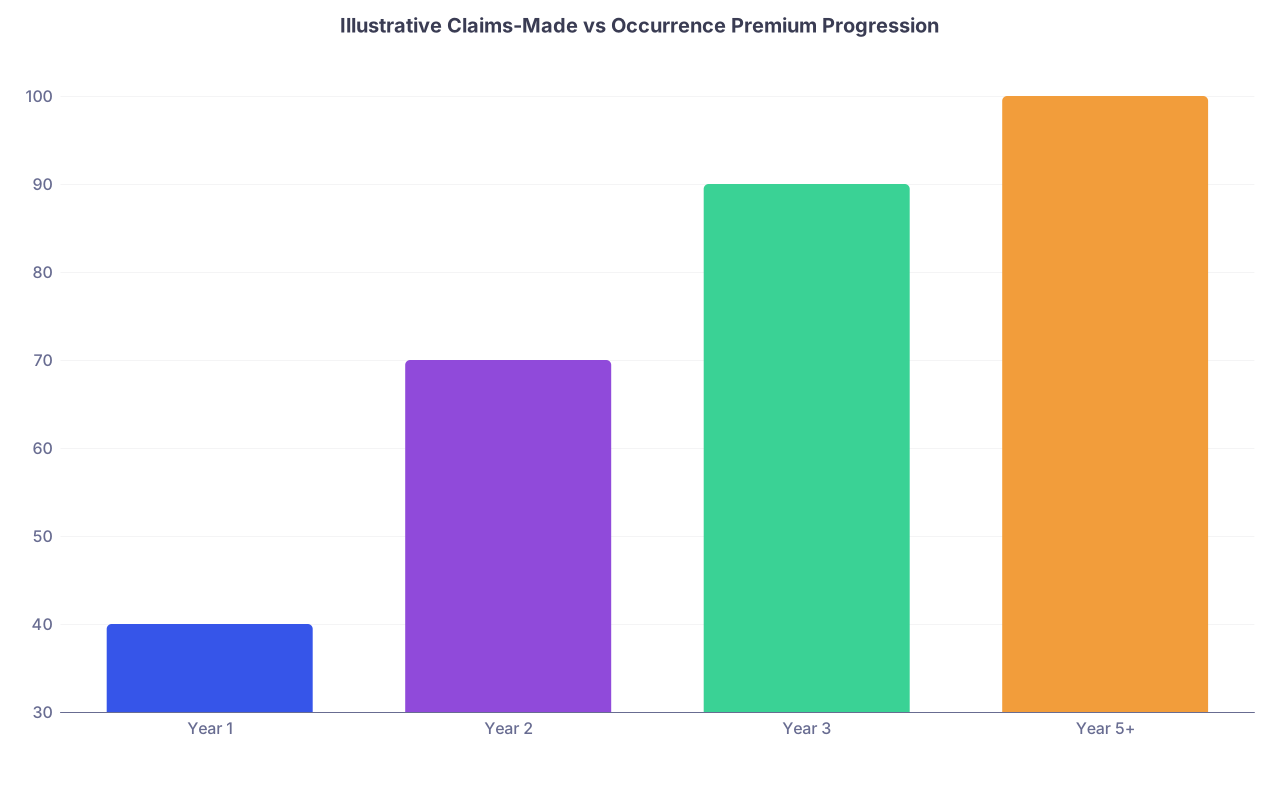
Most physicians are shown a neat premium progression when first offered claims-made coverage. It usually looks something like this:
| Category | Value |
|---|---|
| Year 1 | 40 |
| Year 2 | 70 |
| Year 3 | 90 |
| Year 5+ | 100 |
Under a representative book:
- Year 1 claims-made premium ≈ 40% of a mature claims-made premium.
- Year 3 ≈ 90%.
- By year 5, the policy is fully mature—roughly 100% of the “true” rate.
Occurrence, by contrast, is typically priced close to the mature loss cost from day one. Depending on specialty and jurisdiction, occurrence premiums often run 15–35% higher than mature claims-made for equivalent limits and underwriting.
That discount is not free. It is the present value of the tail you are implicitly agreeing to pay for later.
The tail endorsement: where the real money hides
Tail coverage (extended reporting endorsement) turns a claims-made policy into a de-facto occurrence policy for past acts. It allows you to report claims after the policy ends, as long as the incidents occurred after the retroactive date and before the end of the last policy period.
Most physicians underestimate tail cost by a wide margin. The data does not support that optimism.
| Specialty Segment | Common Tail Factor | Example If Mature Premium = \$25,000 |
|---|---|---|
| Low risk (psych, FP) | 150% – 200% | \$37,500 – \$50,000 |
| Medium (IM, surgery) | 200% – 250% | \$50,000 – \$62,500 |
| High (OB, neurosurg) | 250% – 300% | \$62,500 – \$75,000 |
These are not theoretical. I have seen OB/GYNs in large metros handed tail quotes north of $100,000 on short notice when leaving a group.
Key quantitative observation: that tail factor roughly captures the unearned future claims cost for your prior work that has not yet been reported. In other words, the part of the occurrence risk you did not pay up front.
If your employer pays for your tail under a contract, that is great. Many do not. And many contracts that “promise tail” have carve-outs if you leave before a minimum tenure or are terminated “for cause.”
Lifetime cost comparison: occurrence vs claims-made
Let us run a simple, realistic scenario. Single physician, med-surg, mature occurrence equivalent premium ≈ $25,000 per year in a moderate-risk state.
Assumptions:
- Occurrence premium: 120% of mature claims-made = $30,000/year.
- Claims-made premium progression as % of mature: Y1 40%, Y2 70%, Y3 90%, Y4+ 100% of $25,000.
- Tail factor at exit: 225% of mature premium.
10-year career in one practice, then retires
Occurrence:
- 10 years × $30,000 = $300,000.
- No tail needed.
- Total = $300,000.
Claims-made:
- Year 1: 0.40 × 25,000 = $10,000
- Year 2: 0.70 × 25,000 = $17,500
- Year 3: 0.90 × 25,000 = $22,500
- Years 4–10: 7 × 25,000 = $175,000
- Subtotal premiums = $225,000
- Tail on exit: 2.25 × 25,000 = $56,250
Total = $225,000 + $56,250 = $281,250.
Difference over decade = $300,000 – $281,250 = $18,750 in favor of claims-made in this simple case.
But that is the rosy version: single job, no gaps, tail bought once on your own terms.
Add real world friction: job change mid-career
Same doctor, but after year 5, she changes practices. First employer does not pay tail; second practice gives “nose” coverage (coverage for prior acts) but only back to a date 2 years after she started the first job. So she must buy a partial tail for the first 3 years.
Calculate:
- Years 1–5 claims-made premium (as above):
Y1 10,000 + Y2 17,500 + Y3 22,500 + Y4 25,000 + Y5 25,000 = $100,000. - Tail for first 3 years (smaller exposure, assume factor ~125% of mature premium):
1.25 × 25,000 = $31,250. - Years 6–10 at new practice: again ramp to maturity but shorter:
Y6 40% = 10,000
Y7 70% = 17,500
Y8 90% = 22,500
Y9–10 2 × 25,000 = 50,000
Subtotal = $100,000. - Final full tail at retirement for years 6–10: 2.25 × 25,000 = $56,250.
Total claims-made spend over 10 years with one job change:
- Premiums: 100,000 + 100,000 = $200,000
- Tails: 31,250 + 56,250 = $87,500
- Grand total = $287,500.
Now the advantage vs occurrence shrinks to $12,500—and we have ignored administrative headaches, pressure in contract negotiations, and the real possibility of more moves.
Change the assumptions slightly (higher tail factor, more job changes, a gap in coverage) and the lifetime cost can flip, with occurrence becoming cheaper on a risk-adjusted basis.
Risk of uncovered years: the silent balance sheet liability
The financial analysis is only half the story. The more serious issue is the risk of uninsured loss.
With occurrence:
- Once a year is closed and premium paid, that exposure is locked down.
- As long as the carrier remains solvent, you can move, retire, take a sabbatical; coverage for that year is fixed.
With claims-made, your protection is a three-variable function:
- Your retroactive date.
- Your continuous coverage (no gaps).
- Tail or nose coverage when you switch carriers or stop practicing.
If any of these fail, exposures open up. I have seen all of the following in real books of business:
- A physician changes groups and “forgets” to confirm who buys tail. Two years later, a claim arises from care in the first group. No one has coverage for that period. That is a seven-figure personal problem.
- A small practice switches carriers and does not buy tail from the old insurer, banking on “prior acts coverage” with the new carrier. The new retro date is misaligned by 18 months. That 18-month slice is uninsured.
- A retiring solo physician declines to buy tail because the $50,000 quote feels high. Five years later, an OB case results in a claim that would have triggered limits. Out-of-pocket.
From a data standpoint, the exposure is measurable. If you have 10 years of practice unprotected by occurrence or confirmed tail, with typical OB loss costs, your expected severity from that gap is not zero. It sits there like a contingent liability on your personal balance sheet.
Specialty-specific claim patterns: who gets hurt most?
Not all specialties experience the tail the same way. The latency and severity distribution drives how critical the policy structure becomes.
| Specialty | % of Claims Filed > 3 Years After Incident | Typical Severity Profile |
|---|---|---|
| Psychiatry | 10–20% | Lower, fewer catastrophic |
| Internal Med | 25–35% | Mixed, some high severity |
| General Surg | 30–40% | Higher, surgical outcomes |
| OB/GYN | 40–50%+ | Very high, birth injury |
Where a large share of claims emerge late (OB, peds, some surgery), the difference between well-managed claims-made and occurrence is mostly about execution risk:
- One missed tail → catastrophic.
- One misaligned retro date → multi-year hole.
- One insolvent carrier with poorly reserved long-tail business → messy runoff.
In low-severity, lower-latency lines (outpatient psych, some derm), the practical risk of a tail gap is still present but the expected severity is lower. That can shift the breakeven economics.
Policy features that change the analytics
Policies are not identical within each type. A few features materially change outcomes.
1. Free tail triggers
Some carriers offer free or deeply discounted tail if:
- You die.
- You become permanently disabled.
- You retire after a minimum number of consecutive years with the carrier (often 5+ years) and above a certain age.
If your career path is long-term with one carrier and you expect to qualify, the net present cost of tail may be close to zero. That tilts the math strongly toward claims-made.
2. Employer-paid tail or nose
Group contracts might specify:
- Employer buys tail if you leave without cause.
- Employer buys tail if they terminate you without cause, but not if you resign voluntarily.
- New employer will provide nose coverage back to your original retro date.
These are not details. They are actuarial assumptions about who pays for your long-tail risk.
A quick way to think about it: if someone else is contractually obligated to pay tail, then you, personally, are effectively buying occurrence at claims-made prices.
3. Policy limits and inflation
Occurrence policies written today may respond to claims 20 years from now with today’s limits in nominal dollars. If the jurisdiction has high or accelerating verdicts (nuclear verdict environment), an old $1M per claim occurrence policy may look smaller in real terms.
Some carriers address this with:
- Higher starting limits;
- Optional limit indexing;
- Excess coverage atop the primary layer.
In a claims-made structure, if you increase limits mid-career, you need to examine how prior acts are treated. Some carriers do not automatically give higher limits retroactively. So early-year exposures can sit permanently at a lower limit unless you buy specific endorsements.
Cash flow and capital: practice-level analytics
From a practice management perspective, claims-made vs occurrence primarily affects:
- Annual cash flow volatility.
- Balance sheet risk from unfunded tail obligations.
Single-physician example:
- Claims-made reduces early-year premium spend roughly 30–40% vs occurrence.
- That “savings” is essentially a deferred expense, payable at exit as tail.
Group practice with 20 physicians:
- If everyone is on individual claims-made policies and the group is responsible for tails on termination, the practice is carrying a hidden liability equal to the sum of expected tails.
- If average mature premium = $20,000 and average tail factor = 200%, fully matured tails represent ≈ $40,000 per physician. For 20 physicians, that is an $800,000 soft liability.
I have watched finance committees stare at this number in disbelief once someone finally does the multiplication.
A group that shifts to occurrence may:
- Raise annual spend by, say, 15–25%.
- But eliminate the multi-hundred-thousand-dollar tail liability accrued over time.
- And simplify buy-in / buy-out negotiations for partners.
This is not a moral question. It is capital structure and risk transfer. You choose where the liability sits: with the carrier (occurrence) or with you and your future self (claims-made until tail is bought).
How to choose using data, not vibes
If I strip this down to a quantitative decision process, it looks like this.
Estimate your career fragmentation:
- 0–1 job changes, long tenure with one carrier, high probability of free tail = low execution risk.
- 3+ expected moves, multiple states, uncertain contracts = high execution risk.
Quantify the tail economics:
- Get actual tail factors from carriers for your specialty and state.
- Ask explicitly about free tail conditions.
Compute a simple NPV comparison:
- Project 10–15 years of occurrence vs claims-made premiums.
- Include realistic tail events (job changes, retirement).
- Discount at a modest rate (3–5%) to compare present values.
Overlay severity profile:
- High-severity specialty + high fragmentation + weak contractual protection = almost always worth paying more for de-risked structure (occurrence or guaranteed tails).
Document who owns the liability:
- In contracts: explicit clauses for tail, nose, retro dates.
- On internal financials: track tail obligations as real liabilities, not theoretical ones.
If you do those five steps with honest inputs, the optimal answer will usually be obvious.
FAQs
1. Is occurrence coverage always safer than claims-made?
Safer from a mechanical standpoint, yes, because it removes retro dates, continuity requirements, and tail purchase decisions. Once a year is insured on an occurrence basis and the carrier is solvent, that slice of risk is fixed. But “safer” does not automatically mean “better” if you have strong contractual tail guarantees and favorable claims-made economics.
2. Can I switch from claims-made to occurrence without buying tail?
Only if the new occurrence carrier offers full prior-acts coverage back to your original retro date, which is uncommon and usually expensive. Usually, moving from claims-made to occurrence means you must either (a) buy tail from the prior claims-made carrier or (b) accept that prior years are uninsured. The data shows many uncovered gaps occur during exactly this type of transition.
3. Why do insurers prefer selling claims-made policies?
Because claims-made gives them faster visibility into losses, better control of exposure through retro dates, and easier capital management. They can exit a line or a jurisdiction more cleanly because they only have to cover claims reported during active policy periods (plus whatever tails are sold), rather than carrying decades of open accident years as in pure occurrence books.
4. How big is the risk if I skip tail for a “low-risk” specialty?
Lower than OB or neurosurgery, but not negligible. Even in outpatient specialties, you can see claims filed 3–5 years after care. If your expected claim frequency is, for example, 1 claim every 20 years and average paid severity is $200,000, leaving 5–10 years of practice without tail might put a non-trivial five-figure expected loss on your personal balance sheet. You are self-insuring that slice whether you admit it or not.
Key takeaways:
- The apparent premium savings of claims-made is just the discounted cost of the tail you will pay later, directly or indirectly.
- Occurrence simplifies risk by tying coverage to dates of care and eliminating retro/tail mechanics, but often at higher annual premiums.
- The smartest move is not to “pick the cheaper one,” but to model your actual career path, tail obligations, and specialty severity so you know exactly where your long-tail liability sits and who is funding it.