
It’s 11:47 p.m. You’re lying in bed, doom-scrolling after a brutal shift. You half‑jokingly tweet, “If one more patient googles their symptoms and argues with me I’m going to scream 😂.” It gets a few likes from med school friends, you drop the phone, and finally pass out.
And then your brain kicks in.
Wait. Could a lawyer screenshot that? Could that actually show up in a deposition one day? Could some random throwaway post be twisted into “evidence” that you don’t respect patients? Could I literally lose a malpractice case because of a stupid tired tweet?
You’re not crazy for thinking this way. I’ve watched residents delete whole accounts at 2 a.m. after seeing one horror story on Reddit. I’ve been in rooms where risk management explicitly said, “Assume anything you post can be read aloud in court.”
So. Let’s actually answer the question you’re dancing around:
Yes, your social media posts can be used against you in malpractice cases.
But that sentence without context is useless, because then your brain jumps straight to: “So I can never post anything, anywhere, ever again, and I’m already doomed by that Instagram from intern year.”
Let’s slow this down and get specific.
How Social Media Actually Shows Up in Malpractice Cases

Think about a malpractice case like this: both sides are looking for anything that helps their story. Social media is just another source of “anything.”
If a case goes far enough (or gets nasty enough), plaintiff attorneys can:
- Search for public posts under your name, nickname, or obvious handles
- Subpoena certain platform records in discovery
- Ask you under oath about your accounts, posts, and even deleted content
Is that common in every case? No. Is it happening zero percent of the time? Also no. I’ve seen it.
Typical ways posts are used:
To attack your professionalism or attitude toward patients
Example: You post, “Sometimes I think half my ED patients are faking it.”
In court, that becomes: “Doctor, you posted publicly that half of your patients are ‘faking it.’ Does that reflect how you approach patient complaints?”
It’s not proof you committed malpractice. But it is ammunition to make you look dismissive and uncaring in front of a jury.To contradict your sworn testimony
Say you testify you never discuss patients online.
But there’s an old post: “Wild night—23‑year‑old came in with a machete wound to the face 😳 #ERlife.”
No names, sure. But lawyers love contradictions. Now you’re not just careless—you’re “untruthful.”To suggest you breached confidentiality
Even “de‑identified” cases can be dangerous if details + time + location can point to a specific person.
That one “harmless” Facebook rant about “a 34‑year‑old woman, 32 weeks pregnant, G3P2 with twins, came in after…”? In a small town? Yeah. That might be identifiable.To show distraction or impairment
Posting selfies mid‑shift. Posting “lol 14 hours no sleep let’s goooo.”
A creative attorney can argue this shows impaired judgment or lack of focus around the time of the alleged error.
Does every plaintiff lawyer dig this deep? No. Many cases settle early. Many don’t need this kind of stretch. But you don’t know which one will be yours.
So yes, social media can absolutely walk into a courtroom and sit there next to you.
What Lawyers, Insurers, and Risk Management Really Worry About
Let me cut through the vague “be professional” lectures you’ve heard 100 times. Risk people aren’t equally freaked out by all content.
They care about a few very specific patterns that light up their internal sirens.
| Behavior Type | Relative Legal Risk |
|---|---|
| Clinical advice about a specific patient | Extreme |
| Rants about patients/cases (even vague) | High |
| Dark humor about illness/death | High |
| Posting from work about being exhausted | Moderate–High |
| Generic medical education content | Low |
| Purely personal, non-medical posts | Low–Moderate |
1. Anything that sounds like patient info
Even if you think, “No way they’d know who this is.”
If a patient or family member recognizes themselves (or thinks they do), that’s a HIPAA headache and, in a malpractice case, it becomes a character attack: “This doctor violates privacy and boundaries.”
That’s brutal in front of a jury.
2. Mocking or contempt for patients
The sarcastic stuff we all say in the workroom hits totally differently as a screenshot.
“I swear if one more ‘chest pain’ is really just ‘ate too much Taco Bell’ I’m leaving.”
“I love when patients tell me how to do my job because they read one WebMD article.”
A plaintiff attorney doesn’t need a smoking gun. They just need the jury to feel like you didn’t care. That you roll your eyes at “difficult” patients.
Those posts hand them that feeling on a platter.
3. “I’m so tired / drunk / done / over it” posts tied to shifts
Posts like:
- “Post‑call and hallucinating lol”
- “Straight from night float to brunch mimosas, let’s go”
- “On hour 26 and my brain has left the building”
Are these relatable? Yes.
Do they look great when someone is accusing you of missing a diagnosis that night? Absolutely not.
Plaintiff side: “Doctor, you stated publicly you were ‘hallucinating’ after long shifts. Is that how you felt the night you treated my client?”
You: internally screaming.
4. “Educational cases” that are way too specific
Everyone wants to do “case of the week” threads now. That can be fine if you’re truly de‑identifying and not posting real‑time.
But I’ve seen people essentially live‑blog cases from their hospital the same day, with very exact ages, labs, CT findings. In big cities this is risky. In smaller communities it can be suicidal.
Your insurer and hospital will care.
“But I Didn’t Do Anything Wrong Clinically. Can a Post Still Screw Me?”
Short answer: yes, it can still make your life harder. Even if your care was good.
Malpractice suits are about:
- What happened
- What can be proven
- And, brutally, how likeable and credible you seem to non‑medical strangers
A social media post won’t magically convert good care into negligence. But it can:
- Make your lawyer’s job significantly harder
- Push a borderline case into “we’d better settle”
- Increase the settlement value because you’d be risky in front of a jury
- Make the board or your employer question your judgment, even outside the actual clinical issue
Think of social media as “bonus evidence.” It very rarely creates a case out of thin air. But once a case exists, it can seriously tilt the ground under your feet.
“What If I Delete Everything Now? Am I Safe?”
Here’s the part nobody likes hearing.
Once there’s any hint of a claim—complaint letter, angry MyChart message, “I’m going to sue,” risk management loop‑in—your posts related to the case are basically frozen in amber as far as the law is concerned.
Deleting them after you reasonably could anticipate litigation can be called spoliation of evidence. That’s a fancy way of saying: “You destroyed potential evidence,” which courts take very seriously.
So:
- Deleting old dumb posts before any case exists = usually fine, actually smart.
- Deleting posts after a claim or letter or official complaint mention = big problem, talk to counsel first.
And just to be extra fun:
Screenshots live forever. Friends, coworkers, random followers—anyone can preserve that stuff.
So no, you’re not “safe” just because you hit delete. The better mindset is: “Would I be okay if this was printed, blown up on a board, and read out loud with my name in front of twelve strangers?”
If the answer is no, that’s not a post you want to keep living out there.
How Your Malpractice Insurer Actually Sees Your Online Life

Insurers aren’t scrolling your TikTok daily. They’re not social media cops. They mostly care about one thing: risk.
The moment there’s a claim and a defense attorney gets assigned, they’re going to ask you directly (and possibly in writing):
- Do you have social media accounts?
- Have you ever posted about patients, cases, or your work environment?
- Did you post anything about this specific patient/event?
If the answer to that last question is “yes,” your posts are now part of the risk calculation.
Some insurers and hospitals have already started including explicit social media clauses or trainings. Think stuff like:
- “You agree not to post any patient-related content on public platforms.”
- “Online professional conduct must comply with HIPAA, privacy rules, and institutional policies.”
You won’t usually be dropped from coverage because of a dumb meme you posted in M1. But if your posts:
- Trigger a board complaint
- Trigger a HIPAA incident
- Or damage the defense in an existing case
You can absolutely find yourself on the wrong side of your risk manager’s patience. And that can affect premiums, coverage decisions, or how eager they are to defend you.
“So Do I Need to Nuke All My Social Media and Disappear?”
This is the catastrophizing question almost everyone ends up at eventually.
Honestly? No, you probably don’t have to disappear off the internet like you’re in witness protection.
What you do need is a very boring, very conservative rulebook for yourself.
Here’s the version I recommend when people are spiraling:

| Step | Description |
|---|---|
| Step 1 | Want to post something |
| Step 2 | Do not post |
| Step 3 | Strongly reconsider |
| Step 4 | Avoid tying post to patient care |
| Step 5 | Probably safe to post |
| Step 6 | Any clinical or patient detail? |
| Step 7 | Could this look unprofessional to a jury? |
| Step 8 | Am I on duty or referencing a shift? |
Things I’d personally avoid almost 100% of the time if I were practicing:
- Talking about specific patients, even “de‑identified,” on public platforms
- Posting anything that looks like you’re mocking or belittling patients, families, or certain groups
- Posting while on shift or from clinical areas
- Posting about how impaired, exhausted, or out of it you are in direct connection to your work
- Sharing real‑time “wild cases” from your own department
And for what it’s worth: closed, vetted, small private groups with strict rules are safer than blasting to public Twitter or TikTok. Still not risk‑free, but less likely to end up on a giant screen in a courtroom.
Concrete Examples: What Will and Won’t Haunt You
Let’s make this painfully real, because that’s usually what calms the anxiety down—seeing the line.
| Example Post | Legal Risk |
|---|---|
| “Long day in clinic but love my patients” | Low |
| “This 19yo with chest pain was totally faking it lol” | High |
| “Case review: 54M with NSTEMI, cath findings and plan…” | High |
| “Explainer: what NSTEMI means in simple terms” | Low |
| “Post call after 28 hours and my brain is sludge 😂” | Med-High |
| “Flu season is brutal, remember to wash your hands” | Low |
The ones that bite you aren’t “I like being a doctor” or “Here’s what hypertension is.”
It’s the specific, snarky, or impaired‑sounding stuff that overlaps with real patient care.
How to Stop Spiraling About Stuff You’ve Already Posted
You might be reading this thinking, “Cool. I’ve definitely already crossed half of these lines.”
Okay. Deep breath. You’re not the first, and you’re not automatically doomed.
Here’s how I’d triage it if I were in your shoes:
Before any claim exists
Go through your accounts with a ruthless eye:- Delete anything that mentions age + diagnosis + timing + location of a real patient
- Delete anything that looks contemptuous or mocking of patients
- Delete posts about being intoxicated, high, or dangerously impaired near work time
- Lock down privacy settings, remove identifying info where possible
This is just good hygiene. You’re allowed to clean up.
If there’s even a whiff of a complaint or lawsuit
Stop deleting. Seriously.
Tell your malpractice carrier or institutional risk management the truth if asked.
And then follow their legal instructions. Not Reddit’s.Going forward
Follow a simple rule:
If you’d be embarrassed or anxious hearing it read out loud with your name and the words “Doctor, you posted…”—don’t post it.
One More Ugly Truth That Weirdly Helps
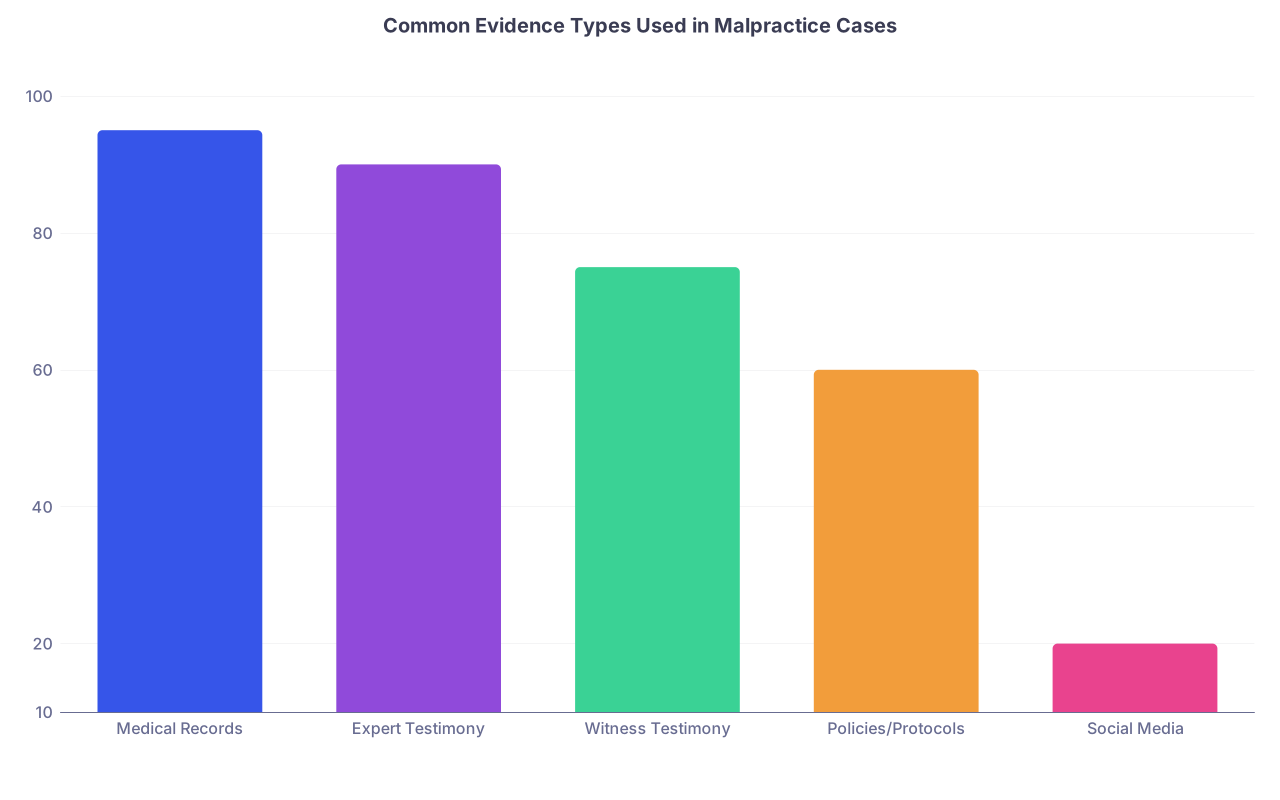
| Category | Value |
|---|---|
| Medical Records | 95 |
| Expert Testimony | 90 |
| Witness Testimony | 75 |
| Policies/Protocols | 60 |
| Social Media | 20 |
Notice that last bar.
Medical records? Almost always used.
Experts? Almost always used.
Social media? Still relatively uncommon overall… but when it’s bad, it’s really bad.
You don’t have to live in constant fear that a meme will end your career. The backbone of a malpractice case is still what you charted, what you did, what actually happened clinically.
Social media just adds unnecessary risk on top of an already risky job.
So the goal isn’t perfection. It’s reducing the chance that when everything is already on fire—complaint, investigation, lawsuit—you don’t have a public digital trail that makes you look reckless, cruel, or careless.
Your Next Step (Do This Today)
Don’t just close this tab and go back to scrolling. Do one tangible thing.
Right now, pick one platform you use the most—Twitter/X, Instagram, TikTok, whatever.
- Open your profile.
- Scroll back 1–2 years.
- Look for anything that:
- Mentions a specific patient scenario
- Talks about being drunk/high/exhausted in relation to work
- Mocks patients, families, or their decisions
If you’re not in the middle of any complaint or lawsuit: delete the worst offenders. Lock your account if you need time to think.
You don’t have to disappear from the internet. But you do need to stop giving hypothetical future lawyers free exhibits.
Start with one platform, tonight. Then you can worry about the rest tomorrow.