
The nightmare scenario nobody warned you about is this: you can be seeing patients in good faith while technically completely uninsured—and nobody tells you until it’s already happened.
That’s not an exaggeration. I’ve seen physicians and midlevels blindsided by a two‑line email: “Your malpractice coverage has been terminated effective X date.” Often sent after X date.
Let’s walk straight into the ugly “what if” you’re worried about:
Can your employer really drop your malpractice coverage without warning?
Yes. They absolutely can. And sometimes they do.
Should they? No. Ethically it’s garbage. Professionally it’s reckless. But your risk doesn’t care about ethics. It cares about the policy language and the contract you signed.
Most employment contracts say something slippery like “Employer will provide professional liability insurance consistent with practice needs” and then quietly reserve the right to change carriers, coverage limits, or terms. A few are more honest and say “subject to change at employer’s discretion.” Translation: they can switch, downgrade, or drop coverage, and you may not have much recourse in real time.
Worse: many clinicians never actually see the malpractice policy. They just hear “we cover you” during onboarding and never ask for proof.
So yes, they can drop it. Yes, you can find out late. And yes, you can be exposed.
Now the panic part: what if this happens and you’re mid‑career, with thousands of patients in your rearview mirror?
The immediate fear: Am I personally on the hook for every patient I’ve ever seen?
This is where people spiral at 2 a.m.
Deep breath. It’s bad, but it’s not “every patient ever” bad in most cases. You need to think about three separate zones:
- Past patients while you were covered
- Patients you saw during the gap
- Future patients once it’s fixed (or not)
The key is what type of policy your employer had: claims‑made or occurrence.
| Feature | Claims-Made | Occurrence |
|---|---|---|
| Coverage trigger | When claim is filed | When incident occurs |
| Needs tail coverage | Yes | No |
| Common for | Groups, hospitals | Some hospitals, rarer |
| Risk if policy dropped | High without tail | Mostly for future only |
If they had:
- Occurrence coverage: you’re covered for incidents that happened while you worked there, even if the policy later dies. No tail needed. Your nightmare is smaller here.
- Claims‑made coverage: you’re only covered if the policy is active when the claim is made. If your employer drops this and doesn’t buy tail, there’s a hole. And you’re standing in it.
This is why “tail coverage” is this ominous phrase that makes everyone’s stomach drop. Without tail on a claims‑made policy, prior patients can become future liability.
Now layer on the really nauseating what-if: what if you don’t even know which type you have? That’s where a lot of people are.
Worst-case chain reaction: how ugly can this get?
Let me be brutal for a second and walk through the nightmare chain, because this is what your brain is already doing:
- Employer changes or cancels malpractice policy without fully telling you. Maybe they sent a vague email. Maybe they didn’t.
- You keep seeing patients, completely assuming you’re covered.
- A serious adverse outcome happens. Patient sues, or attorney sends a letter months later.
- You forward it to your employer, who forwards it to the “new” carrier.
- New carrier looks and says: “Incident date was during coverage gap. Denied.”
- Old carrier says: “Policy terminated effective X. Claim filed after termination. Denied.”
- You find out there was no tail coverage. No occurrence policy. Nothing.
- Plaintiff attorney happily adds you personally as a defendant and goes after your personal assets.
Is that the default outcome? No. But it’s possible. I’ve watched parts of this play out. The only reason most people don’t end up financially destroyed is:
- Cases get settled inside policy limits when some coverage exists somewhere
- Plaintiff attorneys like easy money, not complex pursuit of individual clinicians with limited assets
- Many states have homestead or retirement protections that put some assets off-limits
But if you’re asking “Can I lose everything?”—in a truly uncovered, catastrophic case, yes, it’s theoretically possible. That’s the fear talking, but it’s not completely imaginary.
First 24 hours after you find out coverage was dropped
Here’s what I’d do if I got that email or discovered my employer let coverage lapse:
Stop making assumptions.
Don’t take HR’s “we’ve got it handled” as fact. They may not even understand the difference between claims‑made, occurrence, tail, nose, any of it. You need data.Get proof in writing.
Ask—formally, by email—for:- Name of carrier(s), policy numbers
- Type of policy (claims‑made vs occurrence)
- Coverage dates (start, end)
- Whether tail coverage was purchased for the terminated policy, and if yes, tail dates
You’re not being “difficult.” You’re trying not to get ruined.
Do not voluntarily admit or sign anything.
No “I understand I’m uncovered” acknowledgments. No quick “amendments” that say you’re responsible for your own coverage in the past. That’s how you get set up.Strongly consider pausing high‑risk activities.
If you’re a surgeon, procedures carry higher risk than routine clinic. If you’re OB, deliveries are a minefield without coverage. I know “Just stop working” isn’t realistic, but blindly doing risky stuff with no safety net is worse.Call a lawyer who does healthcare / med-mal defense.
Not your cousin who does divorces. Someone who understands malpractice policies, employment contracts, and state regulations. One consult can save you from signing something stupid or missing a critical deadline.
Yes, that’s a lot. Yes, it’s expensive and exhausting. The alternative is pretending it’s fine and finding out three years later, during a deposition, that it wasn’t.
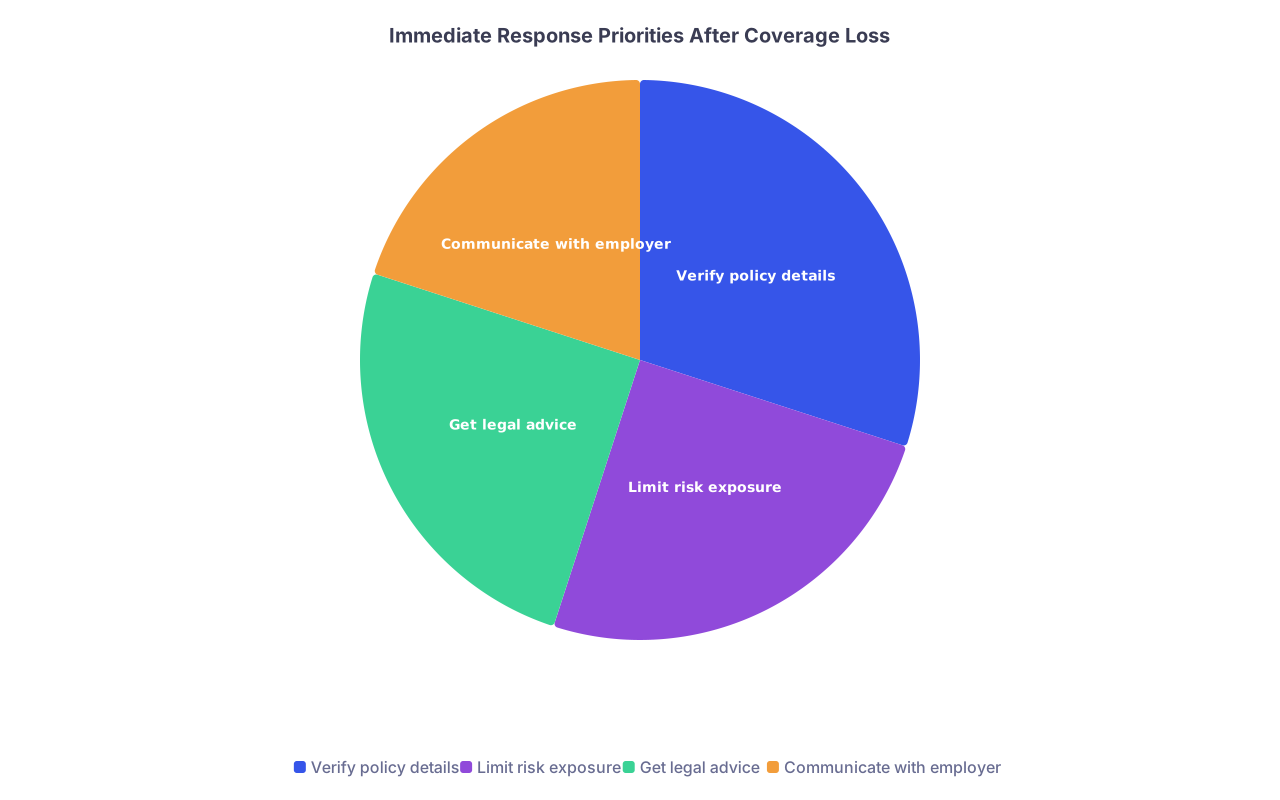
| Category | Value |
|---|---|
| Verify policy details | 30 |
| Limit risk exposure | 25 |
| Get legal advice | 25 |
| Communicate with employer | 20 |
The contract trap nobody reads until it’s too late
Buried in your employment contract is usually some vague malpractice clause. This thing quietly decides how screwed you are if your employer messes up.
Common landmines:
“Employer shall provide coverage while employee is actively employed”
Sounds reassuring. But what if they’re technically “providing coverage” that’s bare-bones, or changes carriers every year with gaps? It doesn’t say anything about tail.“Tail coverage responsibility: Employee”
Translation: when you leave, you’re on the hook for tens of thousands of dollars for tail, even though they chose a claims‑made policy. You may not discover this until you resign.No mention of tail at all
Everyone happily ignores it. Until someone leaves and finds out there never was a plan. Or a coverage change happens and your prior acts are abandoned.
If you find out they dropped coverage without warning, you want to look at:
- Does the contract require them to maintain coverage continuously?
- Are they obligated to tell you of material changes?
- Who’s responsible for tail if they change carriers or terminate the policy?
- Do you have any termination rights if they materially breach?
A healthcare attorney can look at this in about 15 minutes and tell you if you’ve got leverage or you’re basically trapped.
What about charges already filed or things that already happened?
This is where the time axis matters.
Scenario 1: You were fully covered when the adverse event happened, and coverage is occurrence
Your stress is mostly about future patients, not that prior case. Occurrence locks that incident in. Even if they cancel tomorrow, you’re covered for that past event.
Scenario 2: Claims‑made, adverse event happened last year, claim filed after policy terminated, no tail
This is the stomach‑drop scenario. The carrier says “Nope, too late.” You and your lawyer now have to do a few things:
- Look for any other coverage (moonlighting policy, hospital coverage, personal policy, state fund)
- Examine whether the employer’s failure to maintain coverage or buy tail is a breach—potentially opening them up to indemnify you
- Check state law: some jurisdictions have protections or doctrines that might help (not magic, but worth exploring)
This is the type of mess where you 100% want your own attorney, not just the employer’s lawyer speaking vaguely on your behalf.
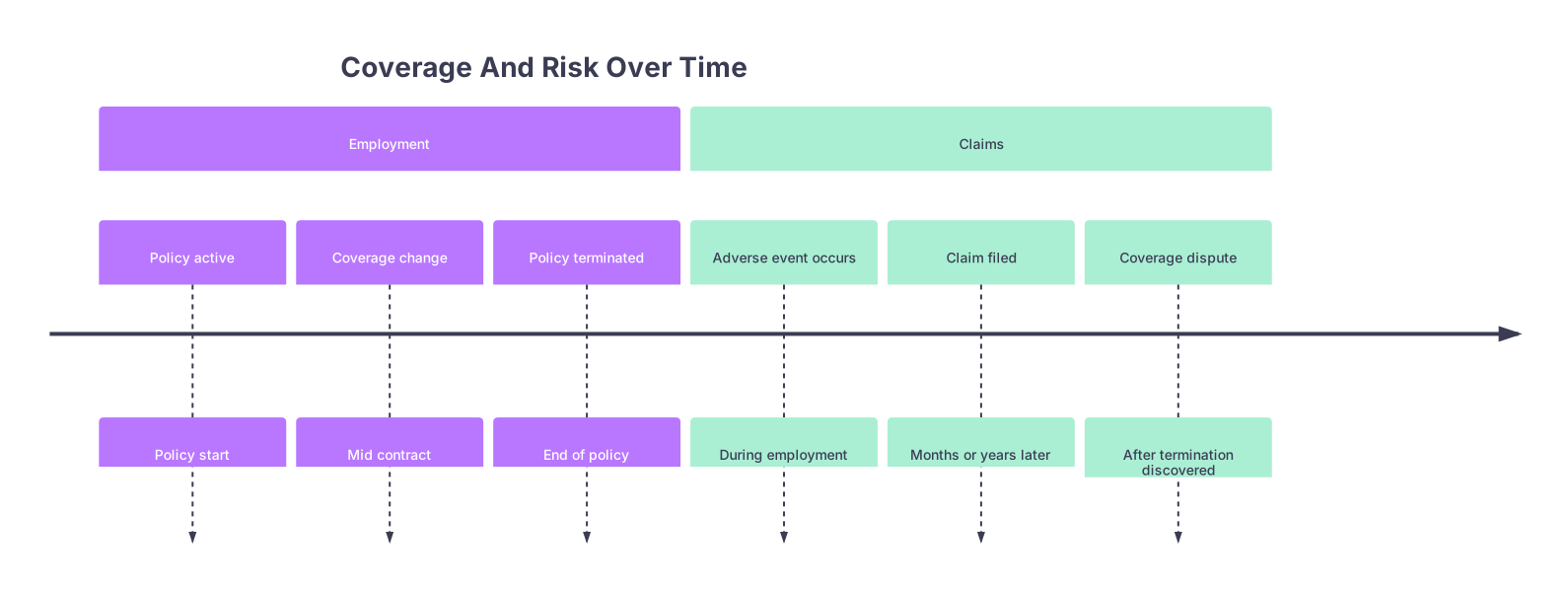
| Period | Event |
|---|---|
| Employment - Policy active | Policy start |
| Employment - Coverage change | Mid contract |
| Employment - Policy terminated | End of policy |
| Claims - Adverse event occurs | During employment |
| Claims - Claim filed | Months or years later |
| Claims - Coverage dispute | After termination discovered |
Should you buy your own malpractice coverage as backup?
This is where the anxious part of your brain is already going: “Maybe I should just carry my own policy so I can sleep.”
It’s not a crazy thought, but it’s not a magic shield either.
Pros:
- You control it. Nobody can drop it without telling you.
- If written correctly, it can cover you for work that isn’t fully covered by the employer (moonlighting, side gigs, etc.).
- Psychological benefit: your fate isn’t entirely in someone else’s hands.
Cons:
- It may exclude activities covered by another employer‑provided policy. Double coverage isn’t straightforward.
- Claims‑made vs occurrence, tail, prior acts—same headaches, but now you own them.
- It can be expensive, and you might still rely on the employer’s coverage for certain institutional work (like hospital-based procedures).
If you go this route, talk to a broker who lives and breathes physician and APP malpractice, and explicitly say, “My employer coverage is unstable, I need something that actually works as primary or backup. Here’s my contract.”
Don’t just click an “apply online” form and pray.
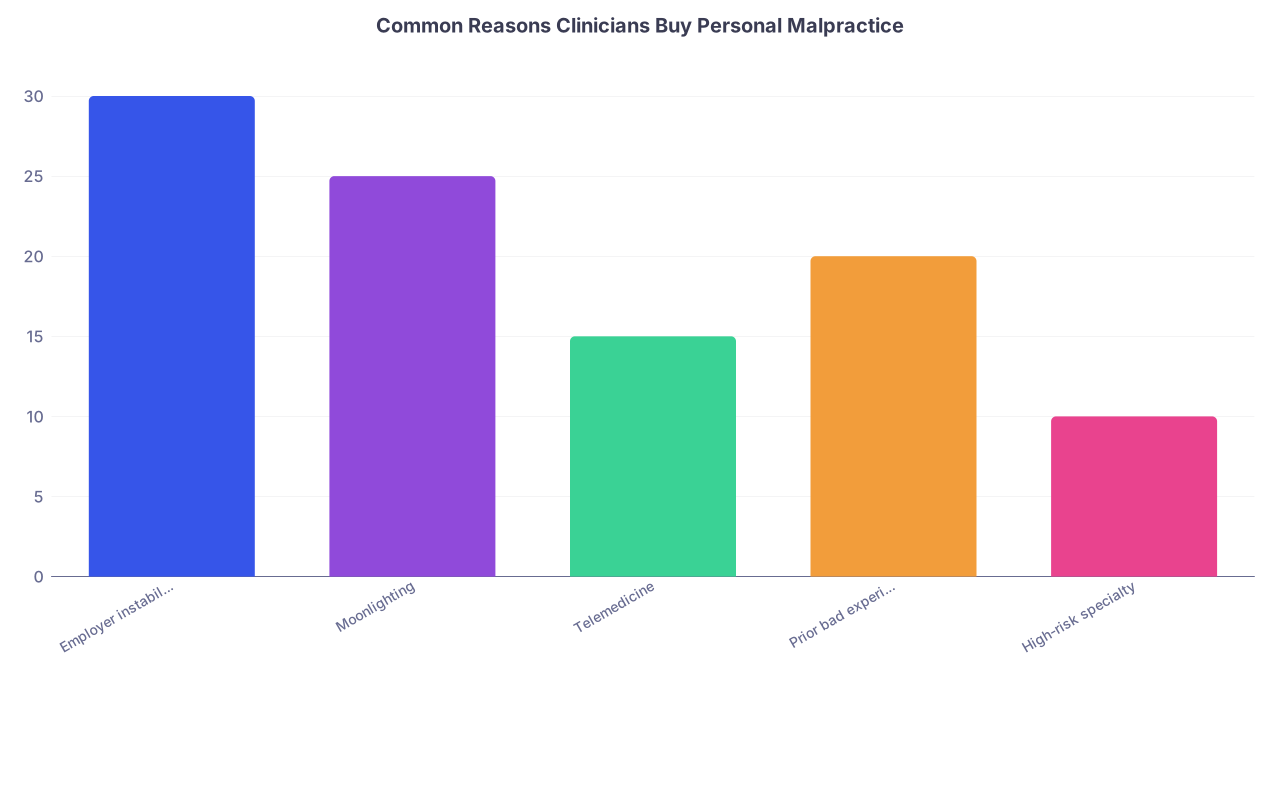
| Category | Value |
|---|---|
| Employer instability | 30 |
| Moonlighting | 25 |
| Telemedicine | 15 |
| Prior bad experience | 20 |
| High-risk specialty | 10 |
How to lower your risk while you’re stuck in the gray zone
If you’re in that horrible limbo—coverage maybe gone, not sure what’s next—you can’t make the risk zero, but you can stop pouring gasoline on it.
Things I’d seriously consider:
- Avoiding new high‑risk patients or procedures until clarity is in writing
- Documenting religiously: clear notes, informed consents, rationale for decisions
- Communicating concerns to leadership by email, not hallway conversations that vanish into thin air
- Keeping your own copies of key documents: contracts, policy summaries, any notice of change
And quietly, privately: I’d update my financial life like I might actually get sued personally. Stuff like:
- Knowing what’s protected in your state (retirement accounts, homestead, etc.)
- Not commingling personal and business money if you’re doing any 1099 work
- Making sure you’re not doing side work completely uninsured without realizing it
This sounds paranoid. Until it doesn’t.

If this hasn’t happened yet but could: what to check now
If you’re just catastrophizing in advance (welcome to the club), use that anxiety as a warning system instead of torture.
You want to know:
- Is my coverage claims‑made or occurrence?
- Who pays for tail if the policy ends or I leave?
- Are there any notice requirements if they change or terminate coverage?
- Can I see a certificate of insurance with my name on it and dates listed?
It feels awkward to email HR or admin and say, “Can I get a copy of the malpractice coverage details?” But every clinician who’s been burned by this wishes they’d been “that person” who asked early.
You are not being dramatic. You are protecting your license, your money, and frankly your sanity.

FAQ (exactly what your 2 a.m. brain is asking)
1. If my employer drops malpractice coverage, am I instantly practicing illegally?
Not automatically, but you might be practicing dangerously. Some states or hospitals require active malpractice coverage as a condition of privileging or employment. So you might be violating institutional rules, not criminal law. The bigger problem is civil liability: if something happens, there’s nothing between you and a lawsuit. You should treat it as an emergency risk issue, not a minor paperwork glitch.
2. Can I be personally sued if my employer loses coverage, or will they be the main target?
You can absolutely be personally named in a lawsuit. In malpractice cases, clinicians are almost always named individually along with the institution. If there’s no functioning policy backing you, plaintiff’s attorneys can—and will—look at you as a source of recovery. Whether they go all the way after personal assets depends on the case and your finances, but the exposure is real.
3. What if my employer says, “Don’t worry, we’re sorting it out”—should I keep working?
That phrase is the anthem of “You’re going to regret this later.” Get specifics: which carrier, what policy number, what effective date, is there retroactive coverage or prior acts included, is there a gap? If they can’t give straight answers or proof of binding, I’d seriously hesitate to keep doing anything high risk. You’re the one on the hook if their “sorting it out” falls apart.
4. If I quit immediately after finding out, does that protect me from being sued for current patients?
Quitting stops you from creating new exposure with them, but it doesn’t erase what you already did. Any care you’ve provided while coverage was absent or questionable is still potential liability. Lawsuits look backward. That’s why you still need to figure out what coverage existed on the dates you saw those patients, even if you walk away tomorrow.
5. How do I even ask my employer about this without sounding accusatory or paranoid?
You can keep it dry and professional: “For my credentialing and personal records, can I please have the current malpractice carrier name, policy type (claims‑made or occurrence), limits, and effective dates, as well as confirmation of any tail coverage for prior policies I’m covered under?” If they get defensive at that, that’s a red flag in itself.
6. Is getting my own personal malpractice policy overkill if my employer ‘covers everything’?
Overkill? Maybe. Overcautious? No. It depends on your specialty, risk tolerance, and how much you trust your employer’s stability. For high‑risk fields (OB, surgery, emergency, anesthesia) or sketchy employers, a personal policy can be the difference between losing sleep and losing everything. But don’t just buy a random policy; talk to a broker and a lawyer so it actually covers the gaps you’re worried about instead of just giving you a false sense of security.
If you strip away all the legal jargon and HR nonsense, this comes down to three things: know what coverage you actually have, get proof instead of promises, and don’t wait until after a lawsuit to realize your safety net was never there.