
The moment a malpractice claim hits your credentialing file, the game changes—and not in ways anyone explains to you in residency.
The claim itself is rarely what ruins you
Let me start with the thing nobody says out loud: one malpractice claim—by itself—almost never destroys a physician’s career. The real damage comes from how that claim echoes through every hidden gatekeeper system you never see: hospital credentialing, payer enrollment, malpractice underwriting, NPDB queries.
You think “I got sued.”
Hospital committees think “What did we miss about this doctor?”
Insurers think “How much is this going to cost us over ten years?”
And all of that gets funneled through credentialing.
How the claim actually shows up in your file
Here’s the basic pipeline:
- Patient or attorney files suit.
- Your malpractice carrier is notified (if they’re not, that’s a separate disaster).
- The case resolves—dismissal, defense verdict, settlement, whatever.
- If it hits reportable thresholds, it goes to the National Practitioner Data Bank (NPDB).
- Every hospital, ASC, and major payer you deal with periodically queries the NPDB.
- Now you’re “the doc with a paid claim” in every committee packet forever.
You don’t see the packets. I have. I’ve sat in those rooms.
Thick PDF from the credentialing office. Cover sheet with red flags highlighted. A short NPDB summary that sounds worse than most charts you’ve ever written. And a committee of physicians and administrators scanning your file in 5–10 minutes, tops.
That’s the reality.
Step-by-step: what happens the first time you apply after a claim
Let’s walk through what really happens when your first application hits after a malpractice claim is on record.
1. The application form: where you start lying to yourself
Every hospital and health system has some version of the same questions:
- Have you ever been named in a malpractice lawsuit?
- Have you ever had a malpractice claim that resulted in a settlement or judgment?
- Have any malpractice claims been filed against you in the past 5 years / 10 years / ever?
They ask it multiple ways on purpose. It’s not redundancy. It’s a trap for the lazy or the dishonest.
You check “Yes.” Now you’re prompted to explain. Here’s where most physicians screw up.
They write vague, defensive garbage:
“Frivolous claim, no wrongdoing. Settled by carrier for nuisance value.”
I’ve seen that exact phrase. Multiple times. It reads terribly in a committee room.
What the committee actually wants:
- What happened medically.
- What your role was.
- What you learned or changed.
- That you are not a walking liability bomb.
You’re not writing for a judge. You’re writing for a room of tired docs and one risk manager with a pen.
2. Credentialing coordinator pulls your NPDB report
The credentialing office runs mandatory NPDB queries on:
- Initial appointment
- Reappointment (often every 2 years)
- Sometimes when anything “concerning” is reported from another facility
They get back a report that includes, for malpractice:
- Date of incident
- Date of payment
- Amount paid
- Allegations in plaintiff language (“failure to diagnose,” “delay in treatment,” “wrong site,” etc.)
- Your role (primary, secondary, etc.)
Those allegation summaries are written to protect the reporting entity, not to help you. They’re blunt, sometimes misleading, and almost always scary-looking if read out of context.
Now your self-narrative on the application is being compared to the NPDB entry. If there’s daylight between the two, the committee notices.
3. Risk management pre-screens your file
In most hospitals, risk management or the medical staff office does an informal pre-read before it even goes to the credentials committee.
Here’s what they’re thinking as they skim your NPDB history:
- How many claims?
- How recent?
- Any obvious pattern? (OB shoulder dystocia after shoulder dystocia, repeated failure-to-diagnose MI, repeated sepsis misses.)
- Any crazy high payouts?
- Does this match what the applicant wrote?
They’re not trying to be fair. They’re trying not to get burned.
You aren’t in the room. Your advocate is the strength and clarity of the written explanations you provided.
If they see two serious claims in the last few years, especially in a high-risk specialty, they will often quietly pull in legal or the CMO before it even hits a full committee.
4. The credentials committee meeting: 10 minutes that matter
This is the part almost no physician ever sees.
A typical meeting agenda has 10–30 applicants, plus reappointments, plus peer review issues, policy updates, and “oh by the way we had a sentinel event last month.”
You are one folder in a stack.
What happens:
- The chair or coordinator flags your file: “Applicant with one prior paid malpractice claim.”
- The NPDB summary is either printed in the packet or shown on screen.
- Your narrative explanation might be read out or summarized.
And then you’re reduced to:
“One claim, five years ago, postpartum hemorrhage with unexpected hysterectomy, settled for $350,000. No subsequent events. Good references from current hospital.”
If your story makes sense, and there’s no pattern, you often get a pass: “Motion to approve.” Done.
If your story is sloppy, evasive, or doesn’t match the NPDB language, the tone shifts:
“Let’s table this and request more information.”
That phrase—“request more information”—is where careers start to stall.
5. “Request for more information” is not neutral
When they “request more information,” what actually happens:
- You get a letter asking for additional details about the claim.
- They may ask for copies of the complaint, your response, expert opinions, or internal review summaries.
- They may quietly call your current CMO or department chair and ask, “Is there anything else we should know about Dr. X?”
Those calls matter far more than any sentence you write.
If your current leadership says, “Great clinician, good teammate, I’d rehire them without hesitation,” most committees will lean toward approval, even with a claim.
If your leadership hedges—“Well, they’re clinically competent…”—that translates to: proceed with caution or deny.
You will never see that conversation documented.
How many claims cross the invisible line?
Let me be blunt.
One paid claim in a normal-risk specialty (IM, peds, hospitalist) spread over 10–15 years? Practically background noise in busy systems.
But here’s where people get nervous:
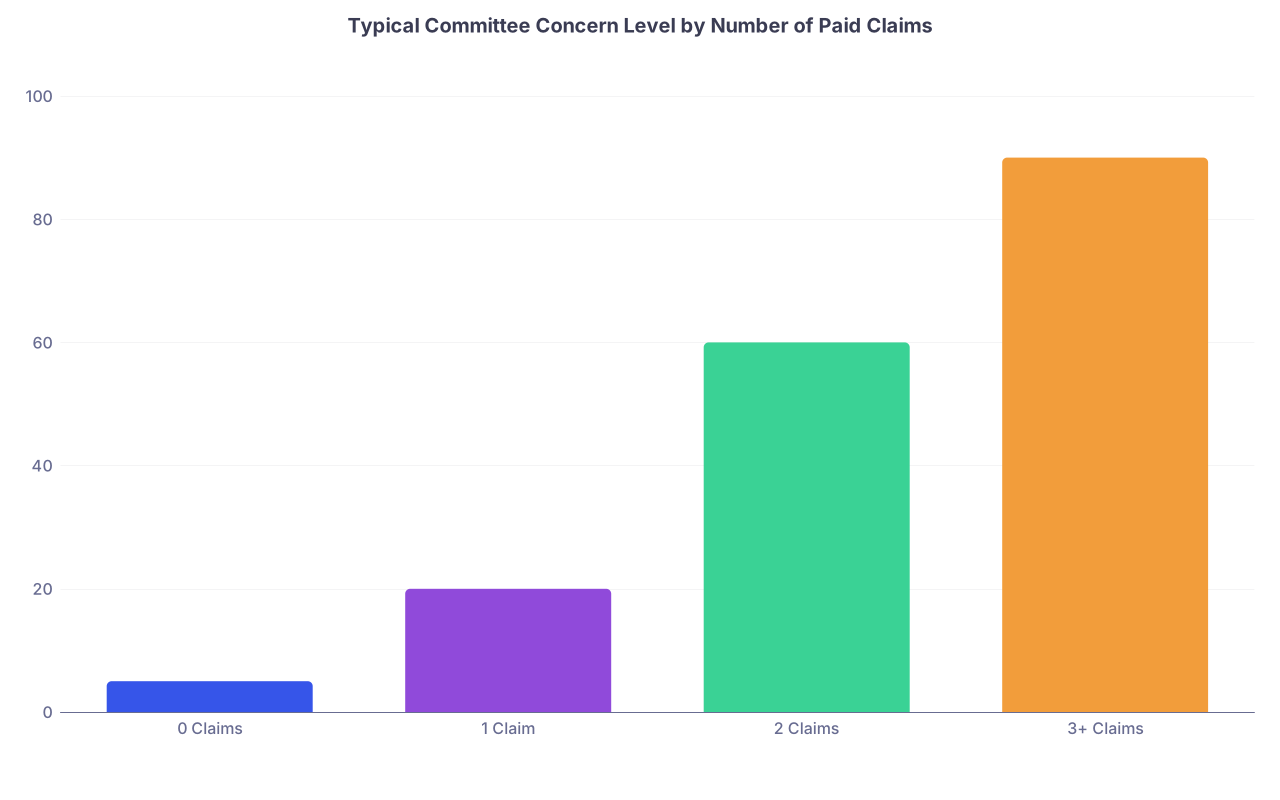
| Category | Value |
|---|---|
| 0 Claims | 5 |
| 1 Claim | 20 |
| 2 Claims | 60 |
| 3+ Claims | 90 |
Those “concern level” percentages are how often I’ve seen committees slow down or add conditions at each level, not actual denial rates.
The real inflection point is not just the raw number, but the pattern and recency:
- Two similar high-severity OB claims in five years? Problem.
- Three low-value claims over twenty years in EM? Less of a problem than you’d think, if defended well.
- One big catastrophic payout in the last 12–24 months? Everyone wants more detail.
Credentialing doesn’t live in isolation either. Underwriters, CMOs, and payers talk—directly or indirectly.
How malpractice carriers quietly shape your credentialing destiny
People underestimate how much your malpractice carrier’s behavior affects credentialing decisions.
Every application asks for:
- Current carrier
- Prior carriers
- Any non-renewals, surcharges, or endorsements
If your carrier has:
- Non-renewed you
- Jacked up your premium with a big surcharge
- Forced you into risk-based CME or monitoring
That all turns into smoke that credentialing committees follow. They may not see the dollar amount, but they see the “notice of non-renewal” or conditions.
Malpractice underwriters are blunt behind closed doors. I’ve heard versions of:
“We’ll keep them, but only at a 100% surcharge and with a $1M deductible.”
You won’t see that in your hospital packet, but the fact that you had to switch carriers suddenly, or can’t get occurrence coverage and are stuck with a sketchy surplus-lines carrier, shows up loud and clear on the form.
In some systems, the CMO will literally call the carrier’s medical director and say, “Off the record, would you put them on your own call schedule?” That answer carries weight.
The NPDB: your permanent record that never really expires
You probably know the NPDB is “permanent,” but you might not grasp how that actually plays at the committee level.
Key reality:
There’s no true statute of limitations on how far back NPDB shows. But hospitals often use “look-back” windows—5 or 10 years—for their formal process.
Informally? If someone sees a catastrophic claim from 14 years ago, they will still talk about it.
Here’s the trick: committees care a lot about trajectory.
I’ve seen files like this:
- Two claims in the first 5 years of practice, both OB.
- Nothing for 12 years after a shift to GYN-only and strong references.
- Risk manager: “Yes, there were early issues, but they changed scope and we’ve seen no further events.”
Those get approved surprisingly often.
Contrast that with:
- Clean for 10 years.
- Two serious claims in the last 3 years.
- NPDB shows recent large payouts.
Everyone in the room wonders: “What changed? Burnout? Sloppy documentation? Impairment?”
That’s when conditions appear.
What “conditional” credentialing really means
You rarely get an outright “no” for a single claim. What you see instead:
- Provisional appointment: 6–12 months with focused professional practice evaluation (FPPE). More chart reviews. Possibly more direct observation.
- Procedure-specific restrictions: They’ll credential you, but not for TAVR, high-risk OB, complex spine, etc., if the claim involved those.
- Required proctoring: Another physician has to sign off on a certain number of your procedures or cases.
- Shorter reappointment cycles: Instead of 2–3 years, they bring you back to committee after 1 year for a re-look.
Those conditions go in your credentials file and sometimes in internal quality systems. If you move again in a year or two, the next hospital sees the pattern: “Why were they provisional? Why was their reappointment shortened?”
You start accumulating a shadow track record that’s harder to shake than the original lawsuit.
Private practice vs employed models: very different tolerance
Let me pull back the curtain on something else no one explains.
In a large employed group or health system, one or two claims may:
- Trigger informal performance reviews
- Push you toward more documentation training
- Get you moved to a lower-risk assignment
But the system wants bodies on the schedule. Their threshold to jettison someone for one claim is often higher than you’d think—unless the claim uncovers behavioral or professionalism problems, then all bets are off.
In small private practice or independent groups, it’s different.
Partners worry about group-level premiums. Two OB claims can spike everyone’s cost. I’ve been in those partner meetings:
“We like her, but we can’t afford another hit. If we take her on, and she has one more payout, our premium doubles.”
So even if the hospital would credential you, the group may quietly pass. You’ll just get the “not a fit at this time” email.
That’s credentialing by wallet, not by quality.
How payers and networks quietly use your claims
You focus on hospital privileges. The payers care about something else: marketability and risk.
They run NPDB and background checks too. Here’s what has happened, more than once:
- Doc gets hospital privileges approved despite a prior claim.
- Applies to join a desirable commercial payer network in a tight market.
- Payer sees the claim plus maybe a couple of quality flags (readmission rates, outlier billing patterns).
- Application sits. And sits. And quietly dies.
They’re not obligated to take you. And they don’t owe you a detailed explanation.
In some states and for some payers, high-risk profiles end up in “tier 2” networks—higher patient copays to see you, worse placement in directories, lower referrals.
You never see the memo where someone wrote: “Risk profile elevated, ok to keep but don’t highlight in narrow network products.”
But that memo gets written.
What actually reassures a credentialing committee
Here’s the part that should guide how you handle this from day one.
Committees are human. They’re made of physicians who’ve been sued themselves. They are not looking for perfection. They’re looking for:
- A coherent story.
- Absence of clear patterns.
- Evidence you learned and adjusted.
- Strong endorsements from people they trust.
So when a malpractice claim hits your credentialing:
- Own it early in writing. On every app. No hedging, no omissions. Inconsistency is what kills you, not the fact of the claim.
- Write a clinical, factual summary. Two or three paragraphs, max. Short background, what happened, your role, outcome, and any changes in practice.
- Show evolution, not self-pity. “I instituted standardized sepsis screening on our service,” or “I now directly review all CT reads in X scenario.” That kind of language lands well.
- Line up references who will actually pick up the phone. Credentialing committees trust live voices more than paper.
You’re not trying to erase the claim. You’re trying to make it old news in the mind of the reviewer.
A quick comparison: how the same claim can play out very differently
| Scenario | Likely Credentialing Outcome |
|---|---|
| 1 claim, 7 years ago, low payout, no pattern, strong references | Approved, maybe with routine monitoring only |
| 1 claim, 1 year ago, high payout, vague explanation, mediocre references | Delayed decision, request for more info, possible provisional status |
| 1 claim, 3 years ago, related to now-abandoned procedure type, documented practice changes | Approved, may restrict specific procedures |
| 1 claim, 5 years ago, plus current carrier non-renewal for “loss history” | Heavy scrutiny, possible denial or strict conditions |
The underlying NPDB entry may be identical. The context you build around it is what changes the outcome.
What you should do the moment a claim is filed (for your future credentialing self)
Most physicians only start thinking about credentialing implications the week they fill out an application with a new “Yes” box to check. That’s late.
From the moment a claim is filed, you should assume the story you build now will be read in a committee room 3–10 years down the road.
Four things I’ve seen smart docs do:
- Keep a private, factual summary. Not in the medical record, not in email. Just your own contemporaneous memo of what happened, your role, the medical decision-making.
- Work with your carrier to understand the narrative. Ask how they intend to describe the payment in the NPDB report. That language matters later.
- Push back (within reason) on indefensible settlements. There are times when your carrier wants to cut a check for convenience, and the “nuisance” payment looks toxic on NPDB. This is nuanced and you need good counsel, but don’t be a passive bystander.
- Proactively improve and document improvements. Protocols implemented, CME completed, peer reviews passed—all of that becomes armor in the future.
Years later, when you’re writing your explanation, you’re not trying to remember what happened. You already have a clean, accurate spine for your story.
The last thing: it’s not always about you
Here’s the uncomfortable reality. Sometimes a malpractice claim becomes the excuse for a system to do what it already wanted.
I’ve seen:
- A hospital wanting to cut back on low-volume surgeons use a recent claim to “reassess need and performance.”
- A group annoyed with a personality but scared to fire them outright quietly decide not to renew after a settlement.
- Competitors on the credentials committee use “concern about risk profile” to delay a new doc joining the market.
That’s the ugly human layer on top of an already messy process.
You can’t control all of it. But you can control whether your file looks like a risk or a grown-up who’s practiced long enough to have some scars.

| Step | Description |
|---|---|
| Step 1 | Malpractice incident |
| Step 2 | Claim filed |
| Step 3 | Carrier notified |
| Step 4 | Defense and resolution |
| Step 5 | No NPDB report |
| Step 6 | NPDB report filed |
| Step 7 | Hospital queries NPDB |
| Step 8 | Credentialing review |
| Step 9 | Approved |
| Step 10 | Conditional approval |
| Step 11 | Delay or denial |
| Step 12 | Payment made? |
| Step 13 | Concerns? |