
The biggest lie physicians believe about malpractice insurance is that it’s all about your specialty and your claims history. It is not. Underwriters flag far more in your file than anyone tells you in residency.
Let me walk you through what they actually look at when your name hits their system—and what quietly gets you labeled “high friction,” “watch closely,” or “do not touch at standard rates.”
How your file really gets built
Your “malpractice file” is not one neat PDF. It’s a patchwork of data feeds and judgment calls.
When your application comes in, three things happen almost simultaneously:
- A junior underwriter (or analyst) does the first scrub.
- The system pulls external data feeds you never explicitly consented to.
- Anything that looks off gets escalated to a senior underwriter or committee.
I’ve sat in those rooms. I’ve watched them open a physician’s file and say, “Oh, it’s one of these.” You never want to be “one of these.”
Let’s start with the core categories that actually trigger flags.
The “obvious” stuff… that they scrutinize way harder than you think
Everyone knows claims history matters. But it’s how the story looks on paper that gets you flagged, not just the fact that “you had lawsuits.”
1. Patterned claims, not one-off disasters
One bad outcome? They shrug. A string of “minor” stuff? They start circling things in red.
Here’s the real internal hierarchy:
- One big catastrophic claim (brain-damaged newborn, missed cancer with huge payout)
- Multiple low-to-moderate severity claims
- Lots of “incidents” or “potential claims” reported to prior carriers
- Multiple board complaints / hospital quality concerns even without big payouts
You know what gets more raised eyebrows than a single $1.5M settlement? Three $100k settlements in five years where the narrative reads exactly the same: “failure to follow up,” “poor documentation,” “communication breakdown.”
Underwriters love patterns. If your file suggests you practice a little loose with follow-up, documentation, or patient communication, they flag you as a systemic risk, not bad luck.
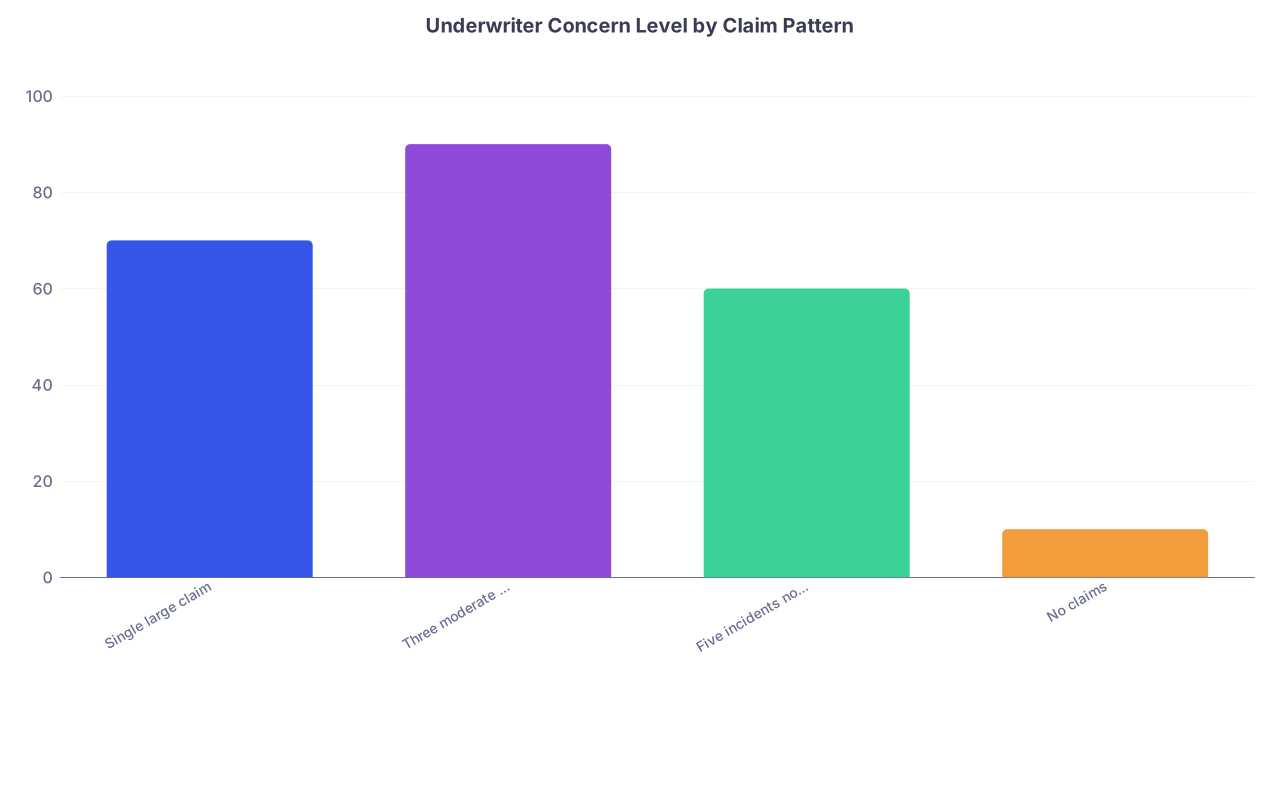
| Category | Value |
|---|---|
| Single large claim | 70 |
| Three moderate claims | 90 |
| Five incidents no payout | 60 |
| No claims | 10 |
What they quietly hate: repeated “failure to diagnose,” repeated “non-compliance with policy,” repeated “poor documentation.”
They don’t care if you swear “that plaintiff lawyer was crazy.” The language in the loss runs is all that matters.
2. Loss runs that read like a horror story
Your loss runs from prior carriers are the Rosetta Stone of your risk. You will never see them interpreted the way an underwriter does.
They read four things:
- Frequency (how often something happens)
- Severity (dollar amounts and clinical impact)
- Time since last event
- Language in the narrative
You see “closed with no payment” and relax. They see “multiple notices of potential claim in a short period” and flinch. Those near-misses tell them how often your practice brushes up against litigation, even if nothing was paid.
And those vague narratives you ignore? That boilerplate matters. If half your entries mention “communication issues” or “documentation inadequate,” that becomes your unofficial brand inside the underwriting department.
What they quietly care about more than your Step scores
Here’s where most physicians are totally blind. Underwriters don’t care what you scored on Step 1. They do care—deeply—about these things you barely think about when you fill out the form.
3. Practice setting instability
If you’ve been at one large system for 15 years, they relax. If your CV looks like a travel doc’s suitcase, they start digging.
They flag:
- Multiple employers or groups in a short time frame (3+ changes in 5 years)
- Rapid shifts between settings: academic → private → locums → telemedicine
- Very recent practice changes not well explained on the application
Here’s why: unstable settings often mean poor systems, sloppy credentialing, fragmented documentation, and nobody owning quality. Underwriters have seen the same story too many times: doc jumps from struggling group to struggling group, leaving a trail of small but annoying claims.
You will never see the internal note that says: “Frequent job changes – possible interpersonal / quality issues. Require explanation.”
But it’s there.
4. Scope-of-practice creep
Nothing makes insurers more nervous than a physician quietly stretching beyond their training.
Examples that trigger extra review:
- FM doc suddenly doing high-risk OB again after years without it
- Hospitalist adding “light” ICU with vents and pressors but no formal critical care support
- Orthopod expanding to spine after mostly doing sports for a decade
- EM doc moonlighting as a “cosmetic injector” in a med spa that has zero protocols
On the application, this looks like:
- Procedural list significantly expanded from prior carrier’s list
- CME history that doesn’t match the new scope
- Privileges applied for that don’t align with training history
Underwriters are not stupid. When they see an FP now doing office-based anesthesia, they ask themselves, “Is this a reimbursement pivot or a true skill set expansion?” That question alone will get your file kicked up to a senior underwriter.

5. High-risk combos of procedures and setting
It’s not just what you do. It’s where and how.
Some combinations that light up the board:
- High-risk procedures in low-resource settings
(e.g., complex sedation in office without proper monitoring / crash cart) - OB deliveries without 24/7 in-house anesthesia or pediatrics
- Spine procedures in surgery centers without clear postop coverage plans
- Telemedicine prescribing controlled substances across multiple states
Underwriters have internal “uh-oh” lists. They will not show them to you. But certain CPT clusters and practice environments trip internal rules that say: “Get more detail. Ask for protocols. Raise rate. Maybe decline.”
The stuff you think is minor that absolutely gets you flagged
Now we get into the things nobody tells you in training. This is where you accidentally bury yourself with an application you think is “honest and thorough” but reads like a legal liability.
6. Sloppy or inconsistent applications
Underwriters assume this: how you fill out your application is how you chart.
I’ve watched a senior underwriter flip through an application, see obvious inconsistencies, and push it aside: “If they can’t complete a five-page form accurately, imagine their documentation.” That’s a quote.
They flag when:
- Dates on your CV don’t match dates on the application
- Training history is incomplete or looks massaged (overlapping jobs with no explanation)
- Gaps > 3 months with no narrative
- Different answers between prior applications and the current one pull through in the system
And here’s the harsh truth: if your application has to go back and forth for “clarifications” more than once, your informal risk rating is already worse, even if they never tell you that.
7. Vague or evasive answers about investigations
Board actions and hospital investigations are a huge deal. But what underwriters hate more than adverse actions is evasiveness.
On the application, when you’re asked:
- “Have you ever been investigated, restricted, or suspended by a hospital, board, or employer?”
The wrong move is half-answering. Writing “see CV” when the CV says nothing. Writing “resolved” with no context. Leaving out a “mere inquiry” that someone else already reported.
Underwriters compare:
- Your answers
- NPDB queries
- Hospital credentialing verifications
- Sometimes even Google, if something smells off
If they find out you minimized something? They don’t just raise your rate. They may decline entirely or add punitive conditions because you’ve now proven you’re not fully trustworthy.
I’ve seen files where the action itself didn’t bother them as much as the cover-up. A physician with a documented but candidly explained board reprimand was approved. Another with “no issues” who clearly had a prior summary suspension that turned up on NPDB? Declined for “misrepresentation.”
Quiet red flags in your professional life that bleed into insurance
You think malpractice underwriting is just about medicine. It is not. It’s about risk behavior.
8. Substance use, behavioral, and professionalism issues
If you are in (or have been in) a physician health program, had disruptive behavior write-ups, or anger-management-mandated interventions, those details often show up indirectly—via board reports, hospital verification letters, or credentialing forms.
Underwriters don’t care about your moral life; they care about risk patterns:
- Prior DUI with no impact on license? Mild concern.
- Multiple DUIs, license probation, and complaints about poor documentation? That’s a perceived cluster of impaired judgment and sloppiness.
They worry about:
- Impaired documentation at key times
- Poor follow-up or missed results
- Angry patient interactions escalating into litigation
They are not psychiatrists. They are pattern matchers. And “substance + quality issues + patient complaints” is one of their ugliest internal archetypes.
9. Social media and online footprint (yes, they really look)
No, they’re not doing a deep OSINT investigation on every applicant. But I’ve watched risk managers pull up Google when a file already smells problematic.
Things that do not help you:
- Long, inflammatory public rants about patients or “idiot administrators”
- Public One-Star review clusters saying “does not listen, rude, dismissive”
- Being a named party in public lawsuits not declared on the application
They are not rating you on bedside manner. They’re asking, “Is this physician prone to adversarial relationships with patients and staff?” Because adversarial physicians get sued more. Repeatedly.
What’s in their internal risk score that you never see
Most of the big malpractice carriers run internal scoring models. You never see the number they tag you with. But it absolutely influences your premium offers and conditions.
Roughly, they’re combining:
- Specialty baseline risk
- Geographic risk (some counties are litigation magnets)
- Claims frequency and severity
- Practice structure and setting
- “Friction” metrics: how much hassle your file has already created
Here’s a simplified version of what they weigh a lot more than you think:
| Factor | Impact Level |
|---|---|
| Claims pattern (not just count) | Very High |
| Practice instability | High |
| Scope creep | High |
| Application inconsistencies | High |
| Board / hospital actions | Very High |
And then there’s a purely human layer: underwriter gut feeling. I’ve heard lines like:
- “This file feels messy.”
- “Everything is technically fine but I don’t like this story.”
- “We’ll quote, but add a surcharge and exclude OB.”
That’s where your narrative and how you present your history really matters.
How to keep your file from getting quietly blacklisted
Let me be blunt: once two or three major carriers have tagged you as “high risk” or declined you, you are going to pay for it—in money, restrictions, or both—for a long time. Sometimes permanently.
So how do you avoid that path?
10. Own the narrative before they write it for you
Underwriters hate surprises. They hate puzzle pieces that do not fit. You beat half the red flags by giving them a coherent story.
You need:
- A clean, consistent CV with exact dates that match all applications
- A short, factual cover letter or addendum for anything messy:
- Job changes
- Board actions
- Hospital investigations
- Practice scope changes
The key: be factual, concise, unemotional. No venting about unfair chairs or toxic systems. Underwriters are not your therapist. They’re deciding if you’re a headache.
A good explanation looks like this:
“In 2019, I was subject to a summary suspension related to documentation compliance and completion of medical records. This was administrative, not clinical. I entered into a corrective action plan, completed additional EMR training, and have had no further sanctions, board actions, or documentation-related incidents since that time.”
That is infinitely better than “hospital politics” or vague hand-waving.
11. Stop treating the application as busywork
Your malpractice application is a legal document. In-house, it’s treated as a quasi-psychological profile of how you operate.
Take the extra hour to:
- Cross-check dates with your CV, LinkedIn, hospital profiles
- List all prior claims and investigations fully and consistently
- Preemptively explain any gaps, changes, or oddities in an attached addendum

| Step | Description |
|---|---|
| Step 1 | Complete Application |
| Step 2 | Cross check CV and dates |
| Step 3 | Submit to Agent |
| Step 4 | Draft brief explanations |
| Step 5 | Underwriter Review |
| Step 6 | Standard Terms |
| Step 7 | Extra Questions or Surcharges |
| Step 8 | Any gaps or issues |
| Step 9 | Clean and consistent |
You don’t win points for brevity. You win for clarity and credibility.
What happens inside when your file gets “interesting”
When something in your application triggers a flag, your file stops being routine and becomes “underwritten.” That’s when committees and senior people start talking about you.
Here’s the internal sequence for a red-flag file:
- Junior underwriter hits a trigger: prior claim severity, board action, messy history.
- File goes to a senior underwriter or risk committee.
- They may request:
- More detailed loss runs
- Explanations from you
- Letters from hospitals or prior carriers
- They decide:
- Approve standard
- Approve with surcharges/limitations
- Approve with exclusions (e.g., no OB, no spine)
- Decline entirely
During these discussions, they’re not only asking “How risky is this physician?” They’re asking “Is this much trouble worth the premium we’ll collect?” Another thing you never hear.
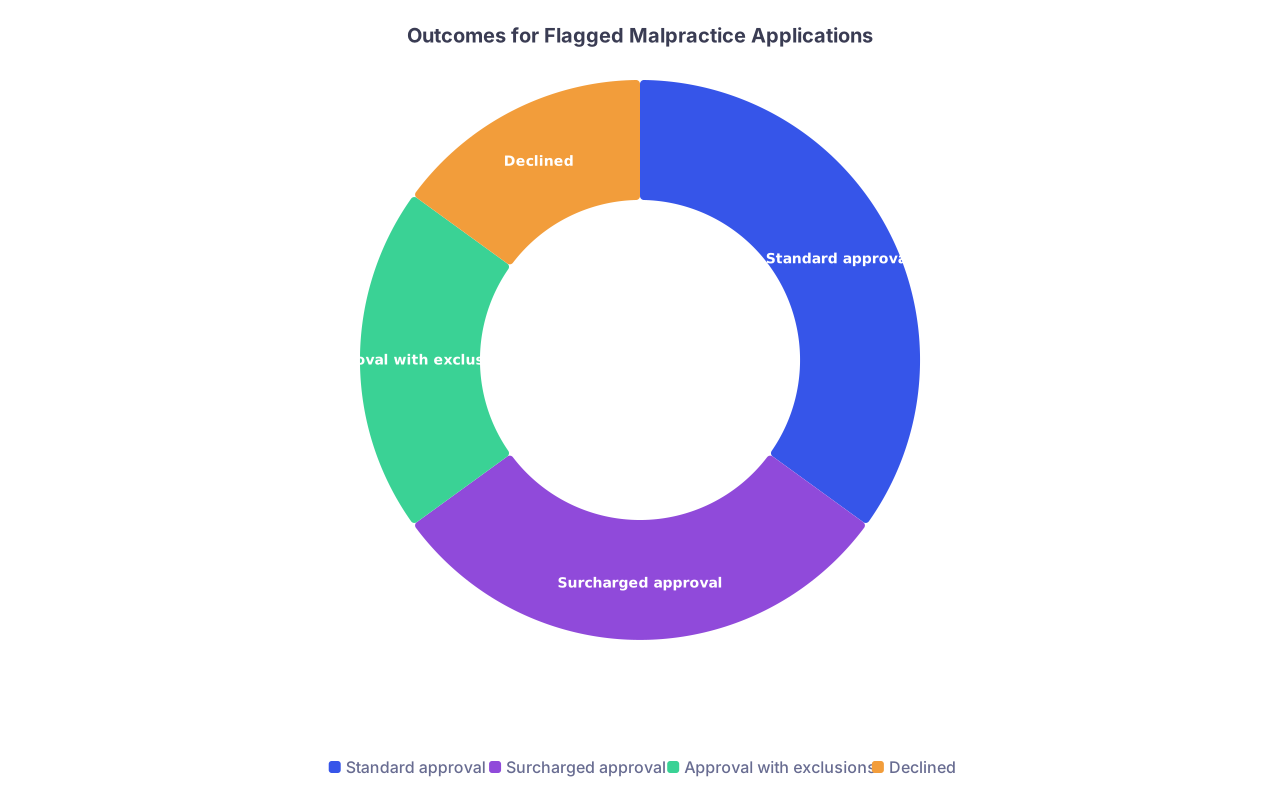
| Category | Value |
|---|---|
| Standard approval | 35 |
| Surcharged approval | 30 |
| Approval with exclusions | 20 |
| Declined | 15 |
If your file requires repeated emails, inconsistent explanations, and uncomfortable phone calls with your broker, your “hassle factor” alone can push you from “surcharged” to “declined.”
For residents, fellows, and early attendings: what to do now
You might be reading this thinking, “I’m not even independent yet.” Perfect. You have time to not screw up your future underwriting profile.
Here’s what actually matters early:
- Start keeping a clean, detailed CV now. Exact dates. No fuzzy ranges.
- Any time there’s an incident, claim, or investigation, document your side factually and store it. You’ll need to remember it five carriers from now.
- Do not casually expand your scope without training, documentation, and policies you can show someone later.
- When you moonlight or pick up telemedicine or locums, assume those choices are going into your long-term risk story.
And if your record already has bumps? Your job is not to erase them. It’s to demonstrate that the pattern did not continue.
FAQs
1. How many claims is “too many” before insurers start to really worry?
There isn’t a magic number; it’s claims per decade plus pattern. One significant claim in 15 years of neurosurgery may get shrugged off. Three moderate claims in seven years of low-risk outpatient internal medicine will absolutely trigger concern. Once you’re above two paid claims in a 5–7 year window, expect closer scrutiny and probable surcharges.
2. Will a single board reprimand ruin my chances of getting coverage?
No, not by itself. What ruins you is failing to disclose it, minimizing it, or having multiple different entities (board, hospital, prior carrier) report different versions of the story. A well-documented, honestly presented reprimand with no further issues for several years is often accepted with maybe a modest rate bump. It becomes poisonous when combined with sloppy applications or repeated quality issues.
3. Do malpractice insurers really check my social media and online reviews?
Not systematically for every doctor. But when a file is already concerning—claims, board action, practice instability—someone in risk or underwriting will sometimes search your name. If they find open patient lawsuits or pages of scathing reviews about rudeness and non-responsiveness, it solidifies their impression that you’re high-friction and likely to generate more claims. It’s confirmatory data, not primary, but it does matter.
4. Can I negotiate or challenge a declination or a huge rate hike?
You can, but only if you bring something new to the table: additional documentation, improved loss runs, updated information, or clarifying explanations. Screaming about fairness does nothing. Having your broker present a crisp narrative—correcting misunderstandings, adding context, showing no new issues over time—can flip a “decline” to a “surcharge with conditions.” But once two or three major carriers have declined you, your options narrow fast.
5. What’s the single smartest thing I can do on my next application to avoid red flags?
Write a short, clear addendum that proactively explains anything even slightly messy: employment changes, board or hospital actions, extended gaps, or significant scope changes. Align your CV, your application, and your addendum so they tell one coherent story with no contradictions. Underwriters do not need perfection; they need a clean, believable narrative that shows you’re self-aware, organized, and not hiding anything.
Three things to remember: they care more about patterns than events, more about honesty than perfection, and more about your story’s coherence than your self-justifications. If you control those, you stop being “one of these” files—and start looking like an acceptable risk instead of a future headache.