
The myth that “most malpractice cases drag on for years” is wrong. The data show something more nuanced, and frankly, more corrosive: a relatively small slice of cases consumes a disproportionate share of time and stress, and you do not know which slice you are in when the process starts.
Let me walk you through what malpractice timelines actually look like, how long you are statistically stuck in limbo at each stage, and what that means for your stress, your money, and your career planning.
The hard numbers: how long malpractice cases actually last
If you want to manage stress, you start with distributions, not anecdotes. Here is the high-level picture from large malpractice datasets (e.g., CRICO Strategies, Physician Insurers Association of America, and several state-level carrier reports):
- Roughly 60–70% of malpractice claims close within 2–3 years of the incident.
- Only about 5–10% go to trial.
- But the cases that go to trial or hang around for settlement in late litigation often last 4–5+ years and account for a disproportionate share of physician stress exposure.
In other words, the median case is not a decade-long nightmare. The tail is. And the tail is long enough to be a real problem.
Let’s quantify typical closure times by resolution type.
| Resolution Type | Median Time to Close | 75th Percentile | 90th Percentile |
|---|---|---|---|
| No payment (dropped/defense win) | 18–24 months | ~36 months | ~48 months |
| Settlement (pre-trial) | 24–30 months | ~42 months | ~54 months |
| Trial verdict | 36–48 months | ~60 months | ~72 months |
Those are not hypothetical. They track closely with major malpractice carrier reports across internal medicine, surgery, OB-GYN, EM, and anesthesia.
Now look at it visually: how many cases close when?
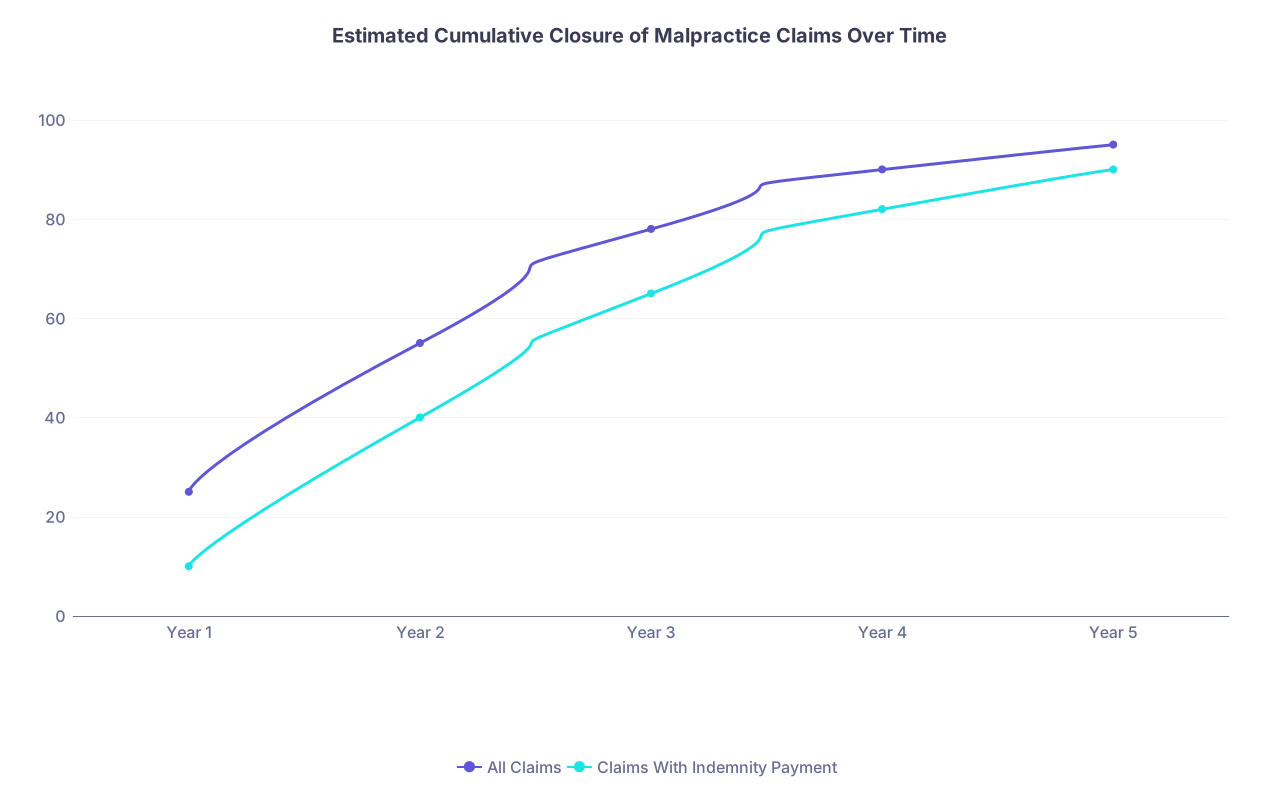
| Category | All Claims | Claims With Indemnity Payment |
|---|---|---|
| Year 1 | 25 | 10 |
| Year 2 | 55 | 40 |
| Year 3 | 78 | 65 |
| Year 4 | 90 | 82 |
| Year 5 | 95 | 90 |
By year 3, around 75–80% of claims are closed. But that still leaves 20–25% of physicians living with an open claim past the 3‑year mark. For a single event. If you have more than one claim in your career, timelines overlap and the background stress becomes continuous.
The real malpractice timeline: step-by-step, with probabilities
Forget the simplistic “incident → lawsuit → trial” narrative. The real process is multi-stage, and the stress curve is not linear. It spikes and plateaus.
Here is the real-world flow, compressed:

| Step | Description |
|---|---|
| Step 1 | Adverse Event |
| Step 2 | Claim Notice or Complaint |
| Step 3 | Initial Carrier Review |
| Step 4 | Early Dismissal or Drop |
| Step 5 | Discovery Phase |
| Step 6 | Case Closed - Settlement |
| Step 7 | Pre Trial Motions |
| Step 8 | Verdict |
| Step 9 | Case Closed - Late Settlement |
| Step 10 | Case Merit Assessed |
| Step 11 | Settlement Talks |
| Step 12 | Trial or Late Settlement |
Now let’s overlay approximate timing and probabilities using aggregated carrier data:
From incident to claim filing: often 6–18 months
Many patients or families do not file immediately. That creates a lag where you may feel safe but statistically are not. Limitation periods (statute of limitations) are often 2–3 years, longer for minors.From claim notice to basic assessment: 3–6 months
Chart review, internal medical review, initial legal evaluation.Outcomes of that assessment (rough ranges across specialties):
- 20–30%: dropped, declined, or dismissed relatively early (often within 12–24 months of incident).
- 50–60%: proceed into full discovery, expert review, and extended negotiation.
- 5–10%: eventually reach trial.
The data pattern is consistent: the majority of cases never see a courtroom, but they still take years to resolve.
The stress signal? You do not know if you are in the early 25–30% that will drop out fast or the 10% trudging toward trial until you have already invested a substantial amount of time and emotional energy.
Stage-by-stage: duration, stress peaks, and what actually happens
You can think of malpractice stress like a time-weighted exposure problem. Consider each stage as an interval with:
- A duration (months)
- An intensity (how much it occupies your mind)
- A probability of escalation
Multiply those together and you get your “stress load” distribution over time. Let’s walk it through.
1. The pre-claim period (incident to notice)
Numbers first:
- Typical length: 6–18 months.
- Probability of any claim being filed after a moderate-to-severe adverse event: widely variable by specialty, but in high-risk fields (neurosurgery, OB, EM) it is significantly higher than baseline; carrier data often show claim rates of 10–20+ per 100 physicians per year in these specialties.
In this phase you might:
- Know something went wrong.
- Suspect a complaint is coming.
- Hear from risk management but not from a lawyer.
Psychologically, this is low-to-moderate chronic anxiety. You are replaying the case at 2 a.m. But there are no depositions yet. No formal discovery. No time off work.
Statistically, many events here never become formal claims. But once you have had a serious event, your subjective probability estimate of being sued goes way up, whether or not the true base rate justifies it.
2. Claim filed and carrier involvement
This is when you get the letter. You notify your malpractice carrier. Now the clock is clearly ticking.
Typical timing:
- Claim filing to full engagement of defense counsel: 1–3 months.
- Initial investigation and expert review kickoff: 3–6 months after notice.
What you actually experience:
- Several long, dense meetings with defense counsel.
- Detailed chart review, timelines, re-reading your own notes under a legal microscope.
- Requests for your personal statement of events.
Stress intensity spikes sharply here. But the duration of this initial acute spike is relatively short. Then you enter the long plateau: discovery.
Discovery: where time really disappears
Discovery is where timelines stretch and costs pile up. From a pure duration perspective, this is your biggest risk zone.
Typical duration:
- 12–24 months is common.
- In complex cases (multi-defendant, multiple experts, institutional co-defendants), 24–36 months is not unusual.
What happens during discovery:
- Written interrogatories and document requests.
- Multiple depositions: you, co-defendants, nurses, consultants.
- Expert reports on both sides.
The data from multiple carriers show:
- A large share of defense costs (often >60%) accrues in the discovery and pre-trial phase.
- Cases that proceed deep into discovery have a significantly higher probability of settlement or trial, simply because so much sunk cost has accumulated by both sides.
Let us map stress across time for a “typical” case that does not settle early.
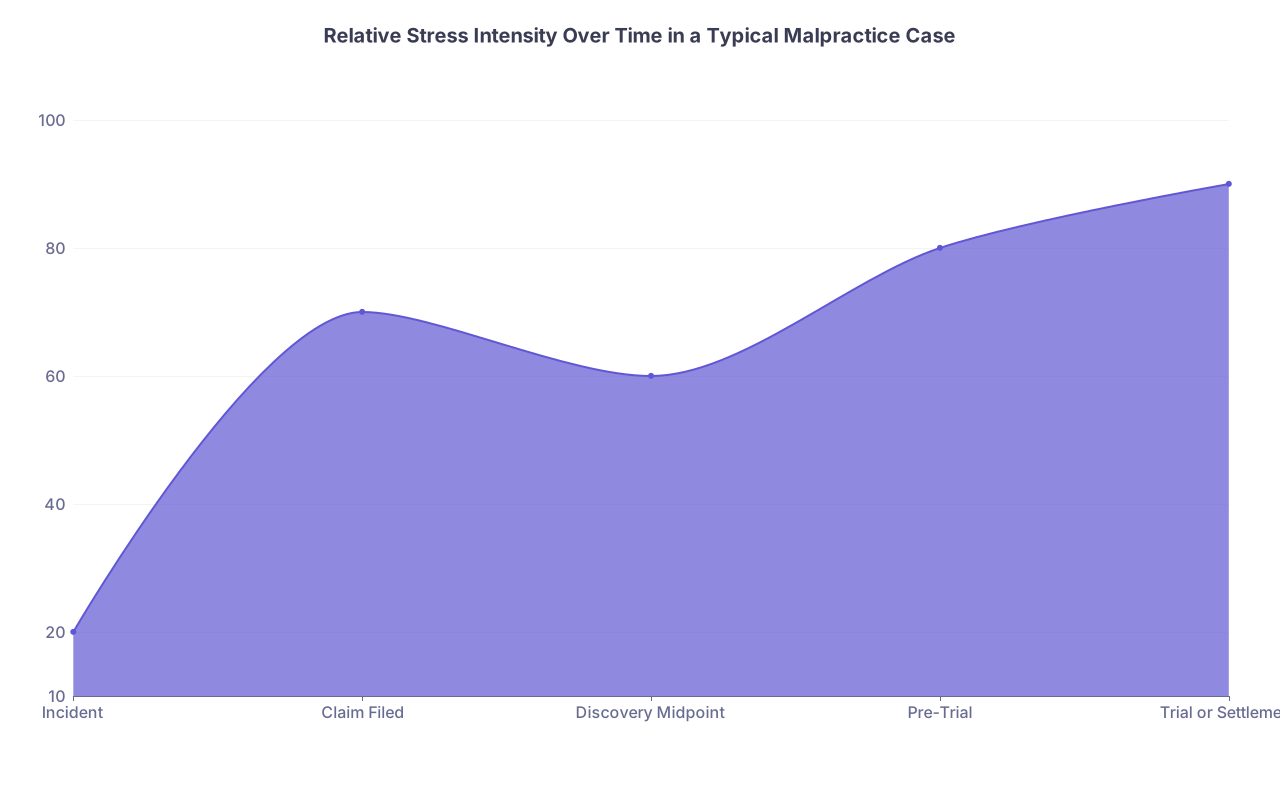
| Category | Value |
|---|---|
| Incident | 20 |
| Claim Filed | 70 |
| Discovery Midpoint | 60 |
| Pre-Trial | 80 |
| Trial or Settlement | 90 |
This is subjective, obviously. But physicians I have seen go through this consistently put:
- Initial fear spike at claim filing.
- A long, grinding plateau during mid-discovery.
- Another spike as trial dates approach.
And notice something: even when “not much is happening” legally, the background cognitive load remains high. That is the plateau at 50–60% intensity for 1–2 years.
Settlement and trial: timing, likelihood, and impact
Here is where physician perceptions often diverge from data.
Most physicians overestimate their chance of going to trial. They imagine the TV version. The numbers say something else.
Across broad datasets:
- Approximately 60–70% of closed claims are dropped, dismissed, or end in defense verdict.
- 20–30% close with settlement.
- 5–10% reach a plaintiff or defense verdict at trial.
But here is the catch: that 5–10% that goes to trial almost always sits at the far right of the time distribution—3–7 years from the incident. So “trial risk” equals “extended timeline risk.”
Have a look at estimated distributions by resolution type:
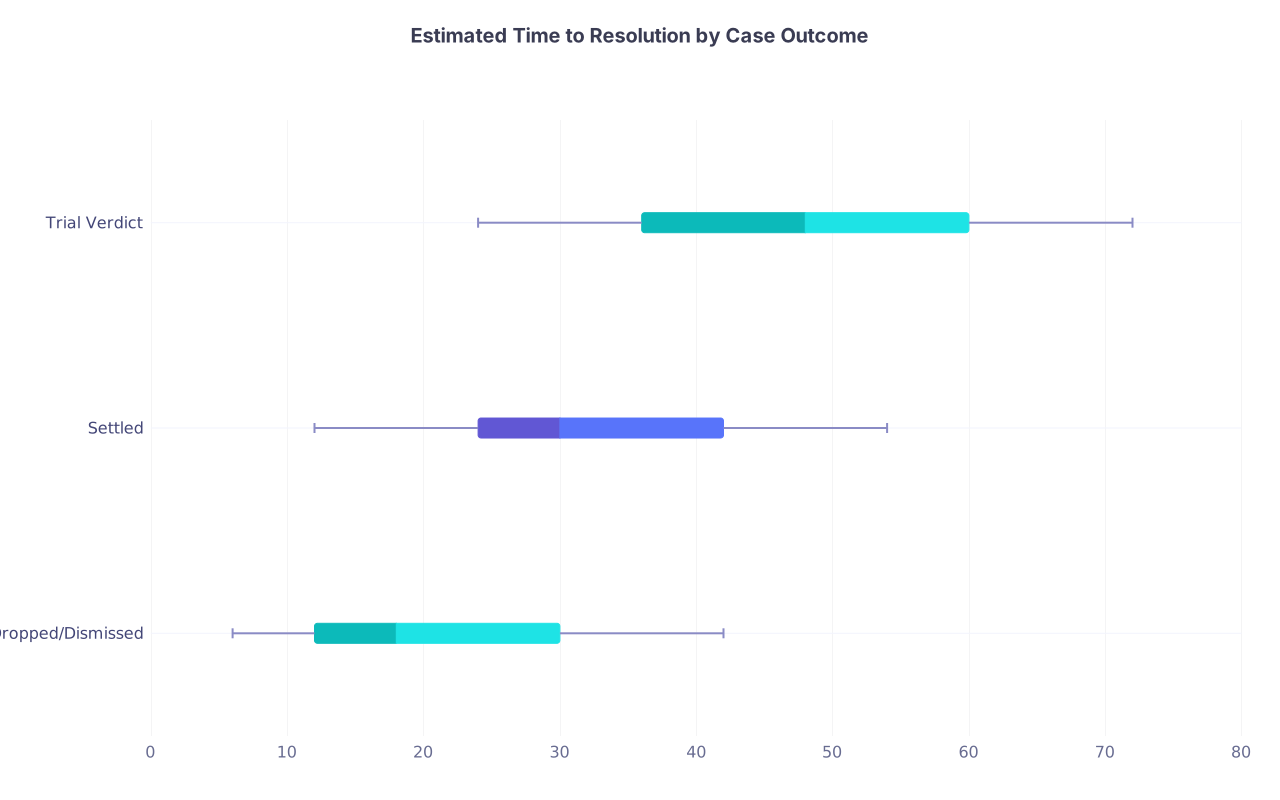
| Category | Min | Q1 | Median | Q3 | Max |
|---|---|---|---|---|---|
| Dropped/Dismissed | 6 | 12 | 18 | 30 | 42 |
| Settled | 12 | 24 | 30 | 42 | 54 |
| Trial Verdict | 24 | 36 | 48 | 60 | 72 |
Interpretation:
- A dismissed case might close in 1.5 years median, but 10% still take >3.5 years.
- Settlements cluster around 2–3.5 years, with a long tail.
- Trials are the longest, with a median around 3–4 years, and a chunk stretching past 6 years.
Again: you do not know which boxplot you belong to until you are well along the time axis.
How different specialties experience timelines and stress
Timelines are not uniform across specialties. High-severity, low-frequency events (e.g., catastrophic neonatal injury) tend to have longer and more contentious litigation.
Approximate patterns:
- OB-GYN and neurosurgery: higher severity, bigger dollars, more defendants, longer timelines, more trials.
- Emergency medicine and anesthesia: relatively high claim frequency, but many claims settle or drop earlier compared with certain surgical cases.
- Internal medicine and family medicine: moderate frequency, often more diagnostic error allegations, with variable timelines depending on injury severity and number of involved clinicians.
A rough comparative snapshot (based on aggregated carrier data patterns, not a single source):
| Specialty | Relative Avg Duration | Trial Likelihood | Stress Pattern |
|---|---|---|---|
| OB-GYN | Long | Higher | High, prolonged |
| Neurosurgery | Long | Higher | High, prolonged |
| General Surgery | Moderate-Long | Moderate | Spikes around major events |
| Emergency Med | Moderate | Lower-Moderate | Many short to mid-length |
| Internal Med | Moderate | Lower | Mixed, often diagnostic cases |
You do not need a full regression model to see the pattern: specialties with catastrophic, high-dollar outcomes tend to see longer timelines. That is not about “fairness”; it is about incentives for plaintiffs’ attorneys and carriers to fight longer.
Financial and career consequences of long timelines
Your malpractice insurer picks up defense costs and indemnity, yes. But the financial and career impact is not zero for you.
Here is where the duration really matters:
Credentialing and privileging
Every hospital privileging form asks for open and closed malpractice claims, with dates, allegations, and outcomes.
A 5‑year case means 5 years of “yes, I have an open claim” on every application, promotion packet, or new job credential file.Insurance underwriting
Carriers absolutely risk-stratify based on:- Number of claims.
- Severity and payout history.
- Specialty and practice setting.
An extended open claim may not change your premium immediately, but multiple long, high-severity claims absolutely will. Actuaries are not sentimental.
Opportunity cost
Days missed for depositions, trial preparation, travel. Scheduling that gets blown up by court calendars. Those are all unbilled hours or productivity hits. For a proceduralist on RVU comp, that is direct income loss.Career decisions
I have watched more than one physician delay job changes or partnership tracks because they “did not want to introduce an active case into a new group.” That is a rational response to a messy system, but it is still a cost.
So yes, your personal checkbook may not write the settlement. But the duration of the process has real financial and professional consequences.
What drives longer timelines (and what you can actually influence)
You cannot control everything. But the data show several consistent correlates of longer litigation:
- Multi-defendant cases (hospital + multiple physicians + nurses).
- Catastrophic injury or death, especially in younger patients.
- Disputed facts or documentation gaps.
- Large economic damages (lost lifetime earnings, lifelong care).
These factors drive discovery complexity and expert battles, which in turn drag out timelines.
On the physician side, there are a few variables you can influence, indirectly:
Documentation quality
No, it will not magically prevent a lawsuit. But clean, contemporaneous, legible, and consistent records reduce the “factual ambiguity” that prolongs expert fighting. Ambiguous charts equal longer discovery and more fertile ground for plaintiff theories.Consistency in narrative
Early, clear, consistent accounts of what happened (to risk management, to your carrier, to your counsel) minimize the risk of contradictions later. Contradictions equal more motions, more depositions, more time.Engagement with defense
Physicians who avoid their defense team, cancel prep sessions, or treat the process as beneath them tend to have rougher, longer proceedings. Preparation does not shorten the statutory calendar, but it can reduce surprises that cause adjournments and re-openings.
You are not the primary driver of the litigation calendar. But you are not irrelevant either.
What this means for stress management: think like an actuary
You cannot make the system fast. You can, however, approach it less like a victim and more like an actuary managing risk exposure.
Key mindset shifts:
- Treat malpractice exposure as a multi-year process risk, not a single event.
- Expect 2–3 years as a realistic baseline timeline for a typical defended claim.
- Understand you have a 10–20% chance of being in the long-tail group (4–7 years) for any given serious claim, depending on specialty and severity.
- Recognize that stress is front-loaded and then chronic. It spikes at predictable points and plateaus in between.
Here is a simple mental model for your own planning:
- If you are in year 1–2 of a claim, with active discovery: plan for high stress and some time off work for legal matters.
- If you are past year 3 with no resolution: recognize you are likely in the more complex subset; expect more trial prep or late-settlement posture.
- If you reach trial scheduling: budget substantial time and emotional bandwidth in the next 6–12 months.
thinking this way does not make it pleasant. It makes it predictable. And predictability, statistically, reduces perceived stress load.
Practical takeaways for financial and legal planning
Let me connect the dots directly to the “financial and legal aspects” you care about, beyond the insurance policy itself.
Cash flow planning
Assume at least one significant malpractice episode during a multi-decade clinical career. Assume 2–3 years of on-and-off time demands if it occurs. Build a financial buffer (yes, the boring emergency fund) that lets you absorb lost clinic days and procedural blocks without panic.Contract negotiations
Understand how your group or employer handles:- Time off for legal appearances.
- Coverage if you are temporarily unable to practice (e.g., at trial).
- Partnership decisions or bonuses if you are embroiled in a case.
Many contracts are vague here. That vagueness becomes very costly once you are actually in litigation.
Insurance structure
Know:- Your policy limits.
- Whether defense costs are inside or outside limits.
- Whether you have consent-to-settle provisions.
You are not just buying coverage; you are buying a particular style of defense strategy and, indirectly, a style of timeline (aggressive fight vs earlier settlement).
Career moves
If you are planning a major move—new state, new group, academic to private, or vice versa—understand how an open case will be perceived in that new environment. The longer the projected timeline, the more strategically you should think about when to move and how to disclose.
The uncomfortable truth
Most of the public conversation around malpractice focuses on payouts and verdicts. Physicians obsess about “Did they win?” and “How much did they pay?”
The more damaging statistic, in my view, is this: a non-trivial fraction of clinicians spend 3–5 years of their working lives with at least one open malpractice claim hanging over them. Sometimes more than one. That is a chronic-stress exposure problem, not just a legal one.
Once you understand the actual distributions—who settles when, who goes to trial, how long cases live at each stage—you are no longer surprised by the delays. You can plan for them. You can align your financial, professional, and even psychological strategies with reality, not rumor.
The legal system will not speed up for you. But with a clear view of malpractice timelines and their stress curves, you are better positioned for the next phase: building a risk and resilience strategy that treats litigation as an expected, manageable part of clinical practice rather than a career-ending outlier. That is the next step in your journey.