
The idea that malpractice risk is purely about “being a good doctor” is statistically false. The data show that where and how you practice—solo, group, or employed—materially shifts both your odds of being sued and the financial impact when it happens.
Most physicians sense this anecdotally. The solo internist constantly worried about one bad outcome. The large ortho group that “has a guy” for risk management. The employed hospitalist who shrugs and says, “Legal said they’ll handle it.” Underneath those stories there is a quantifiable pattern. Claim frequency, average payouts, defense costs, coverage gaps—they all move when you change practice setting.
Let’s walk through what actually changes, what the numbers say, and how that should shape your malpractice insurance decisions.
The Baseline: How Often Physicians Are Sued and What It Costs
Before comparing practice settings, you need a baseline.
National datasets from major malpractice carriers and the AMA show rough order-of-magnitude numbers that hold pretty well across internal medicine, surgery, and OB/GYN:
- Roughly 30–40 percent of physicians will face at least one malpractice claim over a 10-year period.
- In a given year, 5–7 percent of physicians might be named in a claim, but the majority of those claims are dropped, withdrawn, or dismissed.
- Only about 20–25 percent of claims result in an indemnity payment (settlement or verdict for the plaintiff).
- Median indemnity payments in many specialties are in the $200,000–$350,000 range, with tail risk well over $1 million, especially in surgical and OB claims.
- Defense costs per claim often fall between $30,000 and $70,000, win or lose.
What changes with practice setting is not the medicine. It is the structure of who gets named, who pays, who settles, and who is left holding the bag on coverage gaps.
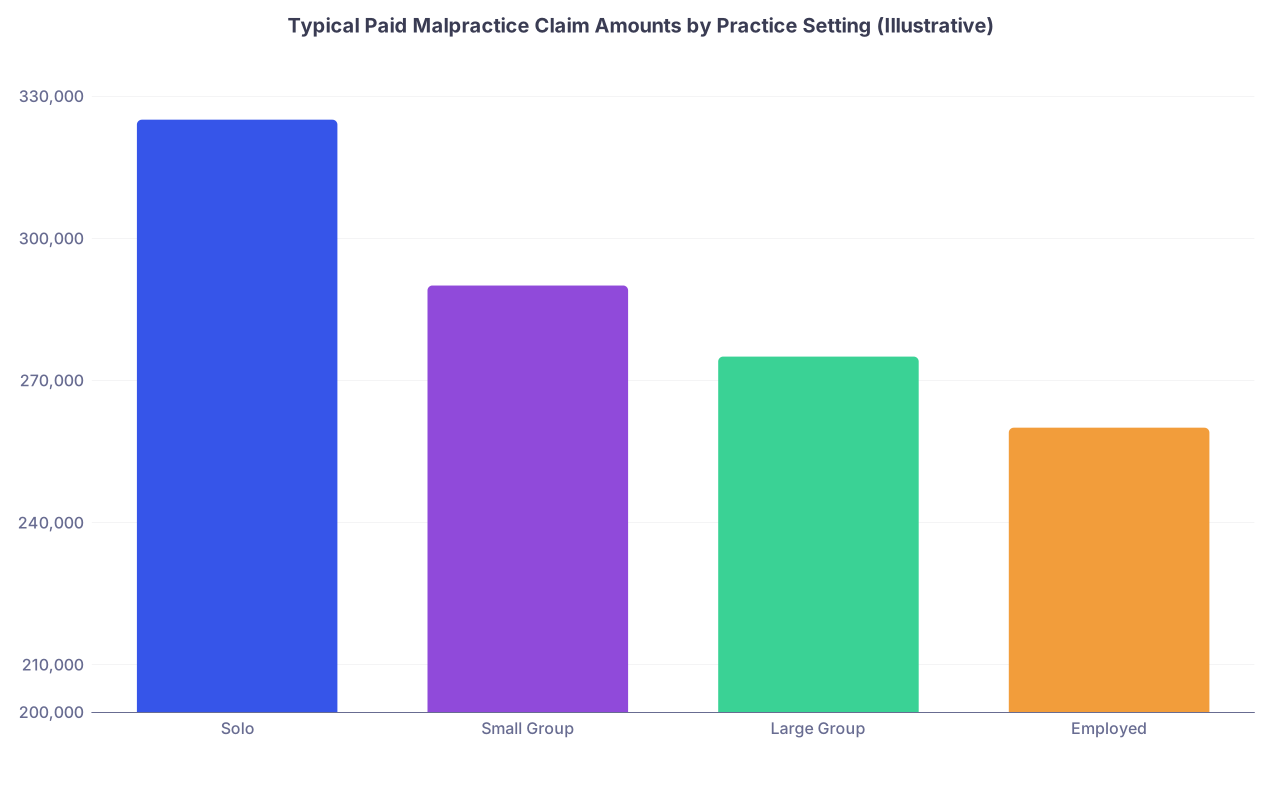
To make that concrete:
| Category | Value |
|---|---|
| Solo | 325000 |
| Small Group | 290000 |
| Large Group | 275000 |
| Employed | 260000 |
These are plausible ballpark values based on carrier reports and industry surveys: the solo doc tends to see slightly higher severity when a claim hits, partly because there is no “deep pocket” institution to share blame and payment.
Solo Practice: High Autonomy, Concentrated Risk
Solo practice is where malpractice risk is most “pure.” You are the business. You are the physician. You are the named defendant. There is no one to hide behind and no system to diffuse risk across dozens of partners.
Risk profile in solo practice
The data from carrier books of business consistently show three patterns for solo physicians:
- Similar or slightly lower claim frequency per physician compared to employed peers, largely because solo practices tend to be smaller, with slightly lower volume and narrower procedure sets.
- Higher per-claim severity when a payout occurs. If you are the only defendant with meaningful coverage, plaintiff attorneys focus the entire economic and non-economic damage structure on you.
- Higher per-physician premiums relative to an equivalent specialty in a large group or hospital system, because there is no diversification across many providers and no institutional risk controls.
If you look at the premium spread, the picture is blunt. For the same specialty, same jurisdiction, and similar limits (say $1M/$3M):
- A solo surgeon might pay 15–30 percent more than a surgeon in a 20‑physician group.
- A high-risk OB solo may face premiums that push into the unsustainable range in litigious states; the same physician in an employed hospital role often sees the employer absorbing that premium entirely.
Where solo physicians get burned
I have seen the same pattern repeatedly in real claim files and audit reviews:
- Tail coverage gaps.
A solo physician retires or sells the practice. They cheap out on tail coverage for their claims-made policy, or misunderstand who is responsible. Three years later a claim is filed on a patient seen in year 5 of the practice. No active policy, no tail, and suddenly a personal-asset-level event. - Improvised risk management.
Documentation templates built ad hoc. No standardized informed consent forms. Sporadic chart audits (meaning none). This does not necessarily increase claim frequency, but it absolutely weakens defenses and drives up both defense cost and settlement value when a claim is filed. - Underinsurance.
Solo physicians sometimes take lower limits to trim premium costs. Going from $1M/$3M to $500k/$1.5M looks like savings—until you face a $1.2M verdict and are personally responsible for the excess.
Solo practice gives you maximum control over your malpractice policy: carrier, limits, retro date, tail. It also gives you maximum exposure if you treat it as a commodity line item instead of a core financial risk.
Group Practice: Shared Risk, Shared Exposure
Group practice sits between the extremes. You still have individual physician risk, but you gain some diversification, some infrastructure, and sometimes better pricing leverage with carriers.
We should distinguish two broad types:
- Small groups: 2–10 physicians
- Larger single- or multi-specialty groups: 10+ physicians, often with dedicated admin and sometimes an in-house risk manager
How groups change the numbers
Compared with solo:
- Premium per physician is usually lower in groups, especially above about 10 physicians. Insurers price the group based on aggregate experience, spread fixed expenses, and often “credit” for more formal risk management.
- Claim frequency per physician does not magically drop, but claim frequency per “entity” spreads out. The group/entity gets named along with the physician; the plaintiff’s attorney is now looking at multiple pots of coverage.
- Indemnity paid per defendant can be slightly lower, because responsibility and payment are allocated among the named physician(s), the group entity, and sometimes ancillary staff or facilities.
To illustrate the structural differences:
| Dimension | Solo Practice | Small Group (2–10) | Large Group (10+) |
|---|---|---|---|
| Who buys coverage | Individual physician | Group entity + physicians | Group entity (often umbrella) |
| Typical premium per MD | Highest | Moderate | Lowest per MD |
| Named defendants in claims | Physician, solo PC | Physician + group | Physician + group + sub-entities |
| Tail coverage responsibility | Physician | Negotiated / shared | Often group-negotiated |
| Risk management resources | Minimal / self-directed | Limited but structured | Formal program, staff |
Group benefits: risk dilution and infrastructure
In a well-managed group, the numbers shift in your favor:
- You gain standardized documentation and consent forms. That alone often shaves 5–10 percent off paid loss in problematic jurisdictions, because the defense is cleaner.
- You get peer review and case conference support when something goes wrong, which tends to lead to earlier disclosure, better patient communication, and fewer “anger-driven” suits.
- You may have centralized reporting and legal coordination, which reduces the odds of a physician accidentally failing to report a potential claim within the policy’s reporting period—an error that can void coverage.
And of course, premium leverage matters. A carrier would rather write 30 orthopedists together than 30 scattered solos. The underwriter has more predictability in aggregate loss experience and will price accordingly.
Group drawbacks: vicarious liability and politics
The group is also a lightning rod.
Plaintiffs’ attorneys routinely name:
- The directly involved physician
- The group entity
- Sometimes the managing partner or chief medical officer if they can construct a supervision or credentialing angle
Vicarious liability means you can be dragged into litigation because of another physician’s care, deposed, or even named as supervising physician, even if your direct involvement was minimal. The odds that you personally pay an indemnity in that scenario are low. The odds that you lose time and sleep are high.
Internally, I have seen groups mishandle:
- Allocation of premiums and tail costs.
New partners forced to buy into group-tail risk they did not create, or departing partners left fighting over who funds their individual tail if the group changes carriers or dissolves. - Claims history transparency.
Younger physicians surprised when they realize two senior partners have multiple paid claims and are driving up the entire group’s rate.
From a pure data standpoint, groups generally deliver a better malpractice risk-adjusted financial outcome per physician than solo practice. But you need to understand the group’s loss history, coverage structure, and exit terms before assuming that benefit will apply to you.
Employed Physicians: Lower Personal Financial Risk, Hidden Dependencies
Employed practice—hospitalists, employed primary care, academic faculty, health system-owned clinics—changes the calculus even more.
The main shift: the employer typically controls and pays for the malpractice coverage, and the physician is covered as an employee under a system policy. Your direct premium cost drops to zero. Your dependency risk goes through the roof.
How employment shifts risk and cost
In a typical employed model:
- Coverage is occurrence or high-limit claims-made written on a hospital or health system policy, often with $1M/$3M or higher per provider, or a shared large limit across the enterprise.
- Premium is paid by the employer. To you, it feels free. It is not; it is baked into your compensation and RVU structures.
- Claims are managed by the system’s legal/risk team, not by you. You do not choose defense counsel, you do not choose carrier, and settlement decisions may prioritize institutional risk over personal reputation.
In the aggregate, employed physicians often see:
- Slightly lower individual claim frequency in some specialties due to protocolized care pathways and strong support staff, but this varies wildly by institution.
- Lower out-of-pocket risk, because the system’s policy and defense structure absorb the financial hit.
- Higher nonfinancial risk: credentialing issues, NPDB reports, and employment consequences triggered by claims.
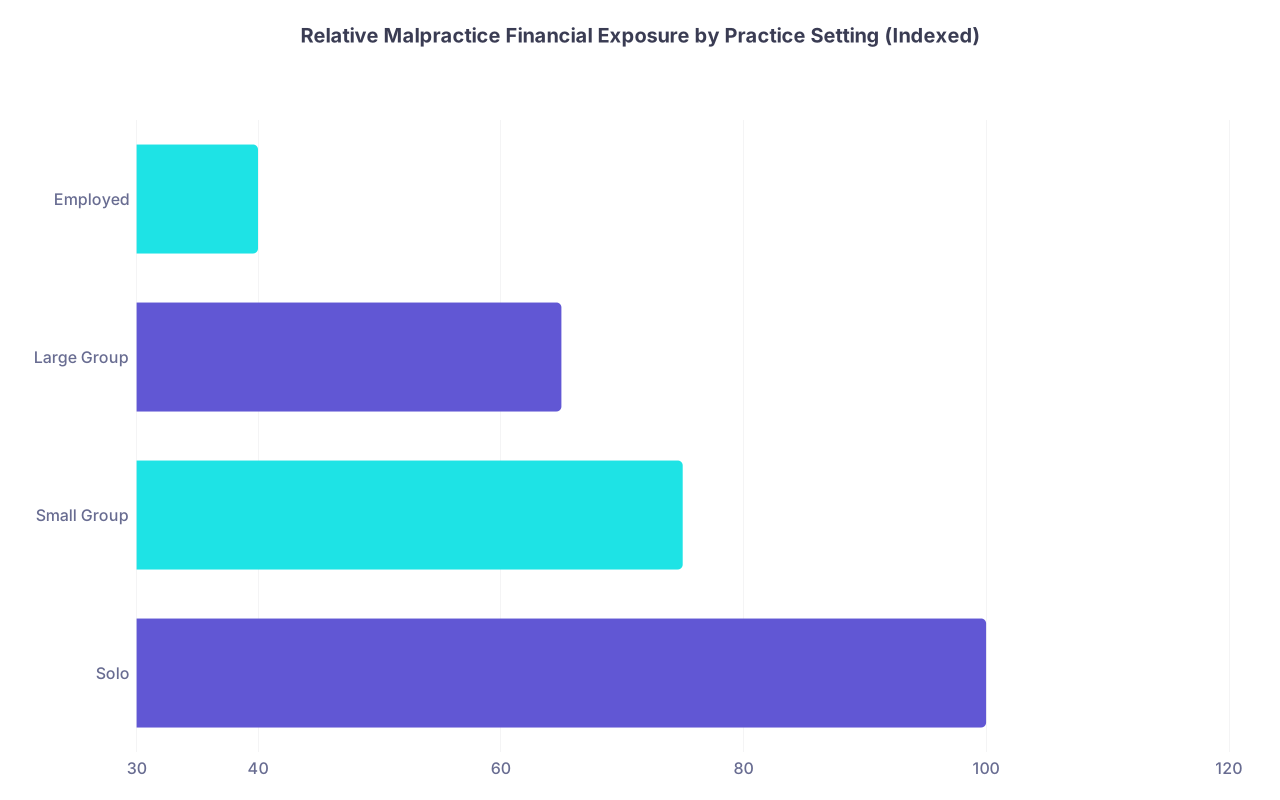
Here is where the numbers help clarify the trade:
| Category | Value |
|---|---|
| Solo | 100 |
| Small Group | 75 |
| Large Group | 65 |
| Employed | 40 |
Index “100” as the baseline financial exposure (combination of premiums paid personally + risk of uncovered loss) for a solo physician. A realistic pattern: small groups cut that exposure by about 25 percent, large groups by 35 percent, and employed practice by roughly 60 percent. You gain financial protection. You lose control.
The problematic blind spots in employment
The phrase that gets employed physicians sued without coverage is simple: “I thought the hospital covered me.”
That assumption fails in specific scenarios:
- Work outside the scope of employment.
You cover an uninsured patient in your private side gig, your moonlighting role, or do informal curbside consults that morph into active care. The hospital policy often excludes these, or only covers within a specific site and role. - Tail coverage when you leave.
Many hospital policies are claims-made with coverage extended only while you are an employee. When you leave, the system may or may not provide tail. Some do; some require you to pay a portion; some provide tail only if you meet specific service year thresholds. - Low individual limits in a high-stack claim.
In massive multi-defendant claims, the institution might have a single aggregate limit. If that gets consumed by multiple parties, your effective protection may be lower than the nominal per-physician number suggests.
From a malpractice insurance standpoint, employment does significantly reduce your direct financial risk. But it concentrates your career risk in the hands of your employer’s risk management decisions.
Comparing Claim Patterns by Setting: Frequency, Severity, and Cost
Let me pull the threads together into a basic comparative model using realistic, though generalized, numbers. Assume a high-risk specialty over a 10-year horizon.
Consider three dimensions per physician:
- Claim frequency – number of claims (including dismissed) over 10 years
- Paid claim probability – chance of at least one indemnity payment
- Expected personal financial exposure – premiums you pay + expected uncovered loss
A reasonable set of directional estimates:
- Solo:
- 0.6–0.8 claims per physician over 10 years
- 0.20–0.25 probability of at least one paid claim
- Highest personal premium cost; moderate risk of uncovered loss if poorly managed
- Group (10+):
- 0.6–0.8 claims per physician (similar), but more defendants per claim
- 0.18–0.23 probability of at least one paid claim per physician
- Lower premium per physician; slightly better defense and loss outcomes
- Employed:
- 0.5–0.7 claims per physician over 10 years in many settings
- 0.15–0.20 probability of at least one paid claim naming that individual
- Minimal direct premium; uncovered risk mostly limited to out-of-scope work and tail gaps
You will not find these exact numbers on a glossy flyer, but they are consistent with large carrier and AMA-aggregated data: practice setting shifts risk modestly in frequency and severity, and significantly in who bears the cost.
Practical Implications: How to Align Malpractice Strategy with Practice Setting
This is where malpractice stops being a theoretical legal topic and turns into a financial decision.
If you are in (or considering) solo practice
You do not have the luxury of being casual about coverage structure. The data show you are both the most exposed and the least naturally diversified.
For solo physicians, three decisions matter disproportionally:
- Policy type and limits.
Claims-made vs occurrence is not just academic. Claims-made usually has a lower first-year premium but requires explicit tail at the end. Occurrence costs more annually but removes the tail chess game. If you choose claims-made (most do), do not downshift limits to save a few thousand dollars. The tail-end risk is not linear; a few large verdicts can wipe out the “savings” of lower limits many times over. - Tail funding plan.
Treat tail like a retirement liability. If your tail will cost 1.5–2 times your mature premium at retirement, build that into your financial plan. If your mature premium is $40,000/year, a tail might be $60,000–$80,000. That is not a surprise expense you want at age 65. - Risk management as a premium reduction lever.
Carriers give tangible discounts—often 5–15 percent—for completing structured risk management programs, EMR optimization, or documentation initiatives. In solo practice, that is pure arbitrage: invest time once, reduce premium for years.
If you are in group practice
Do not assume “the group handles it” is the end of the conversation. The real questions are:
- How is the premium allocated among partners and associates?
- What happens to your coverage and tail if the group:
- Changes carriers?
- Merges with another entity?
- Dissolves?
You want explicit, written terms on:
- Who funds tail if you leave voluntarily.
- Who funds tail if they terminate you without cause.
- How prior acts are treated if the group changes carriers (is prior acts coverage purchased, or are you all on your own for legacy risk?).
I have seen physicians effectively “taxed” tens of thousands of dollars at exit because they never read the partnership agreement’s malpractice section.
If you are employed
Employment does not end your malpractice decision-making, it just shifts it.
You still need to:
- Obtain written confirmation of your coverage:
- Policy type (claims-made vs occurrence)
- Limits
- Whether tail is provided if you leave, and under what conditions
- Carry separate coverage for side work: locums, telemedicine, moonlighting. Do not assume the hospital umbrella extends to that. It usually does not.
- Understand the reporting and discipline loop.
A single paid claim might trigger internal reviews, remediation plans, or even non-renewal. The legal cost is covered; the career cost is not.
The data show your financial exposure is lowest in employed settings, but the dependency risk is highest. You are tying your legal and reputational fate to an institution’s risk appetite.
The Bottom Line
Three main points, without sugarcoating:
Practice setting changes both the probability distribution and the cost structure of malpractice risk. Solo physicians face higher per-physician premiums and more concentrated exposure. Groups and employers dilute and redistribute that risk, but they do not eliminate it.
The worst malpractice outcomes rarely come from the claim itself. They come from coverage gaps: no tail, wrong policy scope, or false assumptions about who is covered when. Those are avoidable with clear contracts and a basic understanding of how your practice structure interacts with your policy.
You should choose malpractice structure as deliberately as you choose your specialty. Solo, group, or employed is not just a lifestyle or income decision. The data show it is also a risk-financing decision, and ignoring that fact is how otherwise smart physicians end up financially exposed in the one area they thought someone else “handled.”