
The malpractice clauses in most physician employment contracts are booby-trapped—and attendings sign them blind every year.
I’ve watched smart, clinically excellent physicians lose six figures, delay retirement, and even avoid changing jobs for years because of one thing: they never truly understood the malpractice section of their first contract. HR understood it. The hospital’s legal team definitely understood it. The physician? Not a chance.
Let me walk you through what actually happens behind closed doors when those clauses are written, revised, and—quietly—enforced.
How Malpractice Is Really Decided Before You Ever See the Contract
Here’s the part no one tells you: that “standard malpractice language” your recruiter shrugs at was almost never written with you in mind.
It’s written to protect:
- The hospital’s balance sheet
- The practice owner’s future sale price
- The system’s ability to cut you loose with minimal financial drag
Your risk? That’s an afterthought, unless you force it to the front.
I’ve sat in meetings where the conversation went like this:
“If we shift to claims-made and make them buy their own tail, our long-term liabilities drop off a cliff in 3–5 years.”
“Will they push back?”
“Most don’t even ask. Our bigger problem is when their attorney actually reads it.”
That’s the environment your contract is born in.
So when you see a few bland lines like, “Physician shall maintain malpractice insurance coverage as determined by Employer”—understand: that sentence might be costing you $60,000–$200,000 someday.
Let’s break the quiet landmines.
Claims-Made vs Occurrence: The Decision They Make For You
If you glaze over at “claims-made vs occurrence,” you’re doing exactly what every hospital hopes you’ll do.
The short version:
- Occurrence: Covers you for incidents that occurred during the policy period, no matter when the claim is filed. No tail. More expensive year-to-year.
- Claims-made: Covers you only for claims made while the policy is active (or during an extended reporting period—tail). Cheaper annually. Tail is the monster at the end.
Most employed physicians today are under claims-made. The trick is not which one they use. The trick is: who pays the tail and under what conditions.
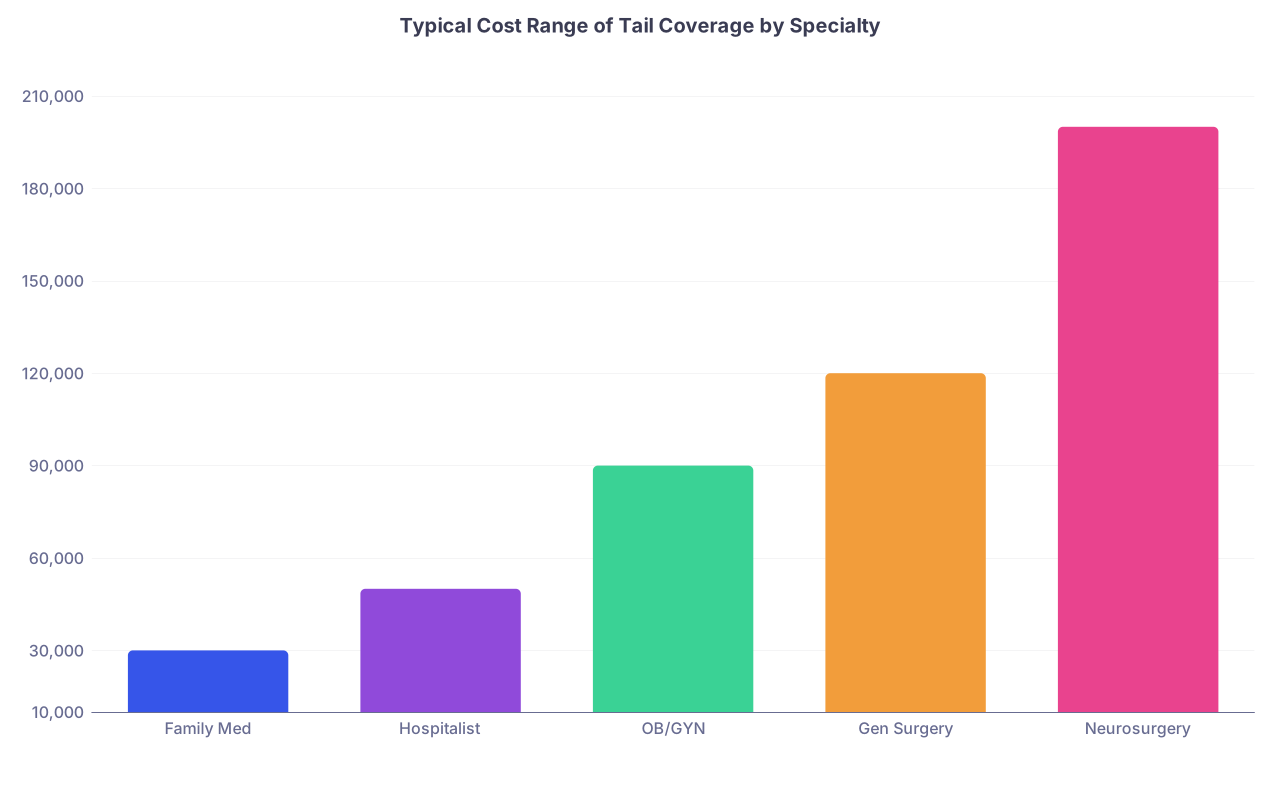
| Category | Value |
|---|---|
| Family Med | 30000 |
| Hospitalist | 50000 |
| OB/GYN | 90000 |
| Gen Surgery | 120000 |
| Neurosurgery | 200000 |
I’ve seen OB/GYNs in the Midwest get tail quotes north of $120,000. Trauma surgeons in big markets? $150k+. That’s not theoretical. Those are real numbers we’ve argued about in real conference rooms.
Now here’s the key: your contract often never states the actual coverage type, limits, or whether a tail is needed. It just says:
“Employer shall provide professional liability insurance”
or worse:
“Physician shall be responsible for any tail coverage required upon termination.”
Most attendings never ask:
- Is this claims-made or occurrence?
- What are the limits (per claim / aggregate)?
- Do I need tail if I leave?
- Who pays for it in specific termination scenarios?
And that’s how they get trapped.
The Tail Coverage Trap: The Clause That Quietly Owns You
The most weaponized malpractice language in your contract isn’t the “coverage” paragraph. It’s the termination + tail paragraph.
Here’s how it’s often structured behind the scenes.
HR/legal wants three things:
- Be able to let you go cheaply
- Push long-term risk away from the organization
- Keep the language “standard” so you don’t question it
So they bake in language like:
“Upon termination of this Agreement for any reason, Physician shall be responsible for obtaining and paying for tail coverage…”
or the slightly “friendlier” version:
“Upon termination by Physician without cause or by Employer for cause, Physician shall be responsible for tail coverage.”
On paper, that looks “fair.” In practice, it’s brutal.
Here’s what actually happens:
You join a group. You’re told, “We provide malpractice, don’t worry.” Five years pass. You get good. Maybe too good. You now have leverage on the market.
You get an offer at a competing hospital with a $60k salary bump and saner call. But your current contract says you owe $80k in tail if you leave voluntarily.
You do the math:
- New job: +$60k/year
- Tail: -$80k upfront
That first year, you’re negative. If you have loans, a mortgage, or childcare, that can be enough to keep you shackled to a job you’ve outgrown.
That’s not an accident. That’s a retention strategy.
And here’s the twist most physicians miss: tail responsibility is usually asymmetric. The employer almost never owes you anything if they terminate you without cause, unless you force that into the contract.
Smart attendings fight for language like:
“If Employer terminates Physician without cause or Physician terminates for cause, Employer shall be solely responsible for any required tail coverage.”
That one sentence can save you six figures.
The Hidden Malpractice Landmines Buried in “Standard” Language
Let’s walk through the specific clauses attendings skim—and regret later.
1. “As Determined by Employer”
Language you see:
“Physician shall be covered under Employer’s professional liability policy with limits as determined by Employer.”
Translation:
“We can change coverage type, limits, or carriers whenever we want, and you’ll live with it.”
I’ve seen groups quietly drop from $2M/$4M policies to $1M/$3M to save premiums, then expand the geographic footprint or complexity of cases. Your exposure goes up. Your protection goes down. Your contract? Doesn’t care.
You want explicit language:
- Coverage type (claims-made vs occurrence)
- Minimum limits (e.g., $1M/$3M or better)
- Employer’s obligation to maintain “no less favorable” coverage during the term
Without that, you’re tied to a black box.
2. Termination-Contingent Tail Games
This is where contracts get sneaky.
Common pattern:
“Employer shall pay for tail coverage if Employer terminates Physician without cause, provided Physician has been employed for at least X years and has not engaged in any conduct constituting cause.”
That “cause” term? Drafted by their lawyer, not yours. It’s often defined as:
- Any alleged breach of contract
- Any “unprofessional” conduct (extremely vague)
- Any loss of privileges (which can stem from politics, not malpractice)
- Any failure to meet productivity targets
I’ve watched groups manufacture “cause” to avoid tail liability:
- Suddenly documenting “communication issues”
- Weaponizing a borderline peer review
- Piling on “professionalism concerns”
You think they wouldn’t do that to save $120k? I’ve watched them do exactly that.
You need tail language that’s clean, objective, and symmetric. If they want broad “cause,” you want narrow tail exceptions.
3. “Coverage During Employment Only”
Wording like:
“Employer shall maintain malpractice insurance coverage for Physician during the term of this Agreement.”
Looks innocuous. It’s not.
That sentence can mean:
- They’re not obligated to cover you for incidents reported after you leave
- They’re allowed to switch carriers midstream and not secure prior-acts coverage properly
- They’ve promised nothing about your post-employment exposure
You want the concept of prior acts and extended reporting baked in somewhere. Or at least an explicit statement of who is responsible for post-termination incident reporting.
4. No Protection if the Policy Changes or the Carrier Folds
Here’s one most attendings never even consider.
Carriers merge. Policies get non-renewed. Groups change brokers. If your contract doesn’t say anything about continuity, you’re depending entirely on your employer’s goodwill.
I’ve seen this mess play out:
- Group shifts carriers. New carrier refuses to cover prior acts for certain higher-risk specialties unless specific endorsements are bought.
- Admin decides not to pay extra.
- Physician only finds out when they try to get credentialed at a new place and the gap is flagged.
Your contract needs at least a line tying coverage to continuous prior acts or the employer’s responsibility to address any gaps if they change carriers.
What Program Directors and Faculty Never Truly Explain
Your residency PD told you, “Make sure your job covers malpractice.” Not wrong. Just wildly incomplete.
What they usually don’t walk you through:
- How claims-made traps are used as golden handcuffs
- How employer-paid tail is negotiable—especially if you’re filling a hard-to-recruit role
- How multi-hospital systems have very different internal rules than small private groups
In faculty meetings, I’ve heard attendings tell residents:
“Just make sure they give you malpractice, that’s the main thing.”
Meanwhile, in those same institutions’ admin meetings, someone is saying:
“We shifted tail to providers three years ago, and attrition dropped.”
No one’s lying to you exactly. But they’re not giving you the whole picture, either.
How Different Employers Quietly Structure Malpractice Risk
The type of employer you choose strongly predicts how malignant the malpractice clauses will be.
| Employer Type | Typical Policy | Tail Paid By |
|---|---|---|
| Academic Center | Claims-made | Usually Employer |
| Large Health System | Claims-made | Mixed / Negotiable |
| Private Group | Claims-made | Often Physician |
| Direct Hospital Hire | Claims-made | Often Employer |
| Locums Agency | Occurrence | Agency (no tail) |
These are patterns, not absolutes. But they matter.
If you’re joining:
- A small private group (GI, cards, ortho): expect aggressive tail-shifting. They’re thinking about sale valuations and partner exits.
- A large health system: more standardized language, but less flexible. They’ll tell you, “We don’t change this for anyone.” That’s often a bluff. Sometimes it’s true.
- An academic center: frequently more benign, but I’ve seen them quietly insert tail-shift language for hospital-employed faculty who aren’t technically “university” employees.
Locums is the simplest: usually occurrence coverage, paid by the agency. You walk away clean after assignment. That’s why some attendings do a locums gap year to avoid tail battles when switching jobs.
The Negotiation Reality: What Actually Moves the Needle
Here’s what I’ve seen, over and over, from the other side of the table.
You send back a contract with thirty redlines including malpractice. Legal and admin roll their eyes and sort your changes into three piles:
- ✅ Must-fix (legal compliance issues, obvious errors)
- ❌ No-way (things that set precedent for everyone else)
- 🤔 Maybe (things they’ll trade to close the deal, especially if they’re desperate to fill the role)
Malpractice tail often sits in that maybe pile—if you push, and if they need you.
If you’re a:
- Solo neurologist in a saturated city with no subspecialty training? You have less leverage.
- Fellowship-trained interventionalist, OB in a coverage desert, pediatric subspecialist in a rural region? Your leverage is real.
You don’t have to “win” everything. But you do need to:
- Clarify coverage explicitly in writing. Type, limits, and who pays for tail under each termination scenario.
- Narrow “for cause” definitions that strip you of tail coverage responsibility.
- Create symmetry: If you leave for cause (they breach), they should pay tail.
- Lock in no less favorable coverage: So they cannot quietly downgrade coverage mid-contract.

| Step | Description |
|---|---|
| Step 1 | Receive Contract |
| Step 2 | Find Malpractice Section |
| Step 3 | Ask Employer Clarify |
| Step 4 | Check Tail Responsibility |
| Step 5 | Propose Revised Language |
| Step 6 | Review For Cause Definition |
| Step 7 | Finalize Contract |
| Step 8 | Decide If Risk Worth It |
| Step 9 | Coverage Type Stated |
| Step 10 | Tail Shared Fairly |
| Step 11 | Employer Will Negotiate |
A lot of physicians assume malpractice clauses are non-negotiable. They’re not. They’re just not easily negotiable. There’s a difference.
The Subtle Ways Malpractice Clauses Haunt You Later
The malpractice section doesn’t just matter when there’s a big catastrophic claim. It bleeds into all sorts of things you don’t connect until it’s too late.
Licensing and Credentialing Nightmares
If there’s a coverage gap because of a poorly managed tail or carrier switch, you may discover it:
- When a new hospital’s credentialing office calls and says, “We can’t verify continuous coverage.”
- When a state licensing board asks for an explanation of a coverage lapse.
That’s not hypothetical. I’ve seen physicians delay job starts by months, or even lose offers, over coverage continuity issues that began with vague contract language.
Future Job Moves
Hospitals absolutely look at your malpractice history when hiring:
- Number of claims
- Payouts
- Gaps in coverage
- Inconsistent carriers or policy types
A messy tail situation, or a fight with a prior group over who was supposed to buy it, can generate exactly the sort of paper trail you don’t want.
Selling a Practice or Becoming a Partner
If you’re joining a private group with an eye toward partnership or future sale, malpractice structure affects:
- Buy-in
- Buy-out
- Sale negotiations
I’ve seen buyers of a practice demand:
- Proof of tail coverage for prior physicians
- Indemnification for any pre-sale acts
If your group has been cheap about tail and coverage structure, it can tank or devalue a sale quickly.

| Category | Value |
|---|---|
| Year 1 | 20 |
| Year 3 | 40 |
| Year 5 | 65 |
| Year 8 | 80 |
| Year 10 | 90 |
That “flexibility %” is abstract, but the trend is real: the earlier you lock yourself into toxic malpractice clauses, the harder it is to pivot later.
How to Read Your Malpractice Section Like an Insider
Here’s how I’d tell a senior resident or new attending to read their contract, line by line, when they hit the malpractice area. Not as a lawyer. As someone who’s watched this go sideways.
You’re looking for answers to these questions, in writing:
What type of policy is it?
Claims-made or occurrence. Don’t accept “standard coverage.” That’s not an answer.What are the limits?
“Adequate” doesn’t mean anything. $1M/$3M is a common benchmark. Some states and hospital bylaws demand more.Who pays for tail, and when?
Break it down:- If you terminate without cause
- If they terminate without cause
- If either party terminates for cause
- If the contract non-renews after expiration
How is “cause” defined?
If cause is vague, your tail “protection” is fake. They can yank it whenever it’s financially convenient.What happens if the employer changes carriers or structure?
Any language guaranteeing continuous coverage or addressing prior acts? If not, you are trusting them blindly.
If you can’t answer all five cleanly from your contract, you don’t understand your malpractice exposure yet.
Get it reviewed. By someone who reads physician contracts for a living, not your cousin who “does real estate closings.”
A Quick Reality Check: What You Can Actually Afford to Ignore
You can’t fix everything. Some groups truly won’t budge. Some markets are cutthroat. You might reasonably accept some risk for your dream job, your family’s needs, or your long-term plan.
But you should make those tradeoffs consciously.
Here’s where I’d draw the line if I were in your shoes:
- Completely vague malpractice language with no clarity on type, limits, or tail responsibility? That’s a no.
- You pay all tail, regardless of termination cause, in a high-risk specialty? For most people, that’s a very expensive set of handcuffs.
- Broad “for cause” definition that nukes tail coverage on almost any negative evaluation? That’s an abuse of power waiting to happen.
If you knowingly accept those, fine. But at least you’ll understand that you’re buying a paycheck with a built-in trap attached.

Frequently Asked Questions About Malpractice Clauses
1. Is employer-paid tail coverage a realistic ask, or will I just get laughed out of the room?
It’s realistic, but it’s very context-dependent. In high-need specialties (OB, anesthesia, EM, GI, interventional anything), hospitals and groups will sometimes concede full or partial tail coverage. I’ve seen deals where:
- Tail is fully employer-paid after a certain number of years of continuous service.
- Tail is split 50/50 if the physician stays beyond a threshold.
- Tail is employer-paid if they terminate you without cause or you leave for a defined “good reason” (cut in comp, relocation, loss of support staff, etc.).
You won’t always win this. But if you don’t ask, you’ll never know what was on the table.
2. If my new employer offers to cover “nose” coverage instead of tail, is that just as good?
“Nose” coverage is prior acts coverage written into your new policy instead of buying tail on the old one. When it’s done correctly, it can functionally replace tail. When it’s done sloppily, you end up with gaps.
Problems I’ve seen:
- New carrier refuses to cover certain high-risk years or certain specialties.
- Coverage limits or definitions change, leaving gray zones for old incidents.
If the new employer is serious about nose coverage, you want confirmation in writing that it will fully cover all prior acts from your previous employment, with no gaps, and ideally see it confirmed in the carrier quote or binder.
3. Does it ever make sense to voluntarily pay my own tail?
Sometimes, yes. If:
- The new job is dramatically better long-term (comp, lifestyle, partnership track).
- Tail cost is painful but not ruinous.
- The alternative is staying in a toxic or dead-end environment.
I’ve seen attendings swallow a $40–80k tail hit to escape a malignant group and double their income in three years. That’s a rational, if painful, move. But you should make that decision eyes open, not blindsided after signing your first contract.
4. How do I know if my coverage limits are “enough”?
Look at three things:
- State norms and any statutory minimums.
- Hospital bylaws for where you’ll be credentialed.
- Specialty risk profile and typical claim sizes in your region.
In many states, $1M/$3M is a standard floor. Some higher-risk environments or large academic centers go to $2M/$4M or more. If your employer is offering less than what other physicians in your specialty and region carry, that’s a red flag they’re cutting corners to save premium dollars.
5. What’s the fastest way to spot a dangerous malpractice clause in my contract?
Go straight to the termination section and find the words “tail coverage,” “extended reporting,” or “professional liability.” If you see:
- “Physician shall be solely responsible for any tail coverage upon termination for any reason” – that’s high-risk.
- Or there’s no mention at all of tail despite a claims-made policy – also high-risk.
Then look up “cause” in the definitions. If “cause” is so broad that almost anything negative could qualify, and your tail protection disappears under “cause,” you’re holding a grenade with the pin halfway out.
Years from now, you won’t remember every RVU or call shift from your first job. But you will remember if a single vague sentence about malpractice locked you into a bad situation or cost you a year’s salary. Read that section like your future depends on it—because, financially, it does.