
It is 10:30 p.m. You are sitting at your kitchen table, half-packed moving boxes around you, contract from your new job signed weeks ago. You open an email from your old practice’s administrator:
“Just a reminder—your malpractice tail quote came back: $186,400. We need to know how you want to proceed before your last day.”
You re-read the number. You do not have $186,400. You signed your new contract months ago. And suddenly you realize: no one ever really explained tail coverage to you.
This article is about not becoming that physician.
Tail coverage mistakes are quiet. They do not blow up your life immediately. They sit in the background, tied to your license and your name, and then surface when you least want them to—during job changes, divorces, disability, retirement, or a malpractice claim years after you left a job. I have watched people lose six figures, bargaining power, and peace of mind because they did not understand a handful of key details.
Let me walk you through the traps that cause real financial and legal damage—and how to avoid them.
Trap #1: Not Understanding What Tail Coverage Actually Is
Too many physicians “kind of” understand tail. “It covers me after I leave,” they say. That is correct but dangerously incomplete.
Claims-made malpractice policies only cover you if:
- The alleged incident happened while the policy was active, and
- The claim is reported while the policy is active.
When you leave a job and that claims-made policy terminates, that second condition disappears. You are naked for any allegations from your time there, unless you have tail (also called an extended reporting endorsement) or you get comparable “prior acts” coverage from a new carrier.
The key point everyone underestimates:
Tail does not cover future work. It covers your past.
What I have seen go wrong:
- A hospitalist leaves after 5 years, assumes she is “covered” because nothing has ever happened. Two years later, a stroke misdiagnosis from year 3 generates a claim. The old group’s policy is closed. She has no tail. Now she is the personal target.
- An OB/GYN moves states. Malpractice from a shoulder dystocia 18 months before he left surfaces. The prior group had claims-made, no tail was purchased, new carrier excluded retroactive coverage. Catastrophic.
If you remember nothing else:
Claims-made + no tail + no valid prior acts coverage = you personally on the hook.
Trap #2: Ignoring the Difference Between Occurrence and Claims-Made
Some of you already think, “My policy is occurrence; I do not need to worry.” That complacency is its own trap.
Occurrence coverage: If the incident happened during the policy period, you are covered, no matter when the claim is filed. No tail needed.
Claims-made coverage: Incident and claim must both fall while coverage is “active” (or extended via tail).
Most private practice groups, hospital-employed positions, and locums arrangements use claims-made because it is cheaper upfront. That lower annual premium is the bait. The expensive hook is the tail.
Here is what physicians frequently misunderstand:
- “The group said they would handle my malpractice.”
Translation: They pay the annual premium while you are there. That says nothing about who pays for tail when you leave. - “I have always had coverage with the same carrier.”
That does not mean you have occurrence coverage. It may be claims-made with a retroactive date. New policy, same carrier, different entity—your continuity is not guaranteed.
At minimum, you must know 3 things about your current policy:
- Is it occurrence or claims-made?
- If claims-made, what is your retroactive date (the date from which coverage begins)?
- Who is contractually responsible for tail if the policy terminates?
If you cannot answer those in under 30 seconds, you are a target for the next trap.
Trap #3: Signing Contracts That Bury Tail Responsibility in Lopsided Clauses
This is where I see the most career damage. The malpractice section of your employment contract is dull, legalistic, and often skimmed over while you focus on salary, call schedule, and bonus structure. Bad idea.
Common ugly clause I routinely see (with small variations):
“Employer shall provide claims-made malpractice coverage. Upon termination of employment for any reason, Physician shall be solely responsible for the cost of any tail coverage.”
That last sentence can easily be a $80,000–$300,000 line you casually accepted.
Let me translate how different versions of these clauses burn you.
| Clause Type | Who Usually Gets Hurt |
|---|---|
| Physician always pays tail | Any physician leaving before retirement or partnership |
| Employer pays only if they terminate without cause | Physicians who resign for any reason (relocation, family, burnout) |
| Tail cost split 50/50 if within first X years | Early leavers; short-tenure physicians |
| Graduated responsibility (0–5 years) | Those leaving in the “worst” years (often years 2–4) |
| Employer pays tail only at retirement | Everyone who makes a normal career move before “retirement” |
The nastiest trap: asymmetric triggering conditions.
Example:
- If they terminate you “with cause” → you pay tail.
- If you resign for “any reason” → you pay tail.
- If they terminate “without cause” → maybe they pay, maybe you split it, or they pay only after X years.
This is not hypothetical. I have seen:
- A cardiologist terminated “with cause” for “unprofessional behavior” because he refused to increase RVUs to an unsafe level. They then cited that to stick him with a $220,000 tail.
- A pediatrician who left after 18 months when her spouse matched to a different city. Her contract said: tail is hers if she terminates within 36 months “for any reason.” Her new job offer did not include prior acts coverage. She wrote a personal check for more than her after-tax annual income.
Here is what you must not do:
- Do not sign any contract where “physician shall be solely responsible for tail” under all or most scenarios.
- Do not accept language that ties employer responsibility only to “retirement” or to extremely narrow circumstances.
- Do not believe verbal reassurances like, “We always help with tail; we just cannot put it in writing.”
If it is not explicitly written, you cannot rely on it. End of story.
Trap #4: Underestimating How Big the Tail Bill Actually Is
Most residents and fellows hear “tail” and imagine something like $15,000–$30,000. Then they see the quote.
Tail is not cheap. It is often:
- 1.5–2.5 times your annual claims-made premium, sometimes more.
- Due as a lump sum within a short window at the end of employment. No 10-year payment plan. No 0% financing.
Typical rough ranges (do not use these as exact quotes, but as a reality check):
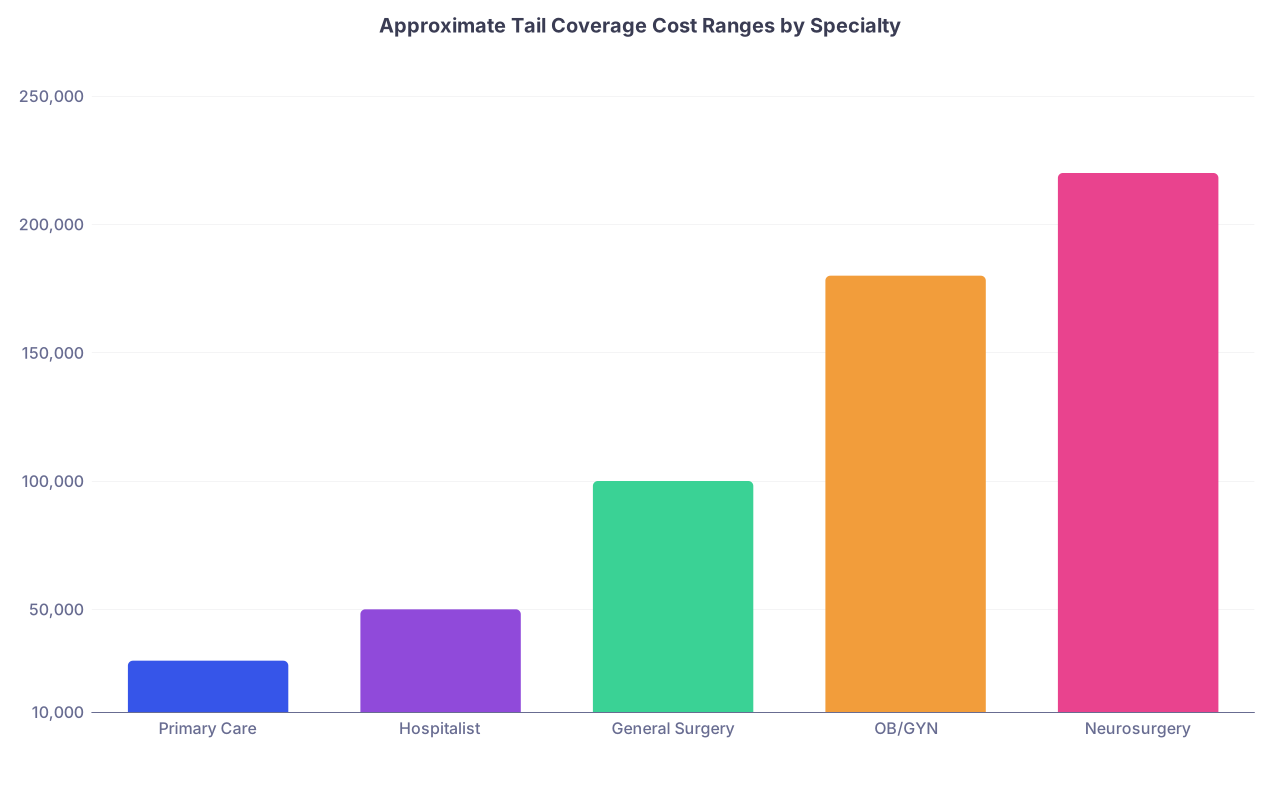
| Category | Value |
|---|---|
| Primary Care | 30000 |
| Hospitalist | 50000 |
| General Surgery | 100000 |
| OB/GYN | 180000 |
| Neurosurgery | 220000 |
Here is where physicians step into financial traps:
No savings plan
They assumed they could “just pay it” out of a future bonus. Tail is due when you exit, not when you feel ready to afford it.Underestimating specialty risk
OB, neurosurgery, spine, emergency medicine, anesthesia with pain—these fields can have massive premiums and corresponding tails.Ignoring state environment
High-litigation states (NY, FL, CA, PA, NJ, some parts of TX) can generate eye-watering quotes compared to low-claim states. Same specialty, different state, 2–3x cost.Jumping jobs frequently with claims-made each time
Each job change without prior acts coverage or negotiated tail responsibility can mean repeated multi–five-figure checks over a career.
If you are in a high-risk specialty on claims-made coverage and you have not directly asked your broker or HR, “What is my current annual premium and the estimated tail cost?” you are flying blind.
Trap #5: Assuming Your New Employer Will “Just Pick Up” Your Prior Acts
This one ends careers in very quiet but painful ways.
Prior acts (or “nose”) coverage means the new carrier agrees to cover your past acts back to a specific retroactive date, so you do not have to buy tail from the old policy. Sounds great. In practice, several hurdles:
- New employer’s carrier may refuse to pick up prior acts at all, especially for high-risk specialties or in certain states.
- They may offer it only if you have a totally clean claims history. A single prior claim (even closed with no payment) can lead to a “no thanks.”
- They may technically agree, but your offer is contingent on underwriting. You sign your resignation letter, then underwriting declines, and now you must buy tail anyway.
The trap sequence I have seen more than once:
- Physician is told informally: “Our plan generally picks up prior acts, so you will not need tail.”
- Physician resigns from old job.
- Underwriting at new group says: “We will cover you starting on your start date only; no retro coverage.”
- Old employer says: “You are no longer on our policy. Buy your own tail.”
- Physician is cornered and forced to either:
- Delay starting new job (and risk the offer), or
- Take on six-figure tail debt.
You avoid this by being annoyingly explicit:
- Ask the new employer in writing:
- Will your malpractice carrier cover my prior acts back to [retro date]?
- Is my offer contingent on underwriting agreeing to this?
- If underwriting refuses prior acts, who will pay my tail?
If you do not have clear written answers, you must assume you may need to fund tail yourself.
Trap #6: Not Understanding How Timing and Claims Affect You Years Later
Tail is about time. And time is where people miscalculate.
Common timing mistakes:
- Leaving a job on December 31, thinking the policy covers the whole year and you are safe. The policy ends when they cancel it, which is tied to your employment end date and their contract—not the calendar.
- Taking a 3-month gap and assuming “nothing can happen now.” The claim can be filed years later. The clock on the statute of limitations in many states is based on discovery, not incident date, especially in pediatrics.
Then there is the underappreciated part: your personal claims history can haunt you.
Every time you apply for new malpractice coverage, licensure, or hospital privileges, you will answer versions of:
- “Have there been any malpractice claims, settlements, or judgments against you?”
- “Have you ever had an application for malpractice insurance denied or coverage non-renewed?”
- “Do you currently maintain tail coverage for all prior claims-made policies?”
A gap in coverage for previous work is a giant red flag. It makes insurers nervous. It makes hospitals nervous. And yes, I have seen offers withdrawn when a candidate’s prior coverage situation looked messy or incomplete.
Think long term:
- Residency/fellowship claims-made coverage with no tail (and no coverage at your next employer) can create confusion later, especially if there was an incident still in play.
- Locums work through multiple agencies, each with their own policies and retro dates, can be a nightmare if one agency never extended tail and then disappeared.
You need your malpractice coverage story to be coherent and defensible on paper.
Trap #7: Believing “I Am a Good Doctor, This Will Never Matter”
This is the ego trap. It is subtle and widespread.
I have had excellent clinicians tell me:
- “I am conservative; I do not get sued.”
- “Our group is very careful; claims are rare.”
- “My specialty is low risk; I am not OB or neurosurgery.”
Then I watch those same people get dragged into lawsuits as part of a team:
- The ER doc, the radiologist, and the hospitalist all named in a delayed sepsis case.
- The anesthesiologist and CRNA pulled into a bad outcome they did not directly cause.
- The PCP named because they saw the patient six months before the acute event.
Your personal skill does not insulate you from being named in a complaint. Plenty of rock-solid physicians get sued as part of a larger, messy clinical picture.
Here is the ugly twist:
You may be exonerated later, but the defense cost and settlement exposure exist from day one. Without tail or valid prior acts coverage, that cost is yours.
A Simple Flow: How to Protect Yourself From Tail Traps
You need a mental checklist. Here is the basic flow you should run before signing any new contract or leaving any job.

| Step | Description |
|---|---|
| Step 1 | Current Job |
| Step 2 | Identify Policy Type |
| Step 3 | Confirm No Tail Needed |
| Step 4 | Find Retro Date and Tail Clause |
| Step 5 | Estimate Tail Cost |
| Step 6 | Review New Job Offer |
| Step 7 | Get Written Confirmation |
| Step 8 | Negotiate Tail Responsibility or Budget Personally |
| Step 9 | Align End/Start Dates |
| Step 10 | Keep All Policy and Tail Documents |
| Step 11 | Claims-made or Occurrence |
| Step 12 | New Employer Covers Prior Acts |
Not pretty. But necessary.
Table: Questions You Must Ask Before Accepting a Job
| Question | Who To Ask |
|---|---|
| Is your malpractice coverage claims-made or occurrence? | HR / Practice Administrator |
| What is my retroactive date and will it be maintained if I change entities within your system? | Malpractice broker / Risk management |
| Who pays for tail in each termination scenario (with cause, without cause, resignation, retirement)? | HR / Legal |
| Will your carrier provide prior acts coverage for my current retro date? | New employer's risk management |
| What is the estimated tail cost today for someone in my specialty and region? | Current insurer / Broker |
If you do not have complete, written answers to every row above, you are setting yourself up for surprises.
Trap #8: Letting Emotions and Urgency Override Cold Legal Reality
You get a dream job offer. Better pay. Less call. Closer to family. The start date is tight; they want you in 90 days.
So you rush:
- You do not let your attorney fully mark up the malpractice section.
- You accept the recruiter’s “we always help with tail” comment at face value.
- You submit a resignation letter to your current job before you have written confirmation about prior acts coverage.
This is how otherwise intelligent, cautious people end up with non-dischargeable debts (yes, some malpractice-related obligations can follow you even through bankruptcy). You absolutely cannot let the emotional excitement of a new role push you into skipping the boring details.
You must do the opposite:
The more attractive the job, the more carefully you scrutinize the malpractice section. Because that is where employers hide the cost of offering you that appealing compensation package.
Trap #9: Treating Tail as a Solo Problem Instead of a Negotiation Point
Last point, and it is a big one: physicians treat tail as an unavoidable personal expense. They assume, “This is just how it is.”
Wrong. Tail is a negotiation lever, and groups expect it—especially for in-demand specialties.
You can and should negotiate:
- Employer pays 100% of tail after X years of service.
- A graduated structure that is actually reasonable (e.g., 0% year 1, 50% year 2, 100% year 3+).
- Employer pays tail if they terminate without cause for any reason.
- Employer pays tail if you leave due to spouse relocation, disability, or major health event.
- Signing bonuses or retention bonuses explicitly earmarked for tail.
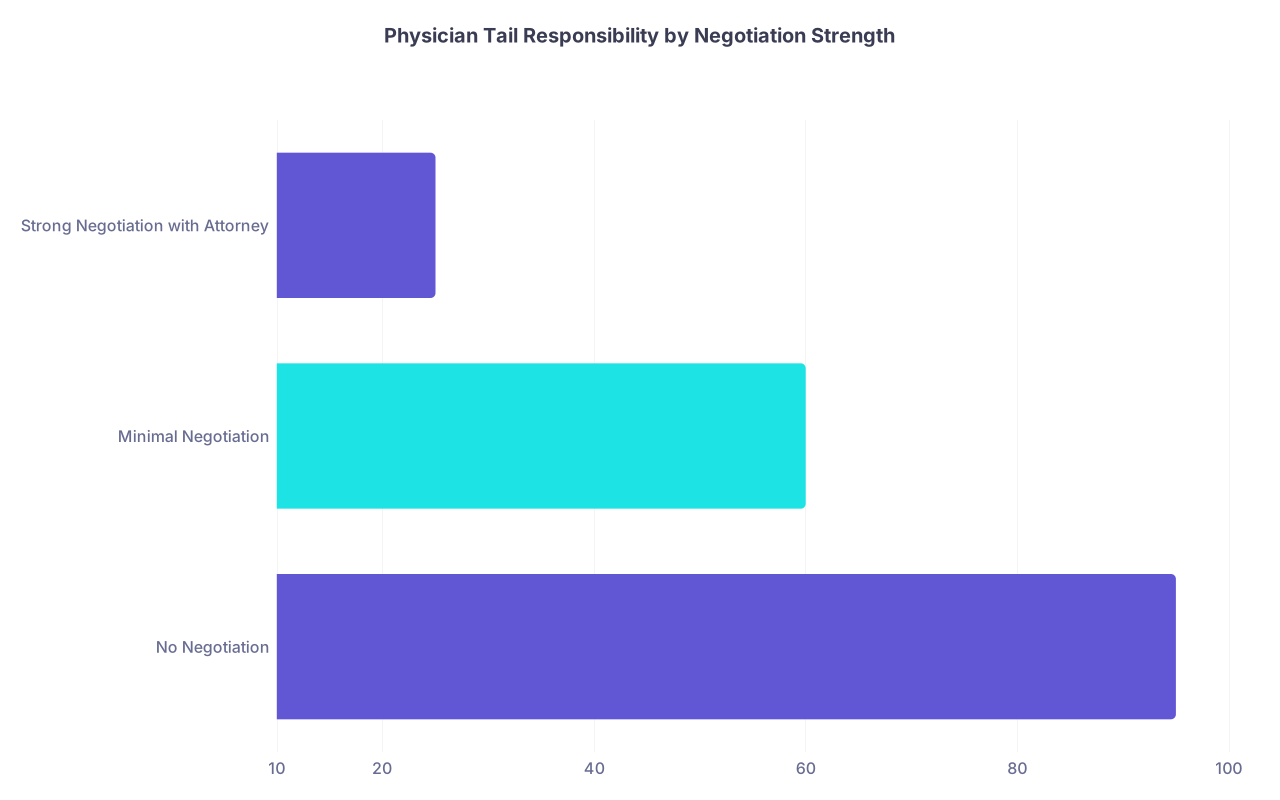
| Category | Value |
|---|---|
| No Negotiation | 95 |
| Minimal Negotiation | 60 |
| Strong Negotiation with Attorney | 25 |
Do not make the mistake of negotiating only salary and ignoring the malpractice/tail clauses. I have seen physicians gain an extra $20,000 in base pay but quietly assume a quarter-million in potential tail obligation. That is not a win.
Pay a healthcare attorney a few thousand dollars once to review your contract and malpractice language. That is not a luxury. It is risk mitigation.
FAQ (Exactly 5 Questions)
1. How far in advance should I start dealing with tail coverage when changing jobs?
At least 6 months before you plan to leave, ideally as soon as you start seriously considering a move. You need time to:
- Confirm your current policy type, retro date, and tail responsibility.
- Get a rough tail estimate from your current carrier.
- Negotiate prior acts coverage and/or tail responsibility in any new offer.
- Adjust your savings plan if you may need to self-fund tail.
Waiting until you have already given notice—or worse, until after your last day—is one of the most common and expensive timing mistakes.
2. Is it ever reasonable for physicians to pay for their own tail?
Sometimes, but it should be the exception, not the default. It can be reasonable when:
- You are joining a tiny practice that truly cannot afford to fund tail and you are getting equity, control, or unusually high compensation in return.
- You are leaving a job very quickly (e.g., toxic environment) and need to exit fast; you “buy your freedom” with a tail payment.
- The amount is relatively small (low-risk specialty, short tenure, low premium state) and the new opportunity is significantly better.
What is not reasonable is a large hospital system or well-capitalized group shifting all tail risk to you while keeping all the structural and financial benefits.
3. What happens if I simply do not buy tail coverage after leaving a claims-made policy?
You create a coverage gap for all prior acts under that policy. If a claim later arises from care you provided while that policy was active:
- The old carrier will deny coverage because the policy is no longer active and no tail exists.
- Your new carrier will usually deny coverage if the incident occurred before their retro date or outside their prior acts agreement.
- You can be personally named and pursued for defense costs, settlements, or judgments.
- Future insurers, hospitals, and boards may view you as higher risk due to the coverage gap.
In short: you are gambling your assets, future income, and professional reputation on the hope that no one ever files a claim.
4. Can I switch from claims-made to occurrence coverage to avoid tail?
Sometimes, but it is not as simple as checking a box. Challenges:
- Many employers and large systems have standardized policies; they will not switch just for you.
- Occurrence coverage is more expensive annually; employers often refuse it because of cost.
- Even if you switch going forward, you still have to deal with tail or prior acts for the past claims-made period.
“Switch to occurrence and there is no problem” is usually fantasy. Occurrence is nice if you can get it from the start or in certain independent/locums setups, but it is not a magic retroactive fix.
5. Do I really need a lawyer just to review the malpractice section of my contract?
Need? Strictly speaking, no. But it is foolish not to, especially for your first job or any large career move. A good healthcare attorney will:
- Translate dense malpractice language into plain English.
- Flag one-sided tail clauses and propose balanced alternatives.
- Make sure termination, non-compete, and malpractice provisions interact reasonably.
- Help you use tail as a negotiation point rather than a surprise bill.
Physicians routinely pay more for a vacation than they pay for legal review of a contract that controls six- to seven-figure obligations. That is backward.
Open your current employment contract right now and scroll to the “Professional Liability Insurance” or “Malpractice Coverage” section. Highlight every sentence that mentions “claims-made,” “tail,” “extended reporting,” “prior acts,” “retroactive date,” or “termination.” If you cannot explain each sentence to another physician without guessing, your next step is clear: get those answers in writing before you make your next career move.