
What happens when you get served with your first lawsuit… and you discover the policy you “thought” you had doesn’t actually cover what happened?
That’s the nightmare I’m trying to keep you out of.
Your first attending year is exactly when you’re most vulnerable to malpractice and insurance mistakes. You’re busier than you’ve ever been, more autonomous, more exposed, and still assuming “the hospital handles all that stuff.” That assumption is how physicians get burned.
Let me walk you through the malpractice landmines new attendings step on all the time—financially and legally—and how to avoid joining them.
1. Assuming “I’m Covered” Without Actually Knowing How
The most expensive malpractice mistake? Blind trust.
New attendings routinely assume:
- “The group covers my malpractice.”
- “The hospital has me on their policy.”
- “HR said I’m fine.”
I’ve seen people sign contracts, start work, and only months later realize:
- They have no tail coverage if they leave.
- Their coverage limits are inadequate for their specialty and region.
- Certain procedures they perform are explicitly excluded.
Here’s the ugly truth: if a claim hits and you’re wrong about coverage, you do not get a do-over.
What you need to verify—yourself
Don’t rely on verbal assurances. Get this in writing and/or in the policy docs:
| Item | Target / Example |
|---|---|
| Policy Type | Claims-made or occurrence |
| Limits (per claim/aggregate) | $1M / $3M typical starting point |
| Tail Coverage | Who pays, when triggered |
| Named Insured | You individually vs. entity only |
| Covered Locations | All sites where you actually practice |
You want:
- A copy of the certificate of insurance listing you as an insured.
- Confirmation of policy type (claims-made vs occurrence).
- Written clarification on who pays for tail when you leave.
Do not be the attending who only finds out after resigning that their group expects them to write a $60,000 tail coverage check out of pocket.
Red flag phrases in contracts
Watch for these slippery lines:
- “Malpractice coverage will be provided in accordance with practice policies.”
- “Coverage is subject to change at employer’s discretion.”
- “Physician may be responsible for certain costs associated with extended reporting endorsements.”
Translated: you might be on the hook for tail, higher deductibles, or gaps—and they’ve just reserved the right to change the deal midstream.
2. Not Understanding Claims-Made vs Occurrence (Until It’s Too Late)
You only misunderstand this once. Then you either pay dearly or get lucky.
Here’s the simple version:
- Occurrence policy: Covers incidents that occur during the policy period, no matter when the claim is filed.
- Claims-made policy: Covers claims made (reported) while the policy is active, for incidents that occurred after the “retroactive date.”
Leave a claims-made policy without proper tail or prior-acts coverage, and your past work can become uninsured overnight.
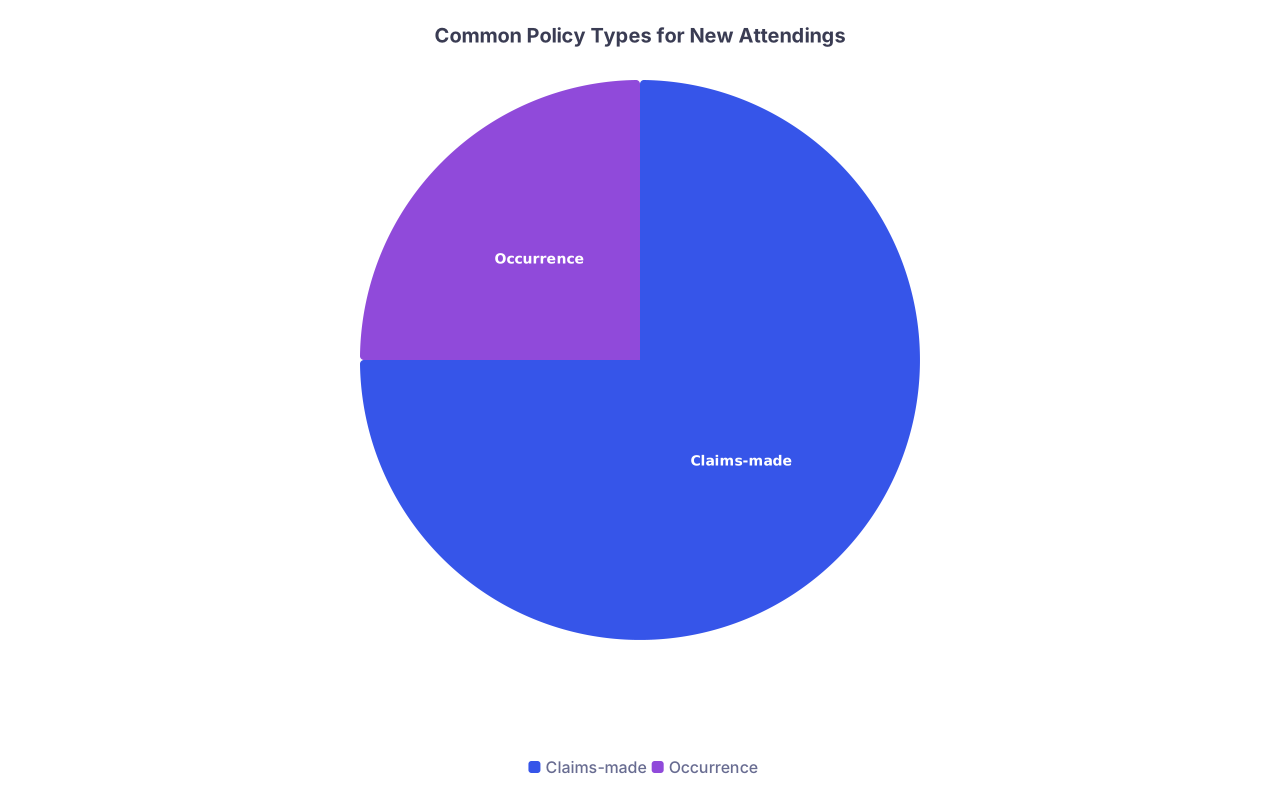
| Category | Value |
|---|---|
| Claims-made | 75 |
| Occurrence | 25 |
The first-year trap
New attendings often:
- Start their first job on a claims-made policy.
- Assume when they leave in 2–3 years, “the new job’s insurance will just cover everything.”
- Don’t realize they need either:
- Tail coverage on the old policy, or
- A new policy that covers prior acts back to their original retro date.
If neither happens? Every patient you saw in that job is now a personal financial risk.
Non-negotiable questions to ask before signing
Ask directly:
- “Is the malpractice policy claims-made or occurrence?”
- “If it’s claims-made, who pays for tail coverage when I leave?”
- “What is my retroactive date?”
- “If I switch jobs, can the new employer’s policy cover prior acts?”
If the answer to “who pays tail?” is vague or “we’ll discuss that later,” that’s not a small detail. That’s a future five-figure problem.
3. Ignoring Tail Coverage (The Silent Budget Killer)
Tail coverage is the classic financial ambush for first-time attendings.
With a claims-made policy, when you leave an employer, you usually need tail to cover:
- Claims filed after you leave
- For incidents that occurred while you worked there
And tail is not cheap.
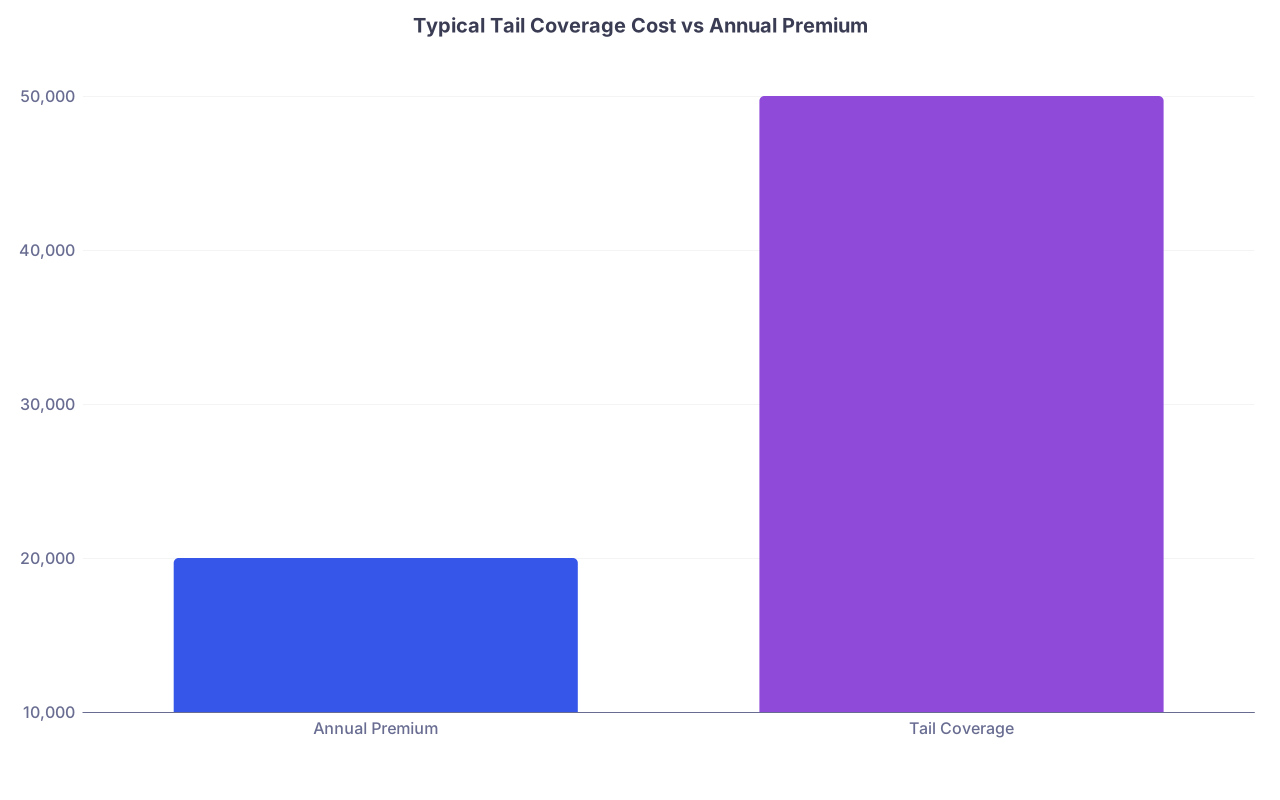
| Category | Value |
|---|---|
| Annual Premium | 20000 |
| Tail Coverage | 50000 |
For many specialties, tail runs around 150–250% of your annual premium. That can easily be $30k–$80k+, depending on specialty and geography.
Common rookie mistakes with tail
Not knowing tail exists
I’ve seen attendings get their “Congratulations!” email on a new job and, two weeks before starting, get hit with a $60,000 tail bill from their old group.Believing “I’ll just stay long enough that they’ll cover it”
Contracts sometimes say, “Employer will pay tail if physician remains for X years.” Physicians leave at year 2.9 of a 3-year requirement. Guess who pays?Assuming the new employer will take care of it
Sometimes they will. Frequently they will not. Especially in competitive markets. Don’t plan on charity.
How to avoid getting wrecked by tail
- Get the tail responsibility spelled out in the contract, in plain language:
- “Employer shall be solely responsible for purchasing tail.”
- Or “Physician shall be responsible for 50% of tail if leaving before 3 years.”
- If you’re paying tail, negotiate:
- A tail-stipend
- A signing bonus earmarked partly for tail
- Or a sliding scale (employer pays more the longer you stay)
And here’s the part almost no one tells you: think about tail before you sign your first job, not when you’re trying to escape a toxic one.
4. Letting Your Side Gigs Go Uninsured
You start moonlighting in the ED. Doing telemedicine. Reading studies for an imaging center. Being “the doc on site” for a med spa. Easy extra cash.
Until you get sued and discover your primary employer’s malpractice policy doesn’t cover any of that.
Most new attendings forget that:
- Employer policies are usually tied to specific locations and duties.
- “Outside activities” are often excluded by default.
- Telemedicine, locums, med spas, cosmetic work can sit in a coverage no-man’s land.

Where people get into trouble
Scenarios I’ve seen:
- Hospitalist moonlights at an LTAC, assumes hospital policy covers them. It doesn’t.
- Internist does cash-pay cosmetic procedures on the side; those procedures are explicitly excluded from their main policy.
- Telehealth work in multiple states; license is fine, malpractice coverage isn’t aligned with all states.
How to handle side work safely
Ask your main malpractice carrier and your employer’s risk management—in writing:
- “Does my current policy cover any practice outside of [hospital/group name]?”
- “Are there any procedures or practice types excluded?”
- “Am I covered in [other state] for telemedicine?”
If the answer is “no,” you need:
- A separate part-time/”moonlighting” malpractice policy, or
- To negotiate add-on coverage if the side gig is significant.
Side money is not worth side personal liability.
5. Underestimating Documentation as a Legal and Financial Shield
Everyone talks about documentation as “good medical practice.” I’m going to be blunt: it’s also your legal armor.
New attendings often:
- Rely on templates and macros without editing them to reality.
- Chart minimally because they’re tired, over paneled, and “no one reads this anyway.”
- Skip documenting phone calls, late-night messages, and patient refusals.
Guess what plaintiffs’ attorneys love? Ambiguity and blank spaces.
The malpractice documentation traps
These are the patterns that hurt you when a case lands:
Copy-and-paste inaccuracies
Old problems still listed as “active,” ROS clearly cloned from prior visits, contradictory statements in the same note.No documentation of clinical reasoning
The outcome was bad, nothing in the note shows you thought carefully, considered differentials, or discussed risks.Missing refusal/ follow-up details
No documentation that you:- Recommended ED evaluation
- Told the patient about warning signs
- Offered tests that were declined
If it’s not documented, in court it often “didn’t happen.”
6. Signing Bad Contracts That Shift Malpractice Risk To You
You’re excited about your first real attending offer. They slide a 20-page employment agreement across the table. You check the salary, PTO, maybe the signing bonus.
You skim the malpractice section. Big mistake.
I’ve seen “standard” contracts include:
- Indemnification clauses requiring the physician to reimburse the employer for legal costs if the employer is sued “because of” the physician.
- Requirements that the physician pay part of the malpractice premium or deductible.
- Provisions where the employer controls settlement decisions completely, even if it harms your reputation.
| Clause Type | Why It’s Dangerous |
|---|---|
| Indemnification | You pay their legal bills |
| Physician pays tail | Huge surprise cost if you leave |
| Large deductibles | You owe money each claim |
| Employer-only control | Settlement may disregard your future |
Watch for these red flags
Phrases like:
- “Physician agrees to indemnify and hold harmless the Employer…”
- “Physician shall be responsible for deductible amounts…”
- “Employer shall have sole authority over litigation and settlement decisions…”
This is where you get your contract reviewed by someone who actually knows physician employment agreements—before you sign.
Not after you’re sued.
7. Misreporting or Hiding Claims and Board Actions
Another massive, career-long mistake new attendings make: they treat reportable events casually.
- Malpractice claims (even dropped ones)
- Board complaints
- Privilege actions
- Formal disciplinary actions
These all live on databases and credentialing forms that follow you for decades.
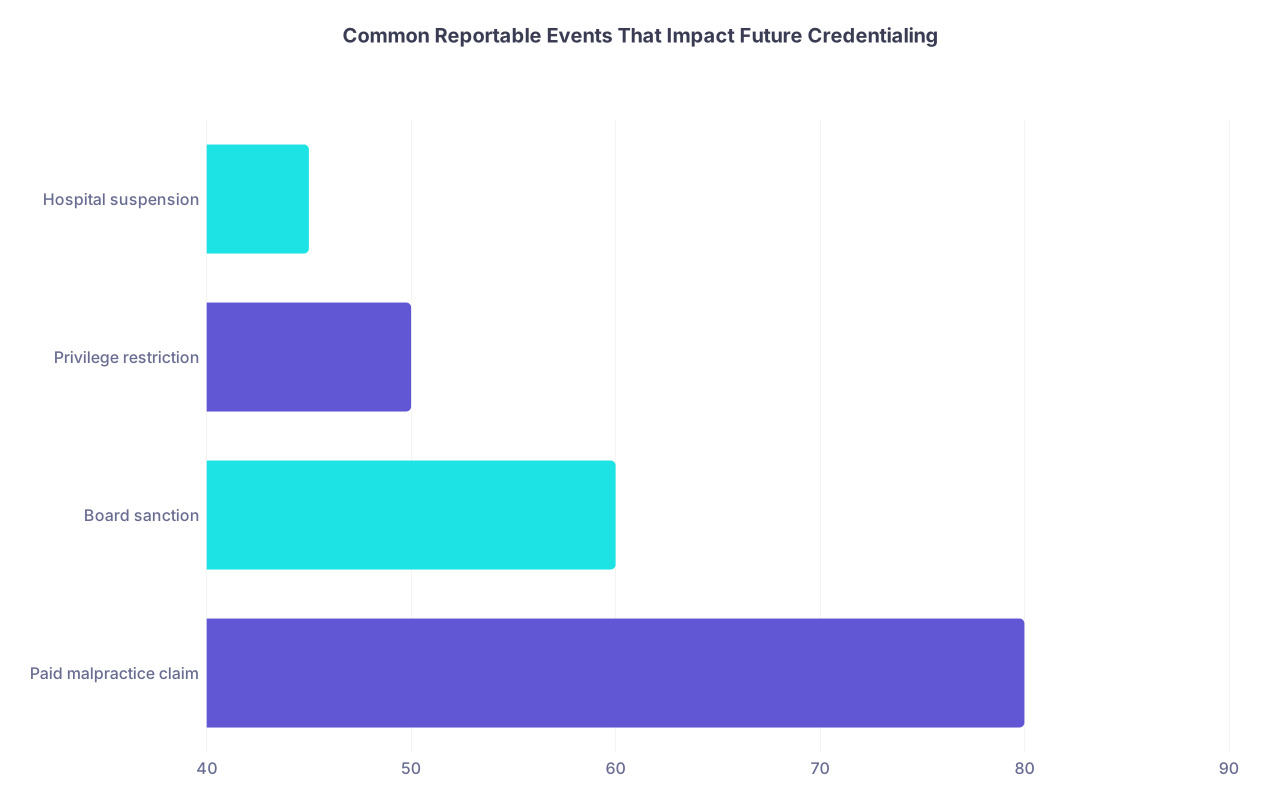
| Category | Value |
|---|---|
| Paid malpractice claim | 80 |
| Board sanction | 60 |
| Privilege restriction | 50 |
| Hospital suspension | 45 |
The mistake is not the event itself, necessarily. It’s lying or “forgetting” to mention it later.
Credentialing forms repeatedly ask variations of:
- “Have you ever had a malpractice claim filed against you?”
- “Have you ever been subject to disciplinary action?”
- “Have you ever had privileges suspended, limited, or revoked?”
If you say “no” when the answer is “yes,” and they find out later—welcome to automatic mistrust. That’s how licenses get scrutinized and jobs evaporate.
What you should do instead
- Report honestly and consistently across all forms.
- Get help from your risk management or an attorney to properly word explanations.
- Keep your own running record:
- Date, case number, insurer, disposition
You can recover professionally from a malpractice claim. Recovering from lying about a malpractice claim is far harder.
8. Not Calling Risk Management or Your Carrier Early Enough
New attendings often wait too long to loop in their malpractice carrier or risk management.
They think:
- “This might blow over.”
- “I don’t want to make it a big deal.”
- “I’ll just apologize and fix it myself.”
Then the complaint escalates into a suit, and the paper trail looks worse because you tried to handle it solo.

| Step | Description |
|---|---|
| Step 1 | Adverse Event Happens |
| Step 2 | Call Risk Management Immediately |
| Step 3 | Document Thoroughly |
| Step 4 | Notify Malpractice Carrier |
| Step 5 | Monitor and Follow Policy |
| Step 6 | Injury or Threat? |
| Step 7 | Patient Complaint or Lawyer Letter? |
Situations where you should call early
- Unexpected bad outcome; patient or family is angry.
- Patient threatens to “get a lawyer” or “sue.”
- You receive a records request from an attorney.
- You get a letter of intent to sue or similar notice.
- Notice of an incident report escalating.
Your carrier and hospital risk team exist to manage exactly this. Use them.
And once you’re in claim territory, stop ad-libbing. Stop “explaining” in ways that sound like admissions of guilt. Stick to factual, non-speculative language and follow guidance from your risk/legal team.
9. Practicing Outside Your Actual Coverage or Competence
Early attendings want to be helpful. You don’t want to look inexperienced. You stretch a bit.
- You take call for a service you’re barely trained in.
- You do a procedure “you saw plenty in residency” but haven’t credentialed for.
- You cover a friend’s clinic, different specialty, different risk profile.
Two separate but related issues here:
Standard of care and competency
If a bad outcome happens while you’re working beyond your documented training/credentialing, your defense is weaker.Policy exclusions
Some policies explicitly exclude:- Certain high-risk procedures
- Certain specialties
- Work outside credentialed privileges
If you want to expand your scope, fine. Do it the right way:
- Get officially credentialed and privileged.
- Confirm coverage with your insurer in writing.
- Get training and support, not just vibes and YouTube.
10. Treating Malpractice Insurance as a One-Time Decision
Last mistake: thinking malpractice coverage is something you set once and forget.
Your risk changes over time:
- You add procedures.
- You pick up new practice sites.
- Your patient volume increases.
- You start doing more telehealth, more high-acuity cases, more admin work.
But most new attendings don’t review their coverage until something goes wrong.

Smart habits that prevent nasty surprises
Once a year, at minimum:
- Review:
- Policy type
- Limits
- Endorsements and exclusions
- Practice locations and covered entities
- Compare:
- Your current scope vs what’s actually covered
- Adjust:
- If you’ve moved, changed employers, expanded roles, or added side work
You don’t need to become an insurance expert. But you need to stop assuming “it’s probably fine.”
Because “probably fine” is not a legal standard.
FAQ (Exactly 5 Questions)
1. Do I really need my own malpractice policy if my employer covers me?
Sometimes yes, sometimes no. If all your clinical work is done exclusively for one employer, their policy might be enough—if it clearly names you, fully covers your scope, and addresses tail when you leave. You absolutely need your own separate policy if you do any work outside that employer: moonlighting, telemedicine, locums, med spa, consulting where you’re actually practicing medicine. The mistake is assuming your employer policy follows you everywhere. It usually does not.
2. How much malpractice coverage do I actually need?
The default you’ll see often is $1M per claim / $3M aggregate. For some high-risk specialties or litigious states, higher limits make sense. You don’t decide this blindly—talk to a broker who deals with physicians in your specialty and region. The bigger mistake isn’t being slightly under- or over-insured; it’s sitting on low limits in a high-risk environment without even knowing your numbers.
3. Is occurrence coverage always better than claims-made?
Not always. Occurrence can be simpler (no tail needed), but it’s often more expensive and not always available through your employer. Claims-made is fine if tail coverage is clearly addressed—ideally paid by the employer after you stay a certain number of years or under specific conditions. The dangerous position is having a claims-made policy and no plan, money, or agreement for tail when you leave.
4. What should I do when I get my first letter from a lawyer or a notice of a claim?
Do not ignore it. Do not respond directly to the lawyer yourself. Immediately notify your hospital risk management and your malpractice carrier, following their reporting process. Keep your communications factual and minimal, and don’t alter or “fix” any medical records. Early, transparent reporting protects your coverage; delays and improvisation can hurt both your defense and your insurer’s willingness to stand behind you.
5. Can I negotiate malpractice and tail coverage as a new attending, or is it all take-it-or-leave-it?
You often have more leverage than you think, especially in hard-to-fill specialties or locations. You might not get everything you ask for, but you can frequently negotiate tail responsibility (shared costs, vesting schedule, employer-paid after certain years), coverage limits, and even extra stipend if you’re expected to carry your own policy. The real mistake is never even trying and accepting the first offer as if it were carved in stone.
Key points:
- Never assume “I’m covered” without confirming policy type, limits, tail, and scope in writing.
- Side gigs, contract clauses, and tail coverage are the three biggest malpractice-related financial traps for new attendings.
- Treat malpractice coverage as a living part of your professional life—review it regularly, ask blunt questions, and don’t sign anything you don’t fully understand.