
Signing an employment contract without dissecting the malpractice terms is how smart physicians end up bankrupt, trapped, or unemployable.
You think the salary is the story. It is not. The malpractice section is where careers quietly bleed out.
I have watched physicians sign “great offers” that hid:
- $80,000 tail bills due 60 days after termination
- Retroactive gaps that left them uninsured for several years of practice
- Contract clauses that let the employer walk away while the physician was still exposed
They did not lose money. They lost peace of mind, leverage, and in a few ugly cases, their licenses.
Let me walk you through the mistakes physicians keep repeating—and the red flags that should make you slow down, ask questions, or walk away.
1. Treating Malpractice Coverage Like a Footnote
The first mistake is psychological. You skim.
You focus on:
- Base salary
- Bonus formula
- Vacation and CME
Then you see a line like “Employer will provide malpractice insurance” and your brain checks the box: “Covered. Good.”
That is how you get burned.
Malpractice insurance in contracts is never just “yes” or “no.” At minimum, you must know:
- Type of policy: occurrence vs. claims-made
- Who owns the policy: you or the employer
- Who pays for tail and when
- Limits of liability
- Whether prior acts (retroactive date) are covered
- What happens when you leave—voluntarily or not
If you cannot answer each of those in one or two clear sentences, you are not ready to sign.
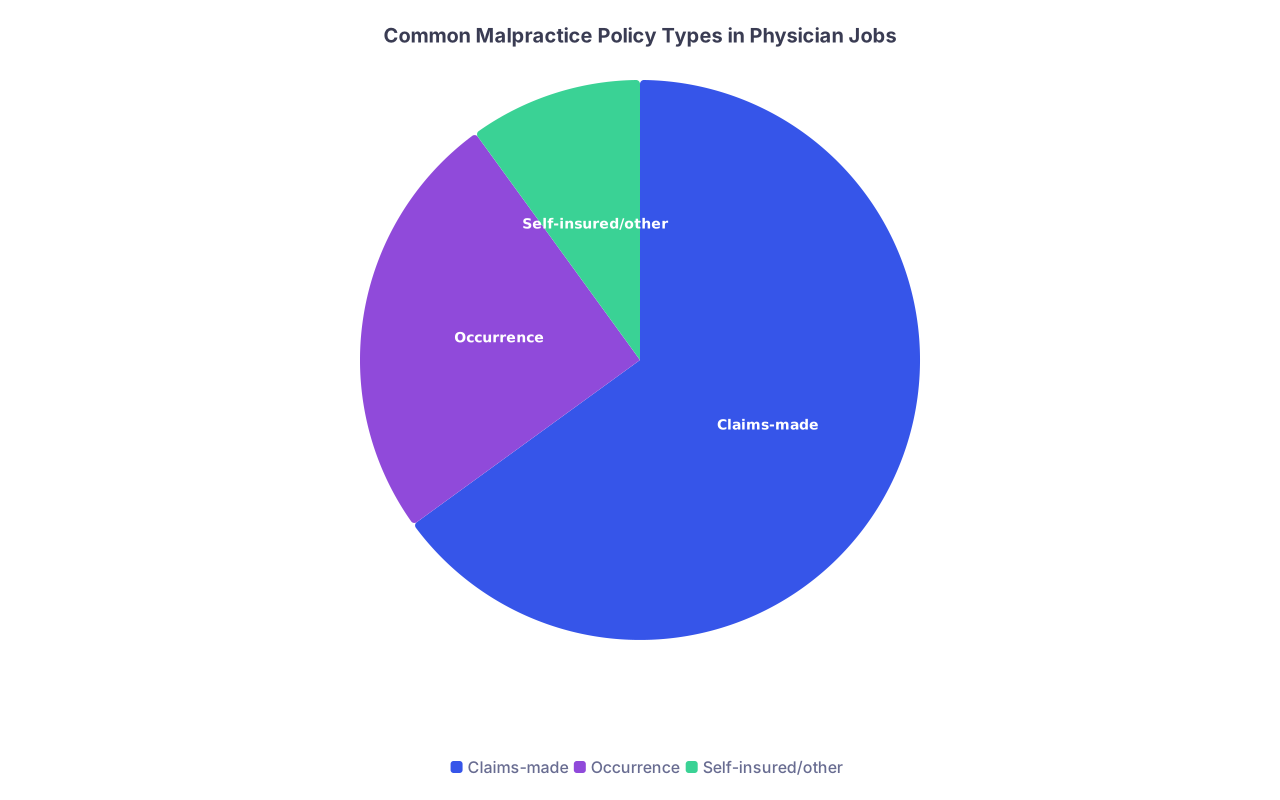
| Category | Value |
|---|---|
| Claims-made | 65 |
| Occurrence | 25 |
| Self-insured/other | 10 |
And here is the hard truth: many employers rely on you not understanding this. They tuck vague, one-line malpractice clauses into 20-page contracts, because ambiguity favors them, not you.
2. Ignoring the Difference Between Claims-Made and Occurrence
If you do not understand this distinction, you are driving without brakes.
Occurrence coverage
Covers incidents that occurred during the policy period, no matter when the claim is filed. You leave the job, the incident later surfaces? Still covered, as long as it happened while the policy was active.
Claims-made coverage
Covers claims that are both:
- Based on an incident that happened after the retroactive date, and
- Reported while the policy is active
When you leave a claims-made policy, you usually need tail coverage, or you are naked for every year you practiced under that policy.
The classic mistake:
A physician sees “employer will provide malpractice coverage” and stops reading. It is claims-made. Tail is not mentioned. Two years later, they leave for a better job and discover they owe $60,000 for tail coverage they did not know existed.
Your red flags:
- Contract does not specify whether coverage is occurrence or claims-made
- Contract says “coverage similar to other physicians in the group” instead of clear terms
- No mention of retroactive date, tail, or future claims after termination
If the employer “cannot remember” what type of policy they use, or tells you it “does not really matter,” that is not a misunderstanding. That is a warning.
3. Blindly Accepting “Physician Pays Tail” Clauses
This is one of the biggest financial landmines in physician contracts.
Tail coverage for a busy specialist (OB/GYN, surgery, EM, anesthesia) can run in the $40,000–$120,000 range. Primary care is sometimes less, but still painful. I have seen early-career physicians owe more in tail than their annual take-home pay.
The most dangerous clause usually looks short and harmless:
“Physician shall be solely responsible for any tail coverage upon termination of this Agreement for any reason.”
Read that again: for any reason.
You get laid off because the group loses a contract? You pay the tail.
You are terminated without cause 11 months in? You pay the tail.
Group dissolves or is acquired and your job disappears? Still you.
This is absurd, but very common.
Smarter structures exist:
- Employer pays tail if they terminate you without cause or do not renew
- Employer and physician split tail based on years of service
- Tail cost is forgiven after a certain number of years with the group
| Tail Structure | Financial Risk to Physician | Comment |
|---|---|---|
| Physician pays 100% | Very High | Major red flag if no exceptions |
| Employer pays 100% | Low | Best for physician |
| Shared, based on tenure | Moderate | Often reasonable compromise |
| Forgiven after X years | Low after vesting | Good retention incentive |
Red flags here:
- “Physician responsible for tail in all circumstances”
- No language about employer paying tail if they terminate without cause
- Employer refuses to even discuss modifying tail responsibility
If they will not negotiate even a carve-out for being fired without cause, they are not sharing risk. They are offloading it onto you.
4. Not Checking the Retroactive Date (Your Hidden Gap)
Claims-made policies live and die by the retroactive date. That date marks the start of what is covered in your professional history under that policy.
If your contract just says “employer will provide malpractice coverage” but does not commit to:
- Including prior acts coverage back to your first date of practice, or
- Maintaining your current retroactive date
You might have a serious gap.
Typical nightmare scenario:
- You finish residency with Program A, covered by their policy.
- You join Practice B. They get you a new claims-made policy, but it starts “as of your date of hire” without prior acts.
- Two years later, a claim arises from something you did in the last six months of residency.
- Program A’s tail might not cover resident moonlighting or certain activities. Your new policy does not cover anything before the retro date. You are out in the open.
You need to see in writing whether:
- The new employer’s policy will cover prior acts
- The retroactive date will match your first day of practice or your last policy
- They are paying for prior acts coverage, or you are expected to arrange it
If the recruiter shrugs and says “insurance will handle that,” do not be reassured. Ask for the exact retroactive date and whether prior acts are included. In the contract, not just over email.
5. Accepting Vague or Missing Coverage Limits
Coverage limits matter. A lot.
Typical limits you will see:
- $1,000,000 per claim / $3,000,000 aggregate per year (1/3)
- $2,000,000 / $4,000,000 in some higher risk environments
A few ugly moves I have seen from employers:
- Low limits hidden in a self-insured pool
- Shared per-claim limits across multiple physicians
- No stated limits at all in the contract
If the contract does not specify:
- Per-claim limit
- Aggregate limit
- Whether your coverage is individual or shared
You are leaving huge questions unanswered.
Red flags:
- Contract language like “coverage as determined by employer’s insurance carrier” with no numbers
- Shared limits in high-risk specialties without any explanation
- Refusal to provide a sample certificate of insurance or declaration page
No, you do not need to become an actuary. But you should know whether you are protected beyond a token amount.
6. Overlooking How Termination Affects Your Coverage
The malpractice section does not live in isolation. It interacts directly with the termination section. This is where people get trapped.
You must connect three things:
- Who pays tail (if applicable)
- What triggers tail responsibility
- What types of termination are possible
There are usually three categories of termination:
- For cause (you breach contract or commit misconduct)
- Without cause (employer just ends it, often with 60–90 days’ notice)
- By you (you resign with proper notice)
Common but dangerous patterns:
- You pay tail if you resign for any reason.
- You pay tail if you are terminated “for cause” (often defined very broadly, including vague things like “failure to meet productivity expectations”).
- You pay tail if the employer elects not to renew.
In other words, you pay tail in almost every scenario except death.
Better contracts:
- Employer pays tail if they terminate you without cause or non-renew
- Tail is shared or forgiven after a certain number of years
- Tail is employer-paid if there is a material change in call schedule, location, or compensation that forces you to leave

| Step | Description |
|---|---|
| Step 1 | End of Employment |
| Step 2 | Employer pays tail |
| Step 3 | Check contract tail clause |
| Step 4 | Often physician pays tail |
| Step 5 | Reduced cost to physician |
| Step 6 | Physician pays full tail |
| Step 7 | Reason for End |
| Step 8 | Tail shared or forgiven? |
If the contract says:
“In any event of termination, Physician shall be solely responsible for any tail coverage.”
You are one HR restructuring away from a five-figure bill.
7. Ignoring Employer Stability and Risk Profile
You can have perfect malpractice language on paper and still be blindsided if the employer collapses or self-insures poorly.
Watch out for:
- Small or new groups in volatile markets, especially those heavily dependent on one hospital contract
- Employers that say “we self-insure” and then provide no detail
- Groups that have recently changed ownership or are actively being acquired
If they self-insure, you need answers:
- Is there excess coverage above the self-insured layer?
- Who administers claims?
- What happens if the group dissolves—does tail exist in that structure?
The mistake: trusting “our lawyer handles all that” or “we have never had a problem.” That is not a plan. That is wishful thinking.
You are not just betting on today’s coverage. You are betting on whether that coverage structure will still exist five years from now when a slow-moving claim surfaces.
8. Failing to Compare Offers on Malpractice Terms (Not Just Salary)
Physicians routinely compare offers like this:
- Hospital A: $280,000 base + RVU bonus
- Group B: $310,000 base + productivity incentive
Then pick Group B because “it pays better.”
Except:
- Hospital A: occurrence coverage, employer pays all premiums and tail, strong limits, clear language
- Group B: claims-made, you pay tail even if terminated without cause, vague limits
Over a few years, that extra $30,000 annually can be wiped out by one tail bill.
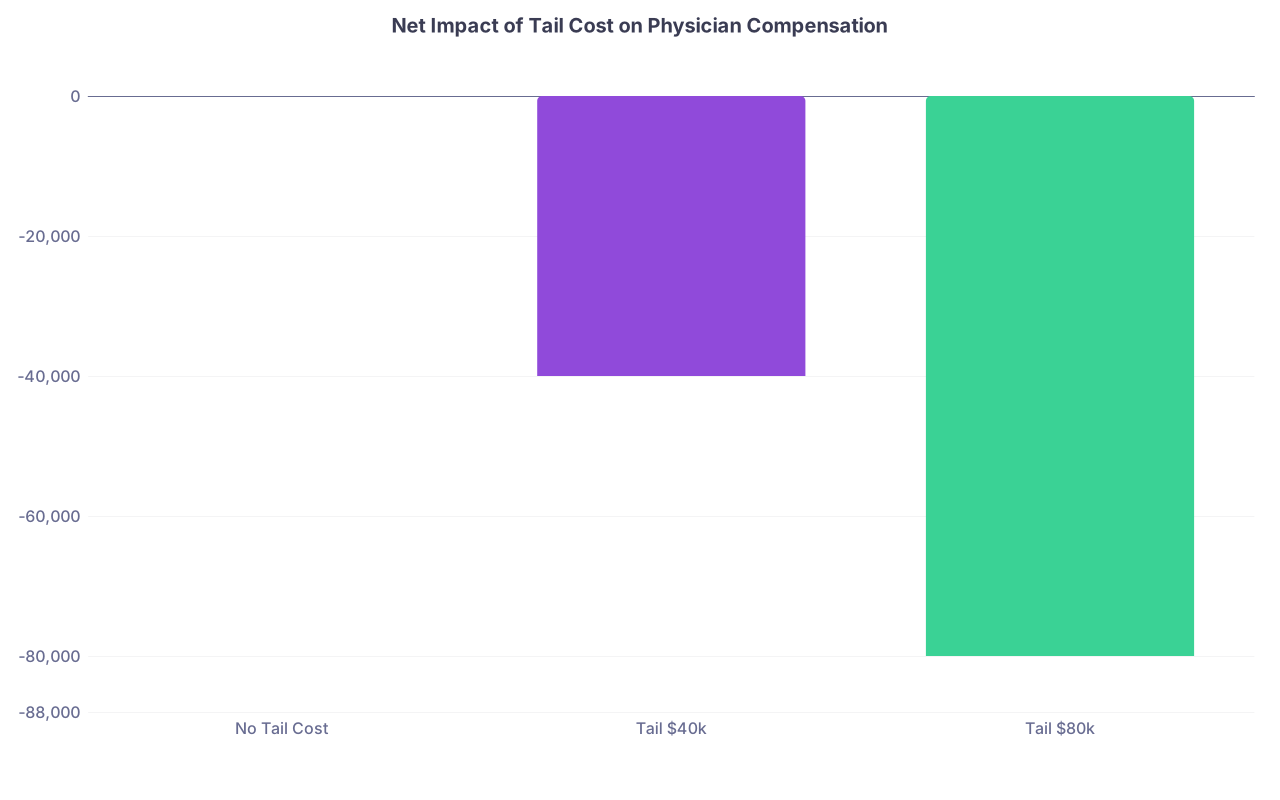
| Category | Value |
|---|---|
| No Tail Cost | 0 |
| Tail $40k | -40000 |
| Tail $80k | -80000 |
You are not comparing just salaries. You are comparing risk profiles, legal exposure, and future cash-flow bombs.
When you stack offers side by side, always include:
- Policy type
- Who pays premiums
- Who pays tail and under what conditions
- Limits of liability
- Retroactive coverage
- Employer’s financial stability
That is your real compensation comparison. Do not be the physician who “got the best salary” and the worst contract.
9. Not Getting Independent Legal Review
This mistake is plain and simple: signing a dense, multi-year, six-figure-impact legal contract without having a healthcare contract attorney read it.
Common rationalizations I hear:
- “The practice seems nice; I trust them.”
- “My friend signed here and said it was fine.”
- “I do not want to rock the boat by hiring a lawyer.”
- “It is too expensive.”
You know what is more expensive?
A $70,000 tail bill due six weeks after you are non-renewed.
A denied claim because of a coverage gap.
An investigation where your policy limits are inadequate because you never checked them.
A decent physician contract attorney will:
- Decode the malpractice language in plain English
- Identify one-sided tail clauses and propose alternatives
- Check for retroactive coverage and limits
- Align termination and malpractice provisions
- Tell you if the risk is acceptable or if you should walk
You do not need to negotiate every comma. But you do need to understand exactly what you are on the hook for.
10. Red Flags That Should Stop You From Signing (Or At Least Make You Negotiate Hard)
Here are the big, ugly red flags, straight:
Malpractice section is under 3 lines and vague
Example: “Employer will maintain malpractice insurance during the term of this Agreement.” No policy type, no limits, no tail language. Too vague.You are responsible for tail in every scenario
Including termination without cause or non-renewal. That is predatory.No clarity on policy type
They will not state “claims-made” or “occurrence” in the contract. If they dodge the question, assume the worst.No limits listed
Or the contract says “limits as determined by employer” with no numbers.No mention of retroactive coverage or prior acts
Especially dangerous if this is not your first job.Employer refuses to provide policy details
They will not share a declaration page or basic information on the carrier, limits, or structure.Termination “for cause” is defined vaguely
Things like “failure to maintain satisfactory performance as determined by Employer” combined with “physician pays tail if terminated for cause” is a set-up.
If you see multiple red flags and the employer will not budge, the safest move is simple: do not sign.
There are other jobs. There is only one of you to be sued.
FAQ (Exactly 4 Questions)
1. Is it ever acceptable for a physician to pay their own tail coverage?
Yes, but only in specific, clearly defined circumstances and with your eyes open. For example, if you resign early from a multi-year contract for your own personal reasons (moving for family, changing specialties), it can be reasonable to share or assume tail. The key is that you understand the estimated cost in advance and can plan for it. What is not acceptable is paying tail when the employer non-renews you, restructures, or terminates you without cause. That is shifting their business risk entirely onto your back.
2. How can I estimate what my tail coverage might cost before signing?
You ask. Directly. The employer or their broker can give you a ballpark range based on: specialty, practice volume, and current premium. A common rule of thumb is that tail may cost 150–250% of the annual premium. So if your annual premium is around $20,000, tail might run $30,000–$50,000. Do not accept “we are not sure” as an answer. Push for a number range in writing or at least in an email. Then decide if that risk is acceptable.
3. Should malpractice insurance ever be a deal-breaker if everything else in the offer is great?
Yes. If the malpractice terms expose you to massive, uncapped, or unpredictable financial risk, walk. I have seen too many physicians seduced by signing bonuses and RVU promises who later regretted ignoring the malpractice section. You can negotiate salary. You cannot negotiate your way out of a lawsuit that hits during an uninsured gap. Solid malpractice terms are a basic safety requirement, not a luxury.
4. Can I rely on the recruiter or practice manager’s verbal assurances about malpractice coverage?
No. Verbal assurances are worthless when a claim hits. “We always take care of our doctors” is not a contract term. “We would never make you pay tail if we let you go” is not binding. If it is not written into the agreement (or at minimum a signed addendum), it effectively does not exist. Treat every promise about malpractice like a medication order—you need it documented, precise, and not open to interpretation.
Key points to remember:
- Never sign an employment contract until you can clearly explain your malpractice coverage, policy type, limits, retroactive date, and tail responsibility.
- Any clause that makes you pay tail in every scenario—especially if terminated without cause—is a major red flag and often not worth the risk.
- Ambiguity always benefits the employer, not you. Get the malpractice terms clear, specific, and in writing, or be willing to walk away.