
It is 4:30 p.m. You just finished a brutal clinic day. You are halfway through signing notes when you see it: a certified mail envelope from “Law Offices of …” or “Clerk of Court.” You open it. Summons. Complaint. Your name in bold as a defendant.
Your stomach drops. You immediately replay the patient’s face, the encounter, the complication. You start thinking: “Am I going to lose my license? Will I be reported to the NPDB? What does this mean for my job? My mortgage? My kids’ college?”
You are in the danger window now. The first hours and days after receiving a malpractice claim are when smart physicians either set themselves up for a controlled, strategic defense—or they make impulsive mistakes that cost them financially, legally, and emotionally for years.
This is the playbook for the first group.
I am going to walk you through exactly what to do, step by step. From the minute you receive the claim, through insurance, lawyers, documentation, financial risk, and settlement decisions. No fluff. Just a protocol you can follow.
Step 1: Immediate Response in the First 24–48 Hours
Your mindset right now matters more than you think. The wrong move—an email, a chart edit, a hallway conversation—can do more damage than the alleged negligence.
1.1 Stop. Breathe. Do not react in writing.
Do not:
- Email anyone about the case details (even close colleagues).
- Text friends or partners about “what really happened.”
- Post, joke, or vent on social media.
- Call the patient or family.
- Open the chart and start “clarifying” old notes.
All of that is discoverable. Juries and opposing counsel love emotional, off-the-cuff messages.
Instead:
- Acknowledge the shock. You will not think clearly for a few hours.
- Clear the next 30–60 minutes.
- Move to a private place.
Your first written move should not be to anyone except your malpractice carrier or designated risk management contact.
1.2 Confirm what you actually received
Look at the documents carefully. Typical items:
- Summons – Formal notice that you are being sued and must respond by a specific date.
- Complaint – Detailed allegations: what the plaintiff says you did wrong and what damages they claim.
- Cover letter – From plaintiff’s attorney or court.
Check:
- Date of service (when you got it).
- Deadline to respond (often 20–30 days).
- Who else is named (hospital, partners, nurses, practice group).
Do not start “defending yourself” in your head yet. Just gather data: what is being alleged, in what court, with what timeline.
1.3 Notify the right people. In the right order.
You have two main obligations now:
- Trigger your insurance coverage.
- Protect your employment/privileges.
In this order:
Call your malpractice carrier’s claims or emergency line.
- Use the number on your policy card or website.
- Say: “I have just received a summons and complaint in a malpractice lawsuit. I need to report a claim.”
- Ask for a claim number and the name and contact of the adjuster or claim representative.
Notify your institution’s risk management department (if you are employed or have hospital privileges).
- Many hospitals require immediate reporting of any claim.
- Keep it factual: “I have been served with a malpractice complaint regarding patient care on [date]. I have reported this to my malpractice carrier.”
Tell your practice leadership (if private group or employed).
- Usually your managing partner, medical director, or department chair.
- Again, factual, no details about what you “should have done.”
3 rules here:
- Say only that a claim has been filed and you have notified insurance.
- Do not give a long narrative yet. That belongs in privileged conversations with your defense attorney, not hallway gossip.
- Do not ignore the claim hoping it goes away. Default judgments are real and ugly.
Step 2: Lock Down the Record (Without Altering It)
Once you know a claim exists—or even a serious threat of one—you are in “litigation hold” territory.
2.1 Preserve everything. Do not edit anything.
You must preserve:
- Full medical record (EMR or paper).
- Phone logs, call center messages.
- Emails related to the patient (within the medical record system).
- Any prior incident reports or risk management notes.
You must not:
- Add late notes that obviously “fix” a problem.
- Edit prior entries to “clarify” events.
- Delete in-basket messages, secure chats, or texts that mention the patient.
Late additions or edits after a claim look terrible in court. Juries see them as cover-ups, even when innocent.
If you genuinely forgot a key factual detail that is clinically relevant and needs to be documented:
- Speak to risk management and your assigned attorney before entering anything.
- If a late entry is approved, it must clearly be labeled “Late Entry,” with current date/time, the event date, and a brief, factual description. No spin. No opinions.
2.2 Get your own copy of the chart
Ask your institution, clinic, or EMR team for a complete copy of:
- All progress notes.
- Orders.
- Messages.
- Nurses’ notes.
- Lab/imaging results.
- Consult notes.
- Consent forms.
Do this through your attorney or risk manager if possible, so the process is clean and documented.
You will not start annotating or marking it up yet. Just secure it.
Step 3: Engage Your Malpractice Insurance – Coverage, Money, and Counsel
This is the financial and legal backbone of your response. You need to know exactly what your policy will do for you—and what it will not.
3.1 Understand your policy type: occurrence vs claims-made
Pull your policy documents or coverage summary. You are looking for the policy type.
| Policy Type | Covers Incidents That Occur | Claim Must Be Filed |
|---|---|---|
| Occurrence | During policy period | Anytime, even years later |
| Claims-made | During policy period | During active coverage (or tail) |
| Claims-made + Tail | During active + tail | During active + tail |
- Occurrence: If the care happened while you were covered, you are protected, even if the lawsuit surfaces years later.
- Claims-made: You are only protected if:
- The care occurred during the policy period and
- The claim is filed while the policy (or purchased “tail”) is active.
If the case involves care at an old job and you are on a claims-made policy, confirm you either:
- Still have that policy active, or
- Bought tail coverage when you left.
If not, you have a real coverage problem and need to talk immediately with:
- Your current carrier.
- A personal attorney (not just the insurer’s lawyer).
- Possibly your old employer (if they carried the policy).
3.2 Confirm your limits and scope of coverage
Ask your adjuster, directly:
- “What are my per-claim and aggregate limits?” (e.g., $1M/$3M).
- “Does my policy cover:
- Defense costs outside the limits, or are they eroding my limits?
- Punitive damages (if applicable in my state)?
- Licensing board complaints defense?”
- “Is there any risk that this claim could exceed my policy limits based on similar cases you have seen?”
You want a blunt assessment. If your state has non-economic damage caps, your carrier should know what typical settlements/judgments look like for similar allegations.

| Category | Value |
|---|---|
| $1M/$3M | 60 |
| $2M/$4M | 25 |
| $500k/$1.5M | 15 |
(Values are illustrative percentages of physicians carrying each limit in many markets; your region may differ.)
3.3 Who picks your lawyer?
Most malpractice policies give the carrier the right to select defense counsel. In practice:
- The insurer uses a panel of “regular” defense firms who know local courts and juries.
- In hospital-employed settings, there may be an institutional preference list.
You should ask:
- “Who will be my defense attorney?”
- “Can I have input if there is a conflict or I have prior negative experience with someone?”
- “Does this attorney represent multiple defendants in this case (hospital, group, etc.)?”
If your interests might diverge from the hospital’s or other co-defendants’ interests in a serious way, you may need “independent counsel.” That is a more complex situation, and you want to raise it early with the carrier and risk management.
Step 4: First Meeting With Your Defense Attorney – Set the Foundation
Your defense attorney is your key ally. But they are only as effective as the information you give them and the boundaries you set.
4.1 Prepare before the first call/meeting
Before that first substantive conversation:
- Review the complaint slowly, line by line.
- Jot down:
- Your independent recollection of events (without reading your notes first).
- Major dates, complications, key decisions.
- Anything you already know is going to look bad (delays, communication gaps, documentation holes).
Do not prepare a 20-page manifesto. One to three pages of bullet points is plenty.
Bring:
- Your own copy of the chart.
- Any letters or emails related to the patient (e.g., from admin or risk).
- Your CV and current job description (for expert evaluation if needed).
4.2 What to discuss in that first meeting
In the first substantial meeting (usually 1–2 hours), you should cover:
Allegations summary
- Ask your attorney to translate legal claims into plain language:
- “They are saying you failed to diagnose X.”
- “They allege improper informed consent.”
- “They claim delay in response to deterioration.”
- Ask your attorney to translate legal claims into plain language:
Case viability and risk level
- Direct question: “Based on what you see so far, how serious is this case compared to others you handle?”
- Force a real answer: low, moderate, high risk.
Timeline
- Discovery phase (records, written questions, depositions).
- Expert disclosures.
- Mediation or settlement conferences.
- Trial window.
Your role and expectations
- How often you will meet.
- When you will be prepped for deposition.
- What they expect you to stop doing (e.g., independent investigation, talking to colleagues).
Communications boundaries
- Confirm what is attorney–client privileged:
- Anything you say/writings you create for your defense attorney, at their request, is generally privileged.
- And what is not:
- Venting with colleagues.
- Personal notes you keep outside the legal team.
- Confirm what is attorney–client privileged:
If your attorney cannot give you a straight answer about risk, strategy, and expectations, that is a problem. You are entitled to clarity.
Step 5: Control Your Mouth and Your Messages
Many malpractice cases are lost not on the medicine, but on attitude and loose communication. Jurors punish arrogance, dishonesty, and “spin” more than technical errors.
5.1 Who you can safely talk to
Safe:
- Your defense attorney.
- Representatives of your insurer or risk management.
- A personal therapist or physician (for your mental health) – but keep clinical specifics minimal and anonymized when possible.
Not safe (regarding case details or opinions):
- Coworkers (“off the record” does not exist in litigation).
- Residents/trainees.
- Friends and family (beyond “I am being sued, it is stressful”).
- Social media followers or private group chats.
Assume any written or electronic communication might end up on a projector in front of a jury. That includes:
- Texts.
- Encrypted messaging apps.
- Personal email.
- Drafts stored in cloud services.
5.2 Handling internal conversations at work
You will hear gossip. Someone will say: “I heard about your case—what happened?” You need stock phrases ready.
Use lines like:
- “I am not allowed to discuss details because it is in litigation.”
- “All I can say is that we are defending the care, and my attorney is handling it.”
- “Any questions should go to risk management or legal.”
If a supervisor or credentialing committee asks for details:
- Clarify whether this is a formal, privileged peer review process or not.
- In formal peer review, your participation may be protected, but that is heavily state-specific. Get your attorney’s advice before attending or submitting any written statement.
Step 6: Financial Risk – What Is Actually at Stake for You
The fear that “I will lose everything” is common. It is also usually exaggerated. The real risk profile is more nuanced.
6.1 Your personal asset risk
In most cases:
- If the judgment or settlement stays within policy limits, your personal assets are not touched.
- If the potential damages exceed policy limits, you enter “excess exposure” territory.
Key questions for your attorney and carrier:
- “Based on this case and this venue, what is the realistic upper range of damages if we lost at trial?”
- “Have similar cases exceeded these policy limits in this jurisdiction?”
If there is a true risk of excess judgment:
- The insurer may be more motivated to settle within limits.
- You may have the right (again, state-specific) to demand settlement within policy limits in certain circumstances.
- You might need personal counsel to protect your assets, separate from insurer-appointed defense counsel.
6.2 How this affects your future insurability and premiums
Insurers track:
- Number of claims.
- Severity of claims.
- Outcome (dismissed, defense verdict, settlement amount).
- Whether there is an NPDB report.
Consequences can include:
- Premium increases.
- Non-renewal from your current carrier.
- Difficulty obtaining coverage for high-risk specialties or procedures.
But the reality:
- A single defended claim with a reasonable outcome rarely ends a career.
- A pattern of repeated large paid claims is a bigger problem.
You can ask your carrier:
- “How does a paid claim vs a defense verdict usually impact future premiums in my specialty with your company?”
- “If this settles, will you be reporting to NPDB? If so, how will it be described?”
Step 7: Discovery, Deposition, and Your Performance Under Oath
The discovery phase is where bad cases can be rescued—or good cases can be wrecked.
7.1 Written discovery (interrogatories, requests)
You will see:
- Interrogatories: Written questions from plaintiff’s counsel.
- Requests for production: They want documents, policies, protocols.
You do not answer these alone.
- Every response is drafted or vetted by your attorney.
- Your job is to:
- Provide accurate factual information to your attorney.
- Help locate documents or explain clinical context.
Remember: the audience is not the plaintiff’s lawyer. It is the future jury.
7.2 Deposition: the main event before trial
Your deposition is often the most critical moment in the case. Many cases settle after the physician’s deposition, based on how you come across.
You must be relentlessly prepared. A good preparation protocol looks like this:

| Step | Description |
|---|---|
| Step 1 | Review Complaint |
| Step 2 | Review Full Chart |
| Step 3 | Meet With Attorney |
| Step 4 | Mock Q and A |
| Step 5 | Refine Answers |
| Step 6 | Discuss Nonverbal Impact |
| Step 7 | Deposition Day |
What you should focus on:
- Facts: Dates, key decisions, major turning points.
- Rationale: Why you made each major decision, framed in standard-of-care language:
- “At the time, based on the information available, I considered X and Y, and chose Z because…”
- Standard of care: Understand how defense experts will frame it in your specialty.
- Communication style:
- No sarcasm.
- No defensiveness.
- No volunteering information beyond the question asked.
Basic deposition rules:
- Listen to the question fully.
- Pause. Think.
- Answer only what was asked. Short, honest, accurate.
- Do not guess. “I do not recall” is acceptable if true.
- Never argue with the questioning attorney.
If your attorney is not doing multiple hours of prep, including mock questioning, push for it. This is where being “too busy” now costs you far more later.
Step 8: Settlement vs Trial – How to Make a Rational Decision
Eventually, you will face the discussion: settle or fight.
This is where ego and fear sabotage judgment. You need a structured way to think about it.
8.1 Key variables in the settlement decision
You and your team should weigh:
Strength of liability defense
- Are there clear, defensible explanations aligned with guidelines and common practice?
- Or did something objectively go wrong with care, communication, or follow-up?
Causation
- Even if care fell short, did it actually cause the outcome?
- Plaintiffs often overstate this. Good defense experts can destroy weak causation.
Damages
- How bad is the harm? Minor, moderate, catastrophic, death.
- Lost earnings, long-term disability, life expectancy.
Venue
- Some counties are notorious “plaintiff-friendly.” Juries there hand out large verdicts.
- Your defense attorney should be blunt about this.
Policy limits and excess risk
- Does a potential runaway verdict threaten your personal assets?
8.2 How to participate intelligently in strategy
You are allowed a voice. Use it. Ask:
- “If we go to trial, what is our best-case, worst-case, and most likely outcome?”
- “If we settle, what range is being discussed?”
- “How will each option affect NPDB reporting and my future insurability?”
Remember:
- A settlement is not an admission of malpractice by you personally, but it will be seen that way by some credentialing bodies.
- A defense verdict is emotionally gratifying, but comes with risk and public exposure.
I have seen physicians push for trial purely to “clear their name,” only to be blindsided by a sympathetic jury and a large judgment. I have also seen smart, strategic settlements that were financially and psychologically better, even when the medicine was arguably defensible.
You need to separate:
- Your personal sense of injustice
from - The legal and financial playing field you are actually standing on.
Step 9: Protect Your Career Long-Term – Credentialing, NPDB, and Reputation
The lawsuit ends. Life goes on. But the paperwork follows you.
9.1 NPDB reports and what you can do about them
If money is paid on your behalf (settlement or judgment), chances are high there will be a National Practitioner Data Bank (NPDB) report.
You should:
- Obtain a copy of the report.
- Review it for accuracy (dates, parties, amount, allegation summary).
- If inaccurate or misleading, work through your insurer and, if necessary, the NPDB dispute process to correct it.
You can also add a physician statement attached to the report. Keep it:
- Short.
- Factual.
- Non-defensive.
No essays. No rants about the legal system. Future credentialing committees will read this.
9.2 Answering credentialing and job application questions
You will see questions like:
- “Have you ever been named in a malpractice action?”
- “Have there been any settlements or judgments against you?”
Answer truthfully. Lying is worse than any lawsuit.
When explaining:
- Give a 2–3 sentence summary:
- Nature of claim.
- Outcome.
- Any system or practice changes implemented since then (without admitting wrongdoing).
Example:
“I was named in a malpractice lawsuit related to a postoperative infection in 2019. The case was settled by my insurer without admission of liability. Our group subsequently updated postoperative follow-up protocols and documentation standards to improve clarity and patient education.”
Short. Neutral. Forward-looking.
Step 10: Emotional and Professional Recovery
Here is the part no one talks about in training: this will get into your head. It will affect how you practice, sleep, and show up at home.
If you pretend it does not, you become the burned-out attending everyone avoids.
10.1 Watch for common maladaptive responses
I have seen these patterns repeatedly:
- Over-defensive practice: Ordering excessive tests or avoiding appropriate risk-taking to never be sued again. It does not work. It does increase burnout and costs.
- Global distrust of patients: Seeing every dissatisfied patient as a future plaintiff.
- Withdrawal from colleagues: Hiding the existence of the case, isolating yourself.
You cannot litigate your way into feeling safe again. It does not work.
10.2 Build a realistic, sustainable response
Do this instead:
- Have one or two trusted colleagues you can confide in generally (not discussing case details), just for emotional support.
- Consider a therapist or counselor familiar with healthcare professionals and litigation stress.
- Use this as a forcing function to:
- Tighten your documentation habits.
- Clarify informed consent conversations.
- Improve how you communicate bad outcomes.
You are not aiming for “never sued again.” That is fantasy. You are aiming for:
- Lower risk.
- Better defensibility.
- Less emotional devastation when—not if—it happens again.
A Quick Visual: The Life Cycle of Your Malpractice Case
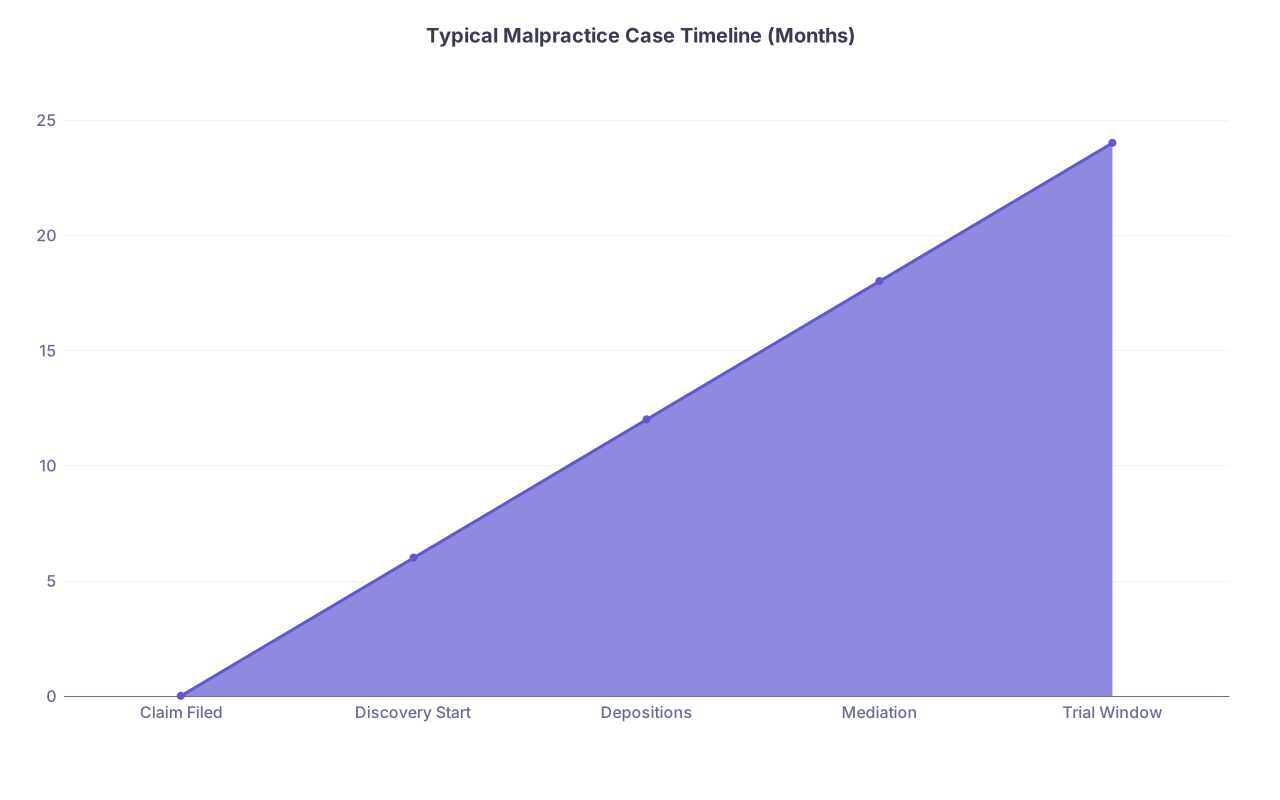
| Category | Value |
|---|---|
| Claim Filed | 0 |
| Discovery Start | 6 |
| Depositions | 12 |
| Mediation | 18 |
| Trial Window | 24 |
And a process view:
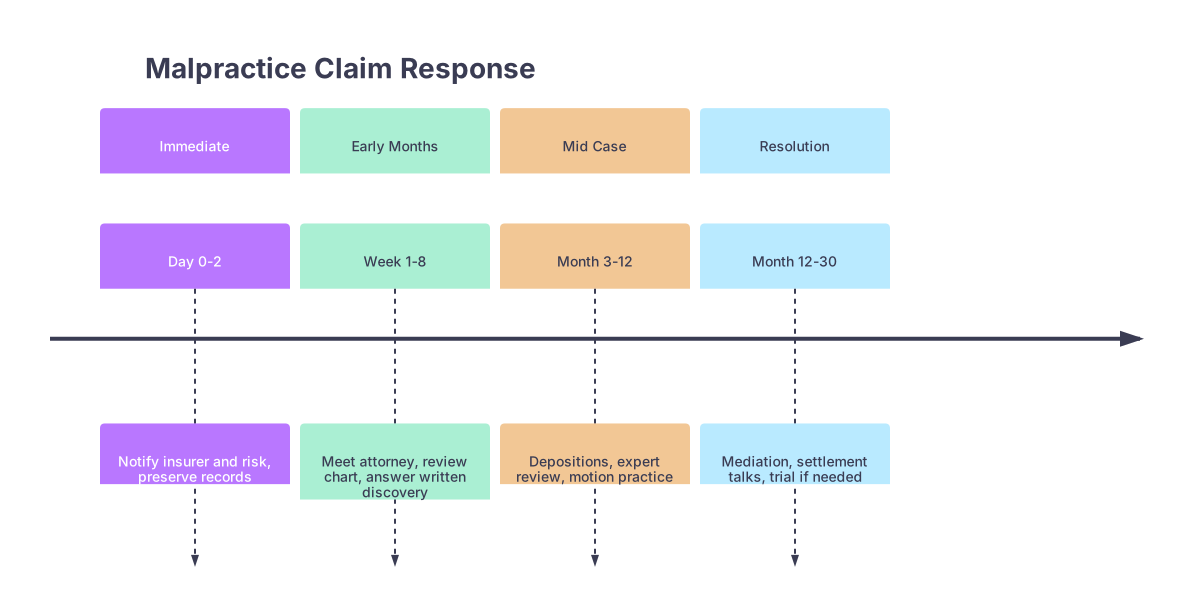
| Period | Event |
|---|---|
| Immediate - Day 0-2 | Notify insurer and risk, preserve records |
| Early Months - Week 1-8 | Meet attorney, review chart, answer written discovery |
| Mid Case - Month 3-12 | Depositions, expert review, motion practice |
| Resolution - Month 12-30 | Mediation, settlement talks, trial if needed |
Expect 18–30 months for many cases from claim to resolution, depending on jurisdiction.
Your Next Concrete Step (Today)
You do not need to solve your entire legal and financial fate tonight. You need to execute the next correct move.
Here is what I want you to do right now:
Create a “litigation file” folder (physical or digital, secured):
- Put the summons, complaint, and any related documents in one place.
- This is your central hub for the case.
Write down, by hand, a brief factual timeline of the care in question from your memory—before you re-read the chart.
- Date(s) of encounters.
- Major decisions.
- Complications and how you responded.
Keep this ready for your defense attorney. Do not email it to anyone else.
If you already notified your insurer and risk management, your next move is to bring this timeline to your first attorney meeting and say:
“Here is what I remember, in order. Tell me what else you need from me to build the strongest possible defense.”
One controlled, deliberate action. Then the next. That is how you get through a malpractice claim without letting it wreck your career, your finances, or your sanity.