
The way program directors coach residents after a near-miss malpractice claim is nothing like the sanitized version you hear in risk management lectures. It’s quieter, sharper, and a lot more strategic. And a good chunk of it is about protecting the institution and the record—sometimes before protecting you.
Let me walk you through what actually happens behind closed doors when you almost trigger a malpractice case.
What “Near-Miss Claim” Really Means To Your PD
Residents think “near-miss” means, “No harm, no foul.” Attendings and program directors do not think that way.
For them, a near-miss malpractice situation is usually one of three things:
- A bad outcome that could lead to a claim, but the family is still quiet.
- A complaint or angry family interaction that sounds like the start of a lawsuit but hasn’t escalated yet.
- An internal incident report that screams, “If this were 10% worse, we’d be talking to defense counsel.”
Inside the program office, this is what happens:
- Your name gets mentioned in a risk meeting.
- Someone pulls the chart.
- The PD gets a quiet email or hallway comment: “You should talk to your resident about this one.”
Nobody writes: “Coach them so they don’t ruin the deposition three years from now.” That’s implied.
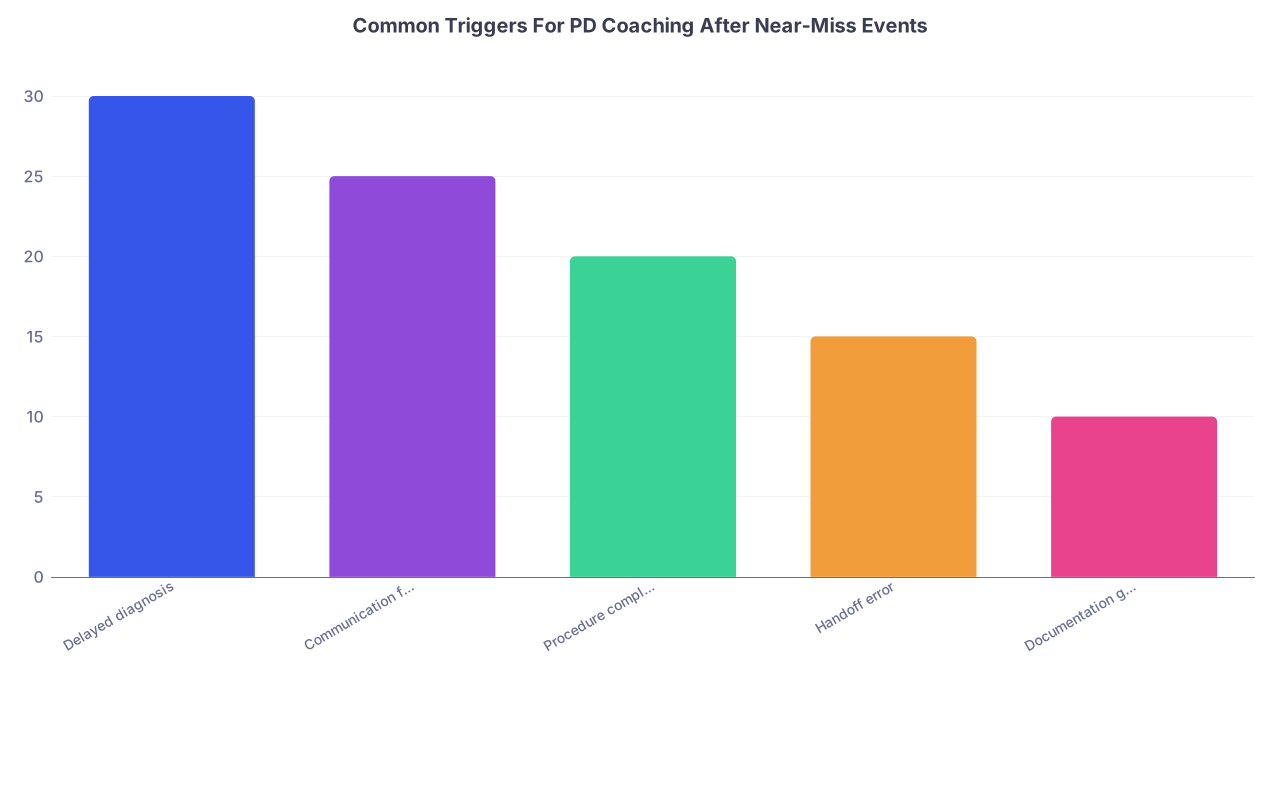
| Category | Value |
|---|---|
| Delayed diagnosis | 30 |
| Communication failure | 25 |
| Procedure complication | 20 |
| Handoff error | 15 |
| Documentation gap | 10 |
The First Conversation: Not What You Think
The initial “come to my office” meeting after a near-miss is almost never just a debrief. It’s a risk containment session.
Here’s the pattern I’ve seen dozens of times:
You walk in. PD already has the chart open—or printed. They’ve talked to the attending. Maybe to risk management. Sometimes to the CMO if it’s ugly.
You start talking about what happened clinically. They let you talk. But they’re listening for three things:
- Are you about to blame someone important?
- Are you about to admit something that, if documented or repeated, hangs the hospital?
- Are you emotionally spiraling in a way that makes you unpredictable in front of a patient, family, or (later) a plaintiff’s lawyer?
Then the coaching begins.
They usually don’t say: “Here’s how to avoid a lawsuit.”
They say: “Here’s how we should be thinking about this case.”
Subtle difference. Legally very intentional.
What they’re doing in that first talk:
Resetting your narrative.
“Let’s walk through the timeline again” translates to “Let’s get your story internally consistent before this snowballs.”Filtering your language.
They’ll quietly correct words:
You: “I missed the PE.”
PD: “You had a working diagnosis that evolved as new data came in. Write it that way.”Testing your stability.
If you’re crying, angry, defensive, or cavalier, they’re deciding whether to pull you off the frontline, push wellness resources, or control who lets you speak to the family.
They are not just protecting you. They are triaging institutional exposure.
The Behind-the-Scenes Huddle: PD + Risk + Legal
You’re not in the most important meeting. That happens after your chat.
Here’s how the closed-door conversation usually plays out between the PD, risk management, and sometimes legal:
- Risk wants to know: Did the resident deviate from policy?
- Legal wants to know: Is there any language in the chart that can be weaponized?
- PD wants to know: Is this a “resident problem” or a “system problem” and how do I keep my program out of the spotlight?
This is the kind of language that gets used:
- “We should get ahead of the documentation.”
- “We may need an addendum clarifying the decision-making.”
- “Let’s make sure future communication with the family goes through the attending.”
Translation:
- Coach the resident to clean up documentation (within legal and ethical acceptable boundaries).
- Reduce the odds the resident free-styles something disastrous to the family or, worse, on MyChart messages.
- Get a consistent institutional story in place early.

This is where your PD decides how hard to coach you.
If they sense litigation risk, the coaching gets surgical.
How They Quietly Rebuild Your Story
I’m going to be blunt: after a near-miss, your memory of the case is negotiable. Not fabricated, but shaped.
PDs, especially in high-liability specialties (OB, EM, surgery, anesthesia), know that three years from now you might be deposed. So they start building the version of you they want on the stand.
They do it by:
1. Reframing what “error” means
You say: “I screwed up. I should have ordered the CT earlier.”
They’ll correct you:
- “You made a judgment call based on the data at the time.”
- “Guidelines say to consider CT, they do not mandate it.”
- “Your differential was reasonable; the outcome was unfortunate.”
Why? Because “I screwed up” turns into a plaintiff’s dream quote when you’re deposed. “This was a judgment call with evolving information” is defensible.
They are training you to describe clinical reasoning, not self-condemnation.
2. Standardizing your language
They’ll push you away from:
- “I missed…”
- “I forgot…”
- “I ignored…”
- “I failed to…”
They’ll steer you toward:
- “At that time, the leading diagnosis was…”
- “The patient’s presentation was most consistent with…”
- “Given the vital signs and labs available, it was reasonable to…”
Again, not to lie. To align your language with how defense experts will later frame the same decisions.
3. Anchoring your memory to the record
Program directors know one brutal truth:
The chart is more real than your memory.
So they’ll say:
- “Let’s walk through your note together.”
- “What did you document for your differential?”
- “Does your note reflect what you’re telling me now?”
If your spoken story and the EMR diverge, they will push you—gently—to recalibrate your recall to what’s documented. Because in deposition, when you’re asked, “What did you rely on?” the safest line is: “My practice is to document my clinical reasoning accurately, so I rely on my note.”
That line doesn’t appear by accident. It’s coached.
Documentation “Coaching” That’s Really Defensive Positioning
There’s a specific flavor of feedback that should make your malpractice radar light up: retroactive documentation coaching right after a near-miss.
Common moves:
- “You might want to add an addendum clarifying that you considered sepsis in your differential.”
- “It may be helpful to specify that you discussed the risks and benefits of discharge with the patient and they understood.”
- “Let’s be clearer that you involved the attending early in the decision.”
Notice the verbs: “clarify,” “be clearer,” “specify.”
Nobody says: “Change.” Because that sounds like altering the record.
And here’s the part most residents never get told: Once there’s even a scent of possible litigation, anything you add to the note will be timestamped and discoverable. Plaintiff’s attorneys love late addenda if they look self-serving.
So risk and PDs walk a tightrope. They want the record to be defensible, but not look artificially polished after the fact.
The smart PDs will explicitly coach you:
- “No new facts. Only clarifications of your clinical reasoning.”
- “Do not write anything suggesting you believe care was negligent.”
- “If in doubt, send the draft to me or risk before you sign.”
If your PD isn’t telling you these things, either they’re naive about litigation or they assume legal will mop it up later.
| Resident Phrase (Avoid) | PD-Coached Alternative |
|---|---|
| I missed the diagnosis | Diagnosis evolved as new data became available |
| I forgot to order the test | Test was deferred initially based on low suspicion |
| I discharged too early | Discharge was based on stable exam and reassuring workup |
| I didn’t call the attending | Care was provided within the team structure and supervision model |
| I made a mistake | This was an unexpected adverse outcome despite reasonable care |
The “Don’t Say This Again” List
Some of the most intense coaching is about your mouth, not your hands.
After a near-miss that might go legal, PDs get very serious about what you say to:
- The patient/family
- Other staff
- Your co-residents
- Your notes
- Email or patient messaging systems
I’ve heard PDs literally say:
- “Stop talking about this case in the team room.”
- “Do not email the family. Face-to-face or phone only, and with an attending present.”
- “If you’re asked, stick to the facts and do not speculate about ‘what should have happened.’”
What they’re trying to prevent:
- Casual hallway comments getting quoted later: “The resident even admitted they screwed up.”
- Angry or remorseful emails that read like confessions.
- Group chat screenshots making their way into discovery.
You’re also subtly coached on how to handle direct confrontation from families.
Instead of:
- “I know, I should have… I’m so sorry, this is my fault.”
You’re pushed toward:
- “I’m very sorry for what you’re going through. I can walk you through everything we did and why.”
Empathy, not admission. That distinction is drilled hard after near-miss scares.
The Long Game: Coaching You For Your Future Deposition
This is the part almost nobody tells residents outright: PDs in lawsuit-heavy specialties pre-coach you for a deposition you might never sit in.
You’ll see it in how they push you during M&M or case conferences after a bad event:
They’ll ask:
- “What were your options at that time?”
- “Was your decision consistent with standard practice?”
- “Would a reasonable physician in your position have done something different with the same information?”
Sound familiar? That’s deposition language.

| Step | Description |
|---|---|
| Step 1 | Near-miss event |
| Step 2 | Case flagged to risk |
| Step 3 | PD reviews chart and talks to attending |
| Step 4 | Private PD-resident meeting |
| Step 5 | Local feedback and education |
| Step 6 | Documentation and communication coaching |
| Step 7 | Involve risk and legal in strategy |
| Step 8 | Monitor future cases and behavior |
| Step 9 | Litigation risk? |
If you notice your PD keeps coming back to:
- “What did you know and when?”
- “What was the accepted standard at that moment?”
- “Would other reasonable physicians agree with this approach?”
They’re not just teaching you medicine. They’re teaching you how to testify.
Good PDs do this instinctively. They’ve sat through depositions or been prepped by defense counsel enough times to know what gets shredded. They’re trying to inoculate you.
How This Ties Back To Your Malpractice Coverage
Here’s the behind-the-curtain connection to malpractice insurance that residents rarely see:
Residents usually rely on their institution’s malpractice policy, often claims-made, sometimes occurrence-based, but always with strings. The institution is the primary client. Not you.
So when a near-miss smells like it could progress to:
- A formal complaint
- A notice of intent
- An actual suit
Risk management and the insurer start caring about you as an exposure source.
Your PD becomes a quiet intermediary between you and the risk department because:
- They see you daily.
- They can shape your behavior.
- They can decide whether you’re a “safe witness” or someone who needs tight supervision.
Sometimes, after a serious near-miss, a resident mysteriously gets:
- Pulled from a certain rotation
- Kept away from a known difficult family
- Excluded from specific family meetings about that patient
Nobody writes: “Removed due to liability concerns.” But that’s the subtext.
The insurer’s unspoken wish list for you:
- Chart consistent with guidelines and institutional policy.
- No self-incriminating commentary anywhere.
- Calm, consistent, non-emotional explanations if you’re ever asked about the case.
Your PD’s coaching is moving you toward that target—whether they ever say the word “malpractice” to your face or not.
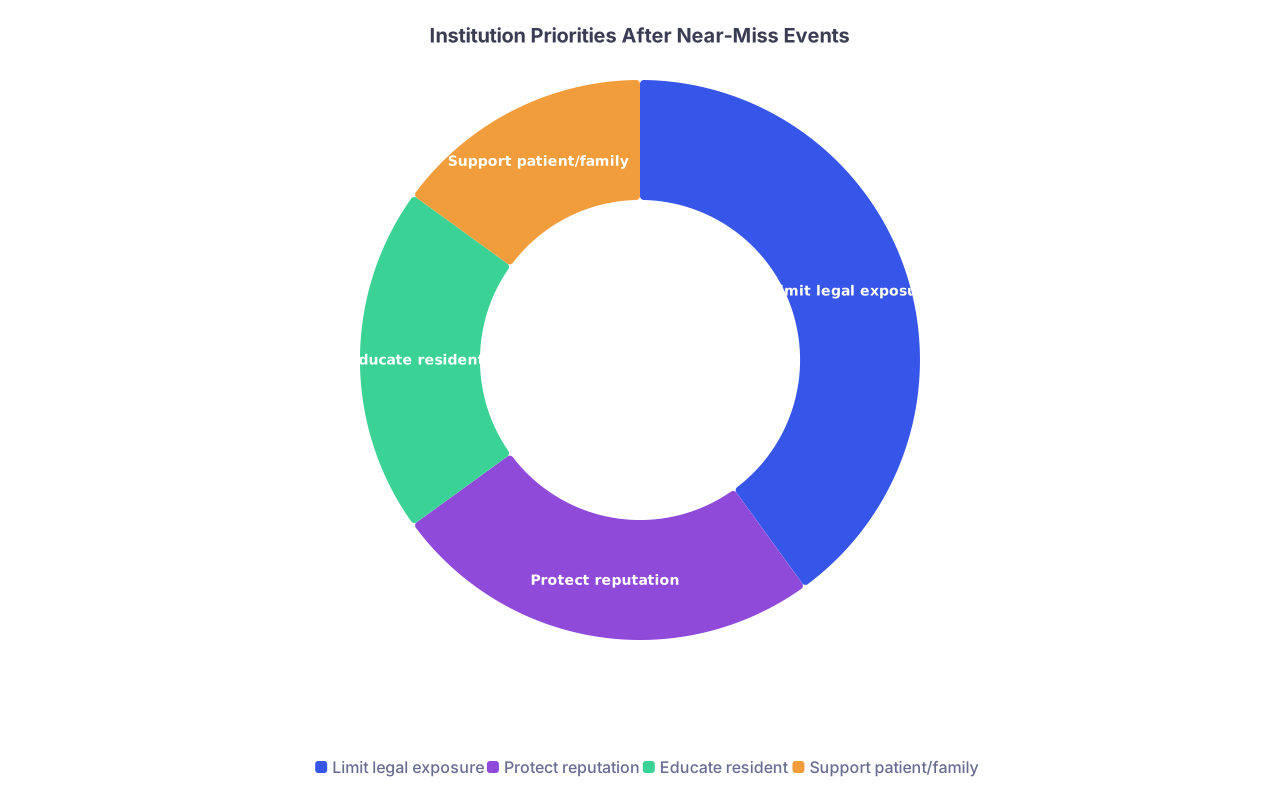
| Category | Value |
|---|---|
| Limit legal exposure | 40 |
| Protect reputation | 25 |
| Educate resident | 20 |
| Support patient/family | 15 |
What Smart Residents Do After They See The Pattern
Once you understand what’s really going on, you can handle these situations like a grown professional instead of a scared trainee hoping not to get fired.
Three tactical moves:
1. Get your own education about malpractice, not just the hospital slide deck
Know the basics:
- Difference between adverse event, error, negligence, and standard of care.
- What’s discoverable.
- Why late addenda get scrutinized.
When your PD “coaches” you, you’ll understand the subtext and avoid volunteering damaging language.
2. Use PD coaching, but keep your integrity
You do not have to distort reality to be legally smart.
If you genuinely believe care fell below standard, you can say:
- “In hindsight, I see options I did not recognize at the time.”
- “At that time, I believed my actions were reasonable, though I’d choose differently now.”
This is honest without handing a plaintiff a headline: “Resident admits gross negligence.”
If your PD feels like they’re pushing you to rewrite history, that’s when you quietly talk to:
- A trusted attending
- The GME office
- Occasionally your own counsel, if things go fully off the rails
3. Remember: the story you tell yourself becomes the story you tell under oath
Residents underestimate how much repetition cements their recall. If you keep saying, “I missed it, I screwed up, I was negligent,” that becomes your default autopilot testimony years later.
Use accurate, measured language early. Describe events, context, reasoning. Not moral judgment.
You can still feel guilty. That’s human. Just do not let your guilt script become your legal script.

What PDs Will Never Say Out Loud
Let me be very clear about a few ugly truths most PDs will never spell out to you:
- They’re balancing your growth against institutional risk. In a near-miss with legal overtones, institutional risk wins. Almost every time.
- Their job security partially depends on demonstrating control over their residents when bad things happen. Coaching you is as much about optics as it is about education.
- They remember which residents are “dangerous in front of a lawyer.” If you ramble, speculate, or dramatize, you will be sidelined in sensitive cases. Quietly.
If you want to be coached like a future attending instead of a liability:
- Be factual.
- Be concise.
- Be willing to analyze without self-immolation.
- Show that you understand systems issues, not just personal guilt.
That’s when PDs relax and start giving you the real playbook instead of damage control scripts.