
The biggest misconception physicians have about malpractice insurance is simple: you think you’re being evaluated only when you get sued. You’re not. You’re being watched—quietly, continuously—often in ways you never see.
Let me tell you what really happens behind the scenes at malpractice carriers and hospital risk offices. Because the way they monitor your clinical practice has financial, legal, and career consequences long before any lawsuit ever lands on your desk.
How Malpractice Insurers Actually See You
From the insurer’s perspective, you’re not just a surgeon, hospitalist, or OB. You’re a risk object with a constantly shifting profile.
They do not just look at: “Has this doctor been sued?”
They look at: “What does the data say this doctor is likely to cost us over the next 3–5 years?”
So they watch. Quietly.
Here’s the core truth: almost every major carrier now uses some form of predictive modeling and data feeds to flag “emerging risk” physicians. That could mean premium adjustments, closer underwriting scrutiny, or—at the extreme—non-renewal.
You won’t see “You’re on a watch list” in any letter. But you will see:
- “We’re updating our underwriting guidelines.”
- “We’re revising our rating tiers for certain specialties.”
- “We need some additional information regarding your practice patterns.”
That’s code. For: your data triggered something.
Let’s break down where that data comes from and how it’s quietly used.
The Data Streams You Don’t Realize They’re Using
Everyone knows they track claims. That’s old news.
The real story is in the proxy data—the things that correlate with malpractice risk even if no lawsuit has been filed yet.
1. Closed-Claims Databases and Near Misses
Carriers pool anonymized data across systems: NPDB (National Practitioner Data Bank), their own closed claims, and often national collaborative datasets. They’re looking for patterns.
Common examples I’ve seen discussed in closed-door risk meetings:
- Surgeons who consistently have “complication but no claim (yet)” events within 30 days.
- Hospitalists with a recurring pattern of readmissions with documentation gaps.
- OB/GYNs with rising rates of “shoulder dystocia with nerve injury” even without a lawsuit filed.
Here’s the part most physicians do not understand: a “near miss” that gets documented in the hospital’s event reporting system can end up reflected in a risk profile that your carrier sees indirectly.
No, they’re not getting a real-time feed of every near miss with your name slapped on it. But aggregate signals flow through:
- Hospital risk reports up to the system level.
- System-level loss data and severity trends fed back to insurers.
- Re-underwriting of “high loss” services, units, or groups, with individuals quietly singled out for “additional information.”
If your name keeps surfacing in bad outcomes—even without claims—underwriters eventually sniff it out, especially in tighter markets.
2. Your Billing and Coding Patterns
This one surprises people, but it should not.
Insurers know that chaotic documentation and sloppy coding tracks very closely with malpractice exposure. So they watch:
- High E/M coding without corresponding detailed documentation in sampled charts.
- Extremely high procedure volumes compared to peers (the “is this even physically possible?” flag).
- Odd combinations of codes that suggest either sloppiness or desperation.
They get this via:
- Hospital or group-level audits that are shared in aggregate.
- Requests for “sample charts” when underwriting or renewing a policy.
- Audits triggered when you request coverage expansion (e.g., adding high-risk procedures).
If your group is on a claims radar, insurers will absolutely ask: “Who are your top producers, and how do they document?” You do not want to be the high-volume physician with thin notes when that question hits.
3. Pharmacy and Order Patterns
This is more common in large systems and captive carriers (think integrated health systems with their own malpractice coverage), but it’s spreading.
They can see:
- High rates of opioid or benzo prescribing compared to peers.
- Chronic lack of lab monitoring on high-risk meds.
- Frequent overrides of key safety alerts in the EHR (e.g., ignoring anticoagulation warnings).
No one calls you and says, “Your opioid prescribing puts you at higher malpractice risk.” Instead, it shows up as:
- “Mandatory risk education” notifications.
- Quiet chart audits “for quality.”
- Your name mentioned in a system risk committee as someone who “may need supportive intervention.”
Again, that phrase—supportive intervention—is code for: this physician is a claims risk.
4. Peer Comparisons and “Outlier” Dashboards
Let me be blunt: if your hospital has “provider dashboards” with color-coded metrics, you can assume risk and legal have looked at them.
Common metrics used as quiet red flags:
- Length of stay far shorter than peers, especially if paired with higher readmissions.
- Mortality or complication indices that place you consistently in the wrong quartile.
- High patient volume with nighttime dictations or delayed documentation suggesting charting after the fact.
Carriers and hospital risk teams love these dashboards. Why? Because they have plausible deniability. They’re “quality” tools. Not “malpractice monitoring tools.”
But when renewal season hits and there’s an internal conversation about “Which physicians worry us on the liability side?”, those same dashboards go up on a screen in a conference room.
I’ve sat in those rooms. Names are read out. Data trends are discussed. And decisions about premiums and terms are made with those colors in the background.
](https://cdn.residencyadvisor.com/images/articles_svg/chart-common-quiet-risk-indicators-used-by-malpractice-i-2188.svg "Common Quiet Risk Indicators Used by Malpractice Insurers")
| Category | Value |
|---|---|
| High complication rate | 90 |
| Outlier prescribing | 70 |
| Documentation gaps | 85 |
| Patient complaints | 60 |
| [Multiple near misses](https://residencyadvisor.com/resources/malpractice-insurance-guide/how-program-directors-secretly-coach-residents-after-near-miss-claims) | 75 |
Patient Complaints: The Canary in the Coal Mine
If you think only lawsuits matter, you’re about a decade behind.
Patient complaints are one of the earliest—and most predictive—signals carriers and risk teams watch. Not just the number. The pattern.
Typical pattern that sets off quiet alarms:
- Multiple complaints clustered around communication, disrespect, or “wouldn’t listen.”
- Repeated issues with follow-up: “No one called me back,” “I couldn’t get my results,” “They brushed me off.”
This often precedes a serious claim by 6–18 months.
Hospitals run complaint reports by provider. Those reports absolutely feed into risk discussions, especially when:
- An insurer is renegotiating rates for a group.
- The hospital is deciding whether to back a physician heavily in a borderline case.
- Leadership is trying to decide if someone is “worth the headache.”
You’ll rarely see that linkage explicitly. Instead, you see language like:
- “We’re concerned about recurring communication issues.”
- “We need a corrective action plan.”
- “There appear to be ongoing patient experience concerns.”
But what they’re really thinking is: One of these is going to turn into a six-figure claim if we don’t blunt it now.
The EHR Trails You Don’t Think About
The EHR doesn’t just record orders and notes. It records how you behave in the system.
Risk teams and carriers care about:
- “Note cloning” patterns that could be weaponized in a deposition (“Doctor, can you explain why this entire note matches last week’s word-for-word?”).
- Orders placed but never signed, or unsigned notes that suggest poor closure.
- Time stamps that make your story look bad: e.g., documentation created long after an adverse event.
In some hospital- or system-owned malpractice programs, risk uses EHR audit logs to build a story before they decide how hard to defend you.
Let me say that again: the way you click around in Epic or Cerner can influence how aggressively your own side chooses to back you in a case.
If they see:
- You opened a result and did nothing.
- You ignored multiple alerts.
- You signed a note with obviously contradictory information.
They’re already calculating settlement probabilities. Quietly.

| Step | Description |
|---|---|
| Step 1 | Physician Clinical Activity |
| Step 2 | Hospital Data Systems |
| Step 3 | Quality Dashboards |
| Step 4 | Risk and Event Reports |
| Step 5 | Billing and Coding Audits |
| Step 6 | Hospital Risk Committee |
| Step 7 | Information Shared with Insurer |
| Step 8 | Risk Scoring and Modeling |
| Step 9 | Underwriting Decisions |
| Step 10 | Premiums, Conditions, or Nonrenewal |
How Insurers Quietly “Score” You
Most large carriers maintain internal risk scores. No, you will never see yours. Yes, it exists.
Common unseen factors that feed those scores:
- Specialty + procedure mix (e.g., OB, neurosurg, high-risk interventional).
- Claims history: number, severity, and pattern, not just raw count.
- Practice setting: rural vs urban, solo vs large group, hospital-employed vs independent.
- Non-claims risk signals: board complaints, NPDB reports, repeated hospital investigations.
Carriers particularly hate:
- Multiple low-severity claims that suggest systemic sloppiness.
- A single catastrophic outcome with glaring documentation problems.
- Physicians who fight every settlement recommendation, driving up defense costs.
There’s an internal category in many carriers that’s the real kiss of death: “frequency-severity potential.” That is, even if you haven’t had a catastrophic case yet, your pattern says you’re capable of one.
This is when you start seeing:
- Steep premium hikes.
- Coverage limits quietly tightened or excess coverage harder to obtain.
- More invasive renewal applications and documentation requests.
Again, none of this is labeled: “You are now high risk.” It’s buried in language like “market conditions,” “specialty adjustments,” or “revised underwriting criteria.”
| Trigger Type | Typical Quiet Consequence |
|---|---|
| Rising patient complaints | Mandatory coaching / monitoring |
| Multiple near misses | Case review, risk committee watch |
| Outlier complication rate | Chart audits, peer review |
| Documentation concerns | Underwriting questions at renewal |
| Board or NPDB action | Premium hike or non-renewal review |
The Role of Your Own Hospital in This Surveillance
Here’s a point people miss: your hospital or health system is often your first monitor, and your malpractice insurer is the second.
Hospitals care about:
- Reducing losses on their captive or self-insured pool.
- Keeping their loss history attractive so external reinsurers (the insurers’ insurers) give them tolerable rates.
- Avoiding public disasters that scare off patients and faculty.
So they do several quiet things you feel only indirectly:
- “Focused Professional Practice Evaluation” (FPPE) that no one calls disciplinary, but that gets reported up to risk.
- Peer review “for quality” that’s actually about understanding liability exposure.
- Mandatory documentation “education” sessions for certain providers, triggered by risk metrics.
That information is summarized and walked into meetings with malpractice carriers, usually at renewal or when negotiating large system policies.
The conversation doesn’t sound like: “We have a dangerous surgeon.”
It sounds like: “We have some active risk management initiatives with a small number of providers in our high-loss services. We’re monitoring and intervening.”
You want to avoid being one of the “small number of providers” they are referring to, because insurers hear that and quietly adjust their models.
What Actually Changes for You When They Get Worried
The monitoring is one thing. The consequences are another.
When a malpractice insurer starts seeing you as a problem, these changes creep in:
Premiums jump disproportionately
Not “everyone’s rates went up 5%.” Yours go up 20–40% relative to peers or compared to prior years. The letter will be vague. Actuarial language. But the cut is specific.Coverage limits become harder to increase
That umbrella or excess coverage you want? Suddenly “not available due to capacity constraints.” Translation: your risk score is ugly.More intrusive underwriting
Repeated requests for operative logs, case mix reports, board actions, CME details. They’re trying to see if you’re cleaning up your act or spiraling.Pressure from your group or hospital
If your risk drives up the group’s blended premium, partners notice. Hospitals notice. Eventually: “We need you to meet with risk and follow their plan.”Less aggressive defense if you’re sued
When your pattern screams “loser case likely,” the insurer’s appetite for dragging things out decreases. They’ll talk settlement sooner, and their enthusiasm for backing your version of events gets… muted.
You don’t see “flagged as high risk” in writing. You feel it as: higher bills, more hoops, weaker support.

What You Can (Quietly) Do To Protect Yourself
No, you cannot stop insurers from monitoring you. The financial and legal stakes are too high. But you can shape what they see when they look.
Here’s the unvarnished playbook I’ve seen work:
Clean, consistent documentation
Not just long. Coherent. Timeline clear. Rationale stated. Critical results acknowledged with a documented follow-up plan. You want any chart plucked at random to look defendable.Fix recurring complaint themes
If you’re hearing (or seeing in surveys) that you seem rushed, dismissive, or unavailable, believe it. That’s a litigation precursor. Two minutes of “tell me your biggest concern today” can save you six months of deposition hell later.Be boringly appropriate in your prescribing
No one gets sued for being reasonable with opioids, antibiotics, and benzos. People absolutely get hammered when their patterns look sloppy or outlier-ish.Know your metrics and where you sit
If your complication rate, readmissions, or LOS is an outlier, don’t shrug. Go to quality or risk and say, “I want to understand and address this.” That’s exactly the kind of physician carriers love—because it signals improvement potential, not denial.Take internal feedback seriously—early
FPPE, peer review, “informal coaching” from risk—this is not noise. It’s advance warning. When you treat it as a genuine early alarm, you often keep your name off the “we might need to non-renew this person” list.
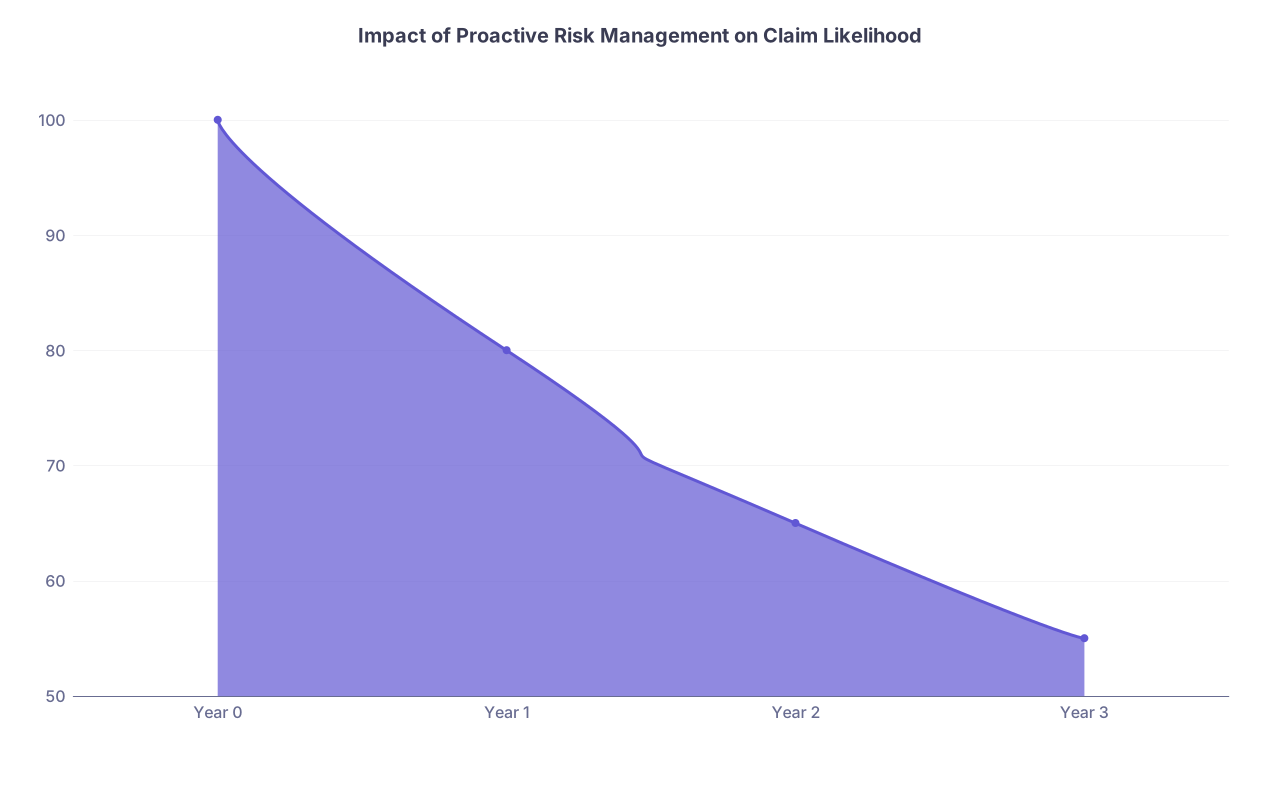
| Category | Value |
|---|---|
| Year 0 | 100 |
| Year 1 | 80 |
| Year 2 | 65 |
| Year 3 | 55 |
The Legal and Financial Reality You’re Actually In
You’re not just practicing medicine. You’re moving through a risk ecosystem where:
- Carriers are trying to survive in a volatile legal climate.
- Hospitals are trying to keep their loss ratios acceptable.
- Plaintiffs’ attorneys are smarter about mining EHRs, complaint histories, and communication gaps than ever.
So the monitoring stays quiet. Subtle. Disguised as “quality,” “education,” “documentation optimization.” But the real levers are financial and legal:
- Your premiums.
- Your ability to get or keep coverage.
- How forcefully your insurer defends you when things go sideways.
Once you understand that, a lot of the opaque, annoying, bureaucratic noise around you starts to make more sense. You see the pattern.
You’re not powerless. But you’re not invisible either.
With this perspective, you can start practicing in a way that’s not only clinically sound but strategically smart from a risk standpoint. That’s how you stay insurable, defendable, and in control of your career trajectory.
The next phase, of course, is what to do when a carrier really does start circling you as a problem—how to read the signals, negotiate, and, if needed, pivot to protect yourself. But that’s a story for another day.