
The story you tell yourself about “risk management” is incomplete. They aren’t just counting lawsuits. They’re quietly building a data-driven profile of you and your clinical behavior—long before anyone files a claim.
Let me pull back the curtain on how this really works.
Most physicians think: “If I don’t get sued, I’m fine with risk.” That’s not how hospital risk management committees, malpractice carriers, and system-level quality boards see you. They track patterns. Near misses. Angry families. Odd documentation. The stuff you never hear about in M&M.
And yes—those patterns follow you. They affect your insurability, your rates, your contract renewals, and whether your name pops up when someone says, “Who do we need to keep an eye on this year?”
This is the part no one explains in residency.
The Real Job of Risk Management (Not the One They Tell You)
Risk management isn’t just “help with lawsuits.” That’s the public-friendly version.
Here’s the internal version I’ve watched play out at multiple institutions:
They exist to protect the hospital’s money, reputation, and regulatory standing. Full stop. You’re part of that equation, but you’re not the center of it. You’re a variable.
When a risk committee sits down—typically a mix of:
- Risk manager(s)
- Chief medical officer / quality officer
- Nursing leadership
- A few seasoned physicians (often the same names every time)
- Occasionally legal counsel or a malpractice carrier rep
—they’re reviewing data from dozens of sources and asking one key question:
“Where are we most likely to get burned next, and who’s involved?”
Your cases show up in that conversation far more often than you realize.
To see how, you need to know what data streams they’re actually watching.
The Data Sources That Put Your Name on the Radar
Every case you touch leaks risk signals into the system. Some are obvious, some are buried.
Here’s where they come from.
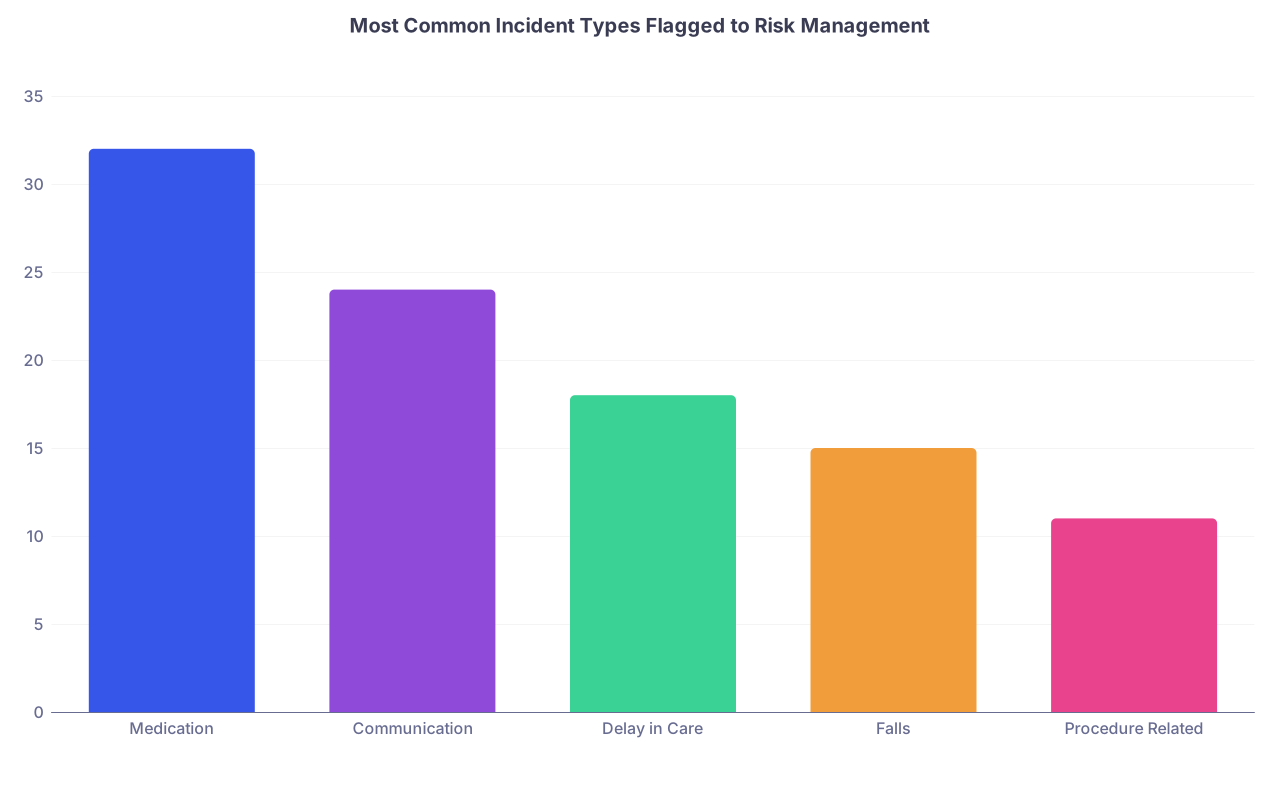
1. Incident Reports (The Hidden Early-Warning System)
Those anonymous “occurrence” or “incident” reports that nurses and staff fill out? Risk committees live in those.
They track:
- Medication errors and near misses
- Delays in care
- “Failure to rescue” vibes (deterioration not escalated)
- Equipment issues
- Patient/family complaints with a clinical angle
No one tells you this, but over a year or two they can build a profile like:
- “Dr. X is associated with a cluster of late consults in the ICU.”
- “We’re seeing repeated communication issues when Dr. Y is on call.”
- “High number of falls or restraints on Dr. Z’s service.”
You may never see a single one of those reports. But your name is in the internal analysis.
| Category | Value |
|---|---|
| Medication | 32 |
| Communication | 24 |
| Delay in Care | 18 |
| Falls | 15 |
| Procedure Related | 11 |
And no, it’s not “one-and-done.” They track trends by physician, unit, and service line. Quietly. Over time.
2. Patient Complaints and Grievances (Especially the “Frequent Flyer” Names)
Every formal complaint doesn’t go straight to risk. But the ones that mention:
- “Doctor refused to see us”
- “Ignored my concerns”
- “Rushed, dismissive, rude”
- “Would not explain what was happening”
- “Refused to apologize / take responsibility”
get flagged.
Risk committees have learned a painful truth: the worst malpractice cases usually start as “communication problems,” not technical errors. So they track these.
Patterns like:
- Repeated complaints involving the same attending
- Unit where families frequently threaten to “call a lawyer”
- Certain call nights that correlate with more grievances
You miss one phone call with a family? Nobody cares. You have six documented complaints in 12 months? Your name is now on a slide at the quarterly risk review.
3. “Difficult Case” Referrals from Legal and Claims
Your malpractice carrier and hospital legal team feed cases into risk management long before a verdict or settlement.
They flag:
- Any case with a demand letter
- Early attorney inquiries
- Pre-suit notices (in states that have them)
- Medical records requests that smell like prep for litigation
On the surface this is about the case. Underneath, they’re also asking:
- “Is this physician connected to other risky events?”
- “Is this an outlier or part of a pattern?”
- “Do we need to watch this person more closely?”
That’s where your entire recent case history starts getting pulled.
What They Actually Track About Your Cases
Let me be very literal here. When we sit in those committee rooms, these are the kinds of specific physician-level patterns that show up on slide decks.
1. High-Risk Case Mix vs. Outcome Pattern
Risk management knows certain services are inherently “hot.” Trauma. Neurosurgery. OB. EM. ICU. They don’t punish you for bad luck.
What they do track is: does your complication and complaint rate match your peers with similar case mix? Or not?
You’ll see internal dashboards like:
| Metric Type | Example Measure |
|---|---|
| Volume | Annual admissions / cases |
| Severity | Average case acuity (DRG, SOI) |
| Outcomes | Complication & mortality rates |
| Process | Time to consult / response times |
| Complaints | Formal grievances per 100 cases |
They’re not dumb. If you do 50 craniotomies a year and have 4 complications, that’s very different from doing 10 and having 4.
But if two surgeons in the same department have similar volumes and complexity, and one has double the post-op return-to-OR rate and triple the family complaints? That name lands in a “watch” or “intervention” category.
2. Documentation Habits That Scream “Future Lawsuit”
You think of your note as a billing artifact. Risk thinks of it as your legal defense.
What they quietly track:
Copy-paste abuse
Same physical exam for 8 days in a row while the patient decompensates. Same ROS on a sedated intubated patient. EHR audit trails expose this in seconds.Inconsistent timing
Order time vs. note time vs. nursing documentation. Example: “Seen urgently at bedside” note timestamped 02:14, but nurse documented “MD notified at 03:00.” This is discussed. Explicitly.Absence of differential or rationale
“Rule out PE, CT ordered” with no reasoning or alternatives. No explanation of why you didn’t thrombolyse. This is where your defense disintegrates later.No documentation of key conversations
Critical moments: prognosis, refusing tests, leaving AMA, code status, declining surgery. If it’s not documented, risk committees assume it didn’t happen when assessing exposure.
When a bad outcome hits, risk teams will sometimes do a retro review of your recent cases. If they keep seeing thin, sloppy, or contradictory documentation, you get labeled as a liability.
Not outwardly. You won’t get an email that says “your notes suck.” But corrections start: “documentation coaching,” “EMR education,” “peer review referral.”
I’ve watched physicians get quietly pushed out of a system over two years because their documentation style scared the hell out of the insurer.
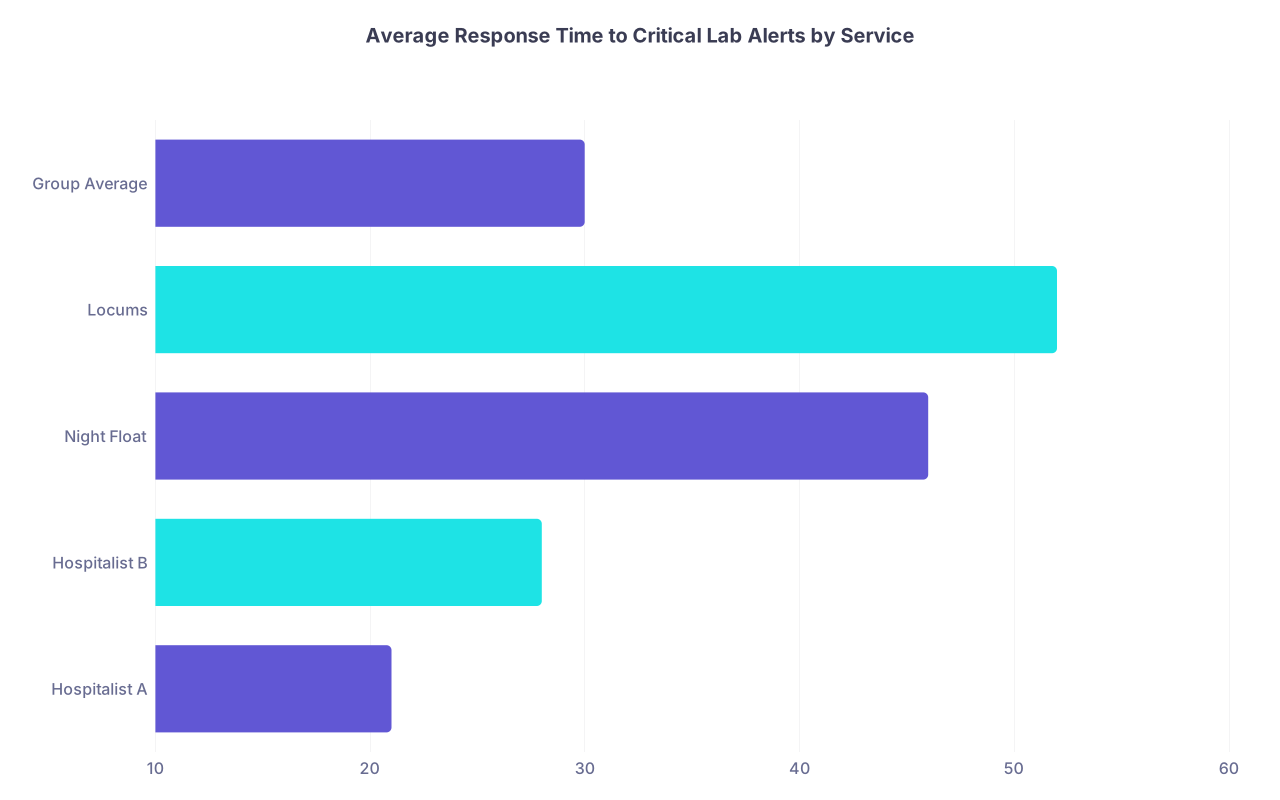
3. Timeline Gaps and Delay-of-Care Patterns
Most high-value malpractice cases hinge on this: Should something have been done earlier?
So risk committees obsess over:
- Time from ED triage to being seen by an attending
- Time from abnormal vital signs to escalation
- Time from critical lab result to documented response
- Time from consult request to evaluation
They track by service and sometimes by individual doctor.
| Category | Value |
|---|---|
| Hospitalist A | 21 |
| Hospitalist B | 28 |
| Night Float | 46 |
| Locums | 52 |
| Group Average | 30 |
When a bad case hits—say a sepsis patient coded upstairs—they reconstruct:
- Nurse notes: “Paged MD at 01:12, 01:22, 01:40”
- EMR: first MD note at 02:05
- Vital trends: MAPs sliding for 90 minutes, no new orders
If this is the first time your name is in such a story, you’re “unfortunate.” If the same pattern shows up in three chart reviews across different cases, you’re now a “risk exposure.”
They don’t always tell you that directly. But from that point your cases get extra scrutiny.
4. Consent Quality and “Expectation Setting”
One of the quietest but most important things they track: informed consent quality.
Not the form. The content.
- Does your consent read like a legal template or is it tailored to the actual patient and procedure?
- Do you consistently document risks that later become the complication?
(e.g., you documented “risk of stroke” in a carotid, and then the patient strokes)
Patterns they notice:
- Surgeons who never list major complications in consent notes
- Vague language: “Risks explained, patient understands,” and nothing else
- No documented discussion on alternatives, including no surgery / conservative management
They correlate this with legal outcomes. Risk committees know the painful truth: poorly documented consent is one of the strongest predictors of a case going nuclear.
So surgeons and proceduralists with consistently lightweight consent documentation get flagged long before anything goes to trial. And that can eventually circle back to their malpractice premiums and contract terms.
How This Flows to Your Malpractice Risk and Premiums
Here’s the part trainees never see.
Your malpractice carrier doesn’t just react to claims. They stratify risk continuously, especially for large groups and hospital-employed physicians.
They care about:
- Frequency of “reportable events” associated with you
- Any prior paid claims or settlements
- Specialty + your personal risk “fingerprint”
- Quality issues raised in peer review that overlap with high-risk patterns
At the system level, they will absolutely give feedback like:
- “This service line is higher-than-average risk.”
- “We’re seeing recurring issues with documentation, consent, and delay in escalation.”
- “These specific clinicians are contributing disproportionately to losses.”
They won’t send a letter saying, “We think Dr. Smith is dangerous.” But they’ll say:
“We recommend targeted education, monitoring, or remediation in these areas. Continued adverse trends may impact pricing.”
On the hospital side, your leadership then has options:
- Put you on a performance improvement plan
- Require you to do specific risk management CME
- Restrict certain privileges temporarily
- Decline to renew your contract “for business reasons”
- Quietly not back you if you want to move to a more competitive group or site
And if you’re in private practice buying your own coverage? Those “prior acts,” reserve amounts on open claims, and even non-paid claims with high exposure will absolutely get baked into your premium and your ability to switch carriers.
The Behind-the-Scenes Meeting When Your Name Is on the Agenda
You need to picture what actually happens the first time your name shows up on a risk committee agenda attached to a serious case.
I’ve seen versions of this scene in academic centers, large community hospitals, and private systems:
A PowerPoint goes up. Case description. Timeline. Key documentation screenshots. Outcome. Family behavior. Any legal contact.
Then someone asks the question that should make you shiver a little:
“Is this consistent with this physician’s usual practice or an outlier?”
Now they’re not just talking about this one case. They’re pulling:
- Recent incident reports involving you
- Any previous complaints with your name
- Past peer-review issues
- Department chair’s informal feedback
- Comparative data vs. your group
Sometimes the chair says, “This isn’t like them. They usually document well, respond quickly, very engaged with families. This was a bad night with three simultaneous codes and a skeleton crew.”
That lands one way.
Sometimes the chair says, “We’ve discussed concerns about their documentation and availability before. Nursing has raised issues. We’ve seen this pattern.”
Different outcome. Much less benefit of the doubt. That difference can be the line between “unfortunate outcome” and “systemic physician risk.”
And yes—this changes how aggressively the hospital and insurer are willing to defend your case versus push for early settlement.
How to Practice in a Way That Survives Risk Scrutiny
You can’t eliminate risk if you touch patients. But you can stop being the person who lights up every dashboard.
This isn’t about being perfect. It’s about understanding which behaviors actually change your profile in the eyes of risk management.
1. Clean Up Your Timeline
Be obsessive about:
- Responding to critical labs and vitals, and documenting when you did
- Making it obvious in your note when you were notified, when you saw the patient, what you decided and why
- Avoiding long “silent” periods in the chart in deteriorating patients
If a layperson can read the chart and follow your timeline, you’ve done 80% of your legal defense already.
2. Document Thought Process, Not Just Actions
Risk committees love notes that show:
- Clear differential diagnosis
- Explicit recognition of risk (“High risk for PE, chose not to anticoagulate because X, Y”)
- Acknowledgment of uncertainty and limited data
- Rationale for not doing common tests or treatments
That’s what allows legal and risk to say, “This was a reasonable judgment call, even though it went badly.”
Minimal note, no rationale? They cannot defend what they cannot see.
3. Treat Every Upset Family as a Future Deposition
Not by being defensive. By being deliberate.
When a family is angry or anxious:
- Slow down
- Sit down
- Use normal language
- Summarize what you said in the note: “Spoke with patient’s wife, explained X, Y, Z, answered questions, discussed risks including A, B, C.”
That note becomes gold when risk reviews the chart and sees you didn’t hide, minimize, or dodge. Committees notice this pattern and give those physicians more support.
4. Fix Your Consents
Stop using the consent note as a throwaway.
Specify:
- Procedure
- Major specific risks (not just “bleeding, infection, injury to nearby structures”)
- Alternatives (including no procedure, conservative management)
- Addressed questions, patient’s understanding
When a complication occurs, risk managers comb that consent note. If the exact complication is there, clearly documented, with patient understanding, the risk profile changes dramatically.
5. Stay Off the “Problem Patterns” Radar
If you don’t want your name coming up often, avoid these repeat offenders:
- Chronic late responder to pages, especially at night
- Known as “never talks to families”
- Constant copy-paste with obviously outdated information
- Snapping at nurses who raise concerns
- Refusing to engage with peer review or feedback
The committee sees those patterns through incident reports, complaints, and chart audits. Fixing just those behaviors will quietly lower your visibility.
Why This Matters for Your Career and Your Wallet
You might think: “I’m a hospital employee, they cover me. Why should I care?”
Because:
- Hospitals absolutely track which physicians are costing them the most in payouts and reserves.
- Those numbers influence your leverage in contract renewals, leadership positions, and whether they invest in you or phase you out.
- If you ever leave, prior risk events follow you. Privileging committees and new malpractice carriers ask for this history in excruciating detail.
Year to year, your personal risk profile can mean:
- Higher or lower malpractice premiums (directly or via group rates)
- Ability to move to a better group or system
- Whether an academic or high-end private program is willing to touch your file
- Whether your current hospital will fight for you in a public incident—or quietly make you the expendable piece
Years from now, you won’t remember the individual progress notes. You will remember whether you built a reputation as the clinician everyone wanted to defend… or the one everyone silently blamed in the conference room when the projector turned on.