
You just got your contract, or you’re mid-career at a large group. HR tells you, “Don’t worry, we provide malpractice coverage.” Someone else mentions they carry their own personal policy on top of that. Now you’re wondering:
Am I being smart by relying on group malpractice coverage, or reckless?
Here’s the direct answer:
Most physicians rely solely on group malpractice coverage and are fine. But there are absolutely situations where keeping your own policy makes sense—and a few where I’d call it almost mandatory. The trick is knowing which camp you fall into.
Let’s break that down clearly.
The Core Question: Do You Need Your Own Policy Too?
Start here:
If your only practice is as a W-2 employee of a reputable hospital or large group that provides solid occurrence or tail-inclusive claims-made coverage, and you have no moonlighting, no side gigs, and no big leadership exposure—then a separate individual malpractice policy is usually unnecessary.
If any of the following are true, you should at least seriously consider your own policy:
- You moonlight or do side work (locums, telemedicine, med spas, cash clinics).
- You are 1099 anywhere, even “one day a month.”
- Your group policy has low limits or obvious gaps.
- You’re in leadership or administrative roles (medical director, CMO, committee chair).
- Your employer has any history of unstable finances, ownership changes, or acquisitions.
- You want your own defense attorney, answerable to you—not your employer or their carrier.
So this is not a one-size-fits-all answer. It’s a decision tree.
How Group Malpractice Coverage Really Works
Ignore the glossy HR slide deck. You need to know the mechanics.

| Step | Description |
|---|---|
| Step 1 | Do you only work as W2 employee? |
| Step 2 | Need own policy |
| Step 3 | Strongly consider own policy |
| Step 4 | Group coverage usually enough |
| Step 5 | Any moonlighting or 1099 work |
| Step 6 | Group policy strong and stable |
| Step 7 | Leadership or high-risk specialty |
What group policies usually cover
Most employer-provided malpractice policies:
- Name you as an insured while you are employed.
- Cover you only for work done within the scope of that job.
- Provide a shared or per-physician liability limit (e.g., $1M/$3M).
- Include defense costs, but the carrier picks the lawyer.
- Protect the employer’s interests first, yours second.

The big coverage type difference: occurrence vs claims-made
You need to know which your employer uses:
| Feature | Occurrence Policy | Claims-Made Policy |
|---|---|---|
| Coverage Trigger | When incident occurs | When claim is reported |
| Needs Tail? | No | Yes, if you leave |
| Common for | Large hospitals, some big systems | Many private groups, smaller employers |
| Cost Over Time | Higher ongoing premium | Lower early, rises with years |
If your employer uses claims-made and does NOT contractually guarantee to pay for tail coverage when you leave (in writing, not verbally), that’s a major red flag. You either:
- Negotiate tail coverage into your contract,
- Budget to buy your own tail later, or
- Carry your own policy structured so you’re not exposed.
When Relying Only on Group Coverage Is Usually Fine
Let me be clear: carrying your own separate policy is not some secret requirement all “smart doctors” know about. It’s often overkill.
You can usually rely on employer coverage when:
- You’re a W-2 employee only.
- You don’t moonlight or see patients anywhere else.
- Your employer is a stable hospital or large multispecialty group.
- The policy limits are reasonable for your specialty and state (e.g., $1M/$3M or higher).
- The contract clearly states they cover your malpractice, including tail, for employed work.
- You’re not doing entrepreneurial side gigs (med spa, aesthetics, concierge, etc.).
In that situation, most risk is adequately handled by the group policy. You’re not getting bonus points from a separate policy.
But. You still need to understand what that group coverage doesn’t do.
What Your Own Individual Policy Adds That Group Coverage Doesn’t
Here’s where a lot of physicians misunderstand the value. It’s not only about “more money if I get sued.”
Your own policy can change who’s in your corner and what gets covered.
1. Independent defense and loyalty
In a shared group policy, the carrier’s priority is minimizing total payout and protecting the institution. That can mean:
- Pressuring you to settle to protect the group brand.
- Blaming individual physicians to shield systemic failures.
- Having one attorney “represent” multiple defendants with conflicting interests.
Your own policy can:
- Provide separate legal counsel whose only duty is to you.
- Push back if the group’s narrative throws you under the bus.
- Give leverage if there’s finger-pointing between you and colleagues.
Is that common? No. But when it happens, it’s ugly. I’ve seen cases where a hospital blamed an ED doc and a surgeon blamed anesthesia, all with one defense team trying to juggle conflicting stories. The physician without separate support usually gets squeezed.
2. Coverage for side gigs and off-contract work
Group policies usually exclude:
- Moonlighting at other facilities.
- Telemedicine platforms you join as a contractor.
- Medical director roles for nursing homes, infusion centers, med spas.
- Consulting or expert witness work involving patient care.
- Volunteer work outside approved programs.
If you do any of that, you need to confirm: is that work covered anywhere?
If not, an individual policy that specifically covers all your professional activities is straightforward and not that expensive, especially in lower-risk fields.
Key Scenarios Where Keeping Your Own Policy Is Smart
Let’s go through concrete situations.
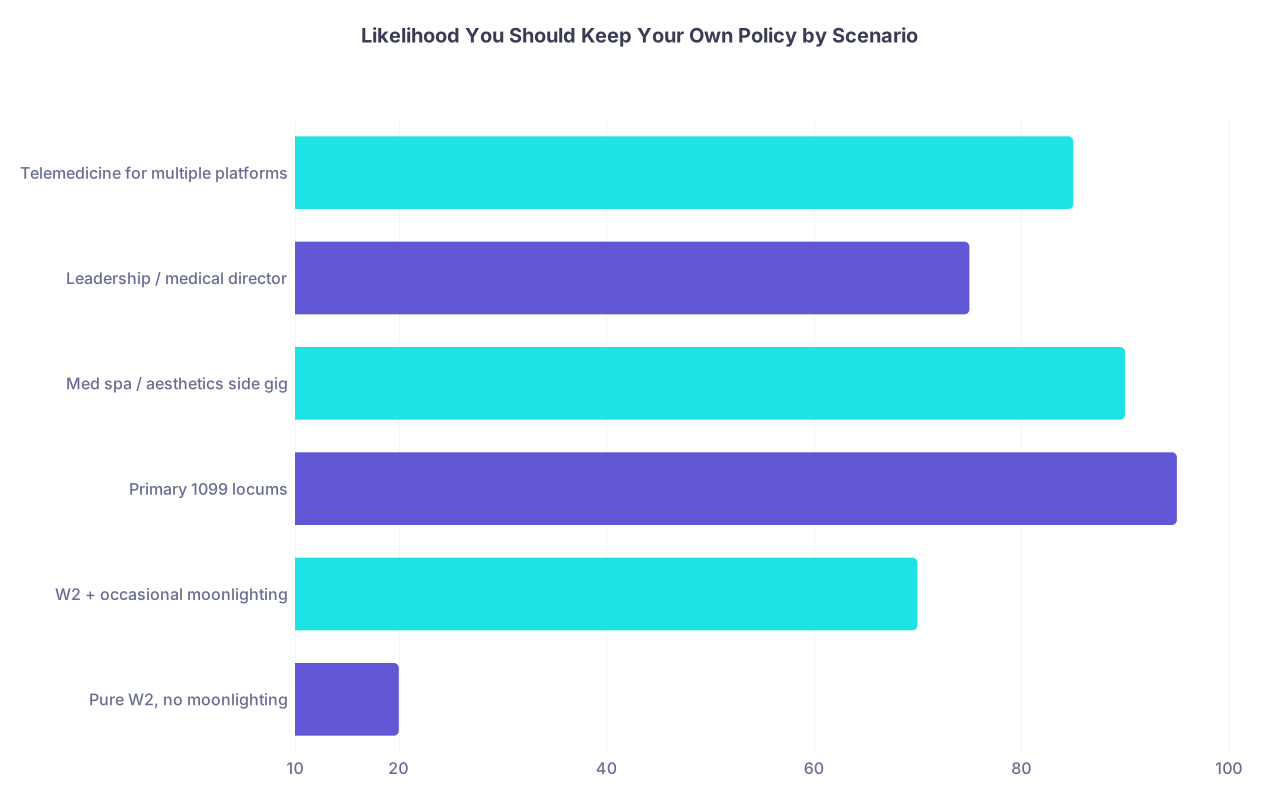
| Category | Value |
|---|---|
| Pure W2, no moonlighting | 20 |
| W2 + occasional moonlighting | 70 |
| Primary 1099 locums | 95 |
| Med spa / aesthetics side gig | 90 |
| Leadership / medical director | 75 |
| Telemedicine for multiple platforms | 85 |
Scenario 1: You do any 1099 or side clinical work
If there is a 1099 anywhere on your tax return related to patient care, do not trust your group policy to cover it. It almost certainly doesn’t.
Examples:
- Hospitalist who moonlights at a neighboring facility.
- Anesthesiologist doing occasional endoscopy center shifts as an independent contractor.
- Dermatologist doing cosmetic procedures at a med spa on the weekends.
- EM doc picking up telemedicine shifts for a national platform.
Each setting typically needs its own coverage, or you need one personal policy that’s structured to cover all of them.
Scenario 2: You’re primarily 1099 (locums, telemed, per-diem)
If you’re mainly 1099, the default assumption flips. You need your own policy unless each individual site provides occurrence coverage that includes you explicitly and you never mix sites.
Locums agencies sometimes provide coverage. Read it:
- Is it claims-made?
- Who pays for tail when the contract ends?
- Does it follow you if you’re later named in a claim?
An independent policy that you own, not tied to any single agency, gives you continuity and control.
Employer Instability, Tail Coverage, and Job Changes
The more unstable your employer, the less comfortable I am relying purely on their coverage.
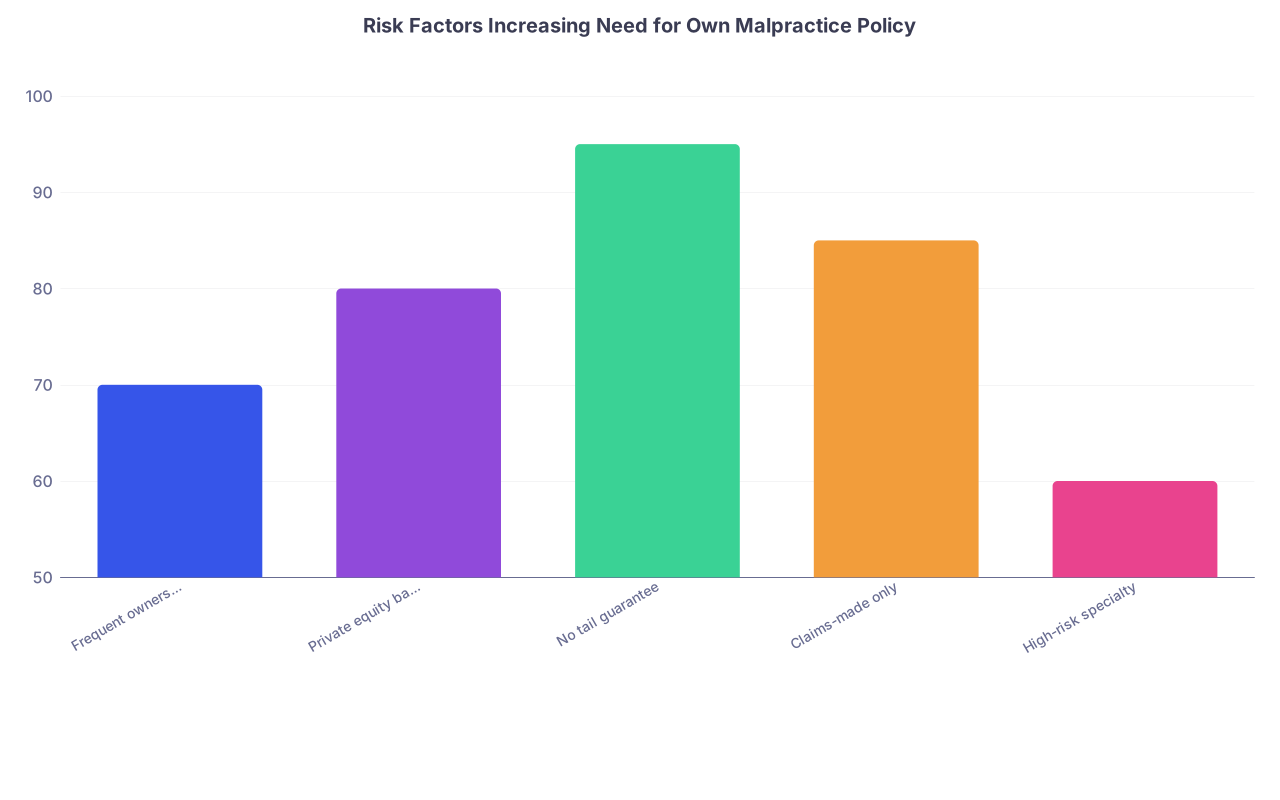
| Category | Value |
|---|---|
| Frequent ownership changes | 70 |
| Private equity backed | 80 |
| No tail guarantee | 95 |
| Claims-made only | 85 |
| High-risk specialty | 60 |
Red flags where I’d seriously consider my own policy:
- Your group is private equity–backed and flips owners every few years.
- Your contract is silent or vague about who pays tail.
- You’ve had colleagues leave and get stuck paying tens of thousands for tail.
- The group has had lawsuits that led to non-renewal or carrier changes.
If the employer policy is claims-made and they won’t guarantee tail in writing, you have three options, none of them ideal:
- Buy your own tail when you leave (often 1.5–2.5x the annual premium).
- Negotiate “nose” coverage at the new job (new carrier covers the prior exposure).
- Maintain continuity through your own individual policy from day one.
Physicians often get burned here because they only realize the tail problem the month they’re trying to leave.
Coverage Limits, State Law, and Specialty Risk
You also have to match your coverage to your risk environment.
| Context | Common Limits | Comment |
|---|---|---|
| Many states / general practice | $1M / $3M | Often standard floor |
| High-risk states (e.g., FL, NY) | $1M / $3M or $2M / $4M | Higher verdict risk |
| Surgical subspecialties | $1M / $3M or higher | Consider higher limits |
| Med spa / aesthetics | Varies widely | Watch exclusions carefully |
If your group coverage is significantly below local norms or specialty expectations, adding your own policy with adequate limits can plug that gap. Just make sure it’s structured properly (primary vs excess, consent to settle provisions, etc.). An insurance broker who specializes in physicians is worth their fee here.
Downsides of Keeping Your Own Policy (Yes, There Are Some)
It’s not all upside.
- Cost. You’ll pay real money—often a few thousand per year at least, more in high-risk specialties or bad legal environments.
- Potential for finger-pointing between carriers. Two policies can sometimes mean each insurer tries to push primary responsibility onto the other.
- Complexity. You now have to track policy dates, retroactive dates, tail obligations, and make sure your side gigs are actually named and covered.
If your situation is simple and your employer coverage is solid, adding your own policy just so you “feel” more insured may not be a smart financial move.
A Simple Framework: Should You Keep Your Own Policy?
Here’s the blunt decision framework I’d use.
You should strongly consider keeping or getting your own malpractice policy if:
- You perform any clinical work outside your main W-2 job.
- You have any 1099 income tied to patient care.
- Your employer’s policy is claims-made and they don’t guarantee tail in writing.
- You’re in a leadership or high-profile role where finger-pointing is more likely.
- Your employer or group has instability, ownership churn, or weak reputation.
You can usually rely on group coverage alone if:
- You’re purely W-2.
- No moonlighting, no side patient care work, no telemedicine.
- Your contract explicitly says they provide malpractice, including tail, at no cost and with clear limits.
- The organization is stable and uses standard limits for your state/specialty.
How to Actually Check What You Need (Concrete Steps)
Do this in the next week:
- Get a copy of your current malpractice declarations page and policy (not just the HR summary).
- Read your employment contract section on malpractice and tail. Look for:
- “Employer shall provide claims-made/occurrence coverage with limits of…”
- “Employer shall pay the cost of tail coverage upon termination…”
- Make a list of every place and way you touch patients:
- Main job
- Moonlighting shifts
- Telemedicine platforms
- Med spa / aesthetics
- Medical director roles
- Volunteer clinics
- For each, write next to it: “Covered by employer A, B, or personal policy?” If you can’t answer, you probably are not covered.
- Call an independent malpractice broker who works with physicians and say:
“I have employer coverage at X. I also do Y and Z. I want a quote for an individual policy that covers all of my clinical work, with [X] limits, and I want to understand tail implications.”

You do not need to become an insurance expert. But you do need to know if you have uncovered work.
Common Misconceptions That Get Doctors in Trouble
Let me kill a few myths:
“If I’m licensed and board-certified, I’m automatically covered anywhere.”
No. Coverage is contract- and policy-based, not license-based.“The locums agency said I’m covered, so I’m good.”
Maybe. Until that policy is non-renewed, or it’s claims-made with no tail, or it excludes something you actually do.“Volunteer work is always protected by good Samaritan laws.”
Often not. And those laws are narrower than people think.“If I get my own policy, I’m double insured, so I’m extra safe.”
Not necessarily. If it’s not structured properly (primary vs excess, retro dates, etc.), you can create more hassle, not less.
FAQs: Keep Group Coverage Only vs Add Your Own Policy
1. If my employer provides malpractice insurance, can I still be personally sued?
Yes. In every malpractice suit, the physician is typically named personally along with the hospital/group. Your employer’s policy usually defends and indemnifies you, but your name is on the lawsuit. That’s normal. Your own policy doesn’t stop you from being named; it just may change who defends you and what’s covered.
2. Does my personal malpractice policy protect me for things I did at my old job?
Only if the policy is written with an appropriate retroactive date that reaches back to when you provided that care. If you switch carriers or start a new policy without tail or proper retro coverage, there can be gaps. This is exactly why claims-made vs occurrence and tail coverage matters. Never assume continuity—verify the retro date.
3. Is it cheaper long-term to just rely on employer coverage instead of buying my own policy?
Usually yes, if your situation is simple (pure W-2, no side work, employer covers tail). In that clean scenario, adding your own policy is more like buying extra peace of mind than a financial necessity. Once you add moonlighting, 1099 work, or tail exposure, the math changes, and your own policy can be the cheaper way to avoid huge one-time tail bills or uncovered lawsuits.
4. Can I be over-insured for malpractice? Is there such a thing as “too much” coverage?
You can be inefficiently insured. For example, having two primary policies that both try to push the claim onto the other can create friction. Also, carrying absurdly high limits in a high-verdict state can theoretically paint a bigger target. But in practice, the bigger issue is structure and gaps, not having “too much” on paper. Focus on correct limits and alignment between policies, not just piling on.
5. I only do telemedicine from home in one state. Do I need my own policy?
Very likely yes, unless you are strictly an employee of a telemedicine company that explicitly provides occurrence coverage and prohibits outside work. Many telemed gigs are 1099, multistate, and use patchwork coverage. That’s prime territory for needing your own well-structured policy that follows you, not them.
6. What about being a medical director—does my group policy cover that?
Sometimes, but not reliably. Medical director roles often involve administrative decisions, policies, and oversight that fall outside standard direct patient care. Some policies exclude administrative acts or limit them. If your contract pays you (often as 1099) to be “Medical Director of X,” do not assume your regular clinical malpractice coverage extends there. Ask the carrier in writing or get a separate endorsement/policy.

7. What’s the single biggest sign I should talk to a broker about my own policy?
If you cannot clearly answer this question: “Who covers me, with what limits, and under what policy type (claims-made vs occurrence) for every single setting in which I see patients or make clinical decisions?” Confusion here is your biggest warning sign. If the honest answer is “I’m not sure,” then your next step is simple: pull your contract and declarations page and get on the phone with a malpractice-focused broker or attorney.
Open your contract right now and find the malpractice section. Circle or highlight any sentence mentioning “claims-made,” “tail,” or “moonlighting.” If you see those words and you can’t explain exactly what they mean for you, that’s your cue: get clarification and, if needed, a quote for your own policy this week.