
The belief that employer-provided malpractice insurance is “enough” is one of the most expensive misconceptions in medicine.
If you rely only on what your employer hands you, you’re betting your career, your savings, and your future insurability on a contract you probably have never actually read.
Let me walk you through what I tell physicians, NPs, and PAs when they ask: “Do I really need my own malpractice coverage, or is the hospital’s policy enough?”
Short answer: Sometimes yes. Often no. And if you do not understand a few key details, you’re the one holding the bag when something goes wrong.
Step 1: Understand What Your Employer Is Actually Providing
First thing: stop calling it “malpractice insurance” like it’s generic. Policies are not all the same. There are at least five variables that matter:
- Claims-made vs. occurrence
- Who owns the policy
- Who pays for tail
- Limits of liability (per claim / aggregate)
- Who is actually insured (you individually, or just as an employee)
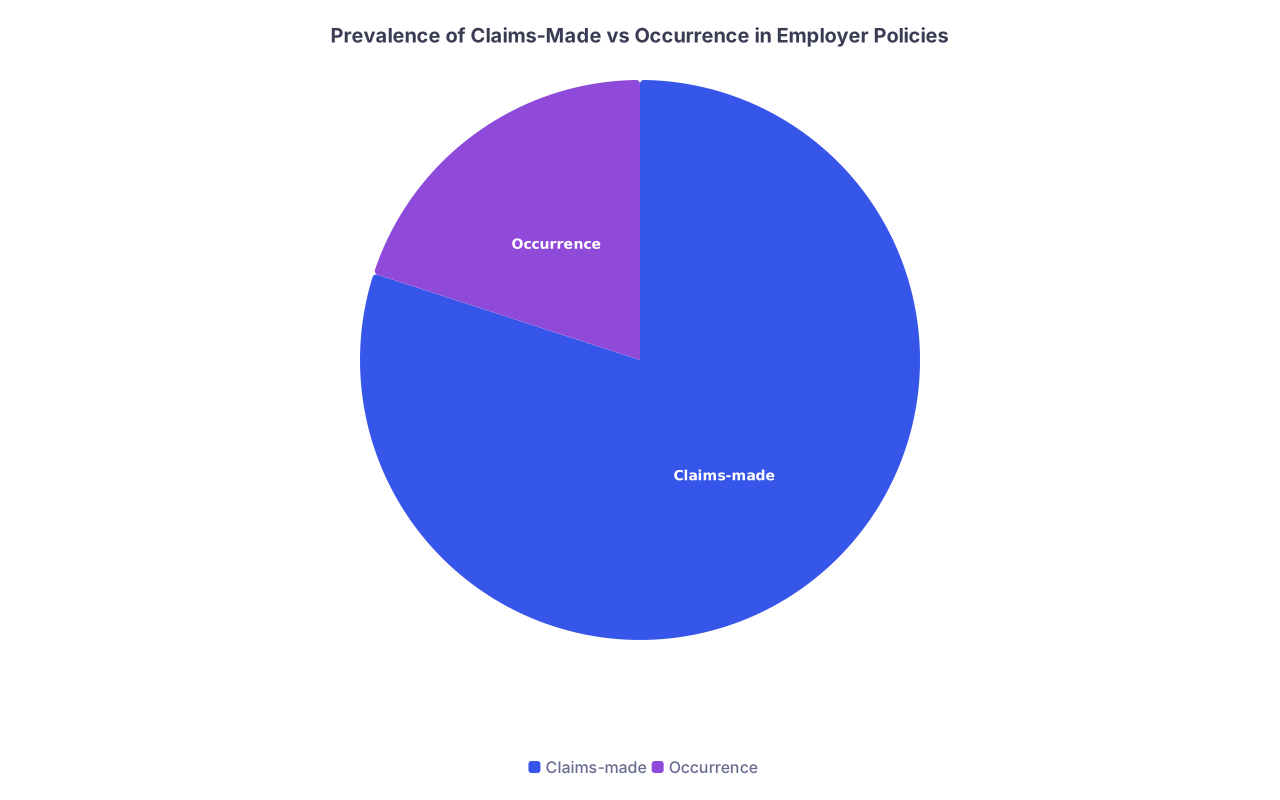
Most employer-provided policies are:
- Claims-made
- Employer-owned
- With no guaranteed tail for you when you leave
Here’s why that matters.
Claims-made vs. occurrence
Occurrence coverage protects you for incidents that occurred during the policy period, no matter when the claim is filed. You can leave a job, retire, move states—if it happened when you were covered, you’re good. No tail needed.
Claims-made coverage only protects you if:
- The incident occurred during the policy period, and
- The claim is reported while that policy is still active
Once you leave that employer and their policy stops covering you, any new claim for past care is your problem—unless someone buys tail coverage.
| Category | Value |
|---|---|
| Claims-made | 80 |
| Occurrence | 20 |
Most group and hospital employers use claims-made because it’s cheaper up front. That’s fine for them. Not always fine for you.
Who owns the policy?
In most employed settings, the policy is in the employer’s name. You are a “named insured” or “additional insured” at best.
Translation:
They control:
- Which carrier they use
- Coverage limits
- Whether to renew
- Whether to buy tail
- How aggressively to defend vs. settle
Your leverage is small unless it’s written in your contract.
Step 2: Tail Coverage – The Silent Trap
Tail is where people get burned.
If you are covered under a claims-made policy, you need tail coverage when:
- You leave the job
- You move to another state or employer that doesn’t pick up your prior acts
- The practice dissolves or goes bankrupt
- You retire
Tail covers you for claims filed in the future for work you did in the past. A single OB claim can roll in 5–10 years later. Pediatrics and surgery also see delayed claims. Family med and IM are not immune either.
Typical tail cost: 150–250% of your last-year premium.
| Specialty | Typical Annual Premium | Approx Tail (200%) |
|---|---|---|
| Internal Medicine | $12,000 | $24,000 |
| General Surgery | $40,000 | $80,000 |
| OB/GYN | $60,000 | $120,000 |
| Emergency Med | $25,000 | $50,000 |
You will see two types of contract language:
- Employer pays all tail
- Physician/APP pays all tail
Sometimes a third: “Tail responsibility is shared or negotiable.” That usually means “We’ll stick you with it unless you fight.”
If your contract says nothing about tail, assume you’re responsible.
I’ve watched people get:
- A $90,000 tail quote when leaving a toxic OB job
- A $30,000 surprise bill when a small group sold to a hospital, and the old entity dissolved
- Stuck because they could not afford tail, then had trouble getting new coverage
If you don’t know who is contractually responsible for tail, you are not protected—no matter how “good” your employer-provided insurance looks.
Step 3: Policy Limits – Are You Sharing a Small Pie?
Most institutional policies look like this:
- $1 million per claim
- $3 million aggregate per year
Or higher (like $5M / $10M) for big hospital systems. That sounds generous until you realize:
- You might be sharing those limits with multiple clinicians
- A single major case can name everyone: the hospital, your group, you, the nurse, the radiologist

| Category | Value |
|---|---|
| Hospital Employed | 5000000 |
| Large Group | 3000000 |
| Small Private Practice | 1000000 |
| Personal Policy | 1000000 |
Are shared limits always bad? Not necessarily. But if you’re in a high-risk specialty, in a litigious state, with a policy that gives the employer first call on defense strategy, you’re not exactly driving the bus.
The key question:
“Are my limits shared or separate, and if shared, with whom?”
If they can’t answer that clearly, assume you’re sharing.
Step 4: Where Employer Coverage Fails You Personally
This is where most people wake up.
Employer-provided malpractice primarily protects:
- The employer’s balance sheet
- The employer’s reputation
You’re covered by extension, but not necessarily in the ways that matter to you long-term.
Here’s where I’ve seen gaps:
License protection – Board complaints
Your malpractice policy may defend you in a lawsuit, but not necessarily in front of the state medical board or nursing board if a complaint is filed. Those are separate processes. Separate risks.Criminal allegations
Rare but real—especially in cases involving controlled substances, alleged fraud, or patient death under suspicious circumstances. Many employer policies specifically exclude criminal defense.Disputes after you leave
If you’ve left on bad terms, do you trust your old employer to vigorously defend you in a claim where their own exposure is central? I don’t.Coverage for side gigs
Your hospital job’s coverage usually does not extend to:- Moonlighting in an urgent care
- Telemedicine on the side
- Expert witness work
- Volunteer clinics (sometimes covered, often not)
Policy control
If the employer decides to settle against your wishes, that settlement goes on your record. That can affect credentialing, privileges, and future job prospects. Some policies give you a “consent to settle” right. Many employer-provided ones do not.
Step 5: When Employer Coverage Might Be Enough
There are situations where I’ll tell someone: “You’re probably fine with what you’ve got—if you understand it.”
Employer-provided coverage is often adequate if:
- You’re fully hospital-employed with a large, stable system
- The policy limits are strong (e.g., $1M / $3M or higher, separate per clinician)
- You have written, contract-level assurance that:
- Tail will be provided at termination, retirement, disability, or death
- You’re an individually named insured
- You have at least some say in settlement decisions
You might not need personal malpractice for basic clinical protection in that scenario. But you may still want:
- A separate license defense policy
- Coverage for any moonlighting or telemedicine
- A plan for what happens if that employment situation changes suddenly
If your career is 100% inside that one system, no side gigs, and they treat physicians and APPs like assets not disposable widgets, then yes, employer coverage can be enough on the pure malpractice side.
But that’s a narrower group than most people think.
Step 6: When You Absolutely Should Consider Personal Coverage
Here’s where I stop being polite. If any of these apply, relying only on employer-provided malpractice is risky:
- You’re in a higher-risk specialty: OB/GYN, surgery, EM, anesthesia, radiology, certain procedural subspecialties
- You move jobs frequently (locums, short contracts)
- Your contract says you pay for tail, or is silent on tail
- You do any independent work: telehealth, locums, part-time at a different site, volunteering with real clinical responsibility
- You’re in a state with aggressive plaintiff bars and high verdicts (think parts of NY, FL, PA, CA, IL, NJ, etc.)
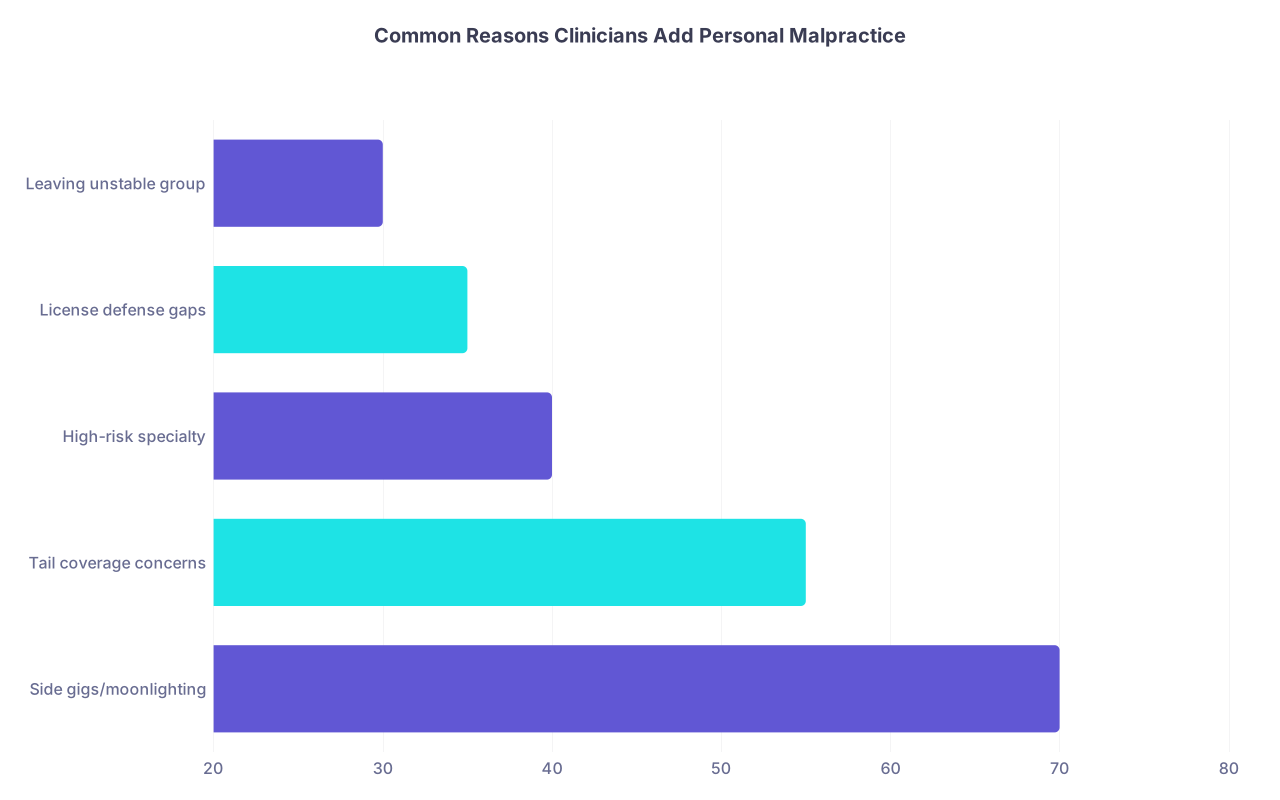
Personal coverage gives you:
- Your own insurance company whose primary obligation is to you
- Control over tail (because you own the policy)
- Coverage that follows you, not your employer
- Often, add-ons like license defense, HIPAA violation support, deposition representation, etc.
| Category | Value |
|---|---|
| Side gigs/moonlighting | 70 |
| Tail coverage concerns | 55 |
| High-risk specialty | 40 |
| License defense gaps | 35 |
| Leaving unstable group | 30 |
I’ve seen personal policies save people when:
- An old employer’s group dissolved and no one bought tail
- A board complaint was filed based on a bad outcome that never turned into a lawsuit
- A clinician did a tiny bit of telemedicine on the side and that was the one case that blew up
Employer coverage wouldn’t have touched some of those.
Step 7: How to Evaluate Your Situation in 10 Minutes
Here’s the quick framework I use with clients. It’s blunt on purpose.
Get the documents
- Your employment contract
- The malpractice certificate of insurance (COI)
- Any policy summary your employer will provide
Answer these questions:
- Is the policy claims-made or occurrence?
- Who pays for tail if I leave, retire, or the group dissolves? Is that in writing?
- What are the limits, and are they shared or separate?
- Am I individually named, or just covered “as an employee”?
- Does this policy cover:
- Moonlighting?
- Telemedicine?
- Volunteer work?
- Does it offer board/disciplinary defense? Up to what limit?
- Do I have a consent-to-settle provision, or can they settle over my objection?
Then make the call:
- If you like the answers, you’re probably fine sticking with employer-only and maybe adding a cheap license-defense rider.
- If you don’t like the answers—or the answers are vague—shop for an individual policy. Get real quotes, not guesses.

| Step | Description |
|---|---|
| Step 1 | Review Contract and COI |
| Step 2 | Strongly consider personal policy |
| Step 3 | Employer coverage may be enough |
| Step 4 | Claims-made? |
| Step 5 | Tail clearly covered? |
| Step 6 | Who pays tail? |
| Step 7 | Any side gigs? |
| Step 8 | High risk specialty or state? |
If you take nothing else from this article, remember this:
If there’s any uncertainty about tail, you do not have “enough” protection.
FAQs
1. If my employer is a big hospital system, doesn’t that automatically mean I’m well protected?
No. Size doesn’t equal alignment with your interests. Large systems often have strong limits and good legal teams—but those teams answer to the hospital, not you. You still need to confirm: claims-made vs occurrence, who pays tail, whether you’re individually named, and what happens if you leave. I’ve seen big-name systems stiff departing clinicians on tail because the contract allowed it.
2. How do I know if my employer’s malpractice covers moonlighting or telemedicine?
Ask in writing. Something like: “Does our professional liability policy extend to any clinical work I do outside this facility, including moonlighting, telemedicine, or volunteer work?” Most of the time, the answer is no, or “only if it is specifically contracted through us.” If it’s not explicitly covered, treat it as uncovered and get separate individual malpractice for that work.
3. Is personal malpractice insurance expensive if I already have employer coverage?
Not usually, if you’re using it primarily for “gap-filling.” If your employer is providing primary coverage and you’re buying a secondary policy or one focused on license defense and side gigs, the premiums can be far lower than a full solo practice policy. You’re often talking in the low thousands per year, sometimes less, depending on specialty and scope. Ask carriers for “excess” or “secondary” quotes if your employer is primary.
4. Can I negotiate tail coverage responsibility in my employment contract?
Yes, and you should at least try—especially in high-risk specialties. Common approaches:
- Ask for employer-paid tail after a minimum service period (e.g., 3 years)
- Ask for shared tail cost that decreases the longer you stay
- Tie tail coverage to involuntary termination without cause or non-renewal
If they absolutely will not budge, factor that tail cost into your decision to take (or keep) the job. A “great” salary can evaporate quickly when you’re stuck with an $80,000 tail.
5. If I buy my own malpractice policy, can I just ignore whatever my employer provides?
No. Your employer policy will usually remain the primary coverage for work you do as their employee. Your personal policy may act as excess or cover things the employer’s policy excludes (like board defense, side gigs, or failed tail). Think of your personal policy as a layer of control and backup—not a replacement—unless you’re fully independent. You still need to understand both.
Key points to walk away with:
Employer-provided malpractice is not automatically “enough”; it’s only as good as its details—especially claims-made vs occurrence and who pays tail. Tail coverage responsibility is the single biggest financial trap, and if your contract is silent, assume the risk is yours. Personal malpractice coverage is your tool to protect you—your license, your side work, and your future—when employer priorities do not line up with your own.