
The biggest malpractice mistake doctors make when leaving their first job is underbuying tail coverage—or worse, skipping it entirely.
You want a number? Here it is: most physicians should buy full, unlimited tail coverage back to their first day of claims-made coverage, and never rely on bare minimum limits if you can avoid it.
Let’s walk through why, when that might change, and how to make a smart decision instead of guessing.
The Short Answer: How Much Tail Coverage Do You Actually Need?
If you’re leaving your first job and had claims-made malpractice coverage, you typically need:
Tail that matches your old policy’s limits
If you were covered at $1M/$3M (per claim / aggregate per year), your tail should be $1M/$3M, not less. Dropping to $500k/$1.5M to “save money” is playing with fire.Tail that covers the full prior acts period
That means from your first day of practice under that policy through your last day seeing patients for that employer. No gaps. No “partial” years. Full prior acts.Unlimited duration, if at all possible
Not “one year” or “three years” of tail. Lawsuits can be filed years later, especially for pediatrics, OB, or anything with long statute-of-limitations plus tolling for minors. You want an indefinite or “unlimited” reporting period.
For 95% of physicians, that’s the correct answer:
Same limits as your active policy + full prior acts + unlimited duration.
Where it gets more nuanced is who’s paying, and whether you actually need to buy your own tail at all.
Step 1: Figure Out Whether You Even Need Tail
Before you argue about how much tail coverage, check if you’re supposed to buy any.
Here’s the basic decision tree:

| Step | Description |
|---|---|
| Step 1 | Leaving first job |
| Step 2 | Review contract |
| Step 3 | No tail needed |
| Step 4 | Get it in writing |
| Step 5 | Shop and negotiate |
| Step 6 | Get nose coverage |
| Step 7 | Claims made or occurrence |
| Step 8 | Who pays tail in contract |
You generally do not need to buy your own tail if:
- Your original policy is occurrence-based (tail not required)
- Your employer is contractually obligated to pay for tail when you leave
- Your new employer provides “prior acts” (nose) coverage that picks up your old exposure
You do need to buy tail when:
- Your coverage is claims-made, and
- Your contract says you’re responsible for tail, and
- Your new employer is not covering your prior acts
If that’s your situation, keep reading closely.
Step 2: Understand What Tail Coverage Actually Does (And Doesn’t)
You’re not buying new malpractice coverage. You’re buying time.
Tail coverage simply extends the window to report claims arising from care you already provided during your old claims-made policy period.
It does not:
- Cover care at your new job
- Fix substandard limits you had before
- Give you a fresh set of limits each year
It does:
- Let you report lawsuits/claims filed after you leave that job
- Apply your old policy’s limits to those future claims
- Protect you from being personally on the hook years later
Which is why “how much tail” isn’t about some random dollar amount. It’s about:
- Matching the limits on your existing policy
- Covering the entire time you were working under that policy
- Extending the reporting period long enough to be meaningful (ideally, unlimited)
Step 3: Match the Policy Limits—Don’t Cheap Out
Here’s where people try to save money and regret it.
If your old policy was:
- $1M/$3M (very common)
- Or $2M/$4M in some higher-risk states or specialties
Then your tail should match those limits.
| Practice Setting | Common Limits (per claim / aggregate) |
|---|---|
| Community hospital | $1M / $3M |
| Academic medical center | $1M / $3M or $2M / $4M |
| Private practice group | $1M / $3M |
| High-risk OB group | $2M / $4M |
If a broker or employer suggests you:
- “Downgrade to $500k/$1.5M to save premium”
- “Just buy a short-term tail and hope for the best”
They’re solving their budget problem, not your risk problem.
The lawsuit doesn’t care that you were “only” able to afford $500k in limits. If a jury comes back with $1.8M and the insurer pays $500k, guess who the plaintiff’s lawyer looks at next. You.
For most physicians:
- $1M/$3M tail is the floor
- Match your existing limits unless your new employer gives ironclad indemnification (rare, and even then I’d be cautious)
Step 4: Duration – Why “Unlimited” Tail Is Usually the Smart Move
You’ll see tail options like:
- 1-year tail
- 3-year tail
- 5-year tail
- Unlimited (or “indefinite”) tail
They scale by price. People get tempted by the shorter ones.
Here’s the problem: many states have 2–3 year statutes of limitations, but:
- They’re often extended for minors until age 18 plus a few years
- There are discovery rules (patient discovers harm later)
- Peds, OB, and some surgical complications can surface way down the line
So a one- or three-year tail can leave you exposed for exactly the cases you care about most: bad outcomes in kids or long-term complications.
If you’re in:
- Pediatrics
- OB/GYN
- Neurosurgery
- Spine
- High-risk procedural subspecialties
Just get unlimited tail. Full stop.
For lower-risk fields (outpatient psych, derm, pathology, etc.), if cost is absolutely killing you, you could consider a 5-year tail in some jurisdictions. I still think unlimited is cleaner and safer, but I’ve seen physicians reasonably accept a long, finite tail in low-risk practice plus protective state law.
But 1–3 year tails? I’d call those last-resort or borderline reckless in most cases.
Step 5: Prior Acts – Make Sure You’re Fully Covered Back to Day One
One more technical piece: prior acts date.
Your tail should:
- Use the same retroactive date (sometimes called “prior acts date”) as your original policy
- That’s usually your first day of coverage at your job
Double-check your declarations page (or ask your broker/insurer):
You want the retroactive date to be your actual start date in that practice or earlier.
If someone tries to sell you tail that only goes back, say, three of your five years there, that leaves a two-year gap. Any alleged negligence from those early years? You’re personally exposed.
Tail should cover:
- Every day you saw patients under that claims-made policy
- Through your last day with that employer
- With the same prior acts date as your originals
Step 6: What About My New Job—Can Nose Coverage Replace Tail?
Sometimes, your new employer will cover your prior acts instead of you buying standalone tail. That’s called “nose” coverage (or just “prior acts” coverage).
If your new employer offers prior acts that:
- Picks up the same retroactive date as your old policy
- Has equal or higher limits
- Is with a reputable carrier
- Is guaranteed in writing in your new contract
Then you might not need to pay for separate tail at all.
This can be a big financial win. But you need to be picky:
- If they only go back some years, that’s a problem
- If the limits are lower, your protection shrinks
- If they say “we usually do that,” but it’s not in your contract – assume they won’t
When it’s true full prior acts, with solid limits, from your start date at your first job → that’s one of the few times I’m comfortable with no personal tail purchase.
What Does Tail Actually Cost—and Is It Worth It?
You’re not crazy to care about price. Tail can be:
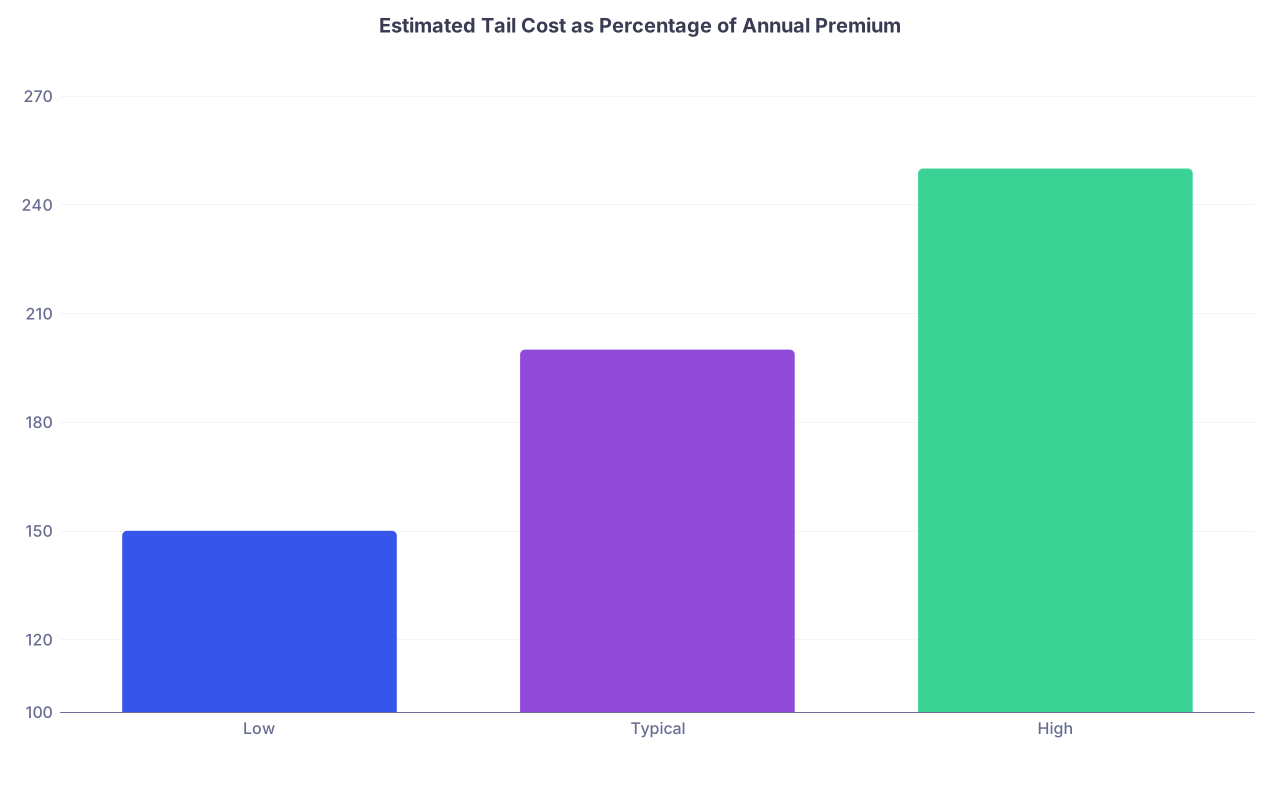
- Roughly 150–250% of your annual premium as a one-time payment
- So if your premium was $15,000/year, tail might be $22,500–$37,500
| Category | Value |
|---|---|
| Low | 150 |
| Typical | 200 |
| High | 250 |
Yes, it hurts. You’re often paying it right when you’re:
- Moving
- Starting a new job or practice
- Dealing with a gap in income
But here’s the uncompromising view: you don’t skip fire insurance because the premium stings the year you buy a house. Tail is financial catastrophe insurance for your career and assets.
You can:
- Try to **negotiate tail payment** in your first contract before you sign
- Ask your new employer for a signing bonus earmarked for tail
- Spread the premium via payment plans with some carriers
But going bare (no tail) or way underinsured because it’s cheaper? That’s gambling your future financial life on a short-term saving.
How to Actually Shop and Decide – A Simple Framework
Here’s how I’d walk through this if you called me from the parking lot after quitting your first job.
Pull your current policy documents
- Find your declarations page
- Note: claims-made vs occurrence, limits, retroactive date
Check your employment contract
- Who’s responsible for tail? You or employer?
- Any conditions (e.g., you pay tail if you leave before 2 years, they pay after)?
Clarify your new job’s malpractice setup
- Are they offering prior acts/nose coverage?
- In writing? With what limits? From what retro date?
If you need your own tail:
- Aim for same limits + full prior acts + unlimited duration
- Get quotes from: your current carrier, possibly an outside broker to compare
- Ask about installment payments
Take a specialty-specific sanity check:
- High-risk fields? Don’t mess around. Full unlimited tail, period.
- Lower-risk outpatient-only? Maybe you entertain a long but finite tail (5+ years), but I still think unlimited is the clean choice.
Visual Snapshot: Tail vs Nose vs Occurrence
| Feature | Tail Coverage | Nose/Prior Acts | Occurrence Policy |
|---|---|---|---|
| Who buys | Usually you or employer | Usually new employer | N/A (built in) |
| When it applies | After leaving old job | At new job, covering past | Year incident occurred |
| Covers past work? | Yes, at old job | Yes, if full prior acts | Yes, no tail needed |
| Extra cost? | One-time big payment | Baked into new premium | Higher ongoing premium |
Common Pitfalls When Leaving Your First Job
I see the same avoidable mistakes:
- Assuming HR “took care of it” without documentation
- Letting the insurer/broker talk you into short, cheap tail
- Not realizing your pediatric or OB cases will haunt you for years
- Ignoring the retroactive date and leaving early years uncovered
- Failing to align your new employer’s coverage with your old exposure
You don’t need to be an insurance savant. You just need to care enough to ask the right questions and insist your coverage isn’t quietly downgraded to save someone else money.

FAQs: Tail Coverage When Leaving Your First Job
1. Do I ever not need to buy tail if I had claims-made coverage?
Yes. You might avoid buying tail if:
- Your employer is contractually required to pay for it, and they actually do
- Your new employer provides full prior acts/nose coverage with the same or higher limits and the same retroactive date as your original policy
- You had an occurrence policy instead of claims-made (no tail required)
If none of those apply, assume you need tail.
2. Is a 1-year or 3-year tail ever enough?
In my opinion, rarely. Maybe for:
- Very low-risk outpatient specialties
- Older physicians with short remaining statute windows and no minors in their panel
- States with unusually narrow and rigid statutes of limitations
Even then, you’re consciously accepting risk. For most early-career physicians, 1–3 year tails are too short. They’re a cost-saving move, not a safety move.
3. Can I buy higher limits tail than I had on my original policy?
Usually, tail coverage is tied to the limits of the underlying policy. Some carriers allow changes, but it’s not standard. Realistically, your focus should be:
- Matching or preserving your current limits
- Not downgrading to save money
If you’re unhappy with your original limits, fix that for your next policy, not retroactively.
4. What if my old employer goes bankrupt or shuts down?
If you had a standalone malpractice policy in your name (even if the employer paid), your tail is between you and the insurer. Employer bankruptcy doesn’t kill your tail.
If coverage was entirely through a self-insured hospital trust or captive, things get more complicated. That’s why you want:
- Written confirmation about how tail is arranged if they close or you leave
- Clear documentation of who’s responsible for claims after separation
If you’re in a shaky practice or private group, I’d be extra vigilant about tail.
5. Can I negotiate tail responsibilities when I sign my first job contract?
You should. Before you sign.
Leverage is highest before you join, not when you’re leaving. You can:
- Ask employer to fully cover tail if you complete a certain term (e.g., 2–3 years)
- Ask for shared tail costs if you leave earlier
- Negotiate a signing or departure bonus structured to offset tail
Every year I see residents sign contracts that dump full tail cost on them, then get blindsided by a $30k bill at age 33. Don’t be that person.
6. What happens if I just don’t buy tail and hope for the best?
If a claim arises later:
- Your old claims-made policy is closed to new reports
- You have no insurer to defend or indemnify you
- You can end up personally named and personally responsible for defense costs and any judgment above whatever minimal help you might get from an old employer (if any)
This is how high-income professionals end up in serious financial trouble. Hoping “no one sues me” is not a strategy.
7. Bottom line—how do I know I bought “enough” tail?
You’ve probably bought “enough” tail if:
- It covers the full prior acts period back to your first day under that policy
- The limits match your original policy (e.g., $1M/$3M)
- The duration is unlimited, or at least long enough to realistically outlast claims for your specialty and state (unlimited is cleaner)
- Your new employer’s coverage doesn’t leave any gaps if you’re relying on prior acts instead of separate tail
- All of this is in writing, not verbal reassurance
If those boxes are checked, you’ve done the adult, boring, financially responsible thing—exactly what protects you when someone decides to come after you years later.
Key takeaways:
- If you had claims-made coverage, default to full prior acts + matching limits + unlimited tail unless you have true prior acts coverage at your new job.
- Don’t downgrade limits or duration just to save money; that’s trading a short-term win for long-term personal risk.
- Lock in tail responsibilities when you sign your first contract, not after you give notice and everyone stops caring about your future.