
You are here
You’re staring at a malpractice quote. The premium looks fine. Limits look fine. Then you hit the line that actually matters in a big claim:
“Defense costs: inside the limits”
or
“Defense costs: outside the limits”
And the broker’s explanation sounds like vague insurance-speak: “One erodes your limits, the other doesn’t.” Which is technically true. And functionally useless.
You want to know:
Which is better?
How big a deal is this really?
And when should you not accept defense inside the limits, no matter how nice the premium looks?
Let’s cut through it.
Core concept: what “inside vs outside the limits” actually means
Forget the jargon for a second. Your malpractice policy has two buckets:
A bucket of money to pay defense costs
– attorney fees
– expert witnesses
– court costs
– depositions, discovery, transcripts, etc.A bucket of money to pay indemnity
– settlements
– judgments
– plaintiff’s damages
The question is: are these two buckets separate or combined?
Defense outside the limits = two buckets
Defense costs are paid on top of your liability limit. Your $1M per claim is essentially reserved for settlement/judgment.Defense inside the limits = one bucket
Defense dollars and indemnity dollars come from the same $1M pot. Every dollar spent on your lawyer reduces what’s left to settle or pay a judgment.
That’s it. Everything else is consequences.
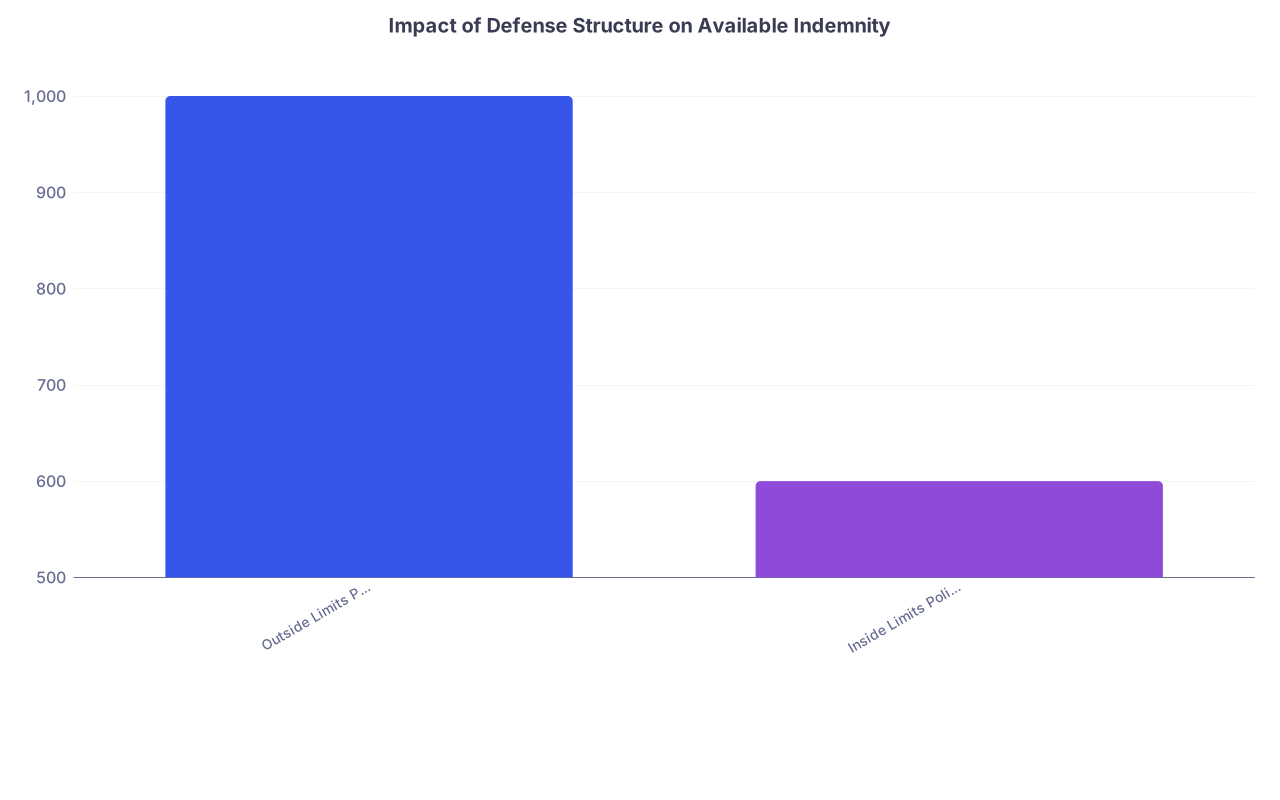
| Category | Value |
|---|---|
| Outside Limits Policy | 1000 |
| Inside Limits Policy | 600 |
(Values are illustrative: remaining indemnity in thousands after $400k defense spend on a $1M limit.)
Simple example: how this plays out in a real claim
You carry a policy with $1M / $3M limits (per claim / annual aggregate).
Scenario A: Defense outside the limits
- Policy: $1M per claim, defense outside
- Defense costs:
- $300,000 in attorney fees and experts
- Indemnity:
- Claim settles for $900,000
What happens?
- Insurer pays:
- $300,000 (defense)
- $900,000 (indemnity)
- Total paid: $1.2M
- You are still fully protected within the policy. The patient gets their $900k. You are not personally on the hook.
Scenario B: Defense inside the limits
Same claim, same numbers:
- Policy: $1M per claim, defense inside
- Defense costs:
- $300,000
- Indemnity available:
- Only $700,000 left in the $1M limit
The case value is still $900,000.
If plaintiff won’t accept $700,000 and you get a $900,000 verdict, your insurer pays the full policy limit ($1M total). That covers:
- $300,000 defense
- $700,000 toward judgment
Leaving a $200,000 gap between the verdict and what insurance will pay.
That $200,000 is now your personal problem (subject to any state-specific protections and post-verdict negotiation, but don’t count on a miracle).
The medical side of this is clear: same medicine, same outcome. The financial side is completely different purely because of the defense-cost structure.
Why defense inside the limits exists (and why you see it more now)
Insurers are not stupid. They know:
- Defense costs in med-mal can be enormous:
- $150k–$500k+ per case is not unusual for complex litigation.
- A lot of malpractice claims drag on:
- multiple experts, several years of litigation, big discovery costs.
So they started doing three things to control their risk:
Offering defense inside limits for lower premium
Makes the “headline” policy limit look the same, but quietly shifts part of the risk back to you.Capping defense even when “outside”
Example: “Defense outside the limits up to $250,000.” Above that, defense may start eroding the limit or stop entirely.Using lower aggregate limits with defense inside
So one really ugly, expensive case can blow through both defense and indemnity.
If you’re in a high-risk specialty (OB, neurosurgery, ortho, anesthesia), you’ll see these options more often. They know you’re price-sensitive and may not read the fine print.
When defense outside the limits is strongly preferred
Let me be blunt: if you can get defense outside the limits at a remotely reasonable price, you usually should.
It’s especially important if:
You’re in a high-severity specialty
OB/Gyn, neurosurgery, spine, cardiothoracic, interventional anything. Claims get expensive. Both on defense and on indemnity.You practice in a high-verdict jurisdiction
New York, New Jersey, Pennsylvania, Florida, California, Illinois (Chicago), and similar “judicial hellholes” where plaintiff verdicts can be massive.You’re part of a small practice or solo
You don’t have a big balance sheet or large umbrella program behind you. A single big shortfall hurts.Your standard limit is only $1M / $3M
If your limits are already modest, letting defense carve into them is asking for trouble.You worry about your personal exposure / assets
Home ownership, savings, investments – all become more relevant when there’s a real possibility your policy won’t cover a worst-case claim.
Is defense inside always “bad”? Not automatically. But it’s more dangerous than most physicians realize, given the size of modern verdicts and defense budgets.

When defense inside the limits may be acceptable
There are a few situations where I don’t automatically recoil at defense inside the limits.
Very low-risk practice profile
Example: outpatient psychiatry, dermatology (non-procedural), allergy/immunology, radiology with exceptionally strong QA and low exposure.
If historical claim severity is low, and limits are reasonably high (e.g., $2M or more per claim), defense inside is less scary. Still not ideal, but less likely to bite you.
Very high limits relative to realistic exposure
If you’re carrying something like $5M / $10M in a specialty where normal settlements are in the hundreds of thousands, it would take a perfect storm of:
- huge defense costs, and
- an outlier verdict
to blow through your combined limit.
Group program with umbrella or excess coverage above
In some large groups or hospital-sponsored programs, the primary layer might have defense inside, but there’s an additional excess or umbrella layer that can effectively back-stop big claims.
You still need to read the excess policy: sometimes defense in excess layers is also inside. Or excess only kicks in after underlying limits are fully exhausted by indemnity, not defense.
Price difference is massive and cash flow is tight
If your options are:
- No coverage, or
- Coverage with defense inside the limits at a price you can actually pay
Then yes, a less-than-perfect policy is better than no policy.
But at that point you should also be talking about:
- state-run patient compensation funds
- hospital coverage if employed
- risk pooling through a larger group or RRG
Because if your budget is so tight you’re forced into dangerous terms, that’s a red flag about your whole risk structure.
Practical: how to read your policy and spot the traps
Most people flip to the declarations page, see “$1M / $3M” and stop. That’s the insurance equivalent of reading just the abstract of a paper and assuming you understand the methods.
You need to look at:
The insuring agreement
Somewhere near the start it will say what the insurer promises to pay:- “We will pay damages up to the limit of liability and we will pay defense costs in addition to the limit of liability…”
vs - “We will pay damages and claim expenses, which together shall not exceed the applicable limit of liability…”
“In addition to,” “outside,” “supplemental” = separate bucket
“Together,” “inclusive of,” “within,” “subject to the limit” = same bucket- “We will pay damages up to the limit of liability and we will pay defense costs in addition to the limit of liability…”
Definitions section
Look at how they define:
- “Claim expenses”
- “Defense costs”
- “Loss,” “damages,” or “indemnity”
Some policies sneak in things like:
- court-ordered interest
- certain fees or costs
as either inside or outside. These nuances can change how quickly limits get eaten.
Supplementary payments
Some policies offer:
- “up to $X for certain defense costs without reducing the limit”
Example: “Up to $25,000 for deposition representation without eroding the limit.” These are nice but usually small.
- “up to $X for certain defense costs without reducing the limit”
-
I see this often:
- “Defense costs are payable outside limits up to $250,000. Once that cap is reached, defense costs are paid within limits.”
That’s a hybrid model. Better than fully inside. Definitely not as good as fully outside.
| Policy Wording Snippet | What It Signals |
|---|---|
| “In addition to the limit of liability” | Defense outside limits |
| “Subject to the limit of liability” | Defense inside limits |
| “Inclusive of claim expenses” | Defense inside limits |
| “Supplementary payments, not reducing limits” | Small carve-outs outside |
| “Defense costs capped at $250,000 outside” | Hybrid, partial protection |
How much does this actually affect your risk?
Think of a “big but not crazy” malpractice case in a tough jurisdiction:
- $350,000 defense costs
- $1.2M settlement demand, negotiated down to $1M
With defense outside the limits, and a $1M per claim policy:
- Insurer pays:
- $350,000 defense
- $1,000,000 indemnity
- You’re fine within the policy structure (though the insurer just swallowed $1.35M).
With defense inside the limits, and the same $1M limit:
- $350,000 defense comes off the top
- Only $650,000 left for settlement
- Plaintiff wants $1M and knows you actually caused a serious injury
- You either:
- settle for policy limits + personal contribution, or
- roll the dice at trial and risk a verdict well over $1M, with the gap uninsured.
That’s the key risk: defense inside turns big but manageable claims into potential personal-asset events.
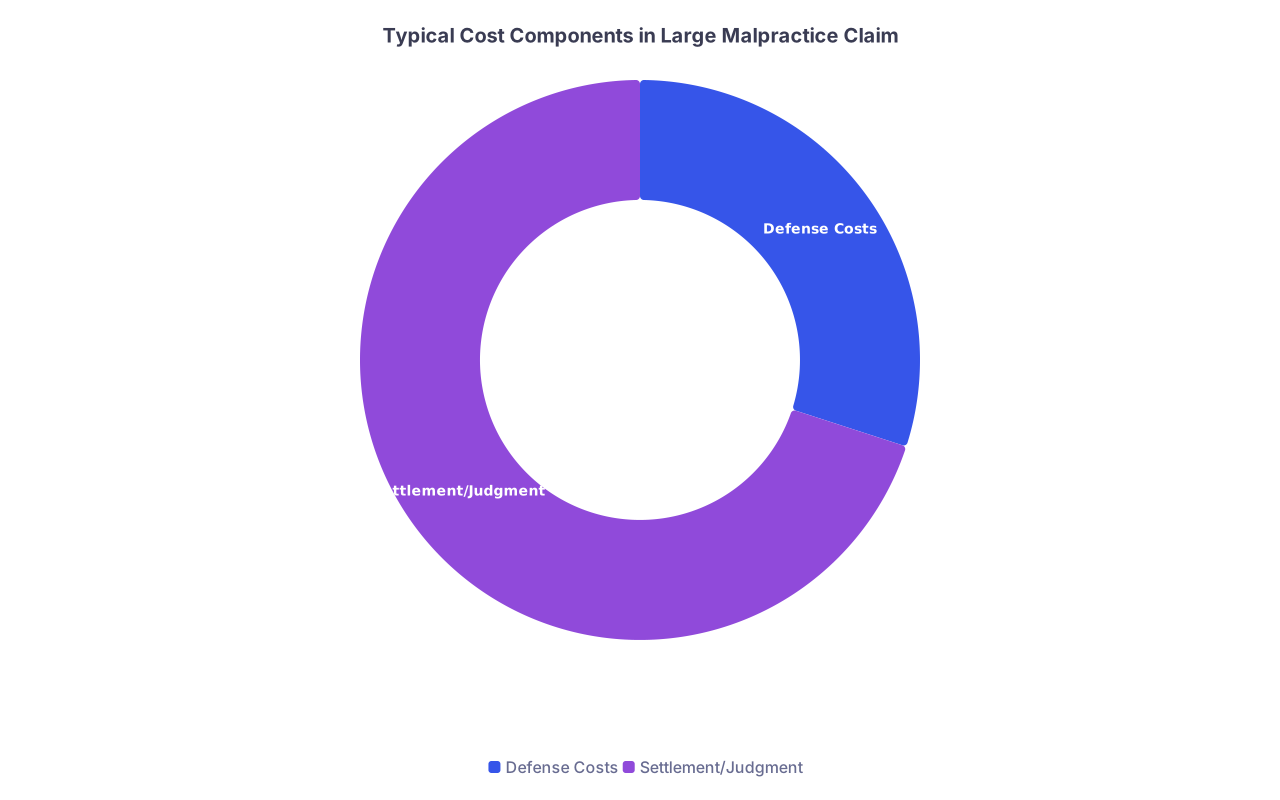
| Category | Value |
|---|---|
| Defense Costs | 30 |
| Settlement/Judgment | 70 |
30–40% of total spend being defense isn’t unrealistic in complex cases. That’s a lot of erosion if it’s coming out of your main limit.
How to decide: a straightforward framework
Here’s how I’d walk a physician through this decision in plain language.
Step 1: Rate your risk profile (honestly)
Use your specialty and jurisdiction:
High-risk if:
- OB, neurosurg, spine, CT surgery, interventional cardiology, anesthesia, ED, trauma
- Practicing in a known high-verdict state or county
Moderate-risk:
- General surgery, ortho, hospitalist, IM, peds, GI, etc.
Lower-risk:
- Psych, allergy, non-procedural derm, pathology, some outpatient-only specialties
High-risk + high-verdict state? Defense inside the limits is a bad idea in most cases.
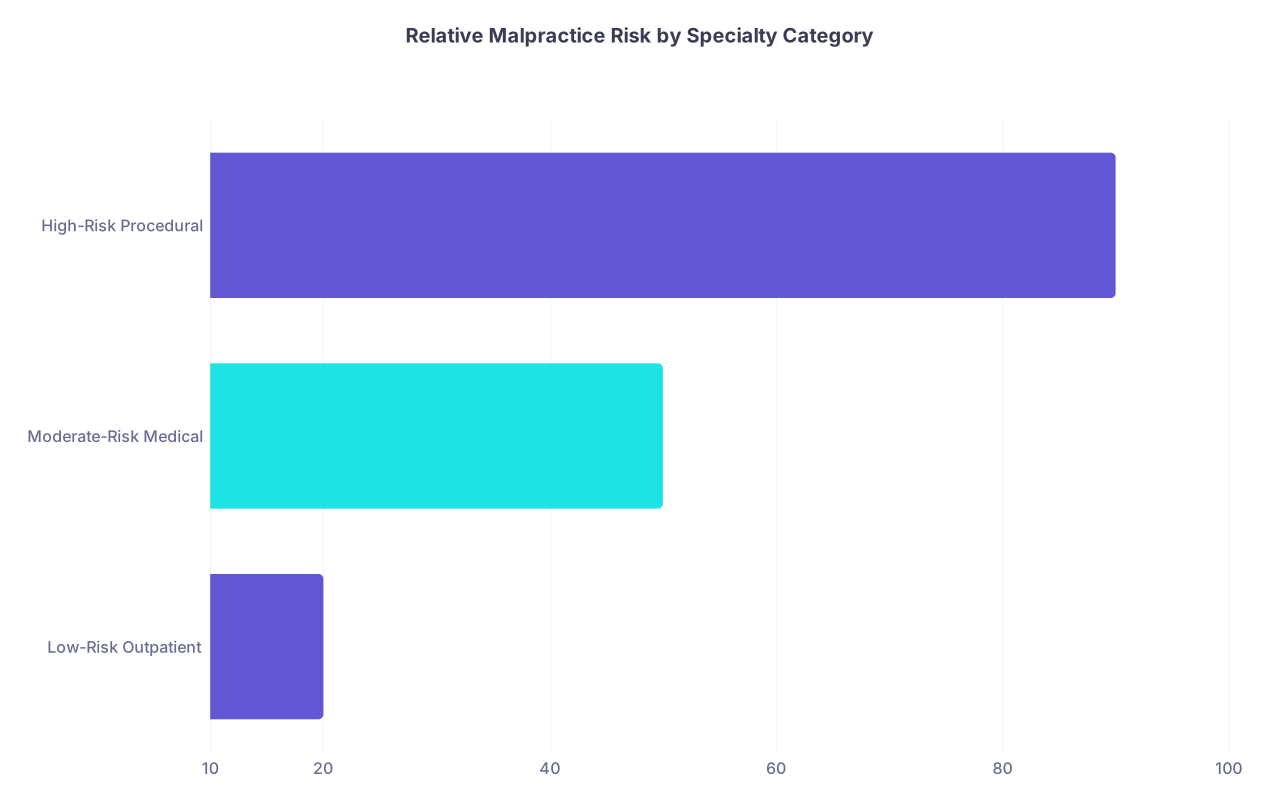
| Category | Value |
|---|---|
| Low-Risk Outpatient | 20 |
| Moderate-Risk Medical | 50 |
| High-Risk Procedural | 90 |
Step 2: Look at your limits relative to real verdicts where you practice
Talk to:
- Your broker
- Hospital risk management
- Local defense attorneys
Ask specifically:
- “What are typical med-mal settlements/judgments in this county for cases like mine?”
- “How often do we see verdicts above $1M? Above $2M?”
If $1M verdicts are routine where you practice, letting defense costs chew through your $1M policy doesn’t make sense.
Step 3: Price the difference
Get two quotes if you can:
- Same carrier, same limits, defense outside vs inside
or - Two carriers: one with outside, one with inside
Ask yourself:
- Is the premium savings worth the potential of personal exposure in a large case?
Often the difference is hundreds to a few thousand per year. That’s not where you want to economize.
Step 4: Consider group leverage
If you’re part of a group:
- Ask if the group can negotiate defense outside the limits for everyone.
- Larger premium volume = better terms.
If the hospital provides coverage:
- Don’t assume it’s generous. Ask specifically:
“Are defense costs inside or outside the limits?”
You’d be surprised how many employed physicians discover the answer only after a claim is filed.

Frequently Asked Questions (FAQ)
1. Is defense outside the limits always better than inside?
Almost always, yes. Defense outside preserves your liability limit for what actually matters to the plaintiff: the money they receive. It reduces the chance that a long, expensive defense leaves too little coverage to settle or pay a verdict. The only time inside might be acceptable is when your risk is low and your limits are well above realistic exposures — and even then, I’d prefer outside if the price is at all reasonable.
2. If my policy has defense inside the limits, should I increase my limits?
If you’re stuck with defense inside, higher limits can partially offset the problem. For example, $2M per claim with defense inside is usually safer than $1M per claim inside. But there’s a point of diminishing returns. You should still ask why you can’t get defense outside, and whether switching carriers or joining a different program is smarter than just buying more of a flawed structure.
3. How can I find out if my current policy is inside or outside the limits?
Do not rely on the declarations page alone. You have to read:
- The insuring agreement section (early in the policy)
- Definitions of “defense costs,” “claim expenses,” “loss,” or “damages”
Look for phrases like “in addition to the limits of liability” (good) versus “inclusive of and subject to the limits of liability” (inside). If you’re still unsure, email your broker or carrier in writing: “Please confirm whether defense costs are inside or outside the policy limits.” Get a clear answer in writing.
4. Does having defense inside the limits affect how the insurer handles my case?
It can. When defense costs erode the limit, the insurer has more incentive to settle earlier to avoid burning through the pot. That can be good or bad. Good if the case is dangerous and early settlement protects you. Bad if you strongly want exoneration and are willing to try the case. With defense outside, the insurer can sometimes fight longer without worrying about using up the indemnity limit, which aligns better with defending your reputation in borderline cases.
5. If a verdict is above my limits, will they really come after my personal assets?
They can. Whether they actually do depends on:
- State homestead and asset-protection laws
- How collectible you appear (income, assets, etc.)
- Plaintiff’s appetite to continue the fight post-verdict
But you should not plan your risk strategy on “they probably won’t bother.” I’ve seen plaintiffs’ counsel absolutely willing to pursue personal exposure when there’s a big gap between the verdict and the policy limit — especially in high-severity injuries. Better plan: structure your coverage so those situations are rare.
6. Is there any way to protect myself if I can only get defense inside the limits?
A few options:
- Buy higher primary limits (e.g., $2M or $3M per claim) so there’s more room for both defense and indemnity.
- See if an excess or umbrella policy is available that clearly states defense is outside its limits.
- Join a larger group, RRG, or hospital program that has stronger coverage terms.
- Strengthen your personal asset protection (proper titling, legal planning) with a qualified attorney.
But the cleanest solution, wherever possible, is still this: get a policy that puts defense costs outside the limits and stop making a single $1M bucket do double duty.
Bottom line:
- Defense outside the limits = safer, cleaner protection in big malpractice cases.
- Defense inside the limits = cheaper on paper, but pushes more risk onto you if the case gets ugly and expensive.
- Read your policy, know which one you have, and do not let a small premium savings trick you into accepting a structure that could expose your personal assets in a serious claim.