
Most physician contracts get malpractice wrong, and the doctor pays for it later. Literally.
If you remember nothing else, remember this: the malpractice section of your contract can be worth more than your entire first year’s salary. One bad phrase—“physician shall be responsible for the cost of tail coverage”—can cost you six figures when you leave.
Here’s exactly what malpractice language you should insist on before you sign anything.
1. Start With the Non‑Negotiables
There are a few malpractice terms that should set off a siren in your head. If these are wrong, you either fix them or you walk.
You want your contract to clearly answer five questions, in writing:
- What type of coverage do I have? (claims‑made vs occurrence)
- Who pays the premium now?
- Who pays tail later (if needed)?
- What are the limits of coverage?
- Does coverage continue for my prior acts and moonlighting?
If the contract is vague on any of these, assume it is not in your favor.
2. Claims‑Made vs Occurrence: Get This Line Right
Most employed physicians see claims‑made policies. Occurrence is better for you but less common and more expensive.
You need explicit language like this in your contract:
“Employer shall provide and pay for professional liability (malpractice) insurance coverage for Physician with [claims-made/occurrence] coverage.”
What you should insist on:
If it’s occurrence: great. No tail needed. Your key line is:
“The professional liability insurance provided shall be occurrence-based, with no requirement that Physician purchase tail coverage upon termination.”
If it’s claims‑made (much more common): that’s fine only if the tail problem is fixed (more on that below). You want:
“The professional liability insurance provided shall be claims-made coverage. Employer shall be solely responsible for all premiums and any extended reporting (tail) coverage required upon termination.”
Any of this garbage language is a red flag:
- “Tail coverage shall be the responsibility of the Physician.”
- “Parties shall negotiate tail coverage at the time of termination.”
- “Physician may be required to contribute to the cost of tail coverage.”
Translation: they want you to be the backup checkbook.
3. Tail Coverage: The Most Expensive Sentence in Your Contract
Here’s where people get burned.
Claims‑made policies only cover you if:
- The incident happened and
- The claim is reported while the policy is in force.
Once you leave and the policy ends, you’re naked—unless someone buys tail.
Tail can cost 150–250% of the annual premium. For high‑risk specialties (OB/GYN, neurosurgery, ortho, EM), that can mean $60k–$150k out of pocket. I have seen young attendings owe more in tail than they made in their last year of residency.
The ideal language is simple:
“Upon termination of this Agreement for any reason, Employer shall, at its sole cost and expense, purchase and maintain extended reporting (tail) coverage covering Physician for professional services rendered during the term of this Agreement in amounts not less than those in effect immediately prior to termination.”
If they push back, watch for traps:
Cost‑sharing formulas
“If Physician terminates without cause, Physician shall be responsible for 100% of tail coverage cost.”
You want the opposite structure, if you absolutely have to compromise:
“Employer shall be responsible for 100% of the cost of tail coverage, except that if Physician terminates without cause before completing two years of employment, Physician shall reimburse Employer for up to 50% of the tail premium.”
Not ideal, but better than you buying the whole thing.
Forgiveness schedules
Some groups use a forgiveness schedule tied to years of service. That’s at least rational, if not ideal.
| Years Employed | Tail Cost Physician Owes |
|---|---|
| < 1 year | 100% |
| 1–2 years | 50% |
| 2–3 years | 25% |
| ≥ 3 years | 0% |
If you’re stuck with something like this, push hard to:
- Shorten the forgiveness timeline
- Cap your share (e.g., “Physician responsibility shall not exceed $25,000”)
- At minimum, get Employer to pay if they terminate you without cause
- Termination scenario language
You want the contract to separate who pays tail based on how the relationship ends. For example:
“If Employer terminates Physician without cause, or if Physician terminates for cause due to Employer breach, Employer shall be solely responsible for the cost of tail coverage.
If Physician terminates without cause, Physician shall be responsible for [X] of the tail coverage cost.”
The “if they fire me without cause, they pay” piece is non‑negotiable in a halfway decent deal.
4. Coverage Limits: Don’t Accept “Standard” Without Numbers
“Employer will provide malpractice insurance with standard limits” is useless. Standard where? For whom?
You want numbers, in writing:
“Employer shall provide malpractice insurance with limits of not less than $1,000,000 per claim and $3,000,000 in the aggregate per policy year, or such higher amounts as may be required by state law or hospital bylaws.”
Typical limits by state vary, but many employers use $1M/$3M as a baseline. Some states or hospitals require different limits; that’s fine, as long as you aren’t below those requirements.
Good additions to insist on:
- Language that if they raise coverage limits, they pay for the increase.
- Assurance you’re covered for vicarious liability claims tied to your work for them.
5. Who Owns and Controls the Policy?
You’re usually covered under the employer’s policy as a named or additional insured. That’s normal.
What you want to avoid: any suggestion that you’re expected to go out and buy your own separate policy unless you’re an independent contractor.
Your contract needs something like:
“Physician shall be covered as a named or additional insured under Employer’s professional liability insurance policy.”
Also add a line about proof of coverage:
“Upon Physician’s request, Employer shall provide certificates of insurance evidencing such coverage and confirmation of tail coverage upon termination.”
And control of defense:
Most policies give the carrier the right to control defense and settlements. You just want a voice, especially on settlements that go to the NPDB.
Sample language to push for:
“Employer shall not consent to any settlement of a claim against Physician without making reasonable efforts to consult Physician. Physician’s consent shall not be unreasonably withheld; however, Physician shall be consulted regarding any settlement reportable to the National Practitioner Data Bank.”
Not every employer will agree. But it should at least be a negotiation point.
6. Prior Acts, Moonlighting, and Gaps
This is where people accidentally leave themselves exposed.
Prior acts (“nose” coverage)
If you’re switching jobs and had a claims‑made policy before, someone has to cover your prior acts:
- Either your old employer buys tail, or
- Your new employer picks up prior acts coverage (sometimes called “nose” coverage).
If your new employer agrees to cover prior acts, get it in writing:
“Employer’s malpractice coverage for Physician shall include prior acts coverage for professional services rendered by Physician before the commencement of this Agreement, as required to avoid gaps in coverage.”
At minimum, your contract should not forbid you from arranging your own tail with your prior carrier.
Moonlighting and outside work
Do not assume your employer’s policy covers you for:
- Side telemedicine work
- Locums shifts
- Med‑spa procedures
- “Helping a friend’s clinic” once a month
Almost always, it doesn’t.
Your contract should clarify:
“Employer’s malpractice policy shall cover only those professional services rendered by Physician within the scope of employment for Employer. Physician shall be solely responsible for obtaining separate malpractice coverage for any outside professional activities approved by Employer.”
Then: do not perform outside work without separate coverage in place.
7. Get the Exact Malpractice Clause You Want (Templates)
You do not need to reinvent the wheel. You just need clean, specific clauses.
Here’s a sample set of malpractice provisions that covers the big issues:
Type and Limits of Coverage
Employer shall, at its sole cost and expense, maintain professional liability (malpractice) insurance covering Physician for services rendered under this Agreement, with limits of not less than $1,000,000 per occurrence and $3,000,000 in the aggregate per policy year, or such higher limits as required by applicable law or hospital medical staff bylaws. Physician shall be insured as a named or additional insured under Employer’s policy.Claims-Made and Tail Coverage
The malpractice insurance provided shall be claims-made coverage. Employer shall be solely responsible for all premiums associated with such coverage during the term of this Agreement. Upon termination of this Agreement for any reason, Employer shall, at its sole cost and expense, purchase extended reporting (tail) coverage providing coverage to Physician for claims first made after termination arising from acts or omissions occurring during the term of this Agreement, with limits not less than those in effect immediately prior to termination.Termination Scenarios
Notwithstanding the foregoing, if Physician terminates this Agreement without cause prior to completing two (2) years of employment, Physician shall reimburse Employer for fifty percent (50%) of the actual premium cost of such tail coverage, not to exceed $25,000. If Employer terminates Physician without cause, or if Physician terminates for cause due to Employer’s material breach, Employer shall be solely responsible for one hundred percent (100%) of the cost of tail coverage.
You’d tweak the cost‑sharing paragraph based on your negotiation. But structurally, this is what “good” looks like.
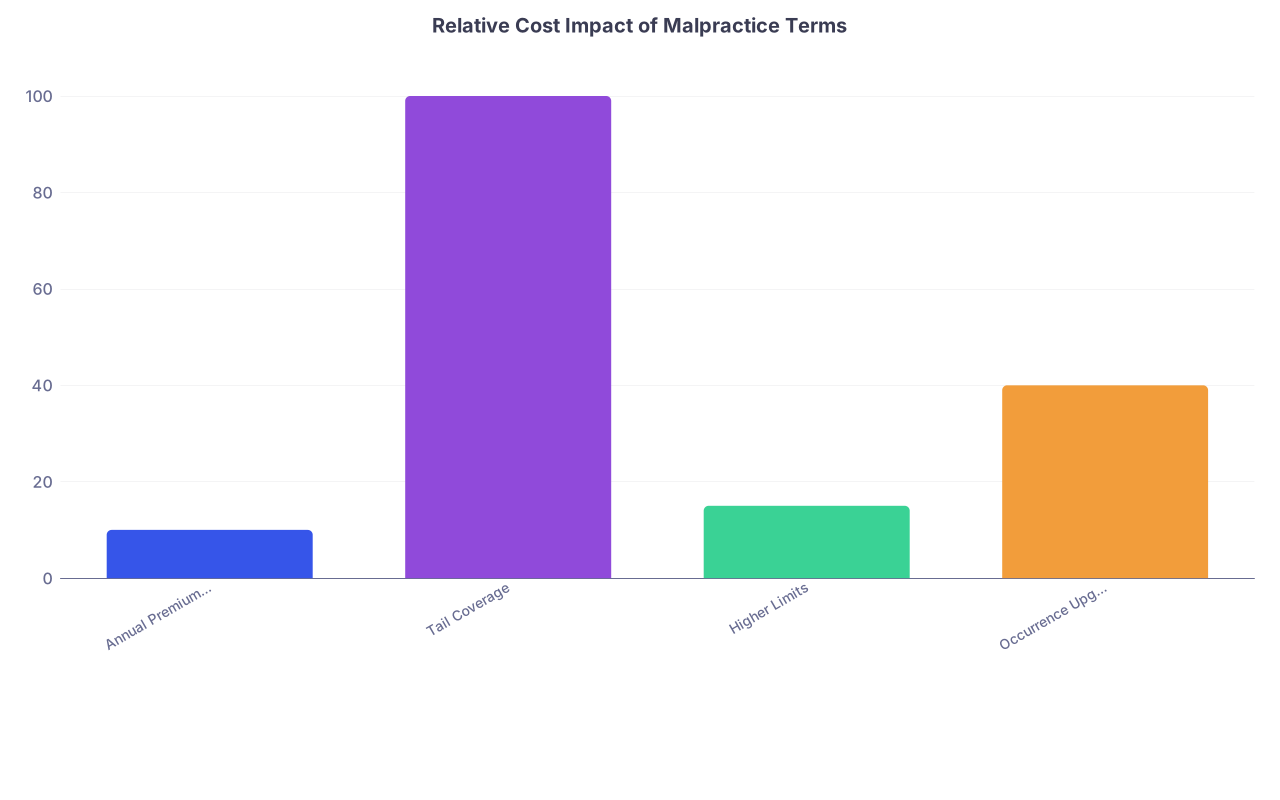
| Category | Value |
|---|---|
| Annual Premium Share | 10 |
| Tail Coverage | 100 |
| Higher Limits | 15 |
| Occurrence Upgrade | 40 |
8. Red‑Flag Phrases You Should Push Back On
If you see any of these, do not gloss over them:
“Physician shall be responsible for obtaining and maintaining malpractice insurance acceptable to Employer.”
→ You’re being treated like an independent contractor.“Tail coverage may be required at Physician’s expense.”
→ Translation: it will be, and it will hurt.“Malpractice insurance is subject to change at Employer’s discretion.”
→ Without tying them to limits or cost responsibility, this is too open‑ended.“Coverage shall be provided consistent with industry standards.”
→ Useless. You want numbers and responsibilities, not vibes.
Your response is straightforward: mark it up. Add clear numbers and clear payor obligations. If they refuse to clarify, that’s your sign.

| Step | Description |
|---|---|
| Step 1 | Review Contract |
| Step 2 | Add claims-made or occurrence language |
| Step 3 | Shift tail to employer or cap cost |
| Step 4 | Add per claim and aggregate limits |
| Step 5 | Specify who pays tail in each scenario |
| Step 6 | Proceed to attorney review |
| Step 7 | Coverage Type Clear |
| Step 8 | Tail Responsibility Clear |
| Step 9 | Limits Specified |
| Step 10 | Termination Scenarios Addressed |
9. When to Bring in an Attorney (And What to Ask Them)
You do not need a healthcare lawyer for every tiny job change.
You absolutely should use one when:
- You’re moving from training to your first attending job
- You’re switching from a large system to a private group
- You’re in a high‑risk specialty (OB, surgery, EM, anesthesia, pain, etc.)
- The contract includes any cost‑sharing around malpractice or tail
Be specific with your attorney:
- “What’s the worst‑case dollar amount I could owe under this malpractice/tail language?”
- “Is there any gap in coverage if I leave or change jobs?”
- “Who pays for tail in each termination scenario? Spell it out.”
- “If I moonlight, what’s my exposure?”
You’re paying them to think in disaster scenarios. Make them do it on paper.
FAQ: Malpractice Language in Physician Contracts
1. If my employer “always pays tail,” do I still need it in the contract?
Yes. Verbal promises from HR or a partner are worthless if the group is sold, the CFO changes, or they suddenly decide you “quit early.” If it is not in the contract, assume it will not happen. You want explicit written language that the employer pays tail and under what conditions.
2. Is it ever okay for me to pay part of the tail cost?
It can be acceptable if the numbers are small and clearly capped. For example, a partial tail obligation if you leave within the first year, capped at a specific dollar amount. What you want to avoid is unlimited exposure or language that lets them pick the most expensive tail option and send you the bill.
3. My contract says “physician responsible for own malpractice.” Am I an employee or contractor?
That phrase almost always means you’re effectively an independent contractor, even if they call you an “employee” for convenience. You’ll be paying your own premium and tail, and you probably don’t get benefits. In that situation, you must negotiate higher compensation to offset that cost or reconsider the offer entirely.
4. Can I rely on my residency/fellowship malpractice coverage once I become an attending?
No. Your trainee coverage typically only applies to work done within the scope of your training program. The day you start attending work under a different employer or capacity, you’re in a new risk world. You need your own coverage there, and you need to make sure your old trainee coverage is properly closed out with tail or prior acts as needed.
5. Should I ever buy my own personal malpractice policy in addition to my employer’s?
Sometimes, but only after talking to a healthcare attorney or a knowledgeable broker. Most employed physicians don’t need a separate policy if they have strong employer coverage. You might need one if you do side work, telemedicine, consulting, med‑spa work, or anything outside the scope of your employer. Do not assume your employer’s policy follows you into those settings.
6. How much leverage do I really have to change malpractice language as a new grad?
More than you think, less than you want. Large hospital systems often won’t rewrite their entire template, but they will sometimes add an addendum or tweak tail responsibility in your specific case. Private groups may grumble, then quietly agree when they realize you understand what tail really costs. The key is asking precise questions and proposing exact language, not just “Can you make this better?”
Bottom line:
- Get in writing who pays for what—especially tail—in every termination scenario.
- Lock down coverage type, limits, and scope so there are no gaps or surprises.
- Treat the malpractice section like a six‑figure decision, because for many physicians, that’s exactly what it is.