
It’s 10:30 p.m. You just got off call, you’re finally scrolling through that renewal email from your malpractice carrier… and your stomach drops. They’re “non-renewing” you because of “loss history.” Translation: you’ve had claims, and they’re done with you.
Now the panic question: Can I still get malpractice coverage with prior claims on my record? Or am I basically uninsurable?
Here’s the answer you actually need:
Yes, you can get coverage with prior claims. But it’s not automatic, and the way you approach it will determine whether you land a decent policy or get stuck with something expensive, restrictive, or both.
Let’s walk through it like a real problem, not an abstract insurance lecture.
1. The Short Answer: Yes, But It Depends On 4 Things
Carriers don’t care that you’re “a good doctor.” They care about risk. With prior claims, they’re asking four questions:
How many claims?
One nuisance claim from 5 years ago is very different from 3 paid claims in the last 3 years.How severe?
- Dismissed with no payment? Mild concern.
- Small settlement under $50k? Manageable.
- Multiple six- or seven-figure indemnity payments? Big problem.
How recent?
- Last 12–24 months = heavily scrutinized
- 3–5 years ago = still relevant but less toxic
7–10 years, especially with clean years since = often discounted
What’s your specialty and practice pattern?
High-risk: OB/GYN, neurosurgery, orthopedics, EM, anesthesia, certain interventional fields
Lower-risk: psychiatry, pediatrics (usually), family med without OB, derm, pathology
If your record is:
- 1–2 older, small, or defensible claims → You’re usually insurable with standard carriers, maybe at a surcharge.
- Several recent, paid, or severe claims → You’re often pushed to E&S (excess and surplus) markets or specialty “hard-to-place” carriers.
So yes, coverage is possible. The real question is: where and on what terms?
2. What Insurers Actually Look At (Beyond “Do You Have Claims?”)
Insurers don’t look at just one line that says “Yes, prior claims.” They look at a lot more detail than you think.
Here’s what they’re evaluating:
Frequency vs severity
- Many small “friction” claims → suggests communication/expectation issues, documentation problems, or practice style patterns.
- Few but catastrophic → suggests rare but high-consequence events, maybe systems issues.
Your role in each case
Primary surgeon vs consultant vs covering doc.
If you were just covering in the ED and got named along with 7 others, that’s very different from being the primary on three high-severity cases.Outcome and payment
- Dismissed before discovery: often treated as noise.
- Dismissed after significant defense costs: still a flag, but less than a paid claim.
- Settlement or verdict against you: big underwriting weight.
Time pattern
Clustered claims (e.g., 3 claims in 2 years from the same hospital) scream systemic problem.
A single claim 8 years ago followed by nothing? That’s survivable.Practice changes after the events
This matters more than most doctors realize. Underwriters want to see:- Did you change protocols?
- Did you drop certain high-risk procedures?
- Did you get additional training or proctoring?
- Did your group change call schedules, handoff systems, or supervision?
Here’s what that looks like in practice:
| Profile Description | Underwriter Reaction |
|---|---|
| 1 dismissed claim, 6 years ago | Usually acceptable, minor note |
| 2 small paid claims, 4–5 years ago | Surcharge, maybe conditions |
| 3+ claims in last 3 years, mixed outcomes | High risk, E&S or declination |
| 1 large paid claim, recent (last 2 years) | Tough but not impossible |
| Repeat similar adverse events in same area | Major red flag, often decline |
3. Where You Can Actually Get Coverage With Prior Claims
You’ve got roughly three “tiers” of options.
1. Standard admitted carriers (best case)
These are the main medical malpractice insurers in your state. They:
- Are regulated by the state
- Offer tail coverage options
- Often have risk management support
You can sometimes still get into this tier if:
- Your claims are low frequency, older, or defensible
- You’re in a lower-risk specialty
- You present a clean, well-documented story (we’ll talk about this)
You might:
- Pay a surcharge (10–50%+)
- Have higher deductibles
- Have some coverage restrictions for certain procedures
2. Excess & Surplus (E&S) / non-admitted carriers
This is where a lot of physicians with multiple or severe claims end up.
What that means:
- Policies can be more customized but also more restrictive
- Rates are usually higher
- Fewer bells and whistles (risk management, consent-to-settle may be more limited)
- Less state oversight of rates and forms
Not automatically bad, but you’ve lost some bargaining power. You’re in “you need them more than they need you” territory.
3. Specialty “hard-to-place” programs
These are niche underwriters who focus on:
- Physicians with serious claims history
- Physicians coming off board actions or privileges issues
- High-risk procedures or concierge/high-dollar practices
You’ll often see:
- Steep premiums
- Mandatory deductibles or self-insured retentions
- Strict underwriting guidelines and reporting requirements
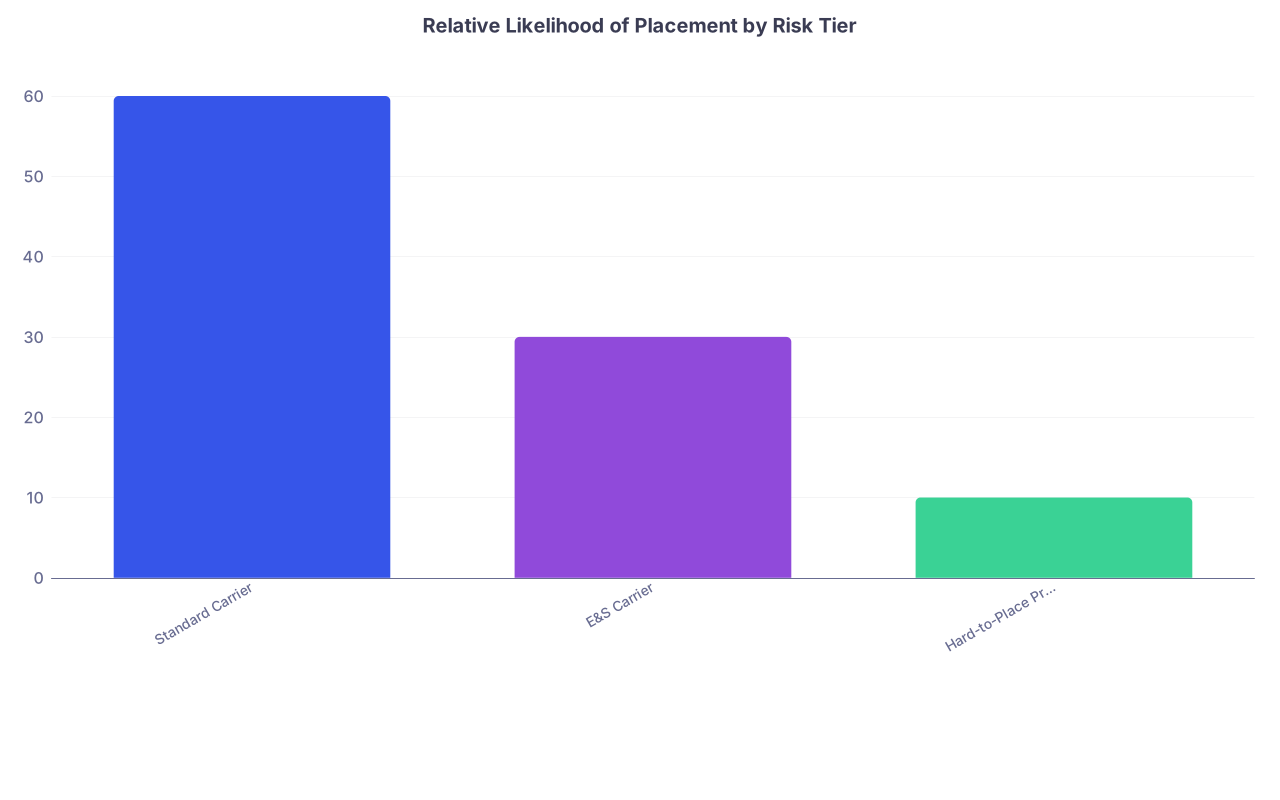
| Category | Value |
|---|---|
| Standard Carrier | 60 |
| E&S Carrier | 30 |
| Hard-to-Place Program | 10 |
That chart isn’t precise data; it’s the rough reality: most with prior claims still land in standard carriers, some need E&S, a minority end up in truly hard-to-place pools.
4. How To Present Your Claims History (This Part Is Critical)
This is where many physicians screw it up. They either under-disclose (bad) or overshare messy, emotional narratives (also bad).
You need a tight, factual, professional claims summary for your broker to use with underwriters.
For each claim, include:
- Date of incident and date filed
- Patient age & brief clinical context (e.g., “G3P2 at 39 weeks, induction…”)
- Your role (primary surgeon, consultant, covering hospitalist)
- Allegations in simple terms (e.g., “delay in diagnosis of appendicitis”)
- Outcome:
- Dismissed / defense verdict
- Settlement amount (if not confidential and you can share generally)
- Key medical-legal defense points
- Most important: What changed after the event
Keep it 1 page per case max. Underwriters don’t want your emotional catharsis. They want: what happened, why it’s unlikely to recur.
Bad approach: “The system failed me, the plaintiff attorney was insane, the patient was noncompliant, this was all politics.”
Good approach: “We identified issues in our on-call cross-coverage and closed-loop communication; since then, our group…” etc.
If English isn’t your first language or you’re not a strong writer, have someone help you tighten and clean this up. It matters more than you think.
5. Practical Moves To Improve Your Chances (And Your Rate)
Let me be blunt: you can’t erase claims. But you can make underwriters more comfortable insuring you going forward.
Here’s what actually works:
Use an experienced malpractice broker, not a random agent.
This is not a DIY project. You want someone who:- Places physicians in your specialty regularly
- Has relationships with both standard and E&S markets
- Knows which underwriters are open to loss history
Show a real risk-improvement story.
Underwriters love a “risk management trajectory.” For example:- Completion of a recognized risk/communication course
- Changes in documentation templates and EMR alerts
- Limiting or eliminating certain high-risk procedures
- Peer review or external chart review to show improvement
Be flexible on structure.
Willingness to:- Accept a higher deductible
- Take a per-claim retention
- Start with restricted coverage that can be broadened after a clean period
Clean house on current practice.
If you’re still at the same chaotic group where all your claims came from? Underwriters notice. New practice setting, better support, clearer protocols: all positives.Don’t lie. Ever.
Failing to disclose a claim is worse than having the claim. Carriers share data. NPDB exists. State boards report. If they catch nondisclosure, you can lose coverage and create a nightmare for future placements.

| Step | Description |
|---|---|
| Step 1 | Prior Claims |
| Step 2 | Standard Carrier Possible |
| Step 3 | Consider E&S Markets |
| Step 4 | Prepare Claims Summary |
| Step 5 | Better Terms and Premiums |
| Step 6 | Higher Cost and Restrictions |
| Step 7 | Claims Severity |
| Step 8 | Risk Improvements? |
6. What Will It Cost Me?
Expect three kinds of “penalties”:
Higher base premium
Surcharges are sometimes explicit:- +10–25% for 1–2 moderate prior claims
- Larger adjustments case-by-case for multiple or severe losses
Higher deductibles or retentions
Some carriers will only write you with:- $25k–$100k per-claim deductible
- Or a self-insured retention where you pay the first chunk of loss/defense
Coverage limitations
You might see:- Exclusions on certain procedures (e.g., VBACs, spinal surgeries, certain cosmetic implants)
- No prior-acts coverage (you keep or buy tail separately)
- Lower limits than you’d like in tough venues
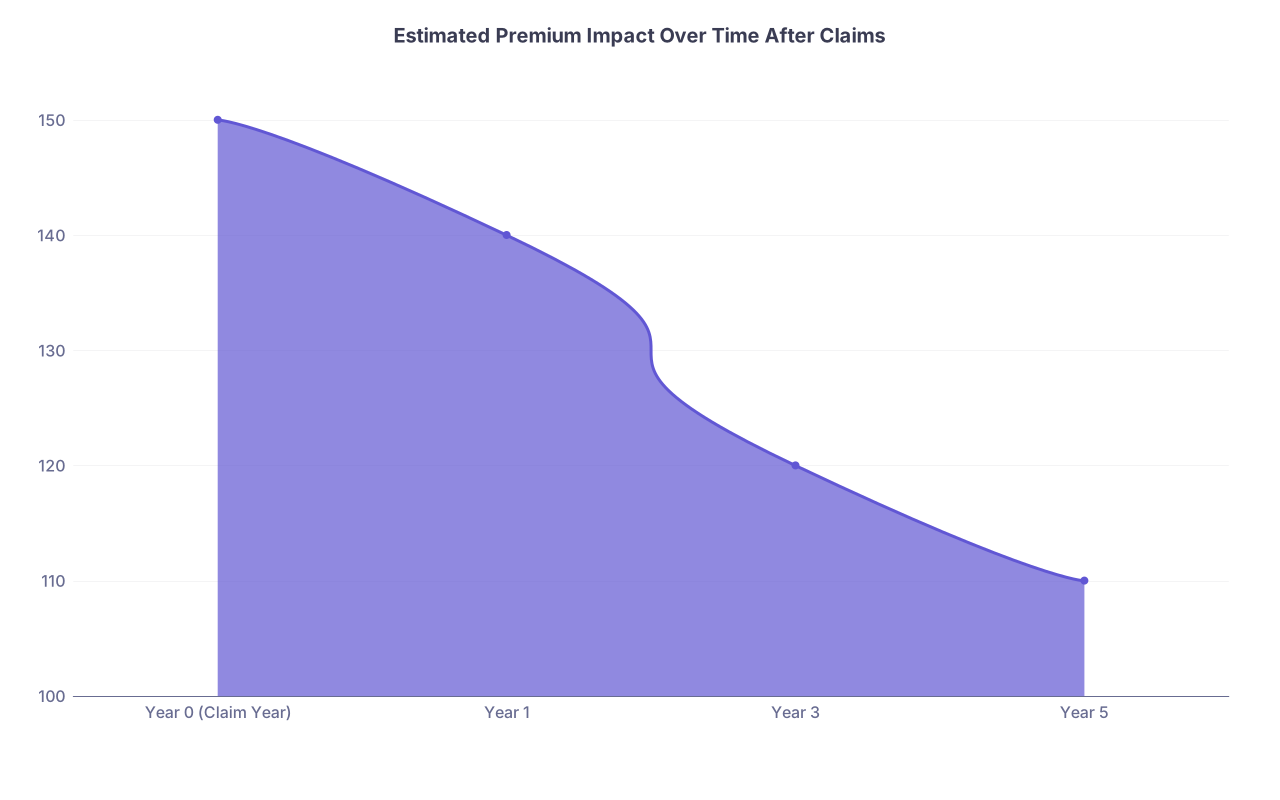
You’re not necessarily stuck here forever. Many underwriters will soften terms and surcharges after 3–5 clean years.
| Category | Value |
|---|---|
| Year 0 (Claim Year) | 150 |
| Year 1 | 140 |
| Year 3 | 120 |
| Year 5 | 110 |
Again, that curve is conceptual, not exact. The point: time + clean practice + good documentation does help.
7. Claims-Made vs Occurrence vs Tail: Extra Landmines If You Have Claims
With prior claims, you need to be extremely careful with policy type and tail.
Key points:
Claims-made policies
Most physician policies are claims-made. Coverage depends on:- Policy being active at the time of the incident
- AND at the time the claim is reported
That’s why tail coverage (or prior-acts) matters when you switch carriers.
Occurrence policies
Less common and more expensive for physicians. Claim is covered if incident occurred during policy period, no matter when reported. Prior claims don’t disappear, but they’re easier to wall off with a clean new policy.Prior-acts coverage
Some carriers will pick up your retroactive date (cover your past acts under the new policy). With significant claims history, they may:- Refuse to pick up prior acts (require you to buy tail from old carrier), or
- Charge a big premium to include them.
Tail coverage
If you’re being non-renewed:- Get in writing what tail options and costs are.
- Don’t assume your new carrier will cover your past. Many won’t.
This is where a good broker earns their commission. You do not want gaps.
8. When Coverage Might Be Very Hard (But Not Always Impossible)
There are situations where getting coverage is genuinely difficult:
- Multiple large paid claims in a short period, same type of allegation
- Adverse state board actions (especially restrictions on practice)
- Loss of hospital privileges related to clinical competence
- Practicing in a high-risk specialty in a “judicial hellhole” venue with bad tort climate
Coverage isn’t necessarily impossible, but:
- Your options may be very limited
- Premiums may be punishing
- You may have to accept a step-down role (fewer procedures, more supervision, academic vs. private practice, etc.) to rebuild credibility
This is also where risk management consultants and sometimes healthcare attorneys get involved to help design a practice structure that a carrier can stomach.
FAQ (Exactly 7 Questions)
1. Can I get malpractice insurance after a paid claim or settlement?
Yes. A paid claim doesn’t automatically make you uninsurable. Underwriters look at how many, how big, how recent, and what changed afterward. One or two reasonable settlements in a long career, especially if older, are usually manageable. Multiple large, recent paid claims are tougher but not necessarily fatal with the right carrier and structure.
2. Are dismissed claims or “nuisance suits” a big problem?
Less than paid claims, but they still count. A single dismissed claim is usually a non-issue. A pattern of many dismissed suits can still bother underwriters because it suggests frequent friction with patients or referral sources, or poor documentation that invites litigation even if you ultimately win.
3. Should I disclose small or old claims if the application doesn’t explicitly ask?
If in doubt, disclose briefly and factually. Most applications ask for all past or pending claims over a certain window (often 5–10 years). Failing to disclose can be treated as misrepresentation and used to deny coverage later. A clean, honest, concise explanation almost always beats hiding things.
4. Will changing specialties help if I have multiple claims?
Sometimes. Moving from a very high-risk area (e.g., OB doing high-volume deliveries) to a lower-risk scope (e.g., gynecology-only, or non-procedural work) can make insurers more willing to write you. But they’ll still look at your history; it’s not a magic reset. What matters is that your future risk profile looks genuinely lower.
5. Can I negotiate my premium or terms if I have prior claims?
To a point. You’re not in a power position, but you can:
- Work with a broker to get multiple quotes
- Offer to take a higher deductible
- Accept some coverage limitations initially
- Ask about rate improvements after a set period of clean practice
Don’t expect miracles, but you’re not completely powerless.
6. Do I need a lawyer to deal with insurers if I have prior claims?
Usually you don’t need a lawyer just to buy coverage. What you need is a solid broker and your own documentation organized. You do want legal input if:
- There are ongoing board actions
- You’re negotiating a separation agreement with a group that affects tail
- There’s concern that application answers might conflict with legal documents or prior testimony
7. Is going without malpractice insurance ever a reasonable option if I can’t get coverage?
No. Going bare in modern U.S. practice is playing Russian roulette with your career and personal assets, and many hospitals, payers, and states won’t even let you practice without proof of coverage. If you truly can’t get standard coverage, you look at E&S, hard-to-place programs, scope changes, or different practice settings—not “no insurance.”
Key takeaways:
- Yes, you can usually get malpractice coverage even with prior claims—but expect more scrutiny, higher cost, and sometimes tighter terms.
- How you package and explain your claims history (and what you’ve changed since) has a massive impact on what offers you get.
- A sharp malpractice broker plus a real risk-improvement story will do more for you than wishful thinking or trying to hide your past.