
You are three months from finishing residency. HR just emailed you two malpractice quotes from different brokers. One says: “Claims-made, tail not included.” The other: “Occurrence, fully rated.” Your future employer wants you to “pick whichever you prefer.”
You nod like you understand.
You do not.
And this is where physicians get hurt financially and legally for no good reason.
Let me walk you through the mechanics like I would explain it to a PGY‑3 about to sign their first real contract.
1. The Core Legal Difference: What Exactly Is Being Insured?
Strip away the marketing. Malpractice insurance is just a contract that answers two questions:
- What event triggers coverage?
- During what time window must that event occur for the carrier to pay?
Claims-made and occurrence answer those questions differently.
Occurrence Policies – The Simple, Old-School Model
Occurrence coverage is tied to when the alleged malpractice happened.
If:
- You had an occurrence policy in force on the date of treatment, and
- A lawsuit or claim arises from that treatment at any time in the future
then you are covered, even if:
- You switched carriers
- You retired
- The policy was cancelled 15 years ago
Legal trigger: Date of the incident / professional service.
Once that policy year is over, your obligation is paid. The insurer carries the long-tail risk. That is why occurrence premiums are higher up front: they are pricing in not just this year’s risk, but decades of possible future claims.
Claims-Made Policies – The Dominant, More Complex Model
Claims-made coverage is tied to when the claim is first made and reported to the insurer, as long as the alleged malpractice occurred after the policy’s retroactive date.
Coverage requires two things:
- The alleged negligent act occurred on or after the retroactive date (retro date)
- The claim is first made and reported while the policy (or a tail/extended reporting endorsement) is in force
Legal trigger: Date the claim is made and reported, subject to retro date.
If you are missing either piece (the retro period or an active policy/tail at time of claim), the carrier can legally deny coverage. That is how physicians end up personally exposed.
2. The Retroactive Date: The Quiet Line That Controls Everything
In a claims-made policy, the retroactive date is the earliest date from which your prior acts are insured. It is the legal boundary of coverage.
Think of it as a vertical line on your timeline. Everything before it: uninsured. Everything after it: potentially covered (if a claim is reported while coverage is in force).
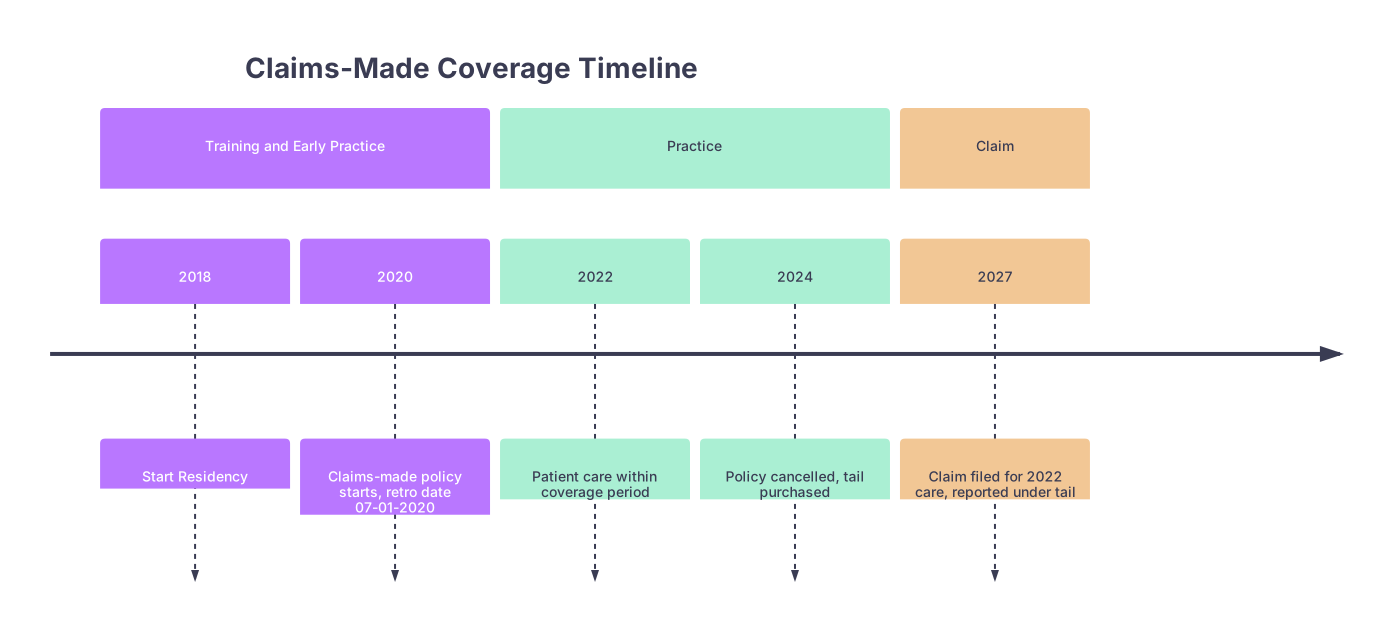
| Period | Event |
|---|---|
| Training and Early Practice - 2018 | Start Residency |
| Training and Early Practice - 2020 | Claims-made policy starts, retro date 07-01-2020 |
| Practice - 2022 | Patient care within coverage period |
| Practice - 2024 | Policy cancelled, tail purchased |
| Claim - 2027 | Claim filed for 2022 care, reported under tail |
Key mechanics:
- The first time you buy a claims-made policy, the carrier sets a retro date, usually the policy start date.
- When you switch to a new claims-made carrier, you must ensure:
- The new carrier agrees to keep the same retro date, or
- You buy tail from the old carrier to cover that earlier period
If a new carrier gives you a “clean” policy with a later retro date, they are quietly cutting off your prior years. That is a classic trap.
3. The Three Time Periods You Must Track
Most physicians only think about: “Am I covered today?” Legally, that is not enough. You have three separate periods that matter.
| Period Type | Claims-Made Focus | Occurrence Focus |
|---|---|---|
| Incident Date | Must be after retro date | Must be during policy year |
| Policy Active Date | Claim must be made then | Policy active at incident |
| Post-Policy Period | Tail or new coverage | Old policy still responds |
- Incident Date – When did you treat the patient / commit the alleged act?
- Policy Active Period – When is your policy (or tail) in force?
- Claim Date – When did the plaintiff (or potential plaintiff) first assert a claim against you, and when did you report it?
Occurrence:
- Only cares that #1 (incident) falls into a year when an occurrence policy was active. #2 and #3 can be disconnected in time by decades.
Claims-made:
- Cares about all three. The incident must be in the covered retro period, and the claim must be made and reported while coverage or tail is active.
4. Deep Legal Mechanics of Claims-Made: Reporting, Notice, and Denials
Here is where the contract language actually matters, down to the commas.
“Claim Made And Reported” – Two Separate Hooks
Most professional liability policies are “claims-made and reported.” That means:
- A claim is first made when you receive a demand for money or services, a lawsuit, or sometimes even a threat letter (check the definition in your policy).
- It is reported when you give written notice to the insurer as the policy requires.
Many policies define a claim broadly: “Any demand for money or services, receipt of a lawsuit, arbitration, or any notice that a party intends to hold you responsible…”
If you get a lawyer’s letter and ignore it for 8 months, then your policy expires or you switch carriers, you may have just converted a covered event into an uncovered one. I have seen a carrier deny coverage because:
- The “claim” (in the contract sense) was first made in June while the old policy was active,
- But the physician did not notify the insurer until February of the next year, after switching carriers.
Old carrier: “Too late. You breached the reporting condition.”
New carrier: “Claim was first made before our policy period. Not our problem.”
That physician ended up personally funding their defense until the lawyers could negotiate a contribution.
Circumstance / Incident Reporting – The Safety Valve
Most decent claims-made policies have a provision allowing you to report a circumstance that may give rise to a claim later.
If you:
- Learn of a bad outcome, adverse event, or patient complaint, and
- Provide sufficient detail to the carrier during the active policy period
then a future claim related to that incident is “deemed made” at the time of your report, even if the lawsuit arrives years later when you are with a different carrier.
Mechanically, this is your backup if you are about to:
- Switch carriers
- Leave a group
- Retire
You should be combing through:
- Any major complications
- Any angry patients / formal complaints
- Any cases where hospital risk management warned you
and reporting those as potential claims before your policy ends. That locks coverage to the old policy year, regardless of what happens later.
5. Tail Coverage: The Most Misunderstood, Most Expensive Line Item
Claims-made policies do not magically cover you for life. Once the policy ends, it covers:
- Only claims that were made and reported before cancellation
The malpractice that occurred while you practiced is still out there, but the reporting window has closed. That is why you buy tail coverage (Extended Reporting Endorsement).
What Tail Actually Does Legally
Tail does not insure new incidents. It does one thing only:
- Keeps the reporting window open for claims arising from incidents that occurred during the original policy period (after the retro date).
So if:
- You practiced from 2020–2025 under Carrier A, retro date 7/1/2020
- You cancel in 2025 and buy tail from Carrier A
Then:
- Any claim made in 2027 about a 2022 surgery is still reported under the old policy, via tail.
Tail is legally an endorsement modifying the old contract, not a new policy. That detail matters for who is insured, what limits apply, and which exclusions control. Whatever was true under the policy (limits, exclusions, consent to settle) still applies.
Tail Cost Structure – Why It Hurts
Typical tail pricing for physicians:
- 150–250% of the mature claims-made premium (sometimes more for high-risk specialties).
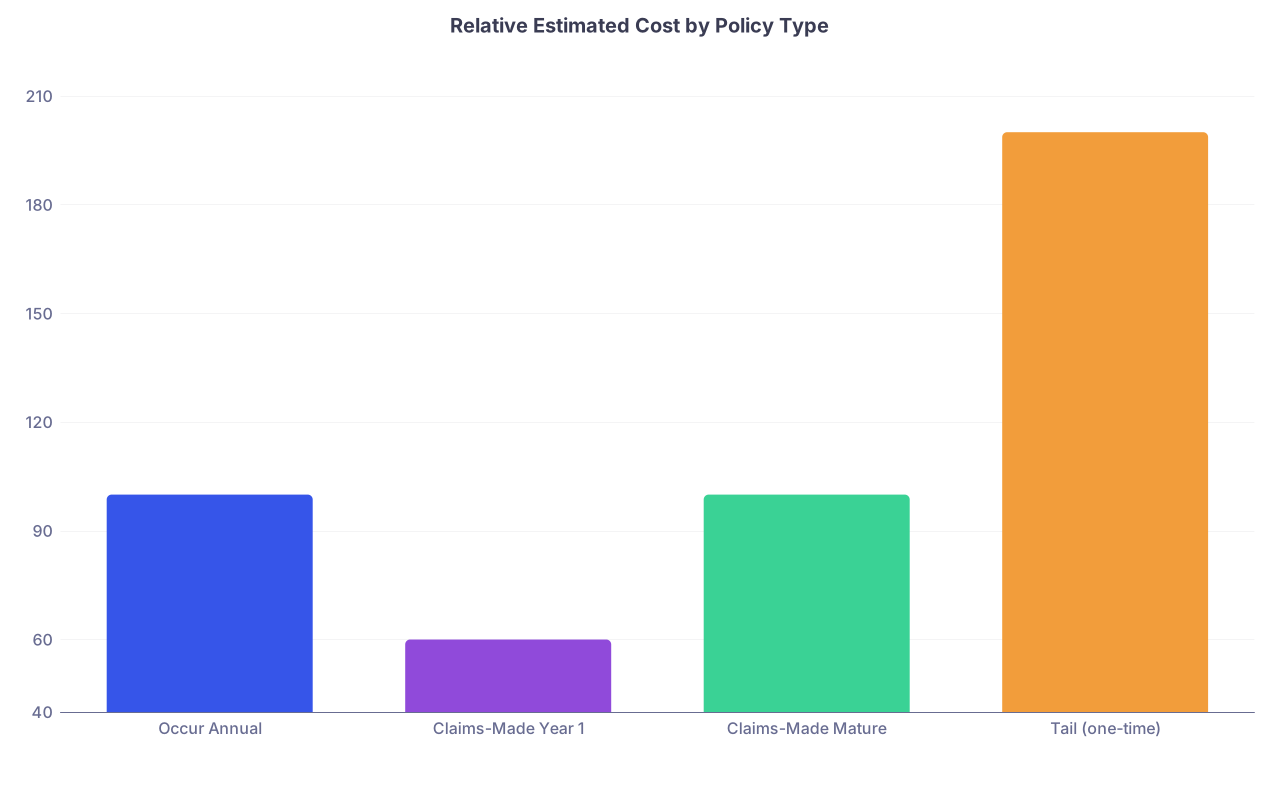
| Category | Value |
|---|---|
| Occur Annual | 100 |
| Claims-Made Year 1 | 60 |
| Claims-Made Mature | 100 |
| Tail (one-time) | 200 |
Example:
- Mature annual premium (claims-made) for OB/GYN in a medium-risk state: $45,000
- Tail quoted at 200%: $90,000 one-time
If your employment contract says “physician is responsible for tail,” you have effectively accepted a future six-figure liability that may come due the day you resign or are terminated.
Who Should Pay for Tail?
This is not theoretical. You need to negotiate it.
Common patterns:
Hospital-employed physicians: Hospital often buys claims-made and promises to pay for tail if they terminate you without cause or if you retire after X years. They may refuse if you leave early or are terminated for cause.
Private practices: Frequently push tail to the physician. Sometimes they cover it on a sliding scale (e.g., 25% per year worked, fully vested after 4 years).
Locums: Agencies frequently provide occurrence coverage specifically to sidestep tail complexity.
My opinion: For a new graduate, agreeing to pay full tail out of pocket is financially reckless unless:
- You are being significantly overpaid relative to market, or
- You have strong contractual vesting that realistically you will meet.
6. Occurrence Policies: Legally Cleaner, Operationally Different
Occurrence feels intuitive:
- If the malpractice happened during year X and you had an occurrence policy active that year, that policy covers it. Full stop.
No tail. No retro dates. No “claims made and reported” games.
Why Occurrence Premiums Are Higher
Insurers carry the long-tail risk. A poor outcome today might lead to a lawsuit 15 years from now. For pediatrics, even longer because minors have delayed statute of limitations in many states.
So carriers:
- Charge a higher immediate premium
- Build reserves to cover claims that might show up long after the policy year ends
From your standpoint:
- Year 1 occurrence premium ≈ mature claims-made premium.
- No huge tail check later.
Where Occurrence Is Common vs Rare
You see occurrence more often in:
- Low-risk specialties (outpatient IM, psych, peds in some states)
- Locums assignments
- Some large academic or hospital-employed packages (especially in more plaintiff-friendly states where institutions want clean coverage structures)
You see it less often for:
- High-risk surgical specialties (OB, neurosurgery, ortho trauma)
- Certain high-liability jurisdictions where carriers prefer to control run-off via claims-made
7. Claims-Made vs Occurrence: Legal and Financial Trade-Offs
Here is the comparison stripped of the fluff.
| Feature | Claims-Made | Occurrence |
|---|---|---|
| Trigger | Claim made + reported | Incident date |
| Needs Tail? | Yes, when policy ends | No |
| Retroactive Date | Critical | Not applicable |
| First-Year Premium | Lower | Higher |
| Long-Term Simplicity | Lower (moving parts) | Higher |
| Switching Carriers | Complex (retro + tail issues) | Simple |
Financially:
- Claims-made is cheaper in the early years, but you pay a big tail bill if you leave.
- Occurrence costs more each year but no tail shock at exit.
Legally:
- Claims-made creates more opportunities for coverage denials based on:
- Late reporting
- Gaps in retro date
- Tail not purchased
- Occurrence is more binary: Was the incident during the policy year or not?
8. High-Risk Scenarios Where Mechanics Really Matter
Here is where people get burned.
Scenario 1: Group Switch, Retro Date Lost
You:
- Start in 2022 with Group A, claims-made policy, retro 7/1/2022
- Leave Group A in 2026, join Group B
- Group B’s carrier issues a new claims-made policy with retro 1/1/2026
Group A refuses to pay tail. You do not buy personal tail.
Result:
- Any claim in 2028 about a 2024 procedure? Uncovered.
- Group A’s carrier: “Policy cancelled, no tail.”
- Group B’s carrier: “Incident pre-dates retro date.”
You personally are the only deep pocket left.
The correct move: Either:
- Negotiate tail coverage from Group A at exit, or
- Make Group B’s carrier pick up prior acts back to 7/1/2022, and confirm that in writing on the declarations page with matching retro date.
Scenario 2: Late Reporting of a “Small Problem”
During your final year at Hospital X, a patient has a severe complication. Risk management is involved. Family is angry, but nobody files a suit yet.
You:
- Shrug and move on
- Do not report anything to your insurer
- Switch jobs and carriers in July
Two years later, you are sued. The adverse event clearly occurred before you switched.
Your new carrier denies:
- The “claim” was first made now, but the incident predates their retro date (or they exclude prior acts).
Your old carrier denies:
- You never notified them during their policy period, despite knowing the circumstance; you breached a policy condition.
You are now in the middle, often with your personal counsel trying to force at least one carrier to step up. It is a mess, and you created it by not using the circumstance-reporting mechanism.
9. Statute of Limitations: How Long Do You Actually Need Coverage?
States control when plaintiffs can sue via statutes of limitation and repose. For example:
- Typical adult med mal SOL: 2–3 years from the date of injury or discovery
- Minors: Often extended; clock may not start until age 18
- Some states have absolute cutoffs (statutes of repose) that bar suits after a fixed number of years regardless of discovery.
Practically:
- For adult care, you often need tail that is unlimited or at least 5–7 years.
- For pediatrics, longer tails are critical because a newborn case can explode when the child is a teenager.
Most malpractice tails in the physician market are unlimited for that retro period. Some cheaper options offer shorter tails (3 or 5 years) – I am not a fan of those except for very specific low-risk circumstances.
10. Consent to Settle, Hammer Clauses, and How Policy Type Interacts
Policy type (claims-made vs occurrence) is not the only legal lever. You also care about:
- Consent to settle: Do you have the right to refuse settlement?
- Hammer clause: If you refuse a recommended settlement and the final award exceeds it, who eats the difference?
- Defense costs inside or outside limits: Do legal fees erode your policy limits?
These provisions usually function the same in claims-made and occurrence, but here is the nuance:
- Under claims-made + tail, your long-tail exposure continues under those same terms for years. So if your policy has a weak consent-to-settle clause, that weakness follows you long after you cancel.
- With occurrence, each policy year might have different carriers and terms. A claim from 2015 uses 2015’s policy language. A 2020 claim uses 2020’s language.
If you are in a high-risk specialty or high-dollar environment, pay careful attention to these. A strong consent to settle with no punitive hammer is worth real money.
11. How I’d Evaluate a Real Offer: Practical Walkthrough
Let us take a realistic scenario.
You are a new general surgeon with two job offers.
Offer A – Large Hospital System
- Coverage: Claims-made, retro at hire
- Annual premium: Paid by employer, mature premium ~$30k (they pay it)
- Tail:
- Paid by hospital if you are terminated without cause or retire after 5 years
- Paid by you if you resign before 5 years or are terminated for cause
Offer B – Smaller Private Group
- Coverage: Occurrence
- Annual premium: $42k, fully paid by group
- Tail: Not applicable
You expect you might want to change jobs in 3–4 years.
Mechanically:
Offer A:
- Years 1–4: Fine, employer paying premiums.
- If you leave voluntarily in year 4, you owe tail (~1.5–2x mature = $45–60k).
Offer B:
- You pay nothing personally; group covers occurrence premiums.
- After 4 years, you leave and owe no tail. Each prior year stands alone.
Financially, if you are realistic about leaving before 5 years, Offer B probably saves you a large surprise bill. Legally, Offer B is also simpler: less chance of being caught in a retro/tail trap.
12. What I’d Actually Do Before Signing Anything
If you want the short checklist that I would use personally, it is this:
- Identify the policy type in writing: claims-made or occurrence.
- For claims-made:
- Confirm retroactive date and that it will match your actual start of practice.
- Confirm who pays tail, and under which exit conditions (resignation, termination without cause, cause, retirement).
- Ask whether tail is unlimited or time-limited.
- Ask whether the employer’s next job will:
- Provide prior acts coverage back to the original retro date.
- When leaving a job:
- Get a certificate of insurance and endorsement showing retro date and any tail purchased.
- Send written notice to current carrier of any known or suspected incidents before coverage ends.
- For occurrence:
- Confirm that each policy year is occurrence (not some hybrid).
- Get annual certificates to prove coverage existed for each year.
If your contract shifts tail to you and you are not being heavily compensated for it, push back. If they refuse, at least know what you are signing up for.
13. Locums, Moonlighting, and Side Gigs: Extra Complexity
One more wrinkle: multiple policies.
You might:
- Have a full-time job with a claims-made policy provided by your employer
- Do moonlighting or telemedicine with occurrence policies through other entities
Key points:
- No coverage stacking: For a given incident, generally only one insurer will ultimately be primary. They may fight each other, but you do not get “double” coverage.
- Be explicit about which patients fall under which policy. Locums carriers often restrict coverage to services billed through the locums entity.
- If you are doing side work that your main employer does not know about, and you assume their policy covers it, you are playing with fire.
14. Bottom Line
Do not let HR or a recruiter wave away this topic as “just an insurance detail.” It is a six-figure financial decision and a career-long legal framework.
If you remember nothing else:
- Claims-made = cheaper early, but you either need continuous coverage with the same retro date or you must buy tail. Occurrence = more expensive annually, but cleaner and tail-free.
- Tail is not optional. If you are on claims-made and you stop practice, switch jobs, or lose coverage without tail, you are personally exposed for any future claims from your prior work.
- The retroactive date is sacred. If you switch carriers and lose your original retro date without tail, you just erased years of protection.
Get these three pieces right, and you will avoid 90% of the malpractice insurance disasters I have seen physicians walk into.