
Most physicians sign consent-to-settle clauses they barely understand. That is where people get burned.
Let me break this down specifically. Consent-to-settle sounds protective. Hammer clauses sound vaguely threatening. Both directly affect your license risk, your reputation, and sometimes your personal assets. If you are in practice and you do not understand these provisions, you are effectively betting your career on fine print you have never really read.
We are going to talk like adults here: insurers want to control costs, plaintiffs want money, and you want your name and license intact. Hammer provisions sit right at that collision point.
1. The Core Concepts: Consent-to-Settle vs Hammer Clauses
Start with the foundation. Two ideas you must separate in your head:
- Consent-to-settle provision
- Hammer (or “settlement pressure”) provision
A policy can have:
- Consent without a hammer.
- Consent with a soft hammer.
- Consent with a hard hammer.
- No consent at all. (Yes, these exist. And yes, physicians still buy them.)
What is a consent-to-settle clause?
A consent-to-settle clause means the insurer cannot settle a malpractice claim in your name without your written consent. That is the theory, at least.
Practical meaning: If the plaintiff wants to settle for $500,000, and your carrier thinks it is a good deal, they still need you to sign off if the policy has a consent provision. If you say no, the case proceeds—usually to further negotiation, summary judgment, or trial.
Why does this matter?
- Every indemnity payment in your name gets reported to the National Practitioner Data Bank (NPDB).
- Many hospitals and health systems track “paid claims” like a Hawkeye.
- Certain state boards care much more about "paid claim" vs "dismissed/defense verdict" than they should, but they do.
- Future credentialing, privileging, and even employment can be affected by that settlement line in your history.
So consent-to-settle is not window dressing. It is direct control over whether your name ends up in “paid claims” databases.
What is a hammer clause?
Now the ugly piece.
A hammer clause is the mechanism carriers use to discourage you from refusing settlement when they want to end the case.
Standard hammer structure (simplified):
- Insurer secures a settlement offer acceptable to them and (usually) within policy limits.
- They recommend acceptance.
- You refuse.
- From that point forward, if the final judgment or settlement exceeds the recommended amount, you become financially responsible for some or all of the “extra” amount.
That “some or all” is where the policy language matters.
You will see language like:
If the insured refuses to consent to a settlement recommended by the insurer, the insurer’s liability shall not exceed the amount for which the claim could have been settled plus defense costs incurred up to the date of such refusal.
Translation: the insurer caps their exposure. The overage is now your problem.
The hammer clause turns your right to refuse settlement into a financial gamble.
2. Types of Hammer Provisions: Hard vs Soft vs Cosmetic
Not all hammers hit with the same force. The mistake I see repeatedly is physicians assuming, “I have consent-to-settle, so I am protected.” Maybe. Maybe not.

Hard (Full) Hammer Clause
This is the brutal version.
Structure:
- Settlement offer: $X
- You refuse.
- Final judgment/settlement: $Y
- Insurer pays: $X (sometimes plus defense costs up to refusal date)
- You personally are on the hook for: $Y − $X
Example:
- Policy limit: $1,000,000
- Plaintiff offers to settle for $400,000. Insurer says, “We recommend you accept.”
- You believe care met standard, you refuse.
- Case goes to trial. Plaintiff verdict: $900,000.
- Under a full hammer clause, the carrier might pay $400,000.
- The remaining $500,000 becomes your personal exposure.
If your state allows plaintiffs to chase personal assets above policy limits, you now have a problem that can involve liens, wage garnishment, or forced settlement agreements. Some states protect certain assets; others are less forgiving. The point is: you just moved risk off the carrier and onto yourself.
Soft Hammer Clause (Sometimes Called Modified Hammer)
Soft hammer tries to look more reasonable.
Typical structure:
The carrier and insured share the overage in some ratio if the insured refuses settlement—often 50/50 or 70/30.
Example:
- Offer: $400,000
- You refuse.
- Final outcome: $900,000
- Soft hammer at 50% means:
- Insurer pays: $400,000 + half of the extra $500,000 = $650,000
- You pay: $250,000
You still get hit. Just not as hard. Better than full hammer, but still a serious concern, especially if your personal net worth is significant or you own property.
Cosmetic or “No Hammer” with Conditions
Some policies either:
- Have no hammer at all (rare, more common with physician-owned mutuals or certain regional carriers), or
- Have heavily modified language where refusing settlement does not automatically shift financial exposure, but the insurer still reserves some ultimate control in extreme circumstances (e.g., if you refuse any settlement within limits and there is clear liability).
These policies are the gold standard from a physician-control perspective. They tend to:
- Be more expensive
- Require underwriting that actually cares about your specialty, loss history, and practice pattern
- Often be sold through specialty-focused brokers, not generic commercial agents
You will not stumble into a true no-hammer policy by accident. If you are not sure, you almost certainly do not have one.
3. Why Insurers Care So Much About Settling
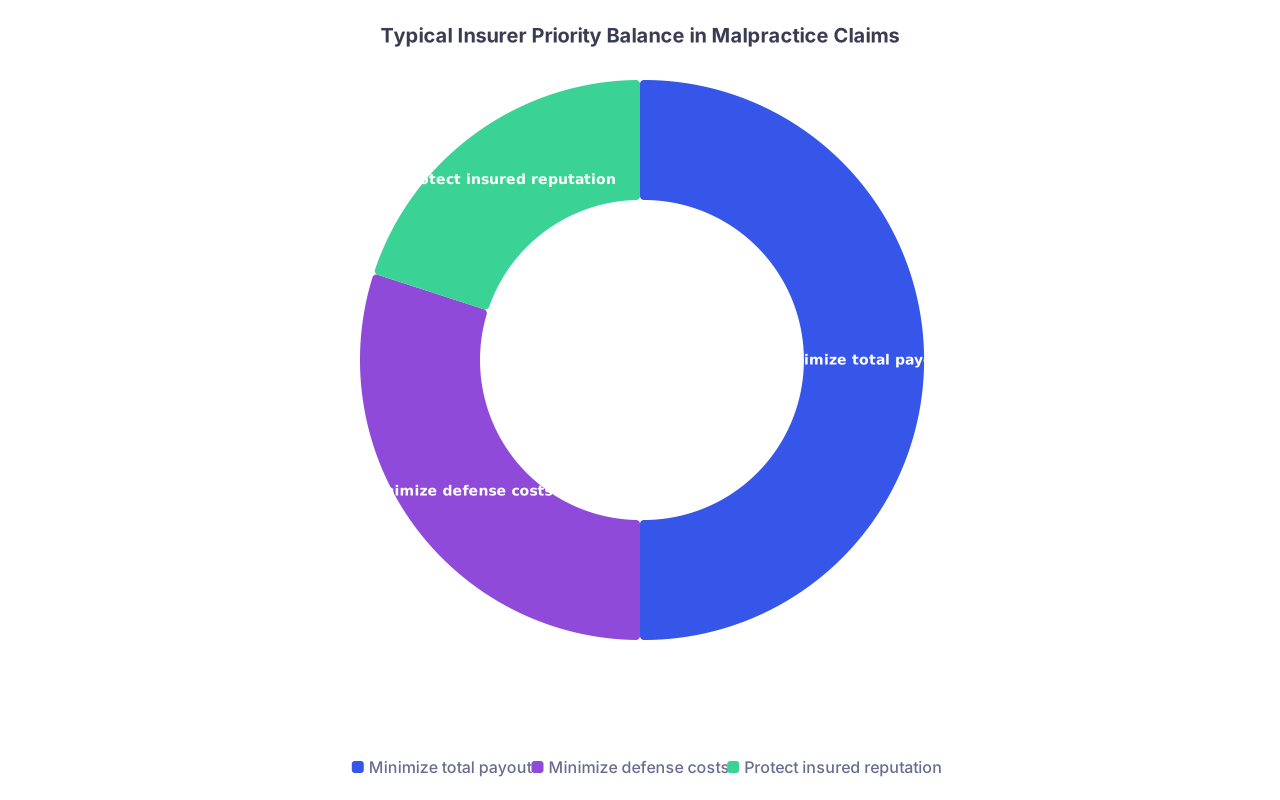
You are not paranoid. Insurers do care more about total payouts than about your reputation. That is how their business model works.
| Category | Value |
|---|---|
| Minimize total payout | 50 |
| Minimize defense costs | 30 |
| Protect insured reputation | 20 |
Roughly how the internal calculus looks:
Indemnity exposure
Main concern. How much might they pay to plaintiff. A sure $400k is often preferable to a 20% chance of a $2M verdict.Defense costs
Trials are extremely expensive. Expert witnesses, depositions, motion practice, travel. A protracted “principled fight” can burn through six figures in legal fees easily. Even in a solid defense, they may choose to settle if their actuarial math says it is cheaper.Reputation of insured / NPDB hits
This is third. Always. Some carriers genuinely try to protect physicians when liability is weak. Others quietly push settlement in marginal cases because the numbers look better for them, not for you.
So when a carrier leans on you to settle “a defensible case,” they are not lying about the economics. They might be absolutely wrong about what is best for your career.
4. How Hammer Clauses Change Your Legal Exposure
Now to the part everyone ignores until it is too late: your personal financial and professional exposure when that hammer clause activates.
Direct financial exposure
Under a hard hammer, your exposure is simple arithmetic: any amount above the insurer’s recommended settlement and limit is on you.
Under a soft hammer, you still catch a defined percentage of the excess.
Key nuance: The hammer may apply even before policy limits are reached. Many physicians incorrectly think, “I am safe as long as the verdict stays under my $1M limit.” Not always. If the offer was $300k and the verdict is $600k, in some policies the “extra” $300k can be partially or fully your problem, depending on the wording.
Indirect financial pressure
Even if the final verdict ends up low or you win at trial, the mere threat of personal exposure changes negotiation posture:
- Your defense attorney (paid by the insurer) quietly knows the carrier wants this closed.
- You start wondering if you want to bet your house on a jury understanding a subtle clinical nuance.
- Pressure mounts to accept an ugly settlement to “avoid catastrophic risk,” even when the medicine is on your side.
I have seen physicians start a case fierce and righteous (“I will not pay a claim for good care”) and end up signing a settlement they hate purely because their hammer clause made the downside too frightening.
Professional exposure: NPDB, boards, privileges
Here is the irony: hammer clauses increase the odds you settle, because they raise the stakes of refusing. More settlements = more NPDB reports.
Credentialers and hospital committees look at patterns. They do not sit down with the record and think like you do (“this was garbage litigation”). They count: number of paid claims, amount, specialty, and trajectory.
A hammer clause can indirectly:
- Increase your “paid claim” count over a career
- Make it harder to join certain groups/hospital medical staffs
- Trigger board inquiries in some states where multiple paid claims raise automatic scrutiny
You are playing a long game. That hammer clause is not about one lawsuit; it is about how your entire 25–30 year practice history reads on paper.
5. Comparing Policy Structures: Where Risk Actually Shifts
Let us put the structures side by side so you can see the trade-offs clearly.
| Policy Type | Consent Required | Hammer Type | Personal Financial Risk | Typical Premium Impact |
|---|---|---|---|---|
| No consent, no hammer | No | N/A | Low (insurer controls) | Lower |
| Consent with full hammer | Yes | Hard | High | Moderate |
| Consent with soft hammer | Yes | Soft | Moderate | Moderate-High |
| Consent with no hammer | Yes | None | Low | Higher |
Here is the trap:
- No consent, no hammer looks “safe” financially—but the insurer can settle anything, anytime, in your name, regardless of merit.
- Consent with full hammer looks empowering—until you read the fine print on financial responsibility.
- Consent with no hammer is rare and usually costs more. You will often need to actively ask for it and sometimes switch carriers.
You are constantly trading between:
- Who controls settlement decisions, and
- Who carries financial risk if those decisions go wrong
You cannot optimize both without paying for it.
6. Reading and Negotiating These Clauses (Yes, You Should)
If you have never actually read your malpractice policy, now would be a good time to fix that.

| Step | Description |
|---|---|
| Step 1 | Get full policy PDF |
| Step 2 | Search for consent to settle |
| Step 3 | Find hammer or settlement condition language |
| Step 4 | Mark key risk shifting phrases |
| Step 5 | Discuss with broker or attorney |
| Step 6 | Decide - accept, renegotiate, or change carrier |
What to look for in your policy
Open the full policy form, not the glossy summary. Then search for:
- “Consent to settle”
- “Settlement”
- “Hammer” (not always used)
- “If the insured refuses”
- “Our liability shall not exceed”
- “Amount for which the claim could have been settled”
Watch for phrases like:
- “Our duty to defend ends when we have paid the amount for which the claim could have been settled…”
- “If the insured does not consent, our liability shall be limited to…”
- “We will not be obligated to pay any sums in excess of…”
These are your red flags. They define the hammer’s force.
Can you negotiate these clauses?
Sometimes. Not always. The answer depends on:
- Your specialty and risk profile (OB, neurosurgery, interventional anything = less flexibility)
- Your claims history (clean history = more leverage)
- The market in your state
- Whether you are buying individually or through a large group
Common negotiation targets:
- Convert a hard hammer to a soft hammer (e.g., 50/50 or 70/30 split)
- Add language requiring a panel review or second-opinion counsel before the hammer can be invoked
- Obtain “true consent” with no hammer from certain physician-focused carriers (expensive but possible)
You do this before you sign or renew. Once the lawsuit arrives, the contract governs everything.
7. Realistic Scenarios: How This Plays Out
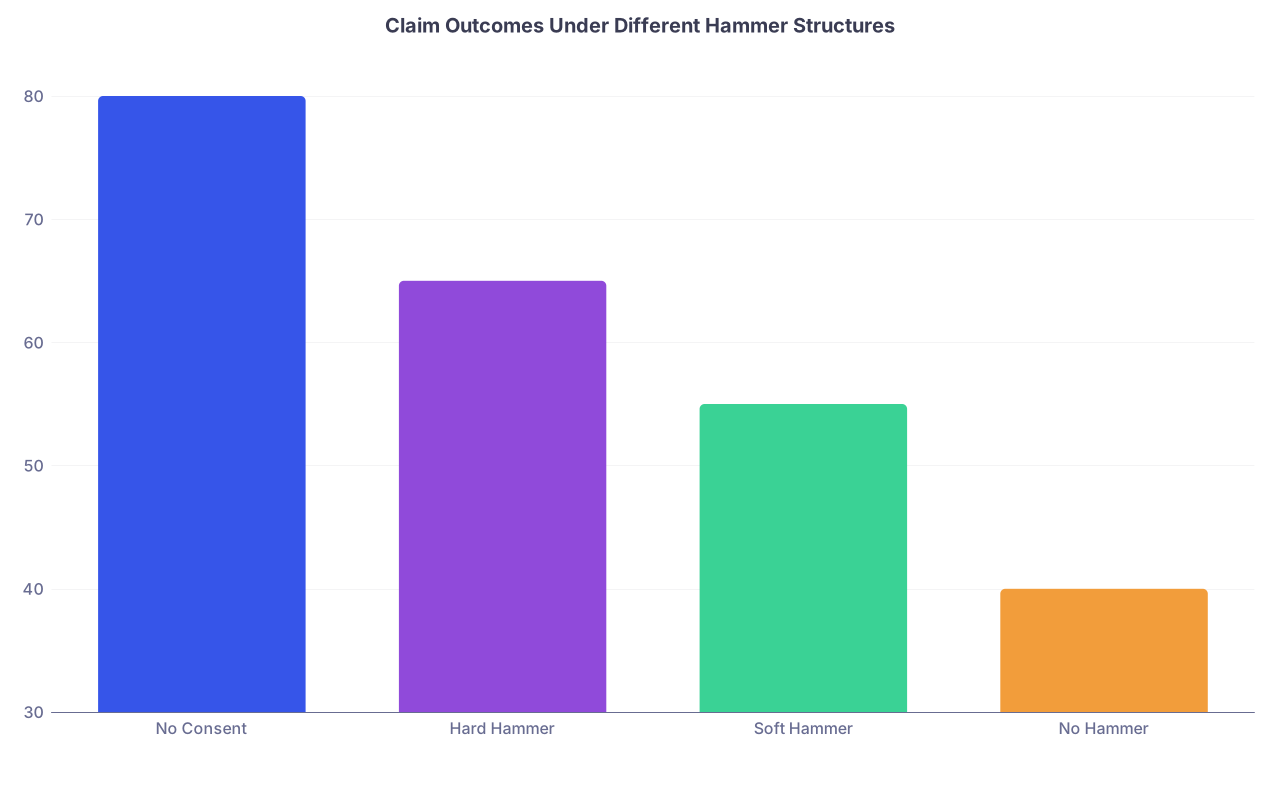
Let me walk you through the scenarios I see often.
| Category | Value |
|---|---|
| No Consent | 80 |
| Hard Hammer | 65 |
| Soft Hammer | 55 |
| No Hammer | 40 |
(Values represent hypothetical percentage of cases that ultimately settle rather than go to trial.)
Scenario 1: Weak case, strong medicine, hard hammer
- You are a hospitalist. Patient with multi-organ failure. Bad outcome but reasonable care.
- Plaintiff’s expert is weak. Defense experts are strong.
- Plaintiff offers to settle for $250,000 early.
- Carrier wants to settle to avoid trial costs.
- You refuse, wanting to clear your name.
With a hard hammer clause, you are told—sometimes explicitly—that if you refuse and a sympathetic jury gives $800,000, you are exposed to $550,000 of personal liability.
Do you still refuse?
Most physicians cave. Not because they think they did anything wrong, but because they do not want their kids’ college fund tied to a jury’s emotional reaction.
Result: unnecessary settlement, NPDB hit, and one more “paid claim” on your record.
Scenario 2: Clear liability, big damages, no hammer
- OB case. Delayed C-section. Clear documentation problems.
- Plaintiff offers $900,000 on a $1M policy.
- You strongly want to settle. Carrier agrees.
Here, the absence of a hammer does not matter. Everybody is aligned. The point where no-hammer matters is when you want to fight and the carrier wants to fold, or the reverse.
Scenario 3: Marginal case, soft hammer, large exposed physician
- Interventional cardiologist with significant personal assets, two partnerships, real estate.
- Alleged delay in cath lab transfer. Disputed timeline. Not a slam dunk either way.
- Offer to settle: $500,000. You think the case is defensible. Carrier is skittish.
- Soft hammer at 50% above recommended settlement.
You refuse. Case goes to trial. Verdict: $1.2M.
Under your clause:
- Carrier pays: $500k + half of extra $700k = $850k
- You pay: $350k
You can write that check or take a hit, but it still hurts. And that is assuming the policy wording is in your favor.
8. Practical Strategy: Minimizing Your Real-World Risk
You are not going to eliminate all malpractice risk. But you can stop being naive about your contract.
1. Choose your carrier intentionally
Do not just pick the cheapest premium.
You want to know:
- Do they provide true consent without hammer, or soft/hard hammer only?
- What is their historical reputation for taking defensible cases to trial versus reflexive settlement?
- Are they physician-owned or purely commercial?
- What are your colleagues actually experiencing with them?
Talk to:
- Senior partners who have been through litigation
- Your specialty society (many have preferred carriers for a reason)
- A malpractice-focused broker, not just the commercial lines person who also sells business auto and property
2. Align your policy with your specialty and risk tolerance
High-risk specialties (OB, neurosurgery, high-acuity EM, interventional cards, anesthesia) should pay more attention here than anyone. You are lawsuit magnets, fair or not.
If:
- Your personal net worth is high, and
- Your state allows creditor access to many of your assets,
then a full hammer clause is dangerous. You should either:
- Move to a soft or no-hammer policy, or
- Consider personal asset protection planning with a knowledgeable attorney (not internet hacks), or
- Increase your limits if reasonably priced and available
3. In litigation, insist on an honest risk conversation
When a settlement is proposed and your clause is in play, demand:
- A clear written recommendation from defense counsel explaining liability and damages realistically, not just “we advise settlement.”
- A frank discussion of worst-case verdict scenarios specific to your jurisdiction.
- An explanation from your broker or personal counsel (not just the carrier’s attorney) of exactly how the hammer clause would apply financially.
You may end up making a painful decision, but at least it will be informed pain.
9. Special Situations: Group Policies, Tail, and Employed Physicians
It gets even messier when you are not buying your own standalone policy.
Employed physicians
If you are hospital-employed or part of a large corporate group:
- The entity often controls settlement decisions.
- Your “consent” is nominal or nonexistent.
- You may not have a personal hammer clause, but you also have zero say.
Downside: The system may happily settle junk cases to protect the brand and clean up the docket, leaving you with NPDB entries that follow you long after you leave.
If you are in this situation, ask specifically:
- Who has authority to consent to settlement on my behalf?
- Do I receive notice and have input?
- Are there internal policies about when to settle versus try?
Most never ask. They should.
Group policies and shared limits
In a multi-physician practice with shared limits:
- One claim can erode shared limits for everyone.
- If one physician refuses a settlement and triggers a hammer scenario, there may be tension about who pays overages or how future premiums will be handled internally.
This is why well-run groups have:
- Internal indemnification agreements
- Clear bylaws about who decides settlement posture
- Sometimes separate supplemental coverage for high-risk partners
Tail coverage and hammer clauses
Your tail coverage usually mirrors your underlying claims-made policy conditions. If your active policy has a hammer clause, your tail generally does too. When you leave a practice, you do not suddenly become immune.
If you are buying your own tail (e.g., leaving a group where they will not pay for it), review the tail offer. Same questions apply:
- Consent-to-settle?
- Hammer language?
- Limits relative to your personal risk?
FAQ (exactly 4 questions)
1. If I have a consent-to-settle clause, can my insurer ever settle without my permission?
Usually they cannot settle in your name without written consent if the clause is well drafted. However, some policies have carve-outs—for example, if you are unreasonably withholding consent or if the claim can be settled within policy limits under specific conditions. Also, in many employed-physician arrangements, the entity has effective control over settlement even if your name is on the claim. Consent-to-settle gives you leverage, but it is not an absolute shield in every configuration.
2. Are no-hammer policies always better for physicians?
From a control and reputation standpoint, yes, they are superior. You can refuse settlement of a defensible case without automatically exposing yourself to personal financial disaster. But they are not free. Premiums can be higher, and some carriers simply will not offer them in highly litigious specialties or high-verdict jurisdictions. The right answer is context-dependent: a no-hammer clause is ideal, but sometimes a well-structured soft hammer is the best you can realistically obtain.
3. Does a malpractice settlement always get reported to the NPDB?
If money is paid on your behalf to settle a malpractice claim, and it meets the NPDB criteria (almost all professional liability settlements do), it will be reported. Dismissals with no payment in your name are not reportable. Defense verdicts at trial are not reportable. This is why the settlement vs trial decision—and the hammer clause that shapes it—matters so much. You are not just deciding about money; you are deciding about a permanent federal database entry.
4. When should I involve a personal attorney instead of just relying on the insurer’s defense counsel?
If a hammer clause is in play and there is a realistic possibility of personal financial exposure, you should at least consult your own attorney—someone who represents you, not the carrier. The insurer’s lawyer is ethically bound to defend your interests, but they are selected and paid by the carrier and live in that ecosystem. A personal attorney can review the policy language, quantify your potential exposure, and help you evaluate whether to accept or refuse settlement from the perspective of your assets, license, and long-term career—not just the insurer’s balance sheet.
Key takeaways, without fluff:
- Consent-to-settle without understanding the hammer clause is a half-measure; the real risk lives in the fine print where the insurer caps its obligation if you refuse settlement.
- Hard hammer provisions can convert a principled refusal to settle into personal financial catastrophe; if your net worth or specialty risk is high, you need to know exactly how your policy handles this.
- You should be choosing carriers and policy structures with your career arc in mind—not just this year’s premium—because every settlement, every NPDB report, and every shared risk decision stacks up over decades.