
You are sitting in your new employer’s office—hospital HR, big health system logo on the wall. You have just signed what looks like a solid contract: decent salary, RVU bonus, relocation, signing bonus. Then the HR rep says, almost as an afterthought: “Oh, by the way, your current malpractice is claims-made, so you will need to handle your tail coverage.”
You nod like you understand. You do not. You go home and realize that “tail” might cost $60,000–$120,000 you did not budget for. And your current group expects you to pay it.
This is where most physicians discover tail coverage—under time pressure, with real money on the line, and with very little honest explanation from anyone who is not financially tied to the outcome.
Let me break this down properly.
1. The Core Concept: What Tail Coverage Actually Is
Malpractice insurance has two basic structures: occurrence and claims-made. Tail coverage only lives in the claims-made world.
Occurrence policy:
If the event (the alleged malpractice) happened while the policy was active, you are covered, no matter when the claim is filed—even years later. When the policy year ends, coverage for that year is “baked in.” No tail needed. You pay more each year up front; the future risk is built into the premium.
Claims-made policy:
You are covered only if:
- The alleged incident occurred after the retroactive date (also called “prior acts” date), and
- The claim is made (reported) while the policy is in force.
When the policy ends, you no longer have coverage for past acts unless:
- You buy an extended reporting endorsement—“tail coverage,” or
- Another insurer assumes your prior acts.
So tail is not new coverage for new mistakes. It is extra time to report claims for work you already did in the past.
The Trigger That Matters: The Retroactive Date
Every claims-made policy has a retroactive date. That is the first day of professional services that are covered under that policy. Anything that happened before that date is not covered, tail or no tail.
When you first buy a claims-made policy, the retro date usually equals the policy start date. As long as you renew with the same carrier, that retro date stays the same. Over years, you build a long block of covered prior acts.
If your retro date is 07/01/2020 and you leave that job in 2026, your tail needs to protect your work from 07/01/2020 up to your last day of coverage. That six-year block is what you are insuring with the tail.
Change the retro date, lose coverage for earlier work. That mistake can cost careers.
2. Why Tail Exists: Claims-Made Growth and the Legal Reality
Malpractice claims often show up years after the alleged incident. Think delayed diagnosis of cancer, pediatric cases, or spine surgery complications. Patients sometimes do not realize there was a problem until long after treatment.
States set statutes of limitations (how long a patient has to file a lawsuit) and statutes of repose (absolute outer limits regardless of discovery). Many malpractice policies are written to roughly track those timelines—often tail is offered for 3, 5, 7, or unlimited years.
Insurers pricing logic: the premium you pay in year one of a claims-made policy does not fully reflect the ultimate risk from that year’s care. Risk builds as more years of prior acts are stacked behind you. Tail is their way of charging to cover those accumulated years after you stop paying annual premiums.
From the physician side: you are paying to prevent a gap. A lawsuit filed two years after you leave a group can hit you personally if there is no valid policy on record for that prior care. Plaintiffs will absolutely name you individually, not just the old practice.
3. Key Triggers: When Tail Coverage Is Needed—and When It Is Not
You do not always need to buy tail yourself. But you must understand what event is changing your coverage.
Here are the main scenarios.
A. You are leaving a job with claims-made coverage
Classic case. You are insured through Group A with a claims-made policy, retroactive date 07/01/2020. You resign in June 2026.
What triggers need for tail?
The day your policy terminates and no new carrier agrees to cover your prior acts from 07/01/2020 forward.
Paths from here:
You buy tail from the old carrier.
- This is the traditional extended reporting endorsement.
- Premium is a one-time lump sum, typically 1.5–2.5x your mature annual premium.
Your new employer’s carrier assumes your prior acts (a “nose” or prior acts coverage).
- They set their retroactive date equal to or earlier than your old retro date.
- Result: No tail needed from the old insurer. Your risk has been “ported” to the new policy.
Your contract says the practice pays for your tail.
- You still need the tail to exist; you just are not the one paying.
You voluntarily let it lapse.
- Then you are practicing naked for past years. If a claim surfaces, you are personally exposed. Plaintiffs’ lawyers will go after personal assets if there is no insurance behind you. I have seen physicians hit with personal judgments years after leaving a group because no one handled tail properly.
B. You are switching from claims-made to occurrence
If your new role uses occurrence coverage, you still must address the old claims-made coverage.
- Old claims-made policy must be tailed or have prior acts picked up by someone.
- New occurrence policy only protects incidents occurring after its start date. It does not “reach back.”
So occurrence for the new job is nice for future simplicity, but it does not magically solve the past.
C. You are staying with the same carrier under a new employer
Sometimes a hospital or large system uses the same insurer across multiple entities. You leave the private group, join the hospital, and both use Insurer X.
If:
- The insurer explicitly agrees to maintain the same retroactive date, and
- The policy documents confirm continuous prior acts coverage,
then you may not need a formal tail from the old practice’s policy. But you get that in writing—endorsement, not a verbal assurance.
D. Retirement, disability, or death
Many malpractice carriers offer free “death, disability, or retirement” tail if you meet certain conditions:
- Usually a minimum number of consecutive years insured with that carrier (e.g., 5 years).
- Retirement from active clinical practice, often defined as permanent cessation of practicing medicine.
- Age thresholds sometimes apply (e.g., age 55+ and insured for 5+ years).
If you qualify, the carrier issues an extended reporting endorsement at no additional cost. That is gold. Lose it by switching carriers late in your career without thinking, and you may destroy tens of thousands of value in free tail you were on track to earn.
4. How Tail Pricing Really Works (And Why It Hurts)
Tail is not random. The cost is tied to:
- Your specialty risk profile
- Your policy limits
- How long you have been insured (i.e., how much prior acts risk exists)
- Jurisdiction (state-level litigation climate)
- Features like unlimited vs limited tail period
Typical range: 150%–250% of your mature annual premium. Sometimes more in high-risk specialties and high-liability states.
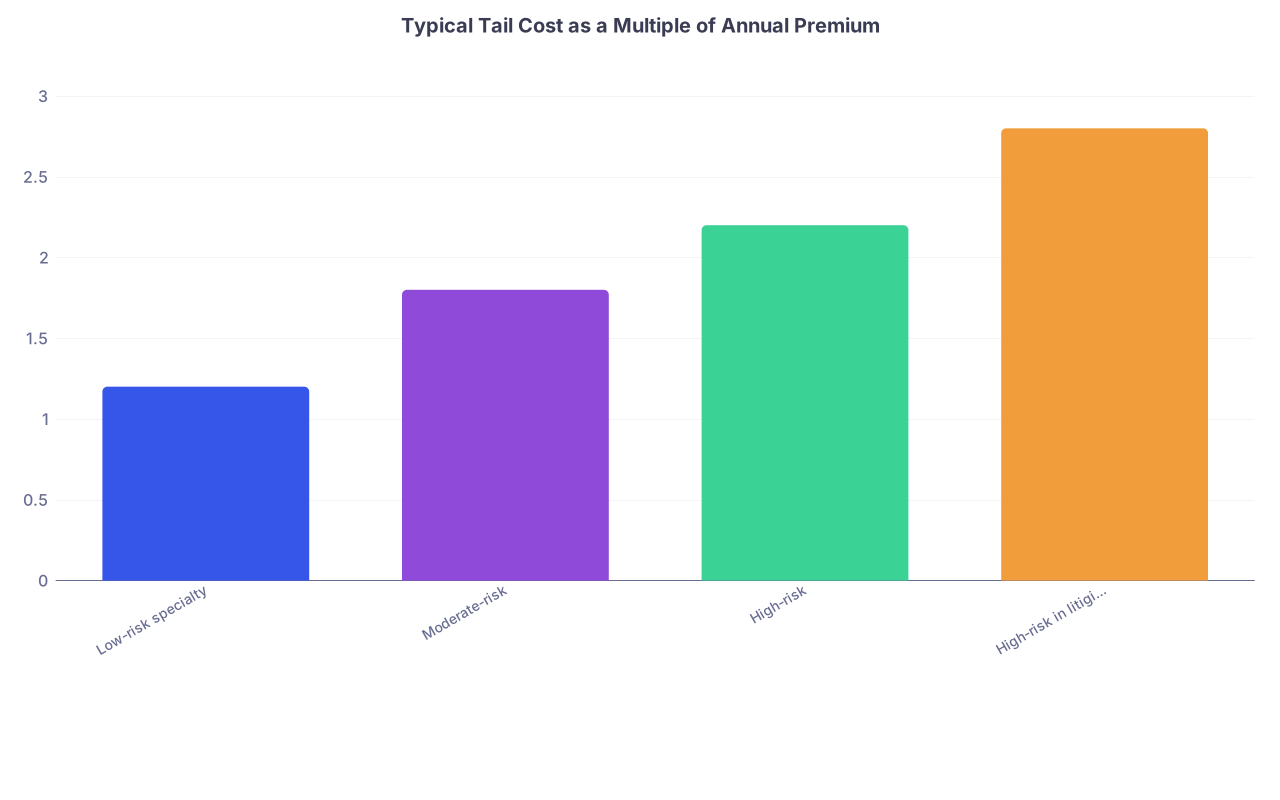
| Category | Value |
|---|---|
| Low-risk specialty | 1.2 |
| Moderate-risk | 1.8 |
| High-risk | 2.2 |
| High-risk in litigious state | 2.8 |
So if your mature annual claims-made premium is:
- Family medicine: $12,000
- OB/GYN: $55,000
- Neurosurgery: $80,000
A 2x tail would run:
- FM: ~$24,000
- OB/GYN: ~$110,000
- Neurosurgery: ~$160,000
This is why people panic about tail. Especially surgeons and OBs leaving private groups.
Important nuance: Tail is usually paid once, up front. There is no refund if you are never sued. Once issued, it is non-cancellable, non-refundable. The insurer is stuck with the risk; you are stuck with the bill.
5. Timelines: How Long Does Tail Need To Last?
There are three overlapping timelines you must think about:
- The statute of limitations in your state
- The statute of repose
- The tail period in your policy
A. Statute of limitations
Most states give patients a set period (often 2–3 years) from the date they discovered or reasonably should have discovered the injury to file a malpractice lawsuit.
Key twist: “Discovery rule.” In delayed diagnosis cases, that “clock” can start much later than the actual incident.
B. Statute of repose
This is the hard stop. Regardless of discovery, no action can be brought after X years from the date of the act or omission. Common ranges:
- 4–7 years for many adult cases
- Extended periods for minors (sometimes until a certain age + years)
So from the insurer’s perspective, the “tail risk” from a given practice year drops sharply once the repose period passes.
C. Tail policy language
Carriers offer:
- 1-year tail
- 3-year tail
- 5-year tail
- Unlimited tail
Most physicians should push for unlimited tail when it is available and financially reasonable. The incremental cost between 5-year and unlimited is often modest compared to the downside of being sued in year 6 and finding out you bought the wrong version.
Some employers or carriers will automatically attach unlimited tail; others will try to sell shorter tails because they look cheaper. That is short-sighted.
6. Nose Coverage: The Alternative To Buying Tail
Nose coverage (also called prior acts coverage) is when your new policy assumes responsibility for prior acts from your old job, back to your original retro date.
Mechanics:
- New insurer sets retroactive date = old retro date (or earlier).
- Premium is adjusted upward to reflect the added risk of past years.
- You do not need to buy separate tail from the old insurer.
When does this work well?
- You are going from private group to large hospital system that wants to control all liability moving forward.
- The new insurer is financially strong and willing to take the risk.
- Your old insurer is not undercutting the deal with a heavily subsidized tail.
When does it fall apart?
- The new insurer insists on a fresh retro date (no prior acts). That means they are only covering you going forward. You still need tail with the old carrier.
- You changed carriers multiple times; the retro date situation is messy and underwriting wants no part of it.
- There are known, open incidents that have not matured into claims; some insurers refuse prior acts if they see a pattern.
Bottom line: Nose coverage can be a powerful negotiating point. But you do not assume it is included. You verify it—explicitly, in writing, with the retro date on the declarations page.
7. Contract Language: Where Tail Gets Hidden (And Weaponized)
Here is where the “nuances” turn into real money and leverage.
Your employment contract’s malpractice section usually has several key lines. You need to dissect them.
A. Who pays for tail?
Common formulations:
Physician responsible for all tail if they leave.
- Worst-case for you.
- Often found in small private practices, older contracts, or groups that are trying to offload cost.
Practice pays tail if they terminate you without cause; you pay if you resign or are fired for cause.
- Very common middle ground.
- Gives you some protection against unilateral termination.
Practice always pays tail (or provides occurrence coverage).
- Better for the physician, often in competitive recruitment markets or hospital-employed positions.
Shared cost (e.g., 50/50) or tiered by years of service.
- Example:
- <2 years: you pay 100%
- 2–5 years: each side pays 50%
5 years: group pays 100%
- Example:
This tiered approach is actually pretty rational. But many contracts are not so balanced.
| Structure Type | Who Pays Tail? |
|---|---|
| Physician pays all | Physician |
| Employer pays all | Employer |
| Split by cause of termination | Depends on situation |
| Split by years of service | Shared / tiered |
| Nose coverage with new job | New employer's carrier |
B. Hidden traps in the language
Watch for:
“Physician shall be responsible for any tail coverage associated with any claims-made policy.”
That is absolute. No exceptions for termination without cause, retirement, or employer sale.“Group may, at its sole discretion, elect to provide tail coverage.”
Translation: they probably will not. They left themselves an out.“Coverage shall be occurrence or claims-made at employer’s discretion.”
If they switch midstream from occurrence to claims-made and then stick you with tail later, you just got played.No mention of tail at all.
In a dispute, many courts will assume the party with greater bargaining power (often the employer) bears ambiguous risk. But you do not want to litigate this. You want it clear up front.
8. Negotiation Strategies: How To Not Get Crushed
You are not going to turn every contract into a perfect deal. But you can avoid the worst outcomes and often claw back tens of thousands with smart, specific asks.
A. Ask early, and ask precisely
Do not say: “Who covers malpractice?”
Say: “This is a claims-made policy. Who is responsible for tail coverage when the relationship ends, under each type of termination?”
Force them to write it down and delineate:
- Resignation by physician
- Termination without cause
- Termination for cause
- Retirement
- Disability
- Death
- Sale or merger of the practice
B. Use market norms as leverage
In many markets:
- Hospital-employed physicians: hospital pays tail or uses occurrence.
- Large multispecialty groups: shared or employer-paid tail.
- Very small private practices: often attempt to shift tail to the doctor.
You can say directly: “Comparable hospital-employed positions in this region cover tail. I cannot accept a position where I must personally fund a six-figure tail if the group decides to restructure in three years.”
If they refuse? That tells you plenty about their culture and how they value physician risk.
C. Tie tail to years of service
If they will not pay 100% of tail outright, push for a vesting model:
Example:
- 0–2 years: Physician pays 100%
- 2–4 years: Each pays 50%
- 4+ years: Employer pays 100%
This acknowledges that tail risk is created by generating revenue for them over time. They benefited. They should share the cost.
D. Use compensation to offset a bad tail clause
Sometimes you cannot get them to budge on tail responsibility. Then you price it in:
If you are likely to owe, say, $90,000 in tail three years from now, you want:
- Higher base salary now, or
- Larger signing bonus, or
- A contractually defined “departure bonus” that effectively funds the tail.
Do not just “hope” it will work out. Quantify the future liability and treat it like a debt they are imposing on you. Because that is exactly what it is.
E. Ask explicitly about nose coverage in transitions
When you are moving to a new job, bring this up before you sign:
“Will your malpractice carrier assume my prior acts back to [retro date] from [old carrier]? If so, please confirm the retroactive date in the offer letter or contract.”
If they will, that can save you a huge tail bill. If they will not, you go back to the new employer and say:
“Without prior acts, I will owe approximately $X for tail at my current group. I need a signing bonus or relocation package large enough to reasonably cover this.”
9. Special Situations: Groups Closing, Mergers, Joint Coverage
The messiest tail disputes show up when the business entity itself changes.
A. Group dissolves or closes
If the group goes out of business:
- Someone still has to buy tail. The carrier does not care that the LLC no longer exists; the claims will hit the named insured and the individual physicians.
- Smart groups budget for “run-off” coverage (effectively group-level tail). Many do not.
You need to know:
- Does the shareholders’ or partnership agreement say who pays run-off coverage?
- If it is silent, expect finger-pointing and litigation later.
B. Sale to hospital or corporate group
When a hospital or private equity buyer acquires a practice, part of the deal is who pays the old claims-made tail.
Often:
- Buyer insists the seller (the old partners) pays for run-off coverage as a condition of closing.
- Physicians employed by the old group might be offered employment contracts with the new organization, with prior acts assumed under the new system.
But sometimes, the buyer will say: “We will not pay for your old tail. That is between you and your docs.” Then you are back holding the bag if your contract did not protect you.
C. “Shared limits” and vicarious liability
Another nuance: if you were on a shared-limit policy with a group (for example, a single $1M/$3M limit for the entity and multiple physicians):
- Your tail might be tied to entity coverage decisions.
- Plaintiffs can go after you individually and the entity. If the entity does not maintain proper tail, that does not protect you personally.
This is one reason some physicians prefer separate individual policies with their own limits and clearly defined tail obligations, even when joining a group.
10. Practical Steps Before You Sign anything
Here is what a rational, mildly paranoid physician does before locking themselves to a malpractice structure.
Get the policy type in writing.
Claims-made vs occurrence. If claims-made, nail down the retro date.Demand explicit tail language in the contract.
Do not accept “the parties will determine at separation.” That is code for “you will fight us later when you have no leverage.”Estimate the future tail cost now.
Ask: “What is the current mature annual premium for my specialty under this policy?” Use the 1.5–2.5x multiplier to get a ballpark.Check for death/disability/retirement tail benefit.
And what conditions you must meet (years continuously insured, age, etc.).Discuss nose coverage if you are transitioning.
Involve both old and new carriers if needed. This is often broker-mediated.Have an attorney review the malpractice and termination sections.
Not the whole contract if you do not want to pay for that. Just the clauses that can cost you six figures. Tell them you care most about tail, non-compete, and termination without cause.
11. Quick Clinical Example: How It Plays Out When It Goes Wrong
You are an OB/GYN in a three-physician private group. Claims-made coverage, retro date 08/01/2018. Annual mature premium: $55,000.
Your contract says, buried in Section 11(c):
Physician shall be solely responsible for any extended reporting endorsement upon termination of employment for any reason.
You do not fight it. You leave in 2027 for a hospital-employed job with occurrence coverage.
Your old carrier quotes tail: 2x premium = $110,000. The group refuses to pay a dollar. Your new employer says their occurrence policy will not pick up prior acts.
You now have two bad choices:
- Do not buy tail, save $110,000 now, and personally carry the risk that any OB case from 2018–2027 could lead to a judgment against your personal assets.
- Borrow or liquidate investments to pay $110,000 for tail.
Both feel terrible because this could have been negotiated four years earlier when the group needed you badly and was offering a $40,000 signing bonus. You did not know to ask.
I have seen this almost line-for-line. Multiple times.
12. Short Summary: What You Actually Need To Remember
Tail coverage is not a luxury add-on. It is the backbone of protection for your past practice when you leave a claims-made policy. No tail or nose coverage = personal risk.
The real levers are: retro date, who pays for tail under each termination scenario, and whether a new employer will assume prior acts. Those three points decide whether you are out $0 or $150,000.
You negotiate tail responsibility up front, before signing, not at resignation. Put it in the contract, get the retro date in writing, and treat future tail cost as part of your total compensation calculation.