
The biggest legal risk most physicians underestimate in group practice is vicarious liability. And it is the one that can quietly bankrupt you if you do not structure things correctly.
You can be sued—and pay—because of what a colleague did while you were nowhere near the building. No call. No chart. No consent form. Nothing. Just your name on the door, or your tax ID on the billing line, and suddenly you are in the crosshairs.
Let me break that down specifically.
What Vicarious Liability Actually Is (Not the Textbook Version)
Vicarious liability is liability you incur for someone else’s negligence, not because you personally did anything wrong, but because of the legal relationship between you and that person.
The classic doctrines you will see in the real world:
Respondeat superior – “let the master answer.”
The entity (or supervising doctor) is liable for the negligent acts of its employees or agents, if done within the scope of their employment.Apparent or ostensible agency – you get treated like an employer because the patient reasonably believed the negligent clinician was acting on your behalf.
Partnership / joint venture liability – each partner can be liable for the acts of other partners in the ordinary course of the partnership’s business.
You do not need to memorize those labels. You need to understand what triggers them in a group practice:
- Who employs whom.
- Whose name or logo the patient sees.
- How compensation and control are structured.
- How the patient could reasonably perceive the relationship.
You can build a technically clever LLC or corporation and still get hammered because your operations scream “one unified practice” and your contracts are sloppy.
How Group Practice Structures Create Vicarious Liability
The legal form on your letterhead—LLC, PLLC, corporation, partnership—is only half the story. Courts care about:
- Control: Who directs the work? Schedules? Protocols?
- Benefit: Who profits from the work?
- Representation: What do patients see and reasonably believe?
Let us go through the common set‑ups and where the vicarious risk actually lives.
1. Traditional Partnership or “We’re All In It Together”
You and three colleagues start “Downtown Internal Medicine Associates.” Equal partners. Shared tax ID. Single EMR instance. Group marketing. Shared staff.
In a general partnership, each partner is typically jointly and severally liable for malpractice committed by another partner in the ordinary course of practice. If Partner A misses a lung mass on a chest X‑ray and there is a large verdict:
- Plaintiff sues Partner A and the partnership.
- If Partner A’s coverage is inadequate, they can go after partnership assets.
- If partnership assets are insufficient, they can pursue personal assets of the partners depending on jurisdiction and structure.
Even if you had no involvement with the patient.
Most “modernized” groups try to blunt this by practicing through a professional corporation (PC), PLLC, or similar. That helps, but it does not magically fix everything. Two traps:
- Many banks or landlords demand personal guarantees for loans or leases. Those can be reachable even if the entity limits malpractice exposure.
- Plaintiffs often try to pierce the entity or argue partnership liability based on how you hold yourselves out.
If your website lists “Our Partners” with smiling headshots and no clear entity distinction, expect plaintiff attorneys to argue partnership exposure.
2. Corporate Group / Large Multispecialty Practice
In big physician groups and multispecialty practices, the usual pattern:
- The entity employs or contracts with the physicians.
- Patients sign paperwork, see signage, and receive bills under the group name.
- The group sets schedules, protocols, EHR, call rotations.
Legally, you now have classic respondeat superior:
- The group is vicariously liable for malpractice of employed clinicians (physicians, NPs, PAs, CRNAs, etc.) within the scope of their duties.
- Individual physicians are personally liable for their own negligence.
- Depending on structure, some physicians (owners, shareholders, managing members) may have indirect financial exposure if a large claim exceeds insurance and threatens the entity’s solvency.
Even if you are “just an employed doc” with no ownership, you are still personally named in suits routinely. Your malpractice policy responds. The group’s policy responds vicariously. Everyone gets dragged into discovery.
3. Independent Contractors: Not the Magic Shield You Think
I have seen more than one practice owner say, “We 1099 the physicians and the NPs, so we are safe from vicarious liability.”
That is wishful thinking.
Courts look past “independent contractor” labels and ask: Is this person functionally an employee?
They look at:
- Who controls hours, schedule, and on‑call obligations.
- Whether the clinician can work for others.
- Who provides the workspace, staff, EMR, equipment.
- How payment works (per shift vs. true business risk).
- How the practice presents clinicians to patients.
If you put an NP in your clinic, under your logo, with your staff, in your EMR, on your website as “our team,” and you set all their rules—do not be surprised if the court calls them your agent, independent contractor agreement or not.
Vicarious liability can attach via:
- Respondeat superior (if effectively an employee/agent).
- Apparent agency (patient believed NP was your clinician).
And now your malpractice exposure is larger than you thought.
4. Hospital‑Based Groups (ED, Anesthesia, Radiology)
Hospital‑based physicians live in an extra layer of vicarious mess.
A typical structure:
- Physician group has exclusive contract with the hospital.
- Group employs or contracts with docs and APPs.
- Nurses, ancillary staff often are hospital employees.
Possible vicarious liability chains:
- Hospital vicariously liable for its employees (nurses, techs).
- Group vicariously liable for its employees or agents (docs, APPs).
- Hospital may be vicariously liable for on‑site group clinicians via apparent agency if the hospital does not adequately disclose independent contractor status.
You, as a physician in that group, can get hit three ways:
- Your personal negligence.
- The group gets sued vicariously—and that can impact your future insurability or tail negotiations even if you personally did nothing wrong.
- If you are a partner or shareholder, a catastrophic group‑level claim can threaten group finances and thus your income, buy‑outs, and deferred compensation.
Where Vicarious Liability Shows Up in Real Claims
Let me walk through scenarios that actually trigger vicarious exposure. These are the patterns insurers and defense counsel see over and over.
Scenario 1: The “House” Doc Gets Dragged In
- Patient sees Dr. A for a surgical consult at “City Surgical Group.”
- Surgery goes poorly; alleged negligence is clear (retained sponge, wrong level spine surgery, etc.).
- Plaintiff attorney sues:
- Dr. A (direct negligence).
- City Surgical Group (vicarious).
- “John Doe Partners 1–10” (to add owners later once they unmask the structure).
You are Dr. B in the same group, never saw the patient. You are not named individually. You still care because:
- Your group’s policy limits are now in play.
- Depending on how your coverage is structured (group shared limits vs. individual), this claim can erode the shared bucket that protects you.
- A very large verdict or settlement can drive up group premiums, cause a non‑renewal, or make future coverage expensive.
Scenario 2: The NP in Your Office
- You supervise an NP in a primary care office.
- Patients schedule through your office, see your logo on the door, and their portal shows everything under “Dr. Smith Family Medicine.”
- NP misses early signs of cauda equina in a low‑back pain patient.
Lawsuit targets:
- The NP (direct negligence).
- You individually (alleged negligent supervision and vicarious liability).
- Your entity (clinic LLC, corporation) under respondeat superior.
This is the sort of case where the physician says, “I never saw the patient, I was not even in clinic that day.” The court’s response: you created the structure, you supervised the NP, and you profited from the visit. That is enough.
Scenario 3: Locums and Apparent Agency
- Hospital contracts with a locums anesthesiologist through an agency.
- The locums doc wears the hospital ID, works in ORs, charting in the hospital system.
- Patient has an anesthesia‑related injury.
Plaintiff sues:
- Locums anesthesiologist.
- Hospital (apparent agency—patient thought anesthesia was a hospital service).
- Sometimes the local anesthesia group if there is confusion about who actually provided coverage.
The hospital’s defense hinges on whether they adequately disclosed “Physicians are independent contractors, not hospital employees” in consent forms and signage—and whether that disclosure was meaningful.
How Vicarious Liability Connects to Your Malpractice Insurance
This is the part physicians get burned on: assuming “I have coverage” when the structure and limits are wrong for their actual exposure.
You have to look separately at:
- The entity’s coverage (group, LLC, corporation, partnership).
- Your individual coverage.
- The interplay between shared limits, per‑claim limits, and aggregate limits.
- Tail exposure when a group dissolves or you leave.
Entity vs. Individual Coverage
Most group practices need both:
Individual physician policies
Cover the direct negligence of each physician. Commonly written as:- $1M per claim / $3M aggregate (US standard in many states).
- Claims‑made, with tail needed when you leave.
Entity policy (sometimes a separate policy, sometimes endorsed)
Covers:- Vicarious liability for acts of employed or supervised clinicians.
- Direct liability for system failures (poor policies, credentialing, etc.).
The key is this: you cannot rely on individual policies alone if your entity is going to be named (and it will be). The entity needs its own limits or at least adequate shared limits.
| Component | Who It Protects | Common Form |
|---|---|---|
| Individual policy | Each physician | Claims-made |
| Entity coverage | Group / practice name | Separate or shared |
| Tail coverage | Departing clinicians | One-time purchase |
| Excess/umbrella | Above primary limits | Occurrence or excess |
Shared Limits: Where Groups Quietly Take On Extra Risk
Suppose your group has a policy that says:
- $3M per claim / $9M aggregate shared by 5 physicians and the entity.
Problem: Those are not $3M each. That is $3M in total for any single claim, and $9M for all claims combined that year.
If two large cases hit in the same policy year, everyone is exposed to:
- Limit erosion for future claims in that year.
- Settlement pressure because “there is not enough left in the pot.”
- Personal financial risk if a verdict exceeds available insurance (especially for those with significant assets or ownership stakes).
Shared limits are cheaper. They are also a bet that not more than one big case will hit at once. Plaintiff attorneys know this and will often probe total available coverage as part of strategy.
Claims‑Made vs. Occurrence and Tail
Most physician policies and many practice entity policies are claims‑made. Coverage responds if:
- The event occurred after the retroactive date, and
- The claim is reported while the policy is in force.
When you:
- Leave a group, or
- The group dissolves, or
- You switch carriers / structures
you need tail coverage (extended reporting endorsement) to protect against future claims for prior acts.
This matters for vicarious liability in a very specific way:
- If your group dissolves and does not buy entity tail, the entity may technically still be sued for acts that occurred during the practice’s life.
- If you personally did not secure your own tail, you can be personally exposed for claims arising from those group patients, including those where your involvement was vicarious (supervision, partnership, etc.).
I have seen physicians assume the group will handle tail, only to learn at dissolution that:
- The group could not afford entity tail.
- Partners are arguing about cost allocations.
- Carriers are quoting six‑figure numbers for large groups with long exposure.
If you are joining a group where vicarious exposure is high (hospital‑based, large multi‑specialty, heavy APP use), you need explicit, written clarity on who pays for what tail, individual and entity.
Specific High‑Risk Relationships: Where Vicarious Liability Explodes
Some arrangements simply carry much more vicarious risk than others. If you are in any of these, you should assume you are on a longer legal leash.
Supervising NPs and PAs
You supervise an NP or PA, they see patients under your umbrella. Legally, risk comes from:
- Statutory supervision requirements.
- Practice policies (sign‑off, level of oversight).
- Billing under your NPI or group NPI.
Plaintiffs will argue:
- Direct negligence by the APP.
- Negligent supervision by the physician.
- Vicarious liability of the doctor and entity.
Your policy might treat APPs as:
- Endorsed under the entity policy.
- Individually named insureds.
- Or, worst case, not covered adequately at all.
You should know:
- Are APPs covered under the group’s malpractice policy, and at what limits?
- Does your own policy explicitly cover supervising responsibilities?
- Do your supervision agreements and clinic workflows reflect the standard of care you would want a jury to see?
Shared Call and Cross‑Coverage
Multi‑physician groups do cross‑coverage all the time. Night call, weekend cross‑cover, hospitalist handoffs.
Common problem:
- You give phone orders or sign off on a covering patient you barely know.
- A bad outcome occurs.
- Primary physician and covering physician both get named.
Vicarious angles:
- Entity liability for whoever was on duty.
- Partnership / group liability if the structure suggests a joint enterprise.
- Shared policy limits if the group coverage lumps everyone together.
Make sure:
- Coverage is not limited to “patients you personally treated.” Many policies are broader, but I have seen messy gaps around cross‑coverage and “curbside” advice.
- Call arrangements are documented under the group umbrella, not casual side deals.
Multi‑Site Practices Under One Brand
One large brand, multiple locations, many semi‑autonomous docs. This looks fantastic on marketing materials and terrible in depositions.
The patient in Clinic A sees Dr. X, but everything—from website, signage, to intake forms—screams one unified practice. A catastrophic error happens in Clinic B under Dr. Y.
You, as Dr. X, might not be sued individually, but your income, bonuses, and future equity can take a hit if:
- The group’s shared limits get exhausted.
- The brand takes a reputational beating and payer contracts suffer.
- The group is forced to restructure or sell under distress.
From a legal architecture perspective, you want to know:
- Are locations separate entities with their own policies?
- Is there a management company structure separating operations from clinical entities?
- How are vicarious links between locations being limited or, at minimum, clearly insured?
Controlling Vicarious Liability: Practical Moves, Not Fantasy Lawyering
You cannot eliminate vicarious liability in group practice. The whole model is built on shared branding, shared patients, shared systems. But you can make it harder for plaintiffs and easier for your insurer.
1. Get Your Structure and Documents Aligned
This is where a decent healthcare attorney more than pays for themselves.
Goals:
- Entity choice that fits your state: PLLC, PC, corporation—aim to protect individual partners where possible.
- Clear operating agreements / shareholder agreements:
- Spell out professional liability responsibilities.
- Allocate tail costs.
- Address what happens to coverage and claims if people leave.
- Avoid defaulting into “general partnership” optics:
- Use the entity name consistently.
- Clarify ownership but do not gratuitously use “Partner” language everywhere if it increases exposure without benefit.
2. Clean Up the Patient‑Facing Side
Apparent agency is created in the patient’s head, not in your bylaws.
For hospital‑based or facility settings:
- Use consent language that clearly discloses independent contractor status where appropriate.
- Use IDs and badges that differentiate hospital staff from independent groups when that aligns with your legal strategy.
- Make sure signage is consistent with the story you will want the jury to hear.
For outpatient practices:
- Be deliberate about branding APPs vs physicians.
- Decide whether patients are clearly “seeing the NP” vs “seeing the practice,” and then insure accordingly.
- If you are going to present everyone under one unified practice, accept the vicarious exposure and do not skimp on entity limits.
3. Match Coverage to Real Exposure, Not Budget Wishes
This is where I see owners make short‑sighted decisions that cost them many multiples later.
You should sit down with a malpractice broker who actually understands group practices (not the person who occasionally writes a solo FP policy on the side) and review:
- Whether each entity that can be named in a suit has coverage.
- Whether APPs are covered at appropriate limits.
- Whether there are any uninsured gaps (e.g., a management company that could be named for “negligent policies”).
- The wisdom or insanity of your shared limit structure.
If your group is high volume, multi‑specialty, or heavy on procedure, consider:
- Higher per‑claim limits.
- Increased aggregate.
- Excess or umbrella coverage for the entity.
- Specialty‑specific higher limits for highest‑risk lines (e.g., OB, neurosurgery).
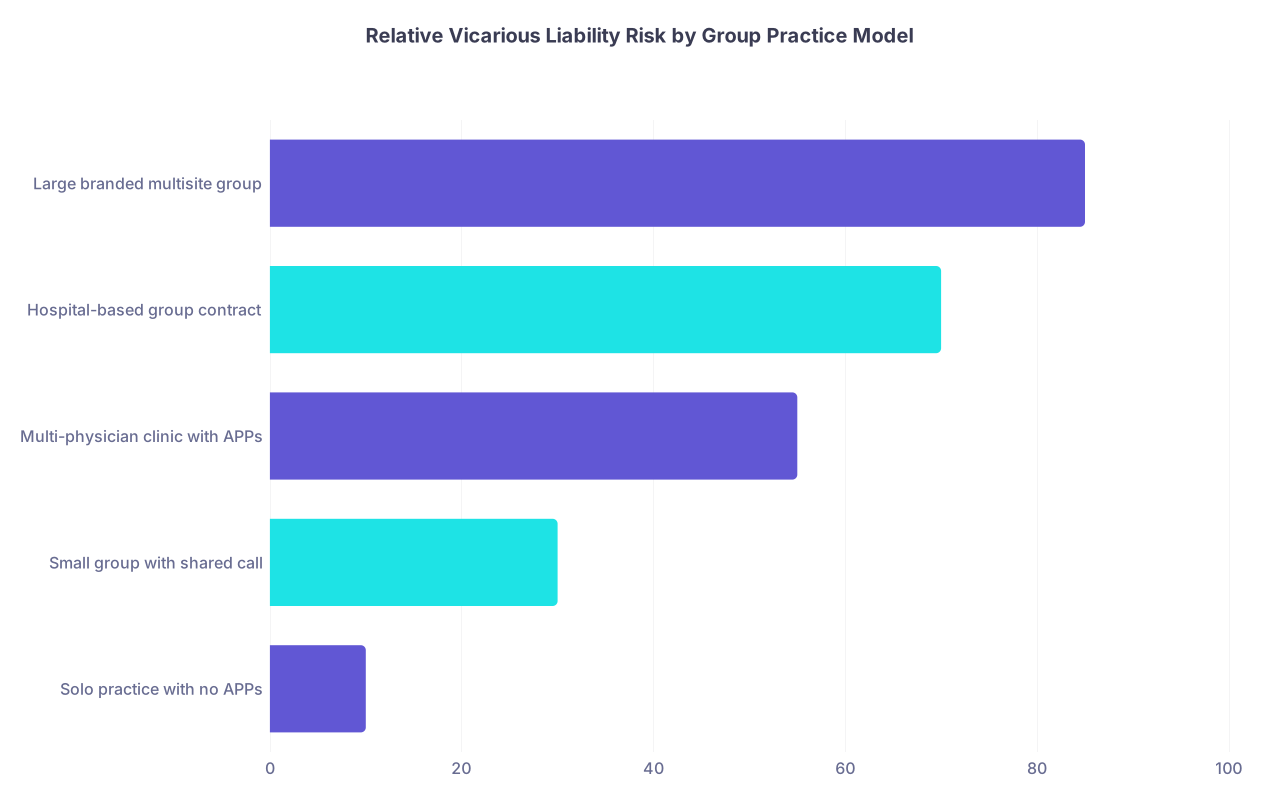
| Category | Value |
|---|---|
| Solo practice with no APPs | 10 |
| Small group with shared call | 30 |
| Multi-physician clinic with APPs | 55 |
| Hospital-based group contract | 70 |
| Large branded multisite group | 85 |
4. Be Realistic about Employment vs Independent Contractor Models
If your clinicians:
- Work your hours.
- Use your systems.
- Cannot build their own patient base independently.
- Are presented to patients as part of your practice.
then they are functionally employees or agents for purposes of vicarious liability.
Two rational choices:
- Accept that and structure robust entity coverage.
- Or genuinely change the relationship so that it is a real independent business (different branding, separate billing, own staff), then still check the insurance carefully.
Pretending a quasi‑employee is an independent contractor solely to dodge payroll taxes or vicarious liability is a good way to anger both the IRS and plaintiffs’ lawyers.
Financial Fallout: How Vicarious Liability Hits Your Wallet Long Term
People focus on the verdict number. That is not where most of the damage lands.
Here is how vicarious liability in a group actually bleeds you:
- Premium escalation: One partner’s catastrophic case can push group premiums up 20–50%+ for years.
- Carrier reluctance: Some insurers will non‑renew groups with recurring high exposure, forcing you into more expensive surplus lines markets.
- Buy‑out and equity hits: In buy‑sell negotiations, a group with a fresh seven‑figure entity settlement is less attractive and may take a valuation haircut.
- Contract leverage: Hospitals and health systems hesitate to renew or expand with groups seen as “high‑risk,” which hits volumes and negotiating power with payers.
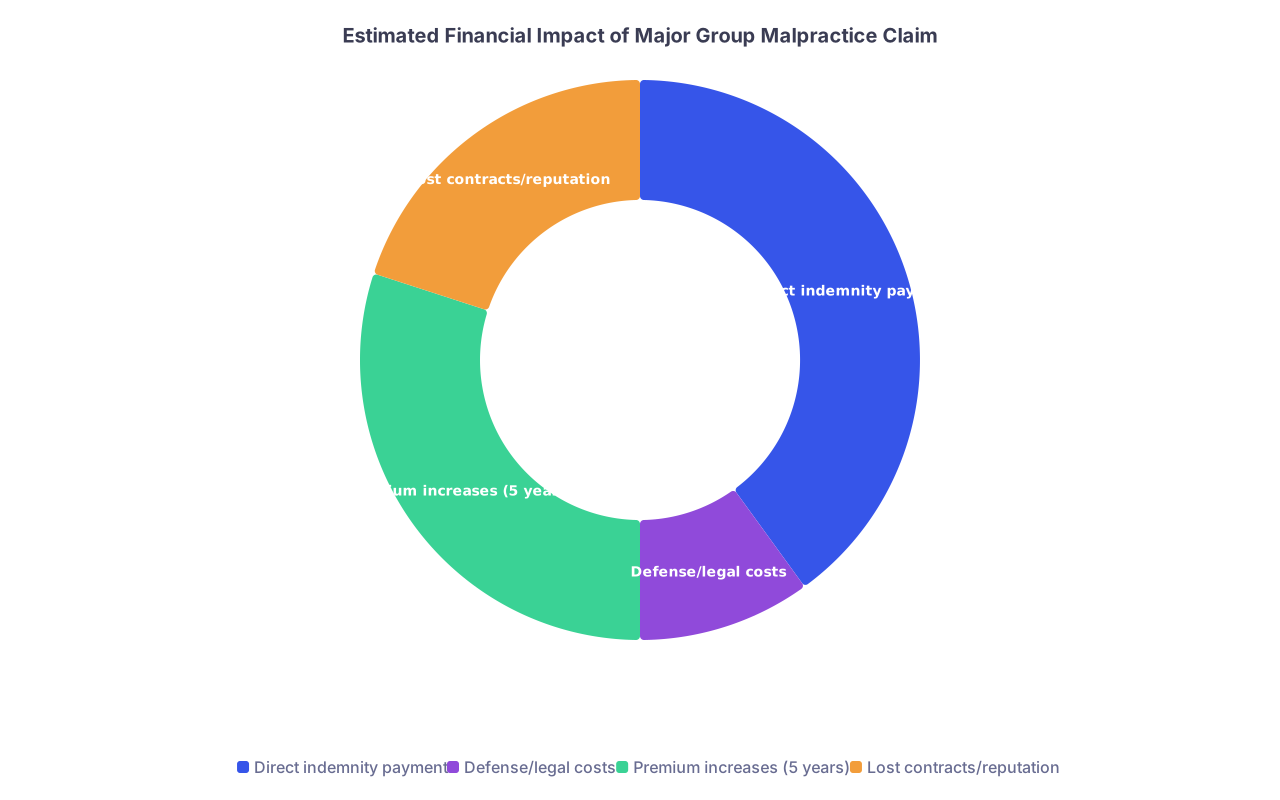
| Category | Value |
|---|---|
| Direct indemnity payment | 40 |
| Defense/legal costs | 10 |
| Premium increases (5 years) | 30 |
| Lost contracts/reputation | 20 |
For senior partners close to retirement, vicarious liability can directly mess with:
- Timing and value of practice sale.
- Cost of tail coverage at exit.
- Earn‑outs or deferred compensation tied to future group performance.
For younger physicians, it hits through:
- Lower profit distributions due to expensive insurance.
- Less flexibility to grow or add services because every new line adds to perceived risk.
How to Audit Your Own Situation (Without a 60‑Page Legal Memo)
You do not need to become a malpractice lawyer. You do need to ask smarter questions.
Here is a practical self‑audit you can do with your administrator, broker, or counsel.

| Step | Description |
|---|---|
| Step 1 | Start |
| Step 2 | List all entities and contracts |
| Step 3 | Who employs or contracts clinicians |
| Step 4 | How are clinicians presented to patients |
| Step 5 | Match each entity with coverage |
| Step 6 | Meet broker and attorney |
| Step 7 | Review limits and shared structures |
| Step 8 | Adjust limits or structure if needed |
| Step 9 | Update policies, consents, and agreements |
| Step 10 | Any uninsured or thinly insured entity |
As you run through that, watch for these red flags:
- Entity that appears on patient bills but is not named on any malpractice policy.
- APPs documented as “independent contractors” but treated day‑to‑day as staff.
- Shared limits that do not scale with group size and specialty mix.
- No written clarity on who buys tail coverage when physicians leave.
- Hospital or facility contracts that broadly indemnify the institution with weak or outdated insurance requirements on your side.
If you see any of those, you have homework.
What Malpractice Insurers Look For (And How That Helps You)
Insurers are selfish. That serves you if you pay attention.
When underwriters review a group practice, they look at:
- Specialty mix and procedure profile.
- Use and supervision of APPs.
- Call structure and cross‑coverage patterns.
- Credentialing and peer review processes.
- Documentation, EHR use, standardized order sets.
They are essentially triaging vicarious risk. If you line up your operations with what underwriters like, you are not just “more insurable.” You are actually less likely to get wrecked in a lawsuit.
Examples:
- Clear, standardized supervision protocols for NPs/PAs.
- Thorough credentialing files that show you did not ignore red flags.
- Delineated responsibilities between hospital staff and group staff.
- Incident reporting and internal review that actually leads to changes.
These operational choices do more to protect you from vicarious liability than yet another paragraph in a contract.
Where This Fits in Your Bigger Financial and Legal Picture
Vicarious liability is not just a “legal” topic. It is a financial one. It touches:
- How you choose to join or form a group.
- How you negotiate partnership or shareholder agreements.
- How you plan for exit and retirement.
- Whether your long‑term wealth is actually insulated from professional risk.
You are not going to fix all of this in an afternoon. You do not have to. But you should not be the physician who finds out, 18 years into practice, that you have been on the hook for four colleague‑caused claims you never thought about.
Start by:
- Getting crystal clear on who can be sued, by name and by entity, for the work you do today.
- Matching that list with actual insurance policies and limits.
- Fixing the obvious mismatches—especially around APPs and entity coverage.
- Updating your internal governance documents so everyone knows who pays for what when things go wrong.
Once you have that foundation, then you can have more nuanced conversations:
- Do we restructure the group into multiple entities?
- Do we add excess coverage for certain specialties?
- Do we change how we brand and present ourselves to patients?
Those are bigger strategic moves and deserve their own discussion.
With a solid grasp of vicarious liability, you are finally in a position to negotiate from strength—contracts, coverage, and partnership terms. The next step is learning how to read those malpractice policies and hospital contracts line by line, so you see the landmines before you sign them. But that is a conversation for another day.