
Supervision is not a shield. If you supervise, you own the risk—legally, financially, and professionally.
Most physicians and residents dramatically underestimate how malpractice coverage actually works when supervision and shared care are involved. They assume one of three things, all wrong in the real world:
- “The hospital will cover us.”
- “The resident is the one who saw the patient; they’ll be liable.”
- “The attending is ultimately responsible, so my role is protected.”
All three are incomplete at best, and in many cases, dangerously naive.
Let me break this down the way I explain it to senior residents panicking before their first attending job, and to attendings who think their faculty contract magically solves everything.
1. The Legal Reality: Supervision = Shared Exposure
Supervision is not a title. It is a legal relationship.
When an attending “supervises” a resident, NP, PA, or student, several overlapping legal concepts kick in:
- Direct negligence (your own acts/omissions)
- Vicarious liability (you’re responsible for someone under your supervision/control)
- Corporate liability (the hospital or group gets dragged in)
- Delegation and non-delegable duties (things the law expects you, not just your trainee, to ensure are done safely)
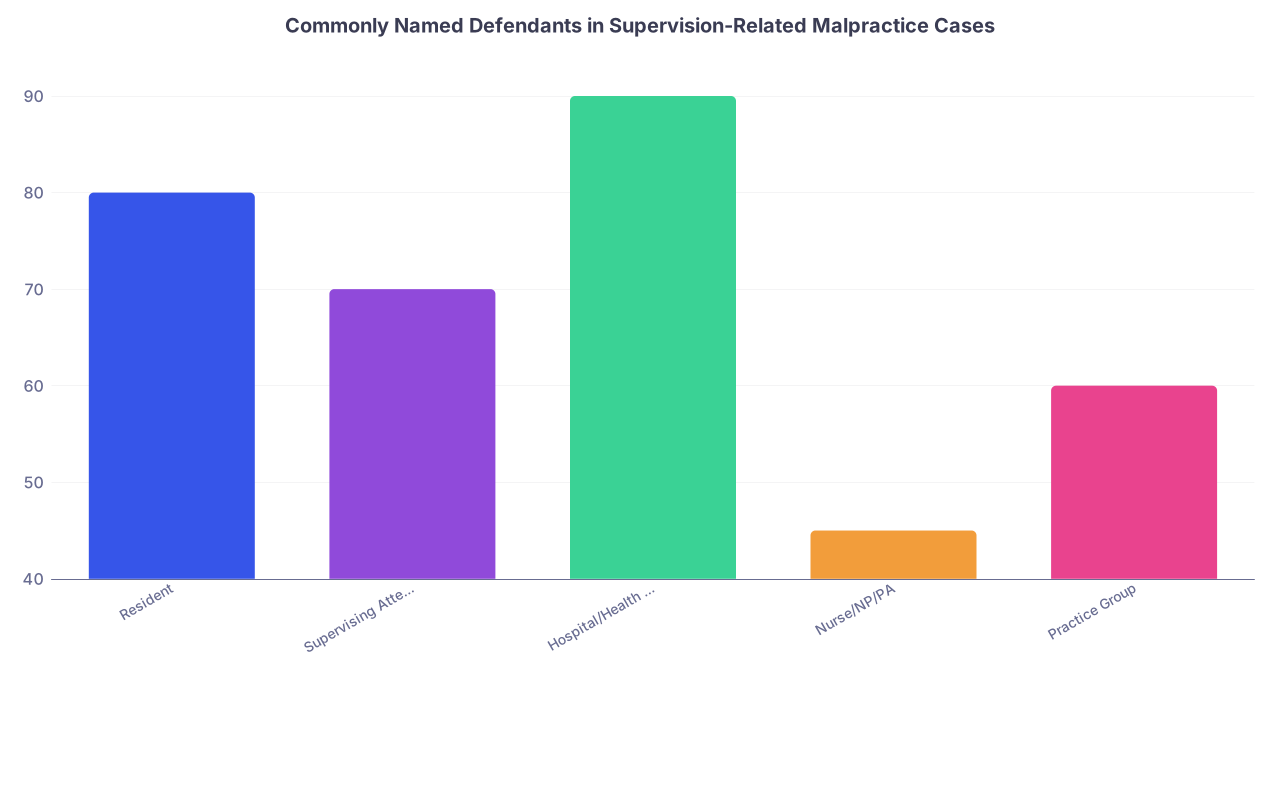
So when there is an adverse event, plaintiffs do not sit around trying to pick just one defendant. They stack:
- The resident
- The supervising attending
- The hospital / institution
- Sometimes the practice group, faculty plan, or locums company
And then they work down the chain of supervision: “Where did the system fail, and who could have stopped it?”
How “shared liability” actually plays out
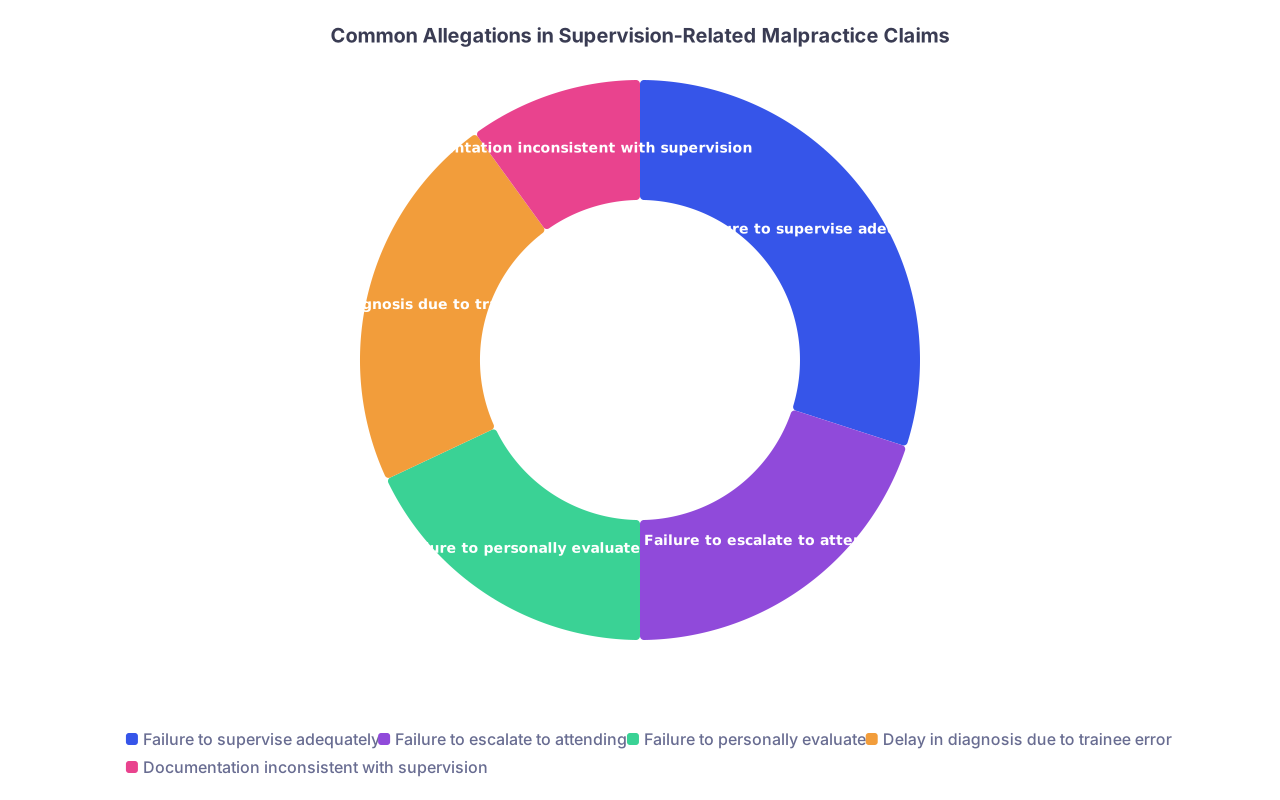
In a typical supervision-related claim, you will see accusations (in some combination) like:
- The resident failed to recognize X.
- The attending failed to:
- Personally evaluate the patient when indicated.
- Provide adequate supervision given the resident’s level.
- Ensure appropriate follow-up / escalation.
- Communicate clearly with the team or consultants.
- The institution failed to:
- Have or enforce appropriate supervision policies.
- Ensure adequate staffing.
The key: even if the attending never saw the patient personally, they can still be named and held liable if the supervision was deemed inadequate.
| Category | Value |
|---|---|
| Resident | 80 |
| Supervising Attending | 70 |
| Hospital/Health System | 90 |
| Nurse/NP/PA | 45 |
| Practice Group | 60 |
Numbers approximate typical patterns from multi-party litigation: hospitals almost always named, attendings named frequently, residents slightly less often—but still very much in the line of fire.
2. Who Covers Whom: Residents, Attendings, and Institutions
The most persistent misconception: “If I’m a resident, the hospital covers everything,” or “As an attending, my trainees are covered under my policy.”
Wrong. Coverage follows contractual and policy language, not assumptions.
Let’s break it down group by group.
A. Residents and Fellows
In almost all ACGME-accredited programs:
- You’re covered for training-related activities under the institution’s malpractice policy.
- Coverage is almost always claims-made, with tail coverage usually purchased by the institution.
- Limits are often something like $1M/$3M or $2M/$4M, sometimes on a shared institutional policy.
But there are hard edges to this.
Most institutional resident policies:
- Do not cover moonlighting outside the sponsoring institution (and sometimes not even internal moonlighting if not explicitly included).
- Do not cover non-clinical consulting, side gigs, telemedicine for outside entities, or volunteer work outside approved settings.
- Do not cover practice after graduation—even if the claim is for care delivered while you were a trainee—if the policy is claims-made and you do not have tail.
So in a supervision scenario:
- The resident is usually covered through the institution.
- The supervising attending may be covered through:
- The same institutional policy (if employed faculty), or
- A separate practice group policy, or
- Rarely, their own individual policy.
The resident is not “covered under the attending’s insurance.” They are almost always covered under the hospital/academic institution’s policy.
B. Attendings in Academic Hospitals
Faculty physicians supervising residents often assume that being “employed by the university/hospital” covers everything. It usually does—for work within the scope of that employment.
Typically:
- The hospital or academic group holds a malpractice policy that covers clinical activities you perform as a faculty member.
- This coverage usually extends to your role as a supervisor of residents/fellows and to team-based care on your service.
- You are personally named in lawsuits, but the insurer provides defense and indemnity (pays judgments/settlements) up to the policy limits.
But there are traps:
- Outside work (affiliate hospital, side clinic, telehealth, expert witness work) may not be covered.
- Contract ambiguities: Just because you work “0.5 FTE faculty” does not mean they cover your off-site locums shifts.
- Shared coverage with residents: If it is one institutional policy, a massive multi-defendant judgment can eat into the shared limits.
C. Community Attendings and Private Groups
In community settings where residents rotate through private practices or community hospitals:
You might see:
- Hospital-employed residents covered by the hospital.
- Residents working with private attendings who have their own group malpractice policy.
- Coverage may or may not explicitly define who is supervising whom.
You have to read three things:
- Your own malpractice policy (as attending).
- The residency program’s affiliation agreement with the hospital / practice.
- The hospital’s bylaws or supervision policies.
Because in some setups, the attending assumes they are supervising “informally,” while on paper, they are explicitly designated as the responsible supervising physician. If something goes wrong, plaintiffs will argue that you had a formal duty to supervise.

3. Claims-Made, Occurrence, and Tail in Supervision Context
You cannot talk about shared liability without understanding how coverage actually attaches to a claim.
Claims-made coverage
Most physicians (especially attendings) now have claims-made policies. You are covered if:
- The care occurred after your retroactive date, and
- The claim is first made while the policy is active (or during an extended reporting period—tail).
In a supervision-related incident, think about:
- When the supervision occurred.
- When the claim was filed.
- Whether your policy (or institutional policy) is still active or has tail.
Example:
- You supervised a PGY-3 on July 1, 2022.
- You left the academic center July 31, 2023.
- A lawsuit is filed in 2025.
If the institution has claims-made coverage and bought tail, you are likely still covered as a former employee for work during your employment period. If they did not, you may have a serious problem.
Occurrence coverage
Less common now, but simpler: the policy covers any incident that occurs during the policy period, regardless of when the claim is made. No need for tail.
If the hospital or group still has an old occurrence policy or a mix of occurrence and claims-made layers, coverage mapping in multi-defendant supervision claims can get complicated, but that is their headache, not yours—assuming you had active occurrence coverage at the time of care.
Supervision twist: overlapping policy periods
It is very common to have:
- Resident: covered by institutional policy.
- Attending: covered by group policy (or same institution).
- Hospital: separate self-insured retention or captive layer.
A single supervision-related claim can trigger multiple policies and multiple years, especially in chronic care scenarios (e.g., long-term missed diagnosis).
Your priority is not to solve the coverage puzzle yourself. Your priority is to make sure:
- You were clearly covered during your practice period.
- Tail coverage exists when you leave a job with claims-made coverage.
| Role | Typical Policy Holder | Policy Type | Tail Usually Needed? |
|---|---|---|---|
| Resident/Fellow | Hospital/Institution | Claims-made | Institution handles |
| Academic Attending | Hospital/Faculty Plan | Claims-made | Yes, when leaving |
| Private Attending | Individual/Group Policy | Claims-made | Yes, when changing |
| Locums Attending | Locums Agency or Self | Claims-made | Often agency-provided |
4. Supervision Levels and How They Affect Liability
This is where a lot of attendings get burned. They think they are supervising appropriately because the resident “seemed comfortable.” That is not the legal standard.
Most institutions and training programs define levels of supervision, such as:
- Direct supervision: attending physically present.
- Indirect supervision: attending not on site but immediately available by phone/tele.
- Oversight: attending reviews care after the fact.
Each level has guidelines on when it is appropriate—for example:
- PGY-1 in the ICU at 2 AM? You better have clear direct/indirect supervision parameters.
- PGY-3 in clinic with follow-up patients? Oversight may be fine if policy allows.
In a lawsuit, plaintiffs will attack:
- Whether the assigned level of supervision matched the resident’s training and the clinical scenario.
- Whether the attending followed the institution’s supervision policies.
- Whether the attending documented involvement appropriately.
The more advanced the trainee, the more reasonable it is to grant autonomy. But autonomy does not mean absence. It means graduated responsibility with safety nets.
Specific supervision failure patterns I have repeatedly seen in claims analysis:
- Resident admits unstable patient; attending cosigns note the next day having never spoken to the resident overnight.
- Attending “covering four services” and “available by phone,” but in reality in the OR or off-site and functionally unreachable.
- “Sign-out supervision”: attendings relying entirely on overnight resident notes without ever verifying with the patient or nurse in high-risk scenarios (e.g., chest pain, sepsis, neuro changes).
Every one of those patterns becomes exhibit A in a lawsuit.

| Step | Description |
|---|---|
| Step 1 | Resident evaluates patient |
| Step 2 | Direct attending involvement now |
| Step 3 | Indirect supervision with clear plan |
| Step 4 | Document attending role |
| Step 5 | Ongoing reassessment by team |
| Step 6 | Acuity or high risk? |
| Step 7 | Resident experience adequate? |
5. How Policies Treat “Supervisory” vs “Direct” Negligence
From an insurance standpoint, your malpractice policy is usually not making a philosophical distinction between:
- You misreading the CT scan personally, vs
- You failing to ensure that the resident’s interpretation was reviewed or confirmed.
Both are allegations against you. Both are covered as “professional services” under your policy, if you were acting within the scope of your covered duties.
But the legal theories are different:
- Direct negligence
- You personally made a bad clinical decision, missed a step, or failed to act.
- Vicarious liability / negligent supervision
- You allowed an inadequately trained or supervised provider to manage the patient without reasonable oversight.
Insurance cares mainly about:
- Was this within your scope of covered practice?
- Was this during your covered period?
- Are you named as a defendant or at risk of being named?
The plaintiff and court care about:
- How egregious your supervision failure appears.
- Whether institutional policies or standards were clearly violated.
- Whether multiple defendants can contribute dollars to a settlement.
So shared liability is not a theoretical thing. It is how the money ultimately gets allocated between defendants and insurers.
| Category | Value |
|---|---|
| Failure to supervise adequately | 30 |
| Failure to escalate to attending | 20 |
| Failure to personally evaluate | 18 |
| Delay in diagnosis due to trainee error | 22 |
| Documentation inconsistent with supervision | 10 |
6. Practical Risk Mitigation: What Smart Supervisors Actually Do
Forget the slogans about “culture of safety” for a second. Here is what actually reduces your risk as a supervising attending (and as a senior resident, frankly).
1. Be explicit about supervision expectations
With your team, you should have clear, repeated rules like:
- “Any chest pain, neuro change, hypotension, or airway issue—call me, even at 3 AM.”
- “No one gets discharged from the ED with new neuro deficits without me being aware.”
- “If you are debating giving tPA, activating the cath lab, or going to OR emergently, I must be in that conversation.”
When there is a case review later, you want to be able to say: “My residents knew, clearly and specifically, when to call.”
2. Document your involvement in a way that stands up
I am not talking about padding notes. I am talking about clarity:
- “Patient seen and examined with Dr. X (PGY-2). I independently reviewed labs and imaging. Agree with assessment and plan as documented, with the following additions…”
- “Discussed case by phone with Dr. Y (PGY-3) at 02:15 regarding chest pain with dynamic EKG changes; I directed transfer to ICU and urgent cardiology consult.”
When all you have is a generic “patient seen and agree with above,” plaintiffs will argue you never truly engaged.
3. Know your institution’s supervision policy—and follow it
Every academic center has one. Most attendings have not read it since orientation 10 years ago.
Plaintiff attorneys love these policies. They will print them out and ask you, under oath:
- “Doctor, you signed this when you started. On the night of this event, which level of supervision was this resident under?”
- “Policy says PGY-1s require direct supervision for unstable patients. Did you see this patient yourself?”
If you are out of sync with written policy, your defense gets harder. Full stop.
4. Do not assume “good residents” need less supervision in high-risk situations
I have seen this exact phrase in depositions:
- “I trusted Dr. R; she was one of our strongest residents, so I did not feel the need to personally evaluate the patient.”
That sounds fine in a hallway conversation. It sounds awful in a transcript next to “patient later died of missed sepsis.”
Graduated autonomy does not mean abdication in high-risk cases. High-risk = your presence or clear, contemporaneous involvement.
5. As a resident: understand you are not invisible
Residents sometimes think:
- “I am covered by the hospital; they will protect me.”
- “They will go after the attending, not me.”
You will be named. You will be deposed. Your documentation, your cross-cover decisions, your “did not call attending” moments will be dissected.
So you:
- Call early for help in high-risk situations.
- Document clearly when you “discussed with attending” (name, time, gist of plan).
- Clarify ambiguous orders, especially if consultants or attendings disagree.
You are a physician. Courts expect you to exercise independent judgment within your level of training, not blindly comply.
7. How Indemnity and Defense Actually Work in Shared Cases
When multiple defendants are named—resident, attending, hospital, group—several insurers (or self-insured entities) may get involved. They will:
- Appoint defense counsel (sometimes shared, sometimes separate).
- Argue behind the scenes about who pays what.
- Negotiate indemnity splits if a settlement occurs.
From your perspective, a few key realities:
You do not want gaps.
No gaps in coverage periods. No jobs without clear written coverage. No assuming “they said we’re covered” without seeing it in your contract or employee manual.You want your own defense if conflicts appear.
If the hospital’s story is “this was doctor error, not system error,” and your story is “I followed your unsafe policy,” you may need separate counsel. Good policies allow this if there is a conflict of interest.Policy limits matter in multi-defendant cases.
If there is a single $1M limit shared by all co-defendants under one policy, and the verdict hits $1.5M, excess exposure can become ugly.
This is why some senior attendings insist on:
- Higher individual limits.
- Clear documentation of whether they share limits with the hospital or have separate amounts.
8. What to Review in Your Own Situation
You cannot fix every systemic problem. But you can stop being blind.
For attendings:
Get your full malpractice declarations page and policy.
Confirm:
- Claims-made vs occurrence.
- Retroactive date.
- Who is the named insured (you vs. group vs. hospital).
- Whether supervision of residents/APPs is within scope.
- Who buys tail if you leave.
Read your contract/offer letter for:
- Tail responsibility.
- Coverage of off-site / affiliate work.
- Any exclusions or special provisions.
For residents/fellows:
Ask GME or risk management:
- “Is all of my clinical work as a trainee covered? Internal moonlighting? External?”
- “Is tail coverage provided for my residency years after I graduate?”
- “Do we have separate coverage when rotating at outside hospitals?”
Understand:
- You will graduate; your institutional umbrella disappears.
- Claims can arise years later. Tail matters, even for training time.
For both:
- Request and read the institution’s Supervision Policy for your department.
- Ask explicitly: “In a lawsuit involving resident-supervised care, how are residents and attendings defended and indemnified?”
Someone in risk management or legal will answer. They usually appreciate people asking before there is a problem.