
The biggest mistake physicians make with side work is assuming their main malpractice policy “probably” covers it. It usually does not.
Why Riders Matter For Teaching, Consulting, and Expert Witness Work
Let me be blunt. Your standard clinical malpractice policy is written to cover one thing: direct patient care within the scope of your declared specialty and setting. Everything else is an exception waiting to happen.
Teaching, consulting, and expert witness activities sit in a legal gray zone between clinical care, professional services, and business activities. Many carriers treat those as separate exposures that must be:
- Explicitly disclosed
- Explicitly underwritten
- Explicitly endorsed (via rider/endorsement)
If you are lecturing for money, advising startups, helping hospitals redesign care pathways, or signing reports as an expert witness without checking your coverage, you are betting your personal assets on wishful thinking.
Let me break this down specifically by type of work.
Core Concepts: How Malpractice Riders Actually Work
Before we slice into teaching vs consulting vs expert witness, you need a clear map of the terrain.
1. Base Policy vs Rider vs Separate Policy
Base policy:
Your primary malpractice policy. Usually “medical professional liability” for clinical practice. Claims-made or occurrence. Carries your main limits (for example, $1M / $3M).Rider (endorsement):
An amendment to the base policy that:- Broadens covered “professional services” (for example, adds “expert witness work”)
- Extends coverage territory or venue (for example, federal court work in another state)
- Adjusts limits or deductibles for a new exposure
Separate policy:
A standalone policy—often “miscellaneous professional liability” or “errors and omissions” (E&O)—for activities that your medical malpractice carrier will not, or should not, touch.
The right structure depends on:
- Your role (employed vs independent contractor vs practice owner)
- Volume and risk of the side work
- Who is paying you and under what contract
- The tolerance of your current carrier
2. Claims-Made vs Occurrence – Why This Matters More for Side Work
Most physicians are on claims-made policies. The year the alleged negligence occurred matters less than the dates the claim is first made and reported.
If you do expert witness work in 2024, get sued in 2027 over that work, and by then you:
- Changed jobs
- Switched carriers
- Did not add tail or continuity for that expert work
You might be completely naked from a coverage standpoint.
Contrast that with an occurrence policy: if the occurrence happened during an active policy year, you are covered even if the claim shows up later. Occurrence is less common in higher-risk specialties and large groups, but you will occasionally see it in academic or part-time settings.
Bottom line: with side work:
- You must know the policy type covering that work
- You must understand if the rider is tied to your main claims-made policy dates
- You must think about tail coverage for side activities when you leave or retire
3. Typical Coverage Limits for Side Work
Carriers often do one of three things:
- Use the same limits as your clinical coverage (for example, $1M / $3M shared)
- Provide a sublimit for the rider (for example, $250K / $250K for expert testimony)
- Require a separate limits layer or policy for consulting/E&O
Here is how this usually looks in practice:
| Side Activity | Common Approach | Example Limits |
|---|---|---|
| Occasional teaching | Included or rider | Same as base (1/3) |
| Regular consulting | Separate E&O policy | 1M / 1M or 2M / 2M |
| Expert witness | Rider with sublimit | 250K / 250K or 500K |
| Startup advising | Separate E&O/D&O | Varies widely |
| Course creation | Rider or separate | Often 1M / 1M |
Teaching: Academic, CME, Online Courses, and “Just a Talk”
Teaching looks low-risk. It is not risk-free.
1. Academic Teaching Under an Employer
Scenario: You are on faculty at a medical school or teaching hospital. You precept, lecture, supervise residents.
- Many academic malpractice policies automatically cover “teaching activities endorsed by the institution” within your scope of practice.
- Coverage usually extends to:
- Supervision of trainees during clinical care
- Classroom lectures tied to your faculty role
- Required committee/advisory work within the institution
But there are landmines:
- Moonlighting teaching for outside CME companies
- Paid speaking that includes clinical recommendations under your name
- Online course content that could be reused, misquoted, or misapplied
You cannot assume that “I am faculty” equals “I am covered for everything I teach anywhere.”
Ask your risk management office in plain language:
- “If I give paid CME talks for an outside company, am I covered?”
- “If I create recorded modules where I discuss cases and treatment options, is that within my institutional coverage?”
- “If a learner says they harmed a patient based on my teaching and sues me personally, how does our coverage respond?”
If you get a two-sentence email saying “You should be covered,” that is not enough. You want written confirmation referencing the actual policy provisions or endorsements.
2. Independent CME and Speaking
If you are not exclusively teaching under an institution’s umbrella, you have three possibilities:
- Your medical malpractice carrier includes “professional education” in covered services.
- Your carrier will add a teaching/education rider for a small additional premium.
- Your carrier excludes these activities; you need a separate specialty educator policy.
You especially need to clarify coverage if:
- You give disease- or drug-specific talks
- You are funded by pharma or device companies
- You address management decisions, not just broad concepts
Look at who the contract names as liable. For many faculty I have seen contracts that state:
“Speaker shall be responsible for any claims arising from the content of the presentation.”
That line means: the company will not stand between you and a plaintiff’s attorney. That is your cue to either have:
- A rider explicitly listing “professional educational services and speaking engagements” under professional services, or
- A separate “professional educator” or E&O policy.
3. Online Courses, Podcasts, and Written Content
The growth area—and where physicians are surprisingly exposed.
You record a video course, write a protocol guide, or run a podcast. Five years later, someone alleges they followed your guidance and a patient was harmed.
Questions you must answer:
- Does your current malpractice policy cover “content creation” at all?
- If yes, is it limited to “within the scope of your employment” or geographically?
- If it is on a claims-made basis, how are old modules covered after you stop paying the premium?
Often, the best structure here is:
- A separate professional liability/E&O policy for your “education company,”
- With language that covers:
- Teaching
- Course creation
- Written and recorded materials
- Website and online content
And then you keep that policy in force or buy tail when you stop.
Consulting: Hospitals, Startups, Guidelines, and “Advisory” Work
Consulting is where malpractice and general professional liability start to blend. The usual binary of “clinical vs non-clinical” breaks down quickly.
1. Hospital or Health System Consulting
Think: pathway redesign, quality improvement, EMR optimization, peer review, utilization review, guideline work for committees.
Many carriers will cover “medical director” or “utilization review” type roles via riders. But they want to know:
- Are you making individual patient decisions?
- Are you approving or denying care?
- How much time and revenue is associated with this work?
You will usually see a “Medical Director / Administrative Services” endorsement that:
- Defines covered services (for example, participation in peer review, committee work, UR decisions)
- Excludes intentional misconduct, antitrust, and regulatory sanctions
- Ties the coverage to your named entity (individual or practice)
Where physicians go wrong is assuming any consulting falling under “QI” is automatically covered. If you sign a contract directly with a hospital as an independent contractor consultant—not as part of your employment—your personal malpractice policy may not automatically extend.
2. Industry and Startup Consulting
Serving as:
- Clinical advisor to a medtech startup
- Member of a scientific advisory board
- Design consultant for a device
- Clinical content advisor for a software product
This is almost never adequately covered by a standard clinical malpractice policy.
Why?
Because the core risk is not classic malpractice. The risk is:
- Product liability
- Failure of a device or software you helped design
- Alleged misrepresentation of efficacy or safety
- Regulatory and securities issues (if you are tied to investor communication)
You need to look for:
The company’s own insurance:
- Product liability
- Tech E&O
- Directors & Officers (D&O) coverage if you are on the board
Contract clauses:
- Indemnification in your favor
- Evidence that you are an “additional insured” on relevant policies
- Limits and scope of what they can seek from you personally
For your own protection, a separate professional liability/E&O policy may be necessary if you:
- Provide independent written opinions
- Develop clinical algorithms or guidelines they adopt
- Participate in marketing, promotion, or investor presentations based on your expertise
Do not rely on your clinical malpractice carrier for this unless you have an explicit written endorsement that says so. Most will deny product-related claims.
3. Clinical Consulting: Case Reviews, Chart Reviews, Teleconsulting
Here it gets blurry. Examples:
- Independent chart review consulting for law firms (not expert witness; just internal review)
- Teleconsulting to outside physicians or clinics without direct patient relationships
- Administrative reviews for insurers or utilization management companies
Some of this can be folded into your medical malpractice with the right rider, especially:
- Peer review
- Utilization review
- Second-opinion consulting where you never see the patient, only the records
But the moment you start acting as a quasi-expert for litigation or for payers making coverage decisions, insurers become cautious.
You will often see specialized endorsements like:
- “Peer Review/Utilization Review Services Endorsement”
- “Independent Medical Examination (IME) Endorsement”
Each will:
- Define covered services very narrowly
- Restrict where and how these services are rendered
- Often include sublimits
This is not just semantic. If an allegation crosses the line from “peer review” to “expert opinion in litigation,” your coverage might evaporate.
Expert Witness Work: The Most Misunderstood Exposure
Physicians love to say, “Expert witnesses rarely get sued.” That is true. Until it is not. And the few who are sued often discover that everybody steps back and says, “Well, that is on you.”
1. Why Expert Witness Work Is Different
Expert witness work is fundamentally legal consulting. The alleged harm is not from your treatment of a patient. It is from:
- Your written or oral opinions
- Your testimony under oath
- Your influence on legal outcomes
Typical allegations against expert witnesses include:
- Negligent or incompetent expert opinion
- Defamation (particularly in reports that attack other physicians)
- Breach of contract with the retaining attorney or party
- Professional negligence in performing review and testimony
Many core malpractice policies were never written with this exposure in mind. So unless there is a specific rider, the carrier’s first reaction is often: denial.
2. How Carriers Typically Handle Expert Witness Coverage
You will see one of four patterns:
Explicit exclusion:
The policy states that expert witness or legal consulting is not covered professional service.Silent (no mention):
Coverage uncertain; carrier decides at claim time. This is where you do not want to be.Limited endorsement:
A rider that:- Adds expert witness work to covered services
- Restricts it to your specialty and board certification
- May exclude defamation and intentional acts
- Often sets a sublimit and may exclude punitive damages
Separate policy:
A standalone “expert witness professional liability” policy, often more common among high-volume experts.
Your job is to move yourself from category 1 or 2 into 3 or 4.
3. Volume and Risk Thresholds
Carriers care about:
- How many cases you take per year
- Plaintiff vs defense ratio
- Jurisdictions where you testify
- Whether you are “advertising” expert services
If you do:
- 1–2 cases per year, purely defense, within your specialty, many carriers will consider a rider with relatively low premium.
- 10–20+ cases per year, mixed sides, multiple states, visible online profile: they will either charge significant premium, restrict coverage tightly, or push you toward a separate policy.
Here is how activity level and coverage options often correlate:
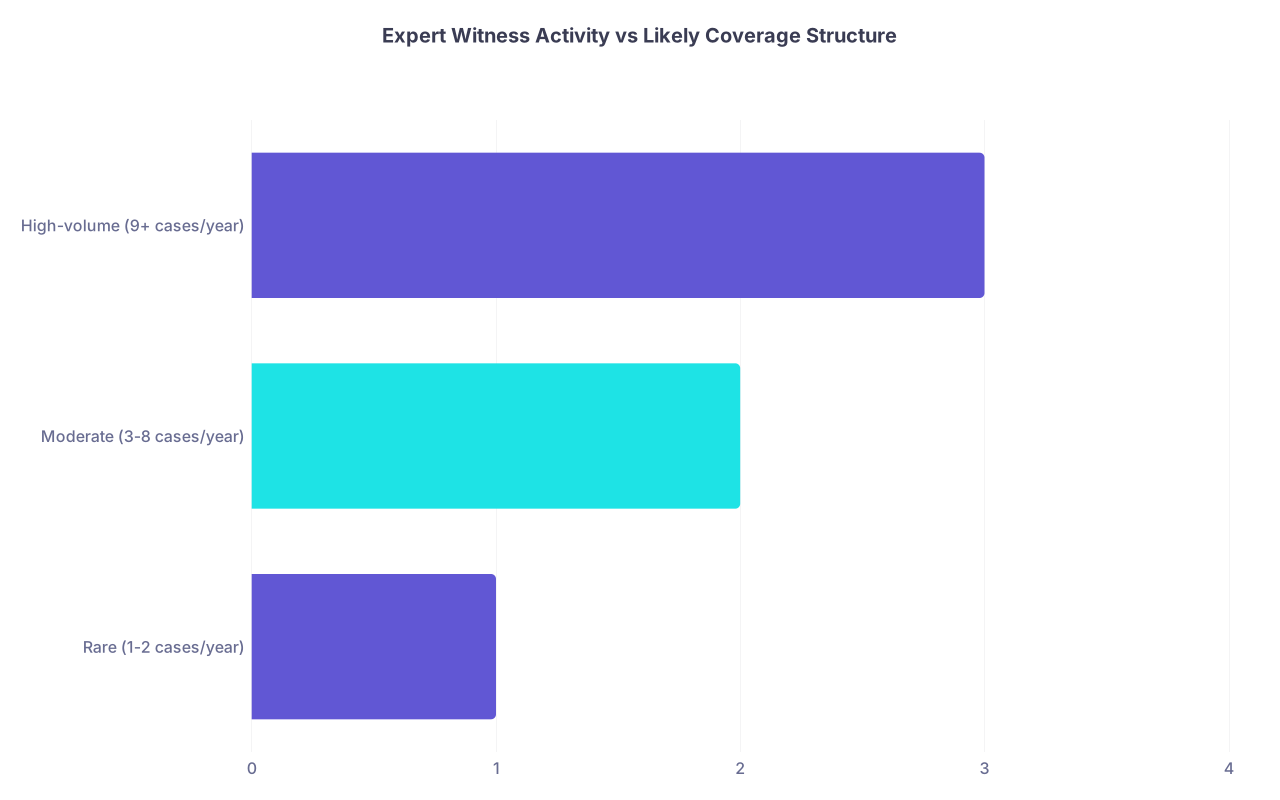
| Category | Value |
|---|---|
| Rare (1-2 cases/year) | 1 |
| Moderate (3-8 cases/year) | 2 |
| High-volume (9+ cases/year) | 3 |
Interpretation:
- 1: Often rider on main policy
- 2: Rider or strong push toward separate policy
- 3: Usually separate expert witness or professional liability policy
4. Cross-State and Federal Work
If you testify in a jurisdiction where you are not licensed, or in federal court:
- Some states treat expert work as “practicing medicine” for licensing rules; others do not.
- Your carrier may restrict coverage to claims arising from services rendered in states where you are licensed and listed on the policy.
You need explicit confirmation that your expert witness rider:
- Covers all jurisdictions where you testify
- Covers both state and federal courts
- Does not require separate scheduling for each state
Step-by-Step: How to Actually Get Proper Coverage
You do not fix this by asking, “Am I covered?” in a vague email. You treat it as a structured risk project.
1. Map Your Activities
Make a clean list:
- Academic/teaching: lectures, CME, course development, online content
- Consulting: hospital, startup, guideline development, chart reviews
- Expert witness: case volume, type (plaintiff/defense), jurisdictions, frequency
For each activity, specify:
- Who pays you? (employer, 1099, company, law firm)
- Where is the work done? (state, venue, online)
- What output do you produce? (reports, protocols, lectures, algorithms)
2. Pull Your Actual Policy Documents
Not the summary. The policy plus all endorsements.
Look for key phrases under “Professional Services” or “Covered Services”:
- “Direct patient care”
- “Supervision of trainees”
- “Medical director services”
- “Peer review and utilization review”
Then look for explicit exclusions:
- “Expert testimony or legal consulting”
- “Teaching or educational activities for entities other than the Named Insured”
- “Product design or development”
- “Opinions provided for litigation”
3. Talk to Your Broker or Carrier Using Precise Language
Do not say, “I just do some teaching and consulting.” Say:
- “I provide paid expert witness reports and testimony in approximately 6 medical malpractice cases per year, all in my specialty, both plaintiff and defense, mainly in State A and State B.”
- “I advise a digital health startup on the clinical safety of their algorithm. I review their protocols and occasionally appear on investor calls.”
- “I develop online CME courses that include case-based treatment pathways with my name attached.”
Then ask very direct questions:
- “Is this activity covered under my current policy? If yes, under what endorsement?”
- “If I am sued solely for my role as an expert witness / consultant / educator, will this policy defend and indemnify me?”
- “Do you recommend a rider or a separate policy for this activity?”
- “If I stop this policy and a claim later arises from past expert work, how is that handled?”
Get the answers in writing. Ideally with actual policy language or a proposed endorsement attached.
4. Choose Between Rider vs Separate Policy
As a rough rule:
Use a rider on your main policy when:
- The side work is low-volume
- Risk is closely related to clinical professional judgment
- Activity is within your specialty
- The same carrier understands and prices the combined exposure
Use a separate policy when:
- You have meaningful revenue from expert, consulting, or education work
- You work across multiple states and venues
- Activities extend beyond medicine into business, product, or tech risk
- Your main carrier is clearly uneasy or restrictive
If you form an LLC or corporation for this work, you absolutely want the entity named on the policy (or rider) as a Named Insured. Individual-only coverage with no entity can create gaps.
Timing, Tail, and Transition: The Trap Few Think About
The quiet killer is what happens when you:
- Change jobs and carriers
- Retire
- Ramp down clinical work but keep consulting or expert work
Three key points.
1. Claims-Made Continuity for Side Work
If your expert or consulting rider is tied to your main claims-made policy, and you switch carriers:
- New carrier usually will not cover prior acts of expert/consulting work done under the old carrier.
- Old carrier stops defending you unless you buy tail that explicitly includes those riders.
So when you exit a job or carrier, you must ask:
- “Does the offered tail cover the expert witness / consulting / teaching endorsement?”
- “Is there a separate tail premium for that endorsement?”
If the answer is no, and you have substantial prior work, you may want:
- A standalone professional liability policy with retroactive coverage back to your first expert/consulting date, or
- Tail from the old carrier that explicitly includes that exposure (often negotiable but not automatic).
2. Retiring from Clinical Practice but Not from Expert Work
Classic scenario: physician retires from clinical practice at 65 but does expert work until 72.
If your expert coverage was piggybacked on your clinical malpractice:
- Once the clinical policy and its tail run their course, you may walk into a gap for ongoing expert work.
- You will need a separate expert liability policy covering:
- Retroactive date (back to when you first did expert work)
- Ongoing future cases
Do not assume “retirement tail” for clinical practice includes non-clinical riders. Often, it does not.
3. Mergers, Acquisitions, and Group Restructuring
If your group practice is acquired and policies consolidate:
- Old group policy might have been covering your hospital consulting role.
- Newly consolidated policy might not support that, particularly if the new parent company is risk-averse.
Any time there is a corporate or employment change, re-run this entire coverage review for your side activities. Do not wait for “renewal season” while you are still signing side contracts.
FAQ (Exactly 5 Questions)
1. Do I really need a rider if my expert witness work is only for the defense and I never examine patients?
Yes. Defense-only work is viewed more favorably by carriers, but the exposure is still non-clinical legal consulting. Plaintiffs have sued defense experts for allegedly biased or negligent opinions. Without a rider or dedicated policy that explicitly covers expert services, your main malpractice carrier can deny the claim on the grounds that you were not providing direct patient care.
2. My academic institution says I am covered for “all activities related to my faculty role.” Does that include outside CME talks I give for honoraria?
Usually not. “Related to your faculty role” generally means teaching and supervision under the institution’s umbrella. Once you contract directly with an outside CME provider, especially for promotional or grant-funded programs, you are stepping outside that umbrella. You should obtain written confirmation from risk management and, if needed, add a teaching/speaking rider or separate educator policy.
3. If I consult for a startup, isn’t their insurance enough to protect me?
Rarely. Their policies (product liability, tech E&O, D&O) are designed primarily to protect the company and its officers. Even if you are an additional insured, coverage may not extend to all allegations against you personally, especially those framed as professional negligence. You need to review the contract’s indemnification language and seriously consider your own E&O/professional liability coverage that names you (and your entity) as insured.
4. Can I just rely on my state’s expert immunity laws instead of buying coverage?
No. Expert immunity doctrines vary widely by state and are evolving. Some jurisdictions allow suits against experts for negligence or misconduct; others do not. Even where immunity exists, you can still be dragged into litigation and incur legal costs to assert that immunity. An appropriate policy or rider does not just pay judgments; it pays for your defense, which is often the most expensive part.
5. Are riders and separate policies for this type of work expensive?
Relative to what you are risking, usually not. A rider for low-volume teaching or a handful of expert cases can be a few hundred to a couple thousand dollars annually. A robust separate E&O or expert witness policy will cost more, but for physicians earning meaningful side income, the premium is a fraction of the revenue. The real cost is not the premium; it is discovering, mid-lawsuit, that there is no coverage at all.
Two things to remember.
First, your default assumption should be that clinical malpractice coverage does not automatically extend to teaching, consulting, or expert witness work unless the policy or rider says so in writing. Silence is not protection.
Second, the volume, complexity, and independence of your side work should drive your structure: rider when exposure is small and adjacent to clinical care, separate policy when it starts to look like its own business line.