It’s 11:47 p.m. You’re scrolling through Reddit and Student Doctor Network, and you hit the posts you always secretly dread:
“Got sued as a resident.”
“Malpractice payout on my record – career over?”
You freeze. Suddenly every worst-case scenario you’ve ever imagined piles on at once.
What if that happens to me?
What if one bad outcome – or one angry family – brands me for life?
What if a malpractice claim literally follows me forever and ruins everything: jobs, credentialing, fellowship, future income?
Let’s walk through this like someone who’s actually scared. Not the glossy risk-management brochure version. The “I’m lying awake at night replaying cases that haven’t even happened yet” version.
First brutal truth: the record part is kind of forever
I won’t sugarcoat this piece, because the internet will eventually tell you anyway.
Malpractice payouts that get reported to the National Practitioner Data Bank (NPDB) are, practically speaking, permanent. They don’t disappear after 7 years like old credit issues. They stay. They’re part of your professional record.
But here’s where people quietly mash all this together and panic:
- Not every claim = a payout
- Not every bad outcome = a lawsuit
- Not every lawsuit = something that wrecks your career
The stuff that “follows you forever” in the scary way is usually:
- Paid claims reported to the NPDB
- Board actions (licensing board discipline)
- Hospital/credentialing actions (suspensions, revocations, reportable restrictions)
An allegation that’s dropped, dismissed, or defended successfully? It may show up for a while on some databases, you may have to disclose it on forms, but no, that by itself doesn’t mean you’re professionally radioactive forever.
Still. I know the fear:
“What if I get even one payout and no one ever hires me again?”
That’s the part we need to actually unpack.
What actually happens when you get sued (and what sticks)

| Step | Description |
|---|---|
| Step 1 | Adverse outcome |
| Step 2 | Patient or family upset |
| Step 3 | Lawyer sends demand or files suit |
| Step 4 | Insurer assigns defense |
| Step 5 | No NPDB report |
| Step 6 | NPDB report |
| Step 7 | Case outcome |
Here’s the reality pattern I keep seeing:
- Something bad happens clinically.
- Family is angry/confused. Sometimes a lawyer gets involved.
- A claim is filed (or a demand letter sent).
- Your malpractice insurer and hospital lawyers step in.
- The case sits. For months. Usually years.
- Then:
- It quietly dies (plenty do)
- It goes to trial and you win
- It gets settled/pays out (sometimes without you agreeing morally, but strategically)
Only that last bucket is what lands on the NPDB as a paid claim.
And even then, the raw fact is often just:
“Patient alleged X. Payment $YYY,YYY. Date.”
No long dramatic story. No legal podcast. Just a cold line in a database.
Now here’s the important part:
Hospitals, groups, and credentialing committees absolutely look at this stuff. But they don’t stop at the scary single sentence. They look for:
- Pattern vs one-off
- Severity (wrong-site surgery vs complex bad outcome)
- Your explanation
- How long ago it was
- Whether there were other red flags (board actions, unexplained job gaps, non-clinical complaints)
So yes, a paid claim follows you. But it’s one piece of a much bigger story they’re reading.
How this really affects hiring, privileges, and your income
Let’s get concrete instead of vague doom.
Almost every application you’ll ever fill out after residency asks something like:
- “Have you ever been named in a malpractice claim or lawsuit?”
- “Have you ever had a malpractice payment made on your behalf?”
- “Have you ever had your clinical privileges restricted, suspended, or revoked?”
- “Have you ever been investigated or disciplined by a medical board?”
You don’t get to lie your way out of this. Lying is actually more career-ending than the underlying case.
So the anxiety kicks in right there:
“I’ll have to check ‘yes’ for the rest of my life. That’s it. I’m done.”
Here’s what actually tends to happen in the real world:
One isolated payout, especially early in career
Annoying. Stressful. But usually survivable.Employers might:
- Ask for details
- Ask for references that can speak to your practice
- Maybe look a little closer at your charts during initial credentialing
But they don’t automatically say, “No thanks forever.”
Multiple payouts with a clear pattern
This is where life truly starts getting harder. Example: three OB claims over 7 years, all shoulder dystocia / fetal hypoxia with payouts. Now committees start worrying about risk behavior, documentation, judgment.
It’s not hopeless, but doors do start closing.Any malpractice plus board discipline or privilege actions
This combo is worse than just a malpractice payout alone. Boards and hospitals punishing you says “this wasn’t just a bad outcome; the system thought you messed up badly enough to sanction you.”
So the nightmare version – “one bad claim and you can never work again” – is not the usual reality. The bigger threat is:
- Dishonesty on applications
- Repeated, similar cases
- Refusing to engage in quality improvement or remediation
- Being difficult to work with so no one wants to go to bat for you
Most systems care more about whether you’re safe now than whether you were ever sued once.
What parts really don’t go away?
Let’s be specific about the “forever” part.
| Item | How Long It Lasts / Impact |
|---|---|
| NPDB malpractice payout | Permanent record; reviewed at new jobs/privileges |
| NPDB board action | Permanent; usually more serious than a payout |
| State board discipline | Often permanent or very long-term on record |
| Court records (public) | Often permanent/Googled, varies by jurisdiction |
| Internal QA reviews (hospital) | Usually internal, not universally visible |
So your fear is valid in this sense: there’s not a magical 5-year expungement button where the NPDB just forgets you exist.
But visibility is different from doom.
Every attending in certain specialties (OB, surgery, EM, anesthesia) knows colleagues with at least one paid claim. Many of them are still:
- Partners in large groups
- Fellowship directors
- Department chairs
- Making solid money and living normal professional lives
Are there doors that may be harder to open? Yes.
Are you automatically done? No.
How much does this really change your financial future?
This is the part people rarely spell out and it’s exactly what keeps you up at night:
“Is this the difference between a stable attending life and financial stress forever?”
Some cold reality:
Premiums
In many employed settings (hospital-employed, large groups), your employer eats the malpractice premium. You don’t feel the direct hit.
In some private practice settings, repeated claims can make your individual premium higher or make you less attractive as a partner.Job options
One payout might:- Close off a few hyper-risk-averse systems
- Slightly slow down hiring in some elite/high-demand markets
But it usually does NOT turn you into an unemployable ghost.
Negotiating power
If you have:- Great references
- Strong clinical reputation
- Solid, honest explanation of the case
Then one payout is often a speedbump, not a wall.
Worst-case cluster
Where it gets rough is:- Multiple payouts
- Publicly searchable horror-case with bad PR
- Plus maybe a board reprimand or probation
Then, yes, jobs narrow, and you might be pushed more toward: - Rural/underserved areas
- Less competitive markets
- Possibly lower-compensation setups
But even then, it’s usually not “zero income.” It’s “less choice, more compromises.”
What you can actually control now (even before anything happens)
This is where your brain probably short-circuits:
“I’m a student/resident. I can’t control who sues me.”
You’re right. You can’t fully control that. Some families will sue no matter what. Some outcomes are just bad.
But there are things you can control that change how a future claim lands on your life.
Documentation
Boring. Unsexy. But absolutely critical.Good documentation:
- Shows you thought about risks and alternatives
- Shows you discussed with the patient/family
- Shows your clinical reasoning, not just what you did
I’ve watched cases go very differently in court and in settlement negotiations because of chart quality alone.
Communication habits
Angry patients and families sue way more often than sad-but-heard ones.
Surgeons and hospitalists who sit down, explain clearly, and don’t vanish when outcomes are bad get sued less. Not zero. Less.How you respond when something goes wrong
Panicking, disappearing, being defensive with the family – all of that makes things worse.
Staying involved, showing humanity, and not stonewalling can blunt a lot of the emotional fuel behind a lawsuit.Being smart with specialty and practice setting
High-risk specialty + chaotic group + zero risk management culture = more exposure.
If you already know you’re the type to spiral about this stuff, choosing a slightly lower-risk path (or a well-supported institution) is not cowardice. It’s rational.Malpractice coverage type
Tail coverage, occurrence vs claims-made – all of that matters for how protected you are if you move jobs. You don’t have to be an expert now, but file it away. Get help reading your contracts later. Don’t sign blind.
The part no one tells you: almost everyone is terrified of this
You’re not weird for obsessing over this. I’ve seen:
- Residents cry quietly after a bad outcome, already picturing themselves being deposed five years later.
- Attendings compulsively re-reading their notes at midnight after a tough discharge.
- Fellows Googling “malpractice record ruin life?” at 2 a.m. on call.
Here’s the ugly truth:
If you practice long enough, in a procedural or acute-care field, the question is often not “if” but “when” you’ll at least be named in something.
And yet…
Most people still have careers.
They still get privileges renewed.
They still send their kids to college and pay their mortgages.
So yes, the fear is rational. But the fantasy that one piece of paper in a government database will erase decades of your work is too extreme.
It’s not “no impact.”
It’s “impact that lives in context.”
Quick reality snapshot: risk across specialties
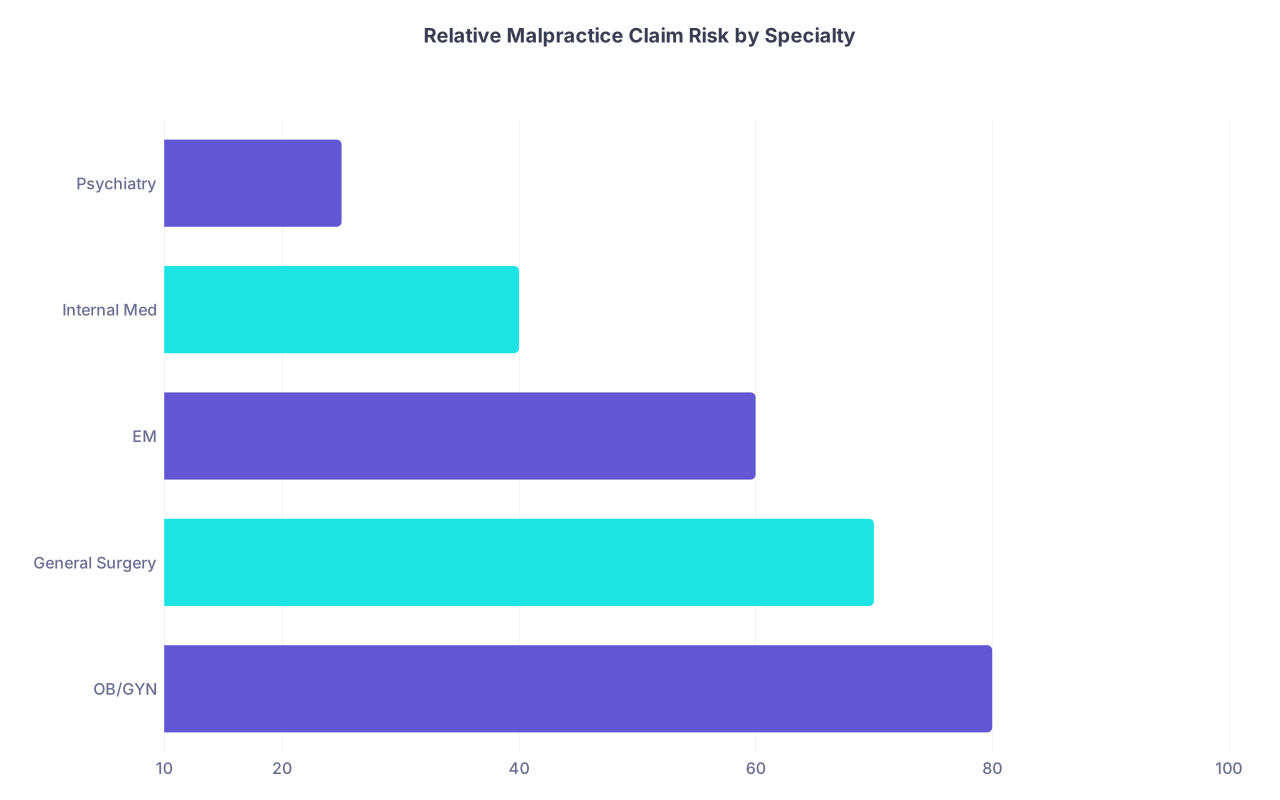
| Category | Value |
|---|---|
| OB/GYN | 80 |
| General Surgery | 70 |
| EM | 60 |
| Internal Med | 40 |
| Psychiatry | 25 |
(Think of those numbers as “relative lifetime likelihood of facing a claim” – not exact percentages, but the hierarchy is very real.)
So if you’re going into OB/GYN or surgery and you’re already this anxious, you’re not crazy. You’re just aware. That awareness can either:
- Paralyze you,
or - Push you to build really strong habits, documentation, and communication to reduce both clinical and legal risk.
I’d pick the second one.
How to talk about a claim or payout when you have to disclose it
Fast-forward: worst case happens. There’s a payout. Now what?
You will be asked about it. Over and over. Job apps. Credentialing. Insurance panels.
The way you talk about it matters a lot.
Your answer should be:
- Factual (dates, basic scenario, outcome)
- Non-defensive (no blaming everyone else)
- Reflective (what you learned, how your practice changed)
For example, instead of:
“Family was litigious and unreasonable, I did nothing wrong, it was just bad luck.”
Something like:
“This was a shoulder dystocia case early in my attending career. The delivery was complicated and the infant had a brachial plexus injury. I followed standard protocols, but the patient’s attorney alleged negligence. The case was settled by the insurer. Since then, I’ve completed additional simulation training in shoulder dystocia, updated my counseling approach around risk, and worked with my department on improving documentation around emergent deliveries. I haven’t had similar events since.”
That answer does two things:
- It tells them what happened.
- It convinces them you’re not a disaster waiting to repeat itself.
If you’re still lying awake at night
Let me be straight: The fear may not fully go away. Medicine is messy. Humans are messy. Legal systems are brutal.
But here’s what I’d anchor on:
- A malpractice payout is permanent data, not a permanent death sentence.
- Patterns and dishonesty kill careers way faster than one bad case.
- Your day-to-day habits now (documentation, communication, humility) are your best defense later.
You can do everything right and still get sued. That’s true.
But you can also have a long, solid career even if that happens.
FAQ (exactly 4 questions)
1. If I’m named in a lawsuit but the case is dropped, does that still follow me forever?
You’ll usually still have to answer “yes” to questions like “Have you ever been named in a malpractice action?” because being named is a factual event. But if there was no payment and it was dismissed or you won at trial, it typically doesn’t go to the NPDB as an adverse action. Employers will care a lot more about paid claims and patterns than a single dismissed case. On paperwork, you’d explain it briefly as “named in a case that was dismissed with no payment made.”
2. Can I ever get a malpractice payout removed from the NPDB?
Realistically, no. There’s a mechanism to correct factual errors (wrong date, wrong amount, wrong person), but not to scrub the existence of a legitimate report. The system is built to be permanent. What you can do is submit a statement that gets attached to the report, explaining your perspective on the case. Credentialing committees will often read that, especially if the case is borderline or complex.
3. Will one malpractice payout stop me from getting licensed in another state?
Almost always, no. State medical boards care a lot more about board discipline, impairment, criminal issues, and repeated or egregious malpractice history. One payout – especially if it’s years old and you’ve practiced safely since – is usually something they ask about, not something that blocks you. You’ll likely have to send supporting documents and a written explanation, but a clean track record afterward goes a long way.
4. Should this risk alone make me avoid high‑risk specialties (like OB, EM, surgery)?
Not automatically. If you love the field and can’t see yourself doing anything else, skipping it purely out of fear of a lawsuit is going to eat at you long-term. But if you’re already deeply anxious, hate confrontation, and lose sleep for days over minor complaints, then yeah, it’s reasonable to factor malpractice risk into your decision. That doesn’t mean run to dermatology. It means be honest with yourself about your tolerance for risk, chaos, and long-term legal stress.
Bottom line:
- Yes, malpractice payouts live on your record essentially forever – but that’s not the same as “career over forever.”
- Patterns, dishonesty, and refusal to learn are far more dangerous to your future than one bad case.
- The habits you build now – documentation, communication, and choosing sane practice environments – are the best insurance you actually control.