
What if one malpractice lawsuit — maybe one you barely understood as a med student or resident — quietly ends your shot at the residency or fellowship you’ve been killing yourself for?
That’s the fear, right?
Not just “this is stressful,” but “this will be in some secret file forever and every PD will blacklist me.”
Let’s walk straight into that fear instead of dancing around it.
First: Are Residents and Fellows Actually Getting Sued?
Short answer: yes, it happens. Less than attendings, but it’s not some mythical unicorn.
You can be:
- Named in a lawsuit as a med student, intern, or resident
- Included because you were in a note, in a sign-out, or in the room once
- Dropped later… or not
A lot of people think, “I’m just a trainee, they’ll sue the attending, not me.”
Plaintiff attorneys don’t think that way. They cast a wide net. If your name is on the chart or you had anything to do with care, you can get named.
But here’s the part nobody tells you when you’re spiraling at 2 a.m.:
Being named in a malpractice lawsuit is not rare.
Being absolutely destroyed by it professionally is.
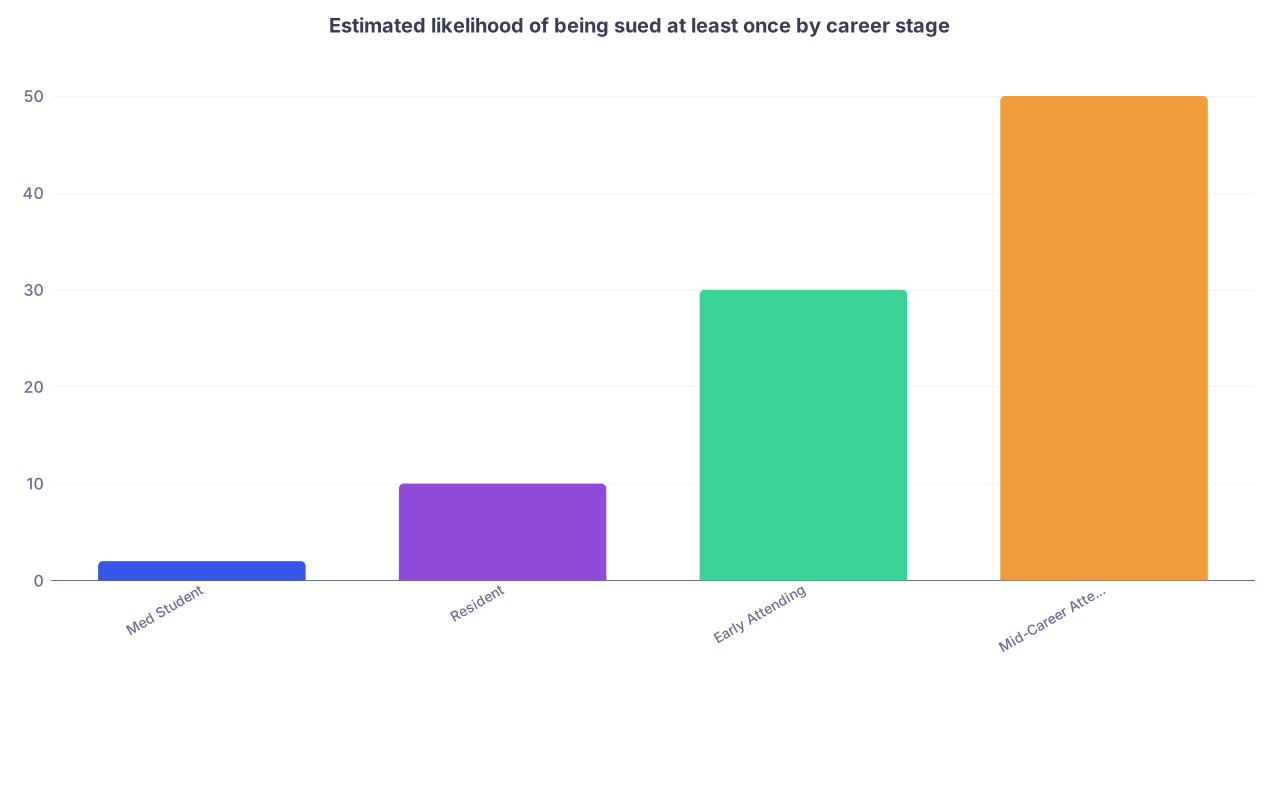
| Category | Value |
|---|---|
| Med Student | 2 |
| Resident | 10 |
| Early Attending | 30 |
| Mid-Career Attending | 50 |
Those numbers vary by specialty and region and are just ballpark estimates, but the direction is real: as you progress, you’re more likely to see a lawsuit, not less. Programs know that. PDs know that. They don’t expect you to be lawsuit-proof.
They’re more interested in:
- What actually happened
- How you responded
- Whether it shows a pattern or a one-off
The story matters way more than the headline: “Named in malpractice suit.”
The Core Fear: Does One Lawsuit Nuke My Application?
Let me be blunt:
For the vast majority of residents and fellows, a single malpractice lawsuit does not destroy residency or fellowship chances.
Can it complicate them? Yes.
Can it raise questions? Absolutely.
Is it an automatic death sentence? No. Not even close.
You’re probably imagining a PD clicking “open file,” seeing “MALPRACTICE LAWSUIT,” slamming the laptop shut, and yelling, “Next applicant!”
Reality is more boring and way less dramatic.
Here’s how programs tend to think:
- If it’s one lawsuit…
- Related to a common complication (missed diagnosis, postop complication, ED disposition)…
- And you weren’t independently practicing outside your level of training…
- And there’s no pattern of disciplinary or professionalism issues…
…it will probably be seen as a risk of practicing medicine, not proof you’re unsafe.
Where PDs start worrying is:
- Multiple lawsuits with similar concerns
- Lawsuits + disciplinary action (board actions, license restriction, professionalism write-ups)
- Clear evidence of recklessness, lying, or cover-up
- You trying to hide it when you were supposed to disclose
That last one? The hiding? That’s what really kills people. Not the lawsuit itself.
So if your question is, “Can one lawsuit, by itself, absolutely end my chances?”
The honest answer: only in rare, extreme situations where the facts are truly awful (gross negligence, criminal behavior, fraud). If you were a standard trainee involved in a complex case that went bad, that’s not that.
What Programs Actually See and Care About
You’re probably imagining some giant red flag flashing on your ERAS/NRMP file: “Lawsuit – DO NOT RANK.”
That’s not how it works.
Programs see things like:
- Questions you answer on ERAS about professionalism, legal issues, licensing
- Explanations you provide if you check “yes” to certain questions
- Letters of recommendation that either allude to concerns or explicitly support you
- Any publicly available info they decide to Google (yeah, it happens… but not as much as people fear)
Most lawsuits never show up as some official “discipline” if:
- You weren’t found liable individually, or
- It was settled under institutional insurance, or
- The case was dismissed, or
- You were just one of many named parties
What PDs worry about more is board or licensing actions. Those are different from a lawsuit. That’s when a state board or governing body says, “Your license is restricted/suspended/censured.” That’s big.
So ask yourself:
- Was this “just” a malpractice suit?
- Or did it lead to a formal board investigation or sanction?
If it’s only the former, your anxiety is probably 10x louder than the actual risk.
When You Have to Disclose a Malpractice Lawsuit
Here’s where the panic usually spikes: the disclosure questions.
Things like:
- “Have you ever been a party to a malpractice claim or lawsuit?”
- “Have you ever been disciplined by any hospital, board, or licensing authority?”
- “Are there any pending legal actions related to your practice of medicine?”
And your brain goes:
“If I say yes, I’m dead. If I say no, I’m lying and could be dead later.”
You can’t lie. Full stop.
If they find out later, that’s way worse than the lawsuit itself.
But you also need to be smart and precise.
A few principles:
- Answer the question that’s actually asked, not every hypothetical one.
- If it says “malpractice judgment,” that’s different from “filed claim.”
- If it asks “professional discipline,” that’s not automatically the same as “was named in lawsuit.”
This is where you absolutely should:
- Talk to your program director, GME office, or institutional legal counsel
- Ask: “For my applications, do I need to disclose X?”
- Get clarity on what exactly is in the record and how it’s categorized
If you DO need to disclose, your explanation needs to be:
- Short
- Factual
- Calm
- Non-defensive
Something along the lines of:
“I was named along with several other providers in a malpractice lawsuit related to a complex ICU case during my PGY-2 year. The care I provided was within my expected scope of training and under direct supervision. The case was handled by the hospital’s malpractice insurer and ultimately [settled/dismissed/closed] without any individual finding of negligence against me. There were no associated disciplinary or licensing actions. The experience pushed me to improve my documentation and communication practices, which I’ve carried forward in my training.”
Done. No drama. No four-paragraph apology tour.
You’re not confessing to a crime. You’re contextualizing a risk of the profession.
Worst-Case Scenarios: When Can It Really Hurt You?
Let’s entertain the nightmare, because I know your brain is already there.
Could a lawsuit seriously hurt your residency or fellowship chances?
Yes — in specific situations.
Things start to get dangerous when:
- The lawsuit involves clear, documented gross negligence
- There’s proof you ignored supervision, falsified notes, or lied
- It triggered hospital discipline, probation, or termination
- The state board took formal action (reprimand, probation, restricted license)
- It’s not the only issue — you also have professionalism write-ups, failed rotations, or an ugly dean’s letter
In those cases, PDs don’t just see “malpractice.” They see: “Is this trainee safe to put in front of patients at 3 a.m.?”
But even then, I’ve seen people come back from really bad-looking situations:
- Residents who were terminated, then matched into another program later
- People with board actions who still got fellowships after they showed growth and stability
- Trainees named in awful-sounding cases who got strong support letters and were fine
You just don’t hear about them because no one posts on Reddit:
“Hey guys, I got sued and still matched fine.”
The internet is biased toward disaster stories. Quiet, “I disclosed it and it was okay” doesn’t go viral.
The Money + Malpractice Insurance Side (That No One Explains Clearly)
Because your category is literally “Malpractice Insurance,” let’s talk about that for a second — it’s part of why this whole thing feels so huge.
As a trainee:
- You’re almost always covered by your hospital or institution’s malpractice policy
- You usually don’t carry your own individual policy for residency/fellowship
- The hospital’s insurer handles defense, settlement, etc.
- You usually have very little control and often only partial visibility into strategy
So:
- A suit can be settled without you agreeing
- Your name could technically be associated with a settled case
- You may not even fully understand the final outcome because everything is filtered through risk management and lawyers speaking legal-ese
This makes it feel like:
- “Something terrible happened with my name on it and I have no idea what they wrote or decided or what’s in some secret database.”
Here’s what actually matters for your future:
- Was there any finding against you personally (judgment, board action)?
- Did your institution label this as a performance or professionalism issue?
- What will your program director say if a PD calls and asks, “Is this person safe and trustworthy?”
| Situation | How Much PDs Usually Care |
|---|---|
| Named in lawsuit, no discipline | Low concern |
| Lawsuit + documented pattern issues | High concern |
| Board action (probation/restriction) | Very high concern |
| One settled case, good references | Usually manageable |
The legal money stuff — how much it settled for, who paid, what exact legal arguments were made — that’s mostly noise for your application. Programs aren’t trying to audit the entire lawsuit. They want to know: are you trainable and safe?
How to Talk About It Without Sounding Dangerous or Defensive
This is the part most people screw up.
They either:
- Over-explain (3-page essay, full case summary, emotional trauma dump), or
- Under-explain (“I was named but it wasn’t my fault, anyway it’s over, can we move on?”)
You want to hit this line: Factual. Accountable. Calm. Brief.
Some guidelines:
- Don’t assign blame (“The attending ignored me,” “The system failed”) even if it’s true. It reads badly.
- Do highlight what you learned and changed: documentation, handoffs, escalation of concerns, better communication.
- Don’t dramatize (“It destroyed me,” “I’ll never forgive myself”). Programs are worried about emotional resilience too.
- Do show emotional maturity: “It was hard, but I sought mentorship, reflected, and improved.”
If it comes up in an interview, something like:
“Yes, I was named in a malpractice case from my PGY-1 year. It was obviously a difficult experience, especially that early in training. The care I provided was consistent with my role and supervision, and there were no findings of negligence or any disciplinary actions. But I did use it as a wake-up call about how high-stakes even routine decisions can be. I tightened up my documentation, got more proactive about calling attending back-ups, and I’ve gotten good feedback on my clinical judgment and communication since then.”
That tells them:
- You’re not hiding
- You’re not melting down
- You’re not reckless
- You grew from it
What You Should Do Right Now If You’ve Been Sued (Or Think You Might Be)
If you’re sitting there with a pit in your stomach about an actual lawsuit or potential one:
Find out exactly what the status is.
Ask risk management or legal: “What’s my status in this case? Named? Dismissed? Settled? Any findings against me?”Clarify what, if anything, is reportable.
Ask: “Does this involve any board action, discipline, or is it purely a civil malpractice claim?”Talk to someone who knows how this plays in applications.
Program director, APD, or trusted faculty who has been on selection committees. Not just your co-resident who read one Reddit thread.Draft a short, neutral explanation now — not at 1 a.m. before ERAS locks.
Then show it to someone experienced and ask, “Does this sound reasonable or defensive?”Do not guess on disclosure questions.
If you’re unsure, ask GME or legal. “For ERAS and future credentialing, how should I answer X?” Many institutions are used to these questions. You’re not the first.
The Part You Don’t Want to Hear (But Need To)
Medicine is messy. Outcomes are messy.
If you stay in this long enough, chances are high you’ll eventually be attached to a lawsuit even if you’re a careful, thoughtful, meticulous clinician.
Your career is not defined by: “One bad outcome + one lawsuit = done.”
It’s defined by:
- Patterns
- Integrity
- How you respond when things go very, very wrong
Programs know that. They’ve been through their own lawsuits. Many PDs have personally been named at some point. They’re not expecting spotless legal histories forever. They’re expecting honesty and maturity.
Your Next Step Today
Open a blank document and write 3–5 sentences explaining your situation as if it were going into an application or credentialing form. No drama, no excuses, just facts and what you learned.
Then ask yourself:
“Would I be comfortable saying this out loud to a PD in an interview?”
If the answer is no, tweak it until it is — and then show it to someone you trust in your program for feedback.