
Does a Board Complaint Automatically Mean a Malpractice Nightmare?
What actually happens if you get that email: “A complaint has been filed with the medical board against you”? Does that automatically mean you’re about to lose your license, get sued, and have your malpractice premiums explode forever?
Let me be blunt: that’s the nightmare version your brain will jump to at 2 a.m.
Reality is more boring. Still stressful, but way less apocalyptic than the horror stories.
Let’s walk through this like someone who’s already spiraling (which I assume you are, because you clicked on this).
Board Complaint vs Malpractice Suit: They’re Not the Same Monster
First thing your brain does is merge everything into one giant catastrophe:
- Board complaint
- Malpractice lawsuit
- Losing your license
- Being uninsurable
- Career over
All one big blob.
But those are actually different tracks.

Here’s the actual split:
| Aspect | Board Complaint | Malpractice Lawsuit |
|---|---|---|
| Who starts it | Patient/public/colleague reports to state board | Patient/family files in civil court |
| Main risk | License, restrictions, public reprimand | Money damages, insurance payouts |
| Standard | Professional conduct / standard of care | Negligence + causation + damages |
| Who defends you | Often through your malpractice or separate counsel | Your malpractice carrier-appointed defense |
| Automatic link? | No automatic lawsuit | No automatic board complaint |
Critical point:
A board complaint does not automatically = malpractice lawsuit. And a malpractice lawsuit does not automatically = board complaint.
They inform each other sometimes. But they’re separate processes.
I know your brain is saying, “Yeah but what if this one becomes both?”
Possible? Yes. Guaranteed? No. Common? Less than your anxiety thinks.
How Often Do Complaints Turn Into Malpractice Nightmares?
You probably assume: “If someone goes to the board, they’re definitely also talking to a lawyer.”
Not necessarily.
A lot of board complaints are:
- Angry patients who want “someone to do something”
- Family members upset about communication, not necessarily outcome
- Colleagues reporting professionalism, prescribing, or documentation issues
- Random boundary/professional conduct issues (social media, language, etc.)
Many of those never turn into civil lawsuits because:
- The damages aren’t big enough to interest an attorney
- There’s no clear deviation from standard of care
- Causation is weak or impossible to prove
- The patient mostly wants validation or an apology, not money
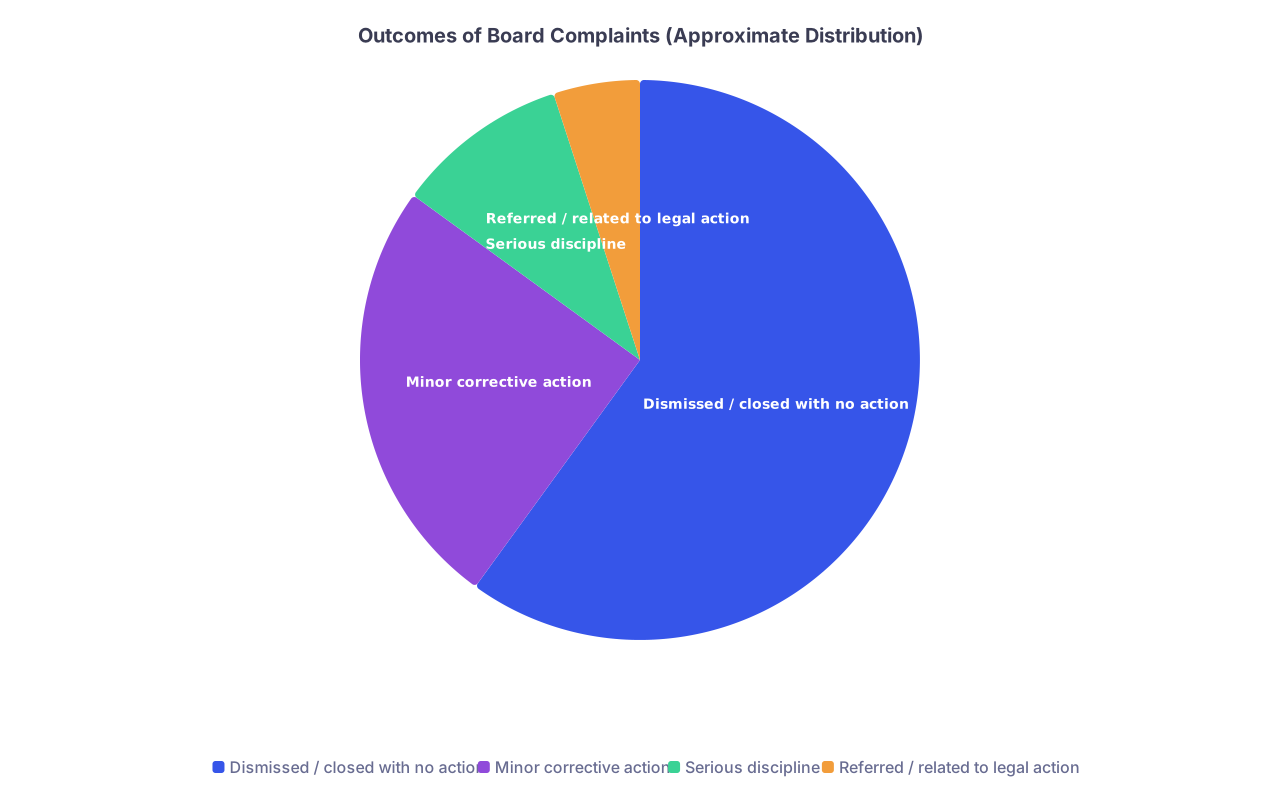
| Category | Value |
|---|---|
| Dismissed / closed with no action | 60 |
| Minor corrective action | 25 |
| Serious discipline | 10 |
| Referred / related to legal action | 5 |
These numbers aren’t exact – they vary by state and specialty – but the pattern is real:
Most complaints die quietly.
A chunk result in some kind of minor corrective step.
A small fraction become really bad news.
An even smaller fraction are directly tied to big malpractice cases.
Your brain, of course, only remembers the horror-story 5–10%.
How a Board Complaint Actually Unfolds (vs the Movie in Your Head)
The movie in your head:
- You get a complaint
- Next week you’re in front of a tribunal
- License gone
- Insurance cancels you
- You’re unemployable
The real process is painfully slow and procedural.

| Step | Description |
|---|---|
| Step 1 | Complaint filed |
| Step 2 | Initial screening |
| Step 3 | Dismissed |
| Step 4 | Request records/response |
| Step 5 | Investigation |
| Step 6 | Informal resolution or consent |
| Step 7 | Corrective action documented |
| Step 8 | Formal hearing |
| Step 9 | Board decision |
| Step 10 | Sanctions or no action |
Some key reality checks:
- They don’t suspend your license based solely on a complaint (unless there’s an immediate severe risk to public safety, which is rare and usually very extreme stuff).
- You’ll usually have a chance to respond in writing.
- Your malpractice carrier or a separate policy may provide counsel to help with the board response.
- It can take months or over a year to fully resolve.
Is it stressful during that time? Absolutely.
Is it automatically the start of a malpractice nightmare? No.
Where Malpractice Insurance Actually Fits Into This
Here’s the part nobody explains clearly when you’re a student or resident: your malpractice policy and board complaints are related, but not identical worlds.

Most malpractice policies:
- Definitely cover civil malpractice lawsuits
- Often cover board complaints / licensing actions to some extent
- But that board coverage might be limited, optional, or capped
You’ll often see something like:
- “Administrative / licensure defense coverage up to $25,000 per proceeding”
- Or quotes separated as: malpractice premium vs regulatory board defense rider
So the ugly scenario you’re afraid of is something like:
- Board complaint filed
- Board finds an issue → formal discipline
- This gets reported to the National Practitioner Data Bank (NPDB)
- Hospital / group privileges reviewed
- Malpractice carrier flags you as higher risk
- Premiums go up, or future credentialing becomes harder
That sequence can happen. Especially with serious findings (fraud, gross negligence, repeated complaints, sexual misconduct, substance issues).
But compare that to the more common reality:
- Complaint filed
- Investigation shows poor communication but no real standard-of-care breach
- Case closed, maybe with a “letter of concern” or request for CME
- No NPDB report, no headline, and your insurer basically shrugs
What Actually Triggers Malpractice Premium Nightmares?
Your anxiety is mixing “board complaint” with “insurance nightmare.” They overlap, but here are the big things that really move the needle for insurers:
| Event | Typical Impact |
|---|---|
| Single board complaint, dismissed | Usually minimal to none |
| Repeated complaints about similar issue | Raised eyebrows, potential premium increase |
| Paid malpractice claim (large payout) | Very likely premium hike |
| Multiple paid claims | Big problem – higher rates, coverage limits |
| Serious board discipline (probation, suspension) | Major impact, sometimes difficulty finding coverage |
So no: one complaint ≠ automatic premium disaster.
Insurers care a lot more about patterns and paid claims than about a single disgruntled person sending in a narrative.
Worst-Case Thinking: What If This One Really Is Bad?
I’m not going to sugarcoat it: sometimes, the nightmare is not imaginary.
Red flags that this complaint is more dangerous:
- There was an objectively bad clinical outcome (death, major disability).
- You know the care was borderline or worse and documentation is thin.
- Multiple staff members expressed concern at the time.
- Risk management was already involved.
- The complaint references “attorney,” “lawsuit,” or “seeking justice” repeatedly.
And:
- Your institution has already done an internal review.
- You’re being requested to give statements to multiple entities (hospital, board, insurer).
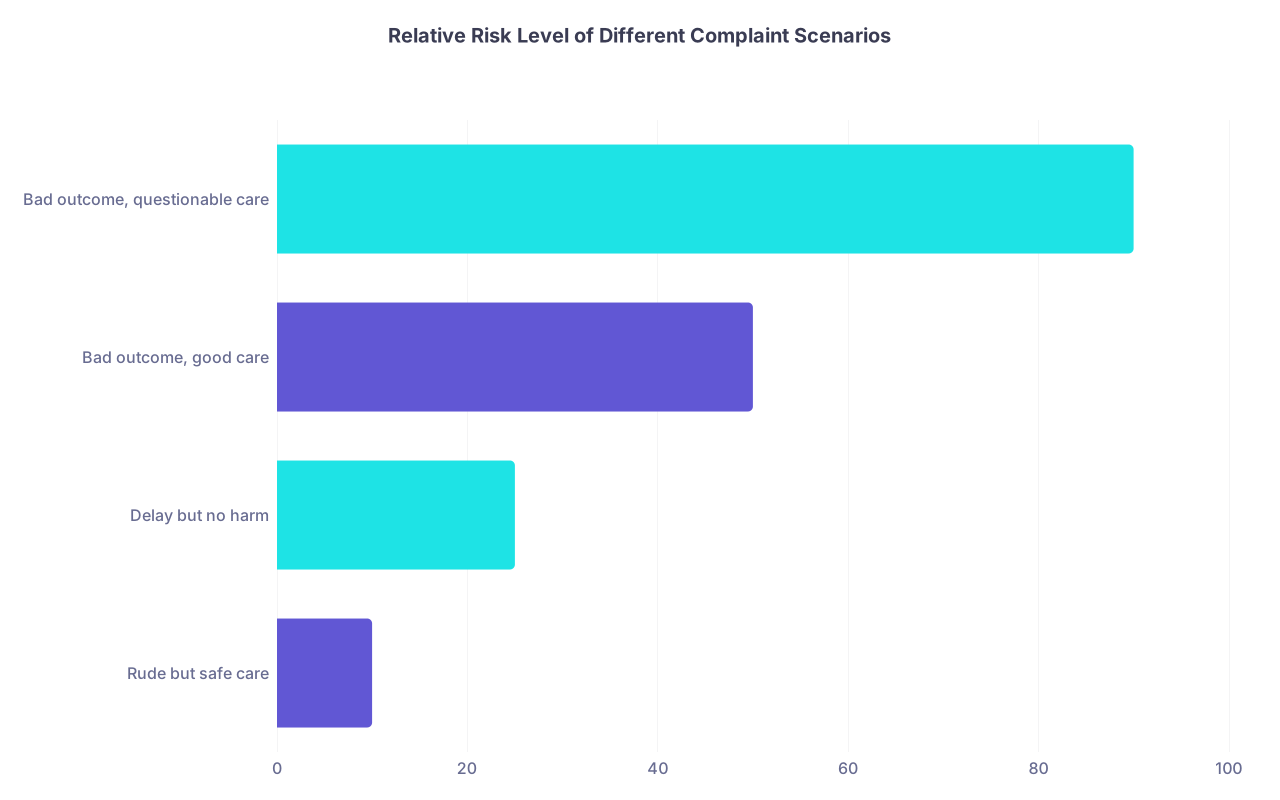
| Category | Value |
|---|---|
| Rude but safe care | 10 |
| Delay but no harm | 25 |
| Bad outcome, good care | 50 |
| Bad outcome, questionable care | 90 |
Even here, though:
- A bad outcome does not automatically mean negligence.
- A board finding does not automatically mean a big civil payout.
- A civil payout does not automatically end your career.
You know what actually destroys people the most?
Silence, denial, and trying to “handle it yourself” because they’re ashamed.
What You Should Do Immediately If You Get a Board Complaint
Your instinct might be:
- Panic
- Vent to colleagues
- Send an emotional, defensive response
- Ignore it for three weeks because your brain is in freeze mode
Please don’t do that.
Here’s the calm, boring, best-possible damage-control plan:
Notify your malpractice carrier
Right away. Even if it’s “just” a board complaint. Many policies require prompt notice of potential claims or investigations. You don’t want them later saying you hid something.Ask specifically about board defense coverage
Do they provide an attorney? Does your policy include regulatory defense? Up to what amount? If your primary carrier doesn’t, you might have a separate policy through your employer or a state/medical society.Get legal counsel before you respond
Do not draft a detailed narrative alone at 1 a.m. while angry and scared. I’ve seen good docs sink themselves with their response, not the care they provided.Lock down documentation
Don’t alter anything. Don’t “clean up” the chart. That’s how minor situations become career-ending. Just make sure you have all the relevant records accessible for your attorney.Stop talking about it casually
Don’t go around the hospital giving your side to five different people. Peer support is one thing; broadcasting your version everywhere is another. Assume what you say might later be repeated or discovered.Start a private log
Dates, who contacted you, what was requested, what you sent, who you spoke with. When things stretch out over months, this timeline becomes a lifesaver.
How to Think About Your Future After a Complaint
I know the real fear under all of this: “If I get a board complaint, am I marked forever?”
Not automatically.

Things that matter more than “Have you ever had a board complaint?”:
- What was the final action (if any)?
- Did it get reported to NPDB?
- Was there a pattern of similar issues?
- Did you show insight and remediation or denial and blame?
Hospitals, groups, and insurers are more worried about practitioners who:
- Repeatedly make the same unsafe errors
- Refuse to engage with feedback
- Show no insight into communication or professionalism issues
A single complaint, resolved with minimal or no action, is not the automatic scarlet letter your brain imagines.
Yes, you’ll have to disclose it sometimes. Credentialing forms are nosy.
But lots of people check “yes” to having had a complaint or investigation and still have perfectly normal careers.
One Thing You Really Should Do Before Anything Ever Happens
If you’re early in training or just starting practice, this is the preventative step almost no one takes, then regrets later:
Actually read your malpractice policy. Especially the parts about:
- Regulatory / board complaint defense
- Limits of coverage
- Whether consent is needed to settle lawsuits
- Whether you have “tail” coverage if you leave
This is the boring administrative stuff that protects your future self when something goes sideways, especially on the board side.
You don’t want to be googling “board defense coverage” after the certified letter is sitting on your kitchen table.
FAQ (Exactly 6 Questions)
1. Can a board complaint happen even if I did nothing “wrong”?
Yes. People file complaints for all kinds of reasons: poor outcome, frustration, miscommunication, unrealistic expectations, or even misunderstandings. A complaint doesn’t mean you actually violated the standard of care. Boards dismiss a lot of cases after review. It’s terrifying to be named, but being complained about ≠ being guilty of anything.
2. Does every board complaint get reported to the National Practitioner Data Bank (NPDB)?
No. Minor actions, letters of concern, or cases closed with no formal discipline are often not reportable. Reportable events are usually serious discipline: license suspension, revocation, probation with restrictions, certain consent orders, or voluntary surrender in lieu of discipline. Your lawyer should tell you if the proposed resolution is NPDB-reportable; that’s something you absolutely want to understand before agreeing to anything.
3. Will one board complaint ruin my chances of future jobs or hospital privileges?
Usually not. What hurts more is a pattern of serious actions or multiple similar events. On credentialing forms, you’ll probably have to say if you’ve ever been investigated or disciplined, but a single complaint that was dismissed or resulted in minor action generally isn’t a career-killer. Context matters a lot: what was alleged, what the board actually found, and how you explain it.
4. Should I contact the complainant or patient directly to “smooth things over”?
No. That’s one of the worst things you can do once a formal complaint has started. It can be interpreted as interference, intimidation, or trying to manage witnesses. Any communication with the patient or complainant at that point should be guided by legal counsel and sometimes risk management. Your urge to “fix it” personally is understandable, but you can accidentally make a small problem much bigger.
5. Do I really need a lawyer if “it’s just a board complaint” and not a lawsuit?
Yes. You don’t always need some $800/hour big-firm litigator, but you do need someone who does healthcare licensing work regularly. Your license is on the line, and your written responses live forever. A sloppy, defensive, or over-sharing statement can haunt you later in lawsuits, NPDB questions, and credentialing. This is exactly the wrong time to wing it.
6. What’s one concrete thing I can do right now to protect myself for the future?
Pull out (or download) your malpractice policy and look specifically for any section labeled “Licensing Board,” “Regulatory Defense,” or “Administrative Proceedings.” If you can’t find it or it’s vague, email your broker or carrier and ask directly: “What coverage do I have for state board complaints, and what are the limits?” That one email, sent today, can save you from complete panic on the day a complaint letter shows up.
Open your malpractice policy or benefits portal right now and find the section on “board” or “licensure” coverage. If it’s missing or unclear, send one short email asking exactly what protection you have if a board complaint is filed against you. Your future panicked self will be very, very grateful.