
It’s a Tuesday at 4:45 p.m. You’ve just finished what felt like a great interview with a large multi-specialty group. The chair was warm, the CMO smiled, HR talked salary. Then someone says the line that changes the air in the room:
“We’ll just need to complete malpractice history verification before we can move forward.”
You walk out thinking it’s a formality. Inside that building, your name is about to be fed into every malpractice database that matters. And three people you have never met will decide whether your past is “explainable” or “too much risk.”
Let me tell you what actually happens on their side of the door.
What Every Hiring Committee Really Checks
You think they just ask, “Any claims?” and move on. No. A real credentialing or hiring review pulls you apart in layers.
Here’s the usual sequence in a well-run hospital or large group:
- HR and medical staff office send you the “malpractice history” form.
- They request “loss runs” from every carrier you’ve ever had in the last 10 years (sometimes longer).
- They compare those against:
- NPDB (National Practitioner Data Bank) reports
- State medical board actions
- Hospital privilege files
- They cross-check what you disclosed versus what the data shows.
The real conversation doesn’t happen in writing. It happens in a small room with the CMO, the chair of your specialty, sometimes the risk manager, sometimes legal counsel. I’ve been in those rooms. The tone is always the same: how bad is this, really, and how likely is it to blow up on us?
They don’t just count claims. They score exposure.
The internal scoring that no one tells you about
Most systems use some version of an informal risk score. It’s rarely written in policy, but they all do it:
- Number of claims
- Timing (clustered or spread out)
- Outcome (dismissed, settled, verdict)
- Payout amounts
- Pattern (same complication, same allegation)
- Alignment with your specialty and practice environment
- Your story and insight when they ask you about it
They may not call it a score, but they treat it like one. Two dismissed claims from residency 9 years ago in OB? Shrug, maybe fine. Three high-payout settlements in the last four years in a community setting? You just became “too hot” for a lot of risk-averse systems.
To make this less abstract:
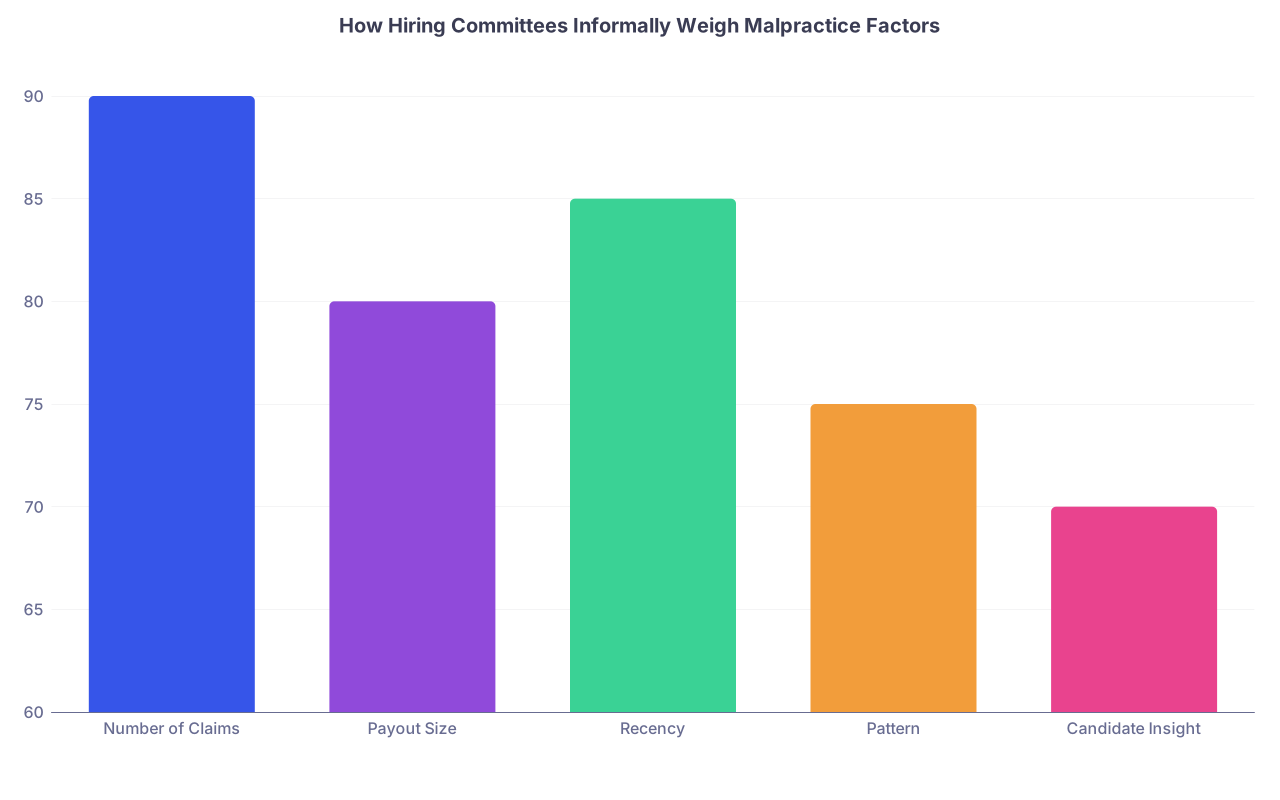
| Category | Value |
|---|---|
| Number of Claims | 90 |
| Payout Size | 80 |
| Recency | 85 |
| Pattern | 75 |
| Candidate Insight | 70 |
Those aren’t official numbers; that’s roughly how heavily people in the room think about them, based on what I’ve watched in committee discussions.
The Truth About “Number of Claims” (They Don’t All Count the Same)
Here’s a secret that would never go into a handbook: three claims isn’t always worse than one. It depends on what those claims are.
Risk managers make distinctions you don’t see on your CV.
They mentally separate your history into piles:
Noise claims – Filed, often dismissed or dropped, small or no payment, usually from high-risk specialties or bad outcomes that weren’t malpractice. Everyone expects some of these in OB, neurosurgery, EM, high-acuity IM.
System claims – Where the allegation clearly involved multiple actors: hospital processes, nursing, administration. The committee often thinks, “This could have happened to anyone in that environment.”
You claims – Where the narrative consistently points back to your decisions, your documentation, your communication. That’s the pile that kills job offers.
I watched one IM candidate with five prior claims get hired into a large hospitalist group because:
- Three were dismissed
- One was a low-dollar nuisance settlement
- One was clearly a bad-system, bad-hand-off case with multiple parties named
Then I watched another candidate with one OB claim and a mid six-figure payout get rejected in 10 minutes. Why? The NPDB narrative made it sound like solo poor judgment, poor documentation, and zero insight into what went wrong.
The committee literally said: “We can defend the five-claims person. We cannot defend this one.”
NPDB vs Reality: Why the Narrative Matters More Than You Think
The NPDB report is your permanent tattoo. Half the committee won’t read your CV as closely as they read that narrative when something looks off.
What they look for in that short NPDB summary:
Was it settled or adjudicated?
- Settlement = “We cut our losses”
- Plaintiff verdict = “Jury found something went very wrong”
Was there payment, and how big?
Small, sub-$50k? Might be nuisance value.
High six figures or seven figures? Everyone in the room sits up straighter.What’s the allegation?
They mentally sort:- Technical error (missed anatomy, technical complication)
- Judgment error (failure to admit, delay in consult)
- Communication/documentation (no informed consent, poor follow-up)
- Professional conduct (impairment, boundaries, gross neglect)
The last two bother them the most. Poor documentation, zero follow-up, egregious communication issues? That’s seen as character, not just a bad day.
The ugly part: the NPDB narrative often reads like a plaintiff’s summary plus a sanitized defense statement. You rarely get to rewrite it. But your interview narrative can blunt the impact if you actually understand what the committee is silently asking:
“Does this person understand what went wrong? Have they changed anything? Or are we importing a lawsuit magnet?”
Specialty, Geography, and Context: Your “Claims Per 1000 RVUs” Problem
Now let’s talk about the part that is completely unfair but very real: your specialty and location controls the baseline.
Nobody is shocked that an OB in New York or a neurosurgeon in Philly has a claims history. Those are bloodbath environments. Risk managers know that.
But a pediatrician in a low-litigation state with three claims? That turns heads.
Here’s roughly how this shakes out in internal risk conversations:
| Specialty | 0-1 Claims (10 yrs) | 2-3 Claims (10 yrs) | 4+ Claims (10 yrs) |
|---|---|---|---|
| OB/GYN | Gold star but not required | Still acceptable with good explanation | High concern, needs strong justification |
| Neurosurgery | Nice but uncommon | Expected in some markets | Serious red flag unless clearly explainable |
| EM | Great but not mandatory | Case-by-case, depends on outcomes | Usually a problem unless obviously “noise” |
| Hospitalist | Expected to be low | Practical concern, deeper review | Usually no-go |
| Pediatrics | Expected to be zero | Big concern | Almost impossible in risk-averse systems |
Again, nobody publishes this. But this is how conversations actually sound.
How Insurers Quietly Shape Your Job Prospects
You think it’s the CMO deciding? Often it’s your malpractice carrier that actually decides whether you get hired, indirectly.
Here’s what you do not see:
Before they finalize an offer, the group often calls their malpractice insurer:
“We’re looking at Dr. X. Here’s their claims history. Can you cover them under our policy and at what rate?”The carrier underwriter reviews your loss runs and NPDB. Then they respond with something like:
- “Standard rate, no problem.”
- “We can cover, but there will be a surcharge.”
- “We decline to cover this physician.”
That last one? That’s the silent death sentence. If their carrier refuses, most systems will not switch carriers for one doctor. You just became “too expensive to bring on.”
Sometimes they technically can cover you, but the premium differential is so high that you become financially unattractive.
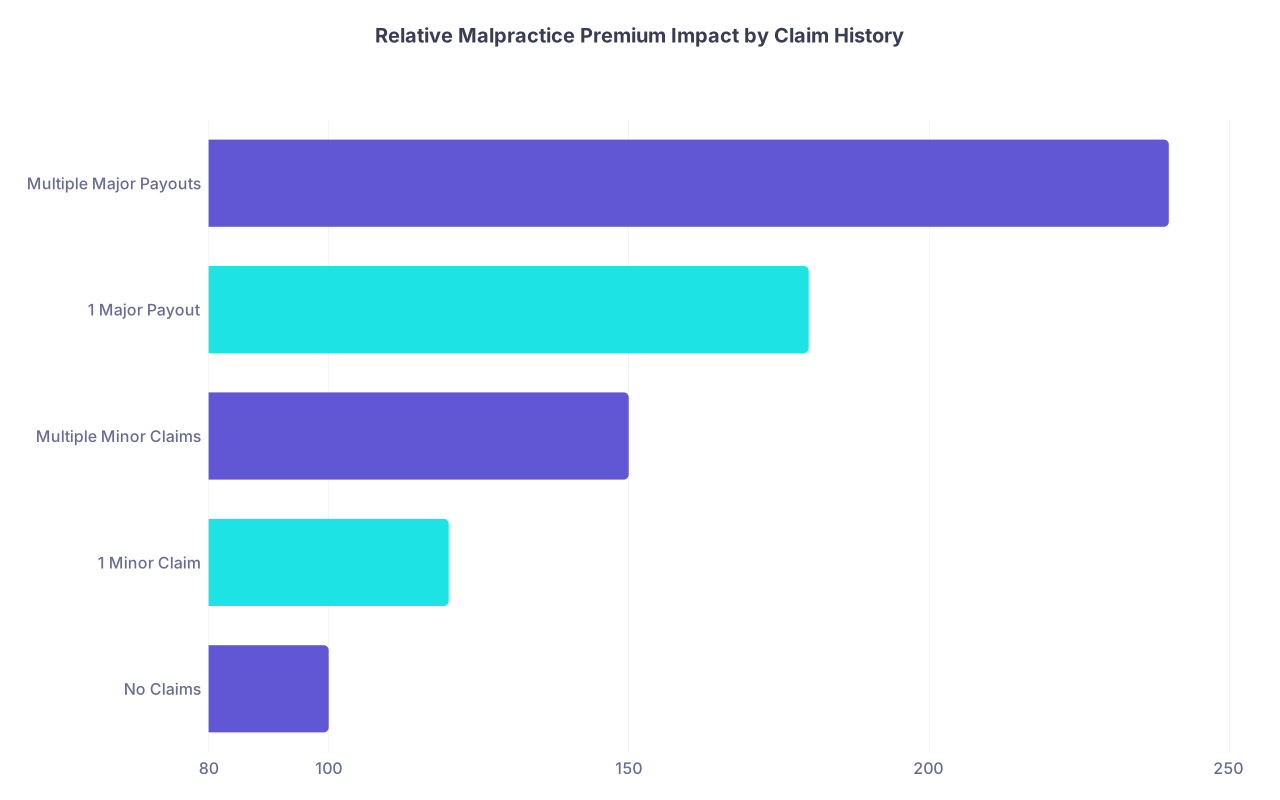
| Category | Value |
|---|---|
| No Claims | 100 |
| 1 Minor Claim | 120 |
| Multiple Minor Claims | 150 |
| 1 Major Payout | 180 |
| Multiple Major Payouts | 240 |
Those numbers are relative, not dollars. But that’s the mental math groups do: if your presence raises their blended premium 30–50%, they look for someone cheaper.
This is especially brutal in small private groups with thin margins. A two- or three-person practice often cannot absorb a large surcharge for you. They will politely “go in another direction” and never tell you why.
Red Flags That Almost Always Trigger Pushback
Let’s get explicit. Here’s what consistently blows up hiring discussions in the back room, irrespective of how smooth you are in person.
Recent, high-payout claim in the last 2–3 years
If there’s a $700k+ settlement two years ago for something like delayed diagnosis of sepsis or missed MI, everyone at the table wonders if they’re inheriting active risk.Pattern of similar allegations
Three separate “failure to follow up on abnormal test” claims? They see a systems and judgment problem baked into how you practice.Mismatch between your story and the documentation
When you tell a rosy version in the interview and the NPDB narrative or loss run suggests something very different, you’re done. Integrity > outcome. I’ve seen candidates lose offers because their “spin” was obviously inconsistent.Nonclinical red flags embedded in claims
Documentation that mentions impairment, disruptive behavior, or abandonment of patient care triggers a more serious level of review. A lot of programs will tolerate a bad outcome. They will not tolerate a professionalism risk.Undisclosed claims
The worst sin. If they find one claim you didn’t list—even if it’s tiny—they see you as dishonest. That’s when a marginal issue turns into an automatic rejection.
How Malpractice History Affects Your Actual Offer (Not Just Getting In)
Suppose you pass the gate and they want you. Your malpractice history will still quietly change the terms.
I’ve seen all of these happens dozens of times:
Lower base salary than “clean” peers
Justified in their budget as offsetting higher insurance cost or risk. You may never be told this is the reason.Longer initial contract term with intense review at renewal
“We’ll do a 1-year contract and reevaluate.” Translation: we want a test period to see if you generate new claims.Different tail coverage rules
They might insist you carry (or pay) your own tail from your prior job, or refuse to pick up prior acts, precisely because your history makes them nervous.Restrictions on scope of practice
In surgery or procedural fields, sometimes they quietly limit you: no complex spine for the first year, no VBACs, no high-risk OB, mandatory second reads on scans. It’s not always formal. Sometimes it’s just how they assign cases.Performance improvement “baked in” from day one
You’ll be on radar. More chart reviews, more peer-review committee visits, more “coaching” meetings.
You still get hired, but you’re not playing the same game as the clean-slate candidate.
How To Present a Claims History Without Killing Yourself
You can’t erase the past, but you can absolutely control how you explain it. I’ve seen people with ugly histories win over committees because they were better at this part than their competition.
Here’s what works in the real world:
1. Radical, accurate disclosure on paper
Do not play games. List every claim asked for, exactly how the application requests:
- Date
- Allegation summary
- Outcome (dismissed, settled, verdict)
- Amount paid (if known)
If something is missing from your memory, say so and ask your prior carrier for loss runs so you can be precise. “I’m not sure, maybe there was something small” is how you sound like a liability.
2. A concise written explanation for each significant claim
If you have more than a minor dismissed case, prepare a 1–2 paragraph neutral description for each. Not emotional. Not defensive. Just:
- Clinical scenario in one or two lines
- What the allegation was
- Core issue in plain language
- What changed afterward in your practice or the system
The smartest candidates have this ready and offer it if asked. Risk committees love clean, structured explanations. It also proves you’ve thought about it.
3. Zero blame-shifting in your verbal story
If you spend three minutes blaming nurses, the ED, radiology, or “the system,” you’re done. The people hiring you know bad systems exist. They want to hear:
- What you personally could have done better
- How your practice is now different
- How you handle similar situations today
One chair I know in surgery literally has a mental scorecard: 60% of your explanation needs to be “my part of this problem” or he will fight your appointment.
When Your History Is Actually Toxic: Real Options
There’s a line where your malpractice history becomes a career problem, not just a hiring friction. You probably already suspect if you’re close to that line.
Patterns like:
- Multiple high-value payouts
- Repeated similar allegations over a short time
- Recent board actions combined with claims
At that point you have to drop the fantasy that you can compete equally for the safest, most prestige-heavy jobs. You need strategy, not denial.
Tactical moves that actually work:
Lean into less risk-averse markets and employers:
Smaller hospitals, rural systems, or independent groups sometimes accept higher risk for coverage needs.Consider locums or short-term contracts first:
A year or two of clean practice, strong references, and no new incidents can gradually reset how you’re seen.Shift to lower-risk niches within your specialty:
For example, an OB moving more toward gynecology, or a surgeon focusing more on endoscopy.Invest in formal remediation:
Advanced communication courses, charting courses, morbidity and mortality quality initiatives. But don’t just take them—document them and talk about them. Committees like to see repentance with structure.
And yes, for a very small slice of physicians with repeated catastrophic outcomes and no insight, doors will close permanently. That’s reality. But most people fall short of that. They just need to stop pretending the system doesn’t care and start managing how they’re perceived.
How This All Ties Back to Your Financial and Legal Life
You asked for the “financial and legal aspects” view. Here it is, without sugar:
Your claims history is a shadow credit score that follows you everywhere. It affects what jobs you can get, how you’re insured, and how much you’re paid.
That shadow score is built from objective data (NPDB, loss runs, board actions) plus subjective interpretation (how your story lands with people like me in committee rooms).
It directly affects:
- Your malpractice premium (personal and group)
- Your contract flexibility (tail coverage, trial periods, scope limits)
- Your earning potential (lower base, fewer high-risk procedures)
- Your mobility (which markets and systems will touch you)
It’s not fair. It’s also not changing anytime soon. So you either learn how this game is played, or you keep walking into interviews blind.

| Step | Description |
|---|---|
| Step 1 | Application Submitted |
| Step 2 | Malpractice Form and CV |
| Step 3 | Loss Runs Requested |
| Step 4 | NPDB and Board Check |
| Step 5 | Standard Credentialing |
| Step 6 | Risk Committee Review |
| Step 7 | Offer and Contract Terms |
| Step 8 | Application Declined |
| Step 9 | Claims or Actions Found |
| Step 10 | Risk Acceptable |
That’s the rough reality of the closed-door process you never see.