
You’re in a windowless conference room just off Risk Management. It’s 7:15 p.m., you just finished a brutal shift, and now there’s a three-ring binder with your name on it sitting in front of a hospital lawyer.
They’re “just doing a routine review” of a case where a bad outcome turned into a claim.
You think: “Good thing I have malpractice coverage. They’re here to help me.”
Let me stop you there.
That binder on the table? A significant chunk of it is your malpractice policy, coverage correspondence, and internal memos about limits and exposure. And that lawyer? Their first duty is not to you. It’s to whoever is paying their invoice.
You need to understand how hospital counsel and carrier-appointed lawyers actually use your malpractice policy—sometimes with you, sometimes against you—because by the time you realize what’s going on, the damage is usually already done.
Who That Lawyer Really Works For
Here’s the piece medical school never bothered to explain: in a malpractice claim, there are usually three legal “sides,” not two.
You think it’s:
- Patient/plaintiff vs.
- You/defendant
Reality is more like:
- Plaintiff
- Hospital/health system and its insurers
- You (and maybe your own insurer, if you’re not purely on the hospital’s policy)
If you’re an employed physician or hospital-based specialist, most of the time the lawyer you meet is selected and paid by:
- The hospital’s insurer, or
- The hospital directly (self-insured systems love this)
Their job is to protect the entity. You’re “included” as long as your interests line up with the hospital’s. The second they diverge, you’ll feel it.
The tool they use to decide where you sit in the pecking order is your malpractice policy: limits, type (claims-made vs occurrence), tail coverage, consent-to-settle, and whether you’re individually named or just an “additional insured.”
They read your policy with one question in mind:
“How do we use this document to control this doctor, shape their testimony, and cap the system’s financial and reputational exposure?”
Not: “How do we protect Dr. Smith’s long-term career?”
I’ve watched that play out in quiet, “friendly” conversations behind closed doors more times than I can count.
The First Move: Turning Your Policy Into a Leash
On paper, your malpractice policy is “protection.” In practice, it’s leverage.
In early case conferences, hospital lawyers and risk managers are looking at three key numbers and clauses immediately:
- Your individual per-claim limit
- Your aggregate limit
- Your consent-to-settle language (or lack of it)
They will never frame it like this, but let me translate the internal discussion for you.
“Dr. Jones has $1M/$3M with consent-to-settle. Employed. Named insured under our umbrella. Claim is filed for $5M requested damages. Venue is plaintiff-friendly. Co-defendants: hospital, two nurses, one resident. We need to decide who we feed to the wolves if this goes sideways.”
You might think that’s dramatic. It isn’t. I’ve heard some version of that speech word-for-word in risk meetings.
If you have weak consent rights (or no true consent right), here’s how your policy gets quietly weaponized:
- They know they can settle you out early to simplify the case, even if it stains your NPDB record, as long as the numbers make sense.
- They know you can be pressured to agree to a settlement “for the good of the team” because “the coverage structure really makes you the logical one to resolve this piece.”
- They know you’re the cheapest lightning rod. If your limits can satisfy a chunk of the exposure, they’ll consider putting your policy on the altar long before they expose hospital funds or higher layers of institutional reinsurance.
I watched a hospital attorney say to an intensivist, in a very calm voice:
“Look, your carrier will cover this within your limits, and we can likely avoid trial. If we keep fighting, the hospital’s self-insured retention kicks in, and that changes everything. This is really the cleanest option.”
Translation: “We’re going to sacrifice your career reputation to save our balance sheet and PR.”
And they use your own policy terms as the justification.
How Coverage Structure Decides Who Gets Blamed
If you want to understand how blame gets distributed in a multi-defendant malpractice case, you don’t start with medicine. You start with coverage charts.
Let’s make this concrete with a simple comparison.
| Scenario | Likely Target |
|---|---|
| Employed MD, low limits, no consent-to-settle | You get pushed to settle early |
| Independent MD, separate policy, strong consent | Hospital more likely to settle around you or take more blame |
| Hospital self-insured, you on occurrence policy | They try to keep you from “infecting” the hospital’s self-insured layer |
| Shared group policy with limited aggregate | Pressure on highest-earning or ‘least valuable’ MD to fall on sword |
| High limits with tail, weak contract protection | You become an attractive payout source for joint settlement |
Behind the scenes, risk management maps out the “coverage tower”:
- Your primary policy (1M/3M or similar)
- Hospital’s primary and excess layers
- Any reinsurance or captive arrangements
- Self-insured retentions
Then they match that against:
- Venue risk (how bad the jury pool is)
- Plaintiff’s theory of the case
- Your defensibility (charting, documentation, bedside manner, emails, prior complaints)
If your policy is easy to tap and you are easy to portray as the “main problem,” your coverage becomes the path of least resistance.
And you will feel that in subtle ways:
- You’re “encouraged” not to fight certain factual narratives because “it doesn’t really change coverage.”
- Your deposition prep quietly steers you toward accepting more responsibility than is strictly accurate, because a clear target is easier to package for settlement.
- Your written statement is “edited for clarity” so that your language aligns with a settlement strategy already set in motion based on your policy limits.
I’ve seen attendings hung out with statements that were essentially drafted to make them the clean scapegoat, while the system and senior partners walked away relatively untouched.
How They Turn Consent-to-Settle Into a Trap
You know that “consent-to-settle” clause you felt so good about when you signed your policy? Hospital lawyers know exactly how to neutralize it.
On paper, it says they can’t settle a claim against you without your written consent.
In practice, here’s how they get around it:
They outline worst-case scenarios in graphic detail: “If this goes to trial and the verdict is above your limits, you could be personally exposed. Plaintiff’s counsel is already talking nuclear numbers.”
They wave the “reputational risk” flag: “If this becomes a public trial, your name is going to be all over local news. Settlement lets us control the narrative.”
They hint at employment consequences: “We can’t tell you what the MEC/credentialing committee might do if this becomes a high-profile loss, but they do review these things closely. Cooperation looks good. Being adversarial does not.”
They lean on isolation: “The other defendants are aligned on this settlement structure. You’d be the only one holding out. That’s… not ideal.”
So yes, technically you have to sign. But the way they present the “choice” is loaded. They use your misunderstanding of your own policy to push you toward the outcome that best serves the hospital and the carrier.
Your policy wasn’t written for you. It was written by underwriters and attorneys whose job is to manage risk pools and payouts. Hospital counsel knows that language almost by heart. You usually don’t.
That’s an asymmetry you feel—but can’t articulate—when you’re sitting in that conference room being “explained” your options.
The Quiet Game With Tail Coverage
Now let’s talk about the single most underrated area where your malpractice policy gets used against you: tail coverage, especially when you leave a job after a claim or near-claim.
If you’re on a claims-made policy, your tail is everything. It determines who’s actually on the hook when a lawsuit lands years after the event.
Hospitals and large groups play games with this constantly.
Typical structure:
- While employed, you’re covered under the hospital’s or group’s claims-made policy.
- When you leave, someone has to pay for tail to cover the prior years of exposure.
Here’s the trick: your employment contract and policy language together create leverage over you.
Picture this:
You’re thinking of leaving your group. You’ve had a couple of tense cases but nothing has formally landed as a lawsuit. Risk management knows there are rumblings with at least one family.
The group’s contract says:
- If you leave voluntarily, you pay your own tail.
- If they terminate you without cause, they pay it.
- If they terminate you for cause, you pay it.
Now guess what happens if there’s emerging risk?
Internal discussion sounds like this:
“Dr. X is likely to be named if this heats up. If they leave now and we terminate for cause, we’re off the hook for tail. That pushes future liability directly onto their shoulders and off the group’s financials.”
They won’t say it out loud to you.
But they will suddenly become very interested in your “unprofessional communication style” or “documentation deficiencies,” and start building a paper trail that justifies a for-cause termination—precisely to dump tail responsibility.
And memory is long in admin land. I’ve watched a system pull a 10-month-old incident, reframe it, and use it to justify a for-cause termination exactly three weeks before a known plaintiff deadline, conveniently shifting tail costs and risk away from the entity.
Data: Why Your Policy Becomes a Target
Let me show you the reality that drives all this maneuvering.
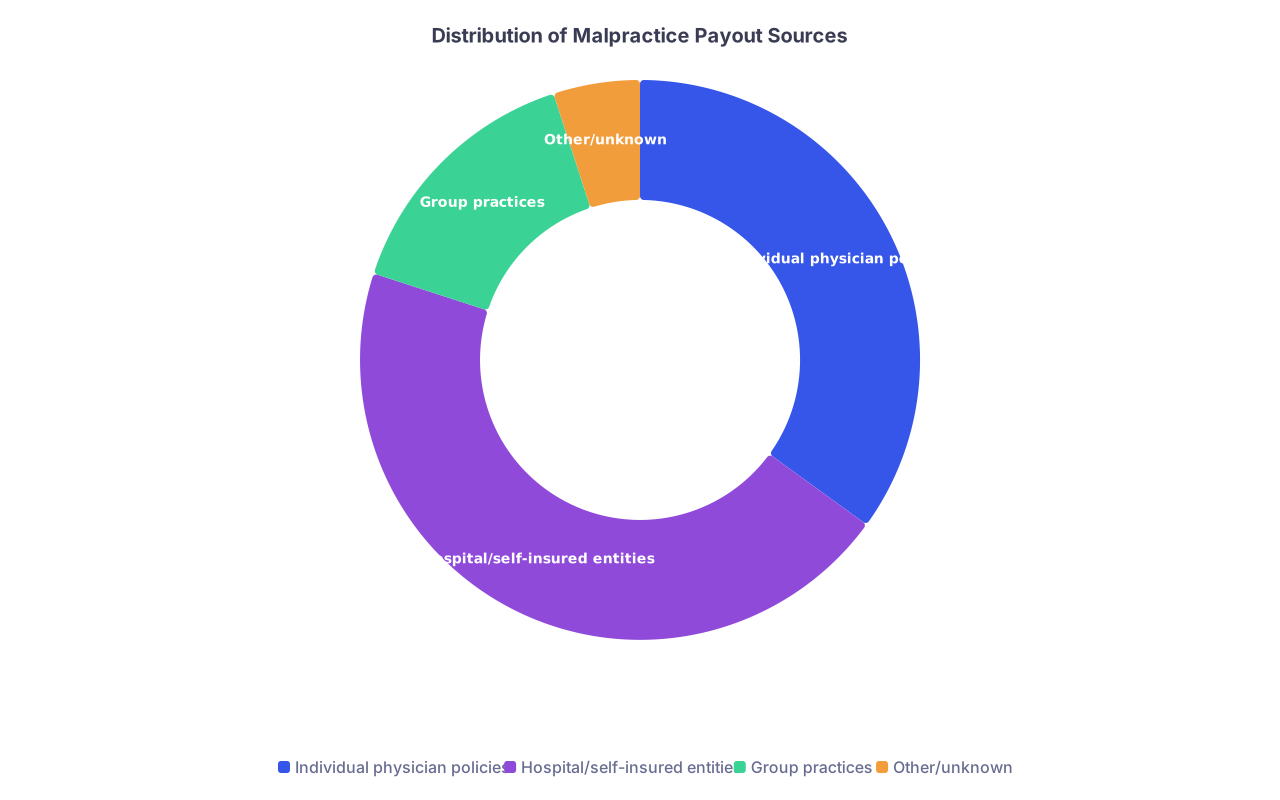
| Category | Value |
|---|---|
| Individual physician policies | 35 |
| Hospital/self-insured entities | 45 |
| Group practices | 15 |
| Other/unknown | 5 |
When a claim is paid, roughly a third of the time the money nominally comes from an individual physician’s policy. That’s not just an accident of who was at the bedside. It’s often a deliberate allocation strategy behind closed doors.
To get there, lawyers use:
- Your policy limits as the “safe” bucket
- Your consent clause as something to manage, not respect
- Your fear of personal asset exposure as a blunt psychological instrument
They know you’re not going to fight them line by line on the policy language. So they use the structure you never fully understood to guide you toward the outcome they’ve already optimized.
How Testimony Gets Tilted Using Coverage
Another trick: shaping your testimony to align with coverage strategy, not clinical truth.
Lawyers can’t ethically tell you to lie. The good ones don’t. But they absolutely can, and do, steer you toward certain emphases that conveniently align with how they want liability allocated.
If the plan is to use your policy as the main payout vehicle, they want you to be:
- The central, clear decision-maker
- The one who “owned” the judgment call
- The person whose actions “broke from the standard of care,” if anyone did
So prep will feel like:
- “Let’s be clear that the ultimate decision to discharge was yours, correct?”
- “The nurse raised a concern but you decided it was still appropriate to send the patient home?”
- “So even though the ICU attending was reachable, you did not escalate at that time. That was your call?”
Notice: all factually accurate questions. But there’s a consistent direction. You become the focal point.
Flip the scenario. Suppose the hospital is the one with the big exposure—massive self-insured retention, bad sentinel event, system-level failure. Now they want you to be:
- Following protocol
- Acting within established policies
- Reliant on system inputs (lab delays, bed shortages, understaffing)
And prep will sound more like:
- “The hospital protocol at that time required X, and you followed that, correct?”
- “You requested the CT within an appropriate timeframe?”
- “There were no ICU beds available when you made that request, right?”
Same case. Different angle. Same doctor. Different allocation of responsibility.
Your policy tells them whether they want to make you bigger or smaller in that story.
The NPDB and How They Sell You Out
Here’s another “we’re just following procedure” moment where hospital lawyers use your policy against you: National Practitioner Data Bank (NPDB) reporting.
Any settlement or judgment where you’re named as a defendant and a payment is made on your behalf is reportable to the NPDB.
Hospitals know:
- NPDB hits follow you for life.
- Many doctors don’t fully grasp how damaging even one report can be.
- You’re terrified of a black mark on your record, but you don’t understand the mechanics.
So they use that fear both ways.
If they want you to accept a settlement that uses your individual policy:
- “This will be reportable, but a single NPDB entry, well-framed, is usually survivable. Far better than a big public trial loss.”
If they want to shield the entity:
- “We structured the payment through your carrier to avoid complicating our self-insured program. Yes, it means NPDB for you, but it keeps the institution’s numbers clean, which helps everyone in the long run.”
“Helps everyone” is doing a lot of work there.
Your policy being the direct payout mechanism locks you into NPDB reporting. The hospital often prefers that to any structure that might implicate systemic failure or create extra internal reporting burdens for the institution.
I’ve literally heard: “Better this sit on the doctor than the hospital.”
They weren’t talking about medicine.
The Internal Timeline You Never See
You think the malpractice process starts when you’re served. It almost never does.
Inside the hospital, the sequence looks more like this:
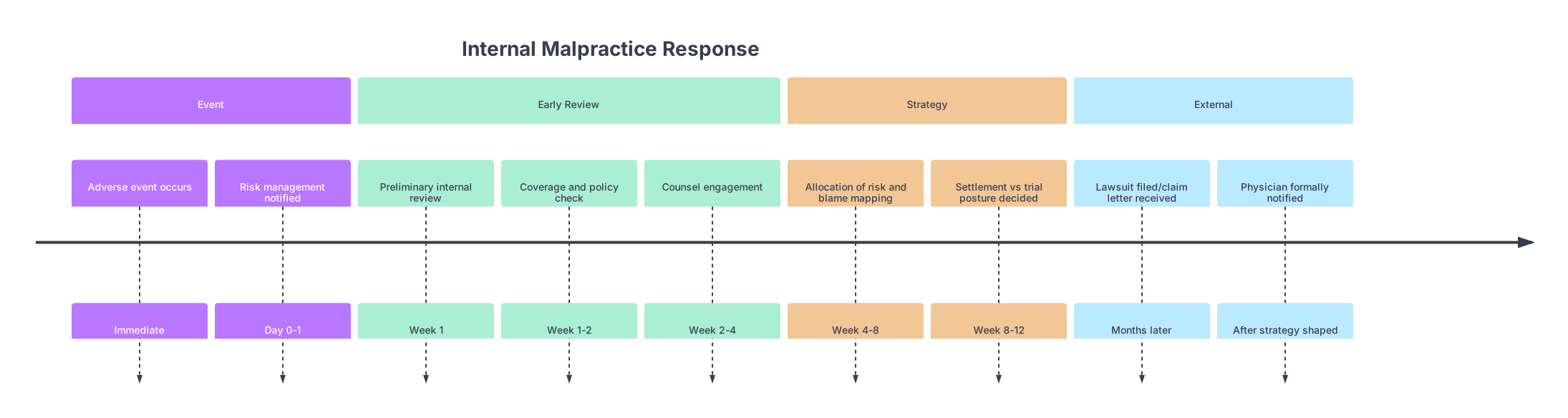
| Period | Event |
|---|---|
| Event - Adverse event occurs | Immediate |
| Event - Risk management notified | Day 0-1 |
| Early Review - Preliminary internal review | Week 1 |
| Early Review - Coverage and policy check | Week 1-2 |
| Early Review - Counsel engagement | Week 2-4 |
| Strategy - Allocation of risk and blame mapping | Week 4-8 |
| Strategy - Settlement vs trial posture decided | Week 8-12 |
| External - Lawsuit filed/claim letter received | Months later |
| External - Physician formally notified | After strategy shaped |
By the time you’re sitting in that conference room being “brought up to speed,” a lot has already happened:
- Your policy has been pulled and reviewed.
- Coverage memos have circulated.
- Initial strategy about who is “primary exposure” has been drafted.
- They already have a working model of whose policies they intend to tap if things go badly.
You’re not joining at the ground floor. You’re walking into a play halfway through the second act.
That’s why your “instincts” about how to handle the case so often collide with what the lawyers are calmly, firmly steering you toward.
What You Can Actually Do About It
You cannot stop hospitals and insurers from looking at your malpractice policy as a risk management tool. That’s the game.
But you can stop walking into that game blind.
Here’s what physicians who don’t get steamrolled usually have in common:
They actually know what’s in their policy. Not the brochure. The policy.
- They know their limits.
- They know if they have real consent-to-settle or just “we’ll use reasonable efforts to obtain your consent” garbage language.
- They know what happens if they refuse settlement. Some policies let the carrier cap its obligation at the offered settlement amount. That’s a loaded gun pointed at your head.
They do not rely exclusively on the hospital-appointed lawyer for personal advice.
- They get an independent attorney—someone whose bill the hospital does not pay—to review the policy, their employment contract, and the case facts.
- They have that attorney explain, in real language, what happens if they say “no” to settlement, or if they push back on blame-shifting narratives.
They think about tail coverage before they sign the first employment contract, not when they’re already in a fight.
And when they sit in that conference room and hear, “Given your coverage, the best course is…,” they translate it in their head:
“Given what’s best for the hospital and the carrier, what we’d like you to do is…”
Then they decide if that’s acceptable for them, personally.
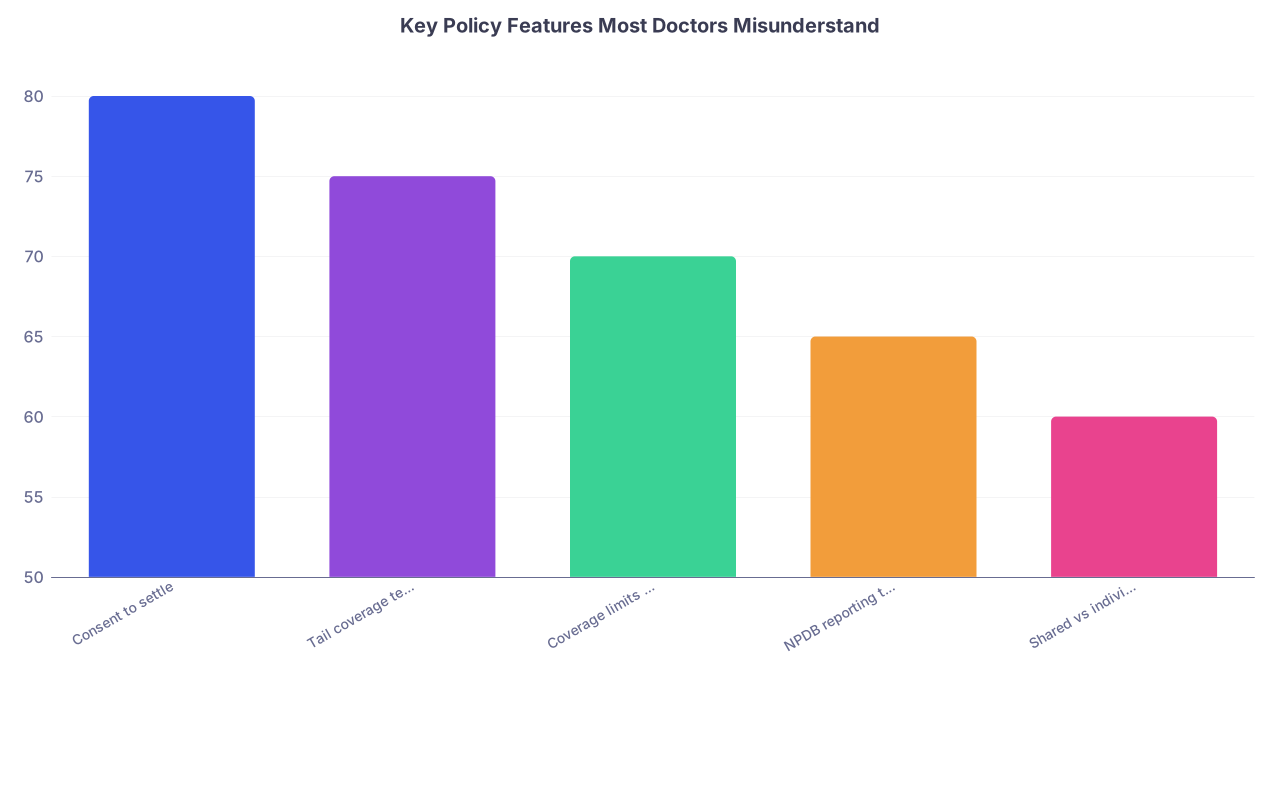
| Category | Value |
|---|---|
| Consent to settle | 80 |
| Tail coverage terms | 75 |
| Coverage limits impact | 70 |
| NPDB reporting triggers | 65 |
| Shared vs individual limits | 60 |
These percentages aren’t formal survey data; they reflect what I see repeatedly when I ask attendings, “Show me your policy and tell me what this clause means.” Most of the time, they can’t.
And that’s exactly the ignorance the system runs on.
The Real Bottom Line
Let me strip this down to what you actually need to remember.
First: The hospital lawyer is not “your” lawyer in the way you imagine. They are an institutional asset manager, and your malpractice policy is one of the assets they manage.
Second: Your policy can be turned into a leash, a scapegoat mechanism, or a bargaining chip—depending on how your limits, consent language, and tail coverage are structured. That process starts long before anyone tells you “we might have a problem.”
Third: The only real counterweight you have is knowledge and independent counsel. If you don’t understand your own policy better than the person across the table, you’re not really in the conversation—you’re just the one signing where they tell you.
That’s how hospital lawyers actually use your malpractice policy against you.
Whether they succeed depends on how much you’re still willing to outsource understanding your own risk to people whose job is to protect someone else.