
It’s 7:42 pm. You’re halfway through reheating some sad leftovers when you see it: an email from risk management. Subject line: “Notice of Deposition – [Patient Name].” Your stomach drops. Your brain immediately jumps to:
“I’m going to say something wrong. I’ll get sued for millions. I’ll lose my license. My program will hate me. I’ll never get a job. This will follow me forever.”
Let’s slow this down.
You’re not crazy for spiraling. Every physician I know has had that “oh my god deposition” dread, even the ones who posture like they’re cool with it. The problem is, nobody explains what actually happens. It’s all whispers: “Don’t say too much,” “Just answer the question,” “It was brutal,” with zero practical detail.
So here’s the real, unvarnished walkthrough of what happens when you’re called for a deposition, what your malpractice insurance really does for you, and what’s actually at stake vs what your 3 am brain insists is at stake.
First: Why You’re Even Being Deposed
Let me be blunt: being deposed does not mean you’re a terrible doctor. It means you were involved in the care. Period.
You can be deposed as:
- A named defendant (you’re actually being sued)
- A non-party fact witness (you’re not being sued, but you treated the patient)
- A corporate representative (if you’re later in your career or in admin, less likely now)
Your malpractice insurance exists for this exact situation. Not theoretically. This is literally what you pay premiums for, or what your hospital pays on your behalf. When a suit is filed and you’re named, your carrier assigns you a defense attorney. You don’t go into this alone unless something has gone off the rails badly (think: working somewhere without coverage or doing something clearly outside scope).

| Category | Value |
|---|---|
| Settles before trial | 60 |
| Goes to trial | 10 |
| Dropped/dismissed | 30 |
Most cases never see a courtroom. A deposition is part of discovery. It’s information-gathering, not a public execution. It just feels like one when you’re in the hot seat.
Step-by-Step: What Actually Happens Once You’re Called
Here’s the basic sequence. I’m skipping the legal fluff and giving you what it looks like from a “you’re the doctor” point of view.
1. You get notified
Could be:
- Risk management emails you
- Your malpractice carrier calls
- Your program director gets looped in
You’ll likely see words like “Notice of Deposition,” “Plaintiff,” “Defendant,” “Case number.” Terrifying language, but procedural.
Your very first move should be:
- Forward to your malpractice carrier contact (if they didn’t send it)
- Let your program director/department chief know
- Do not call the patient, their family, or post in your group chat with names/details
You are allowed to talk to your lawyer. Freely. That’s protected.
2. You get assigned (or meet) your defense attorney
Your malpractice insurance pays for this. You don’t get a bill.
The attorney will usually:
- Email/call to introduce themselves
- Set up a prep meeting (can be virtual or in person)
- Ask you not to look at the chart yet until they talk to you (yes, really)
Is every defense attorney amazing? No. Some are fantastic, some are mediocre, a few are condescending. But they all share one core incentive: defend you and the insured entity successfully. Your interests are aligned more than you think.
The Prep: The Part Everyone Underestimates
The deposition itself is only as tolerable as your preparation. Most of the anxiety is front-loaded here.
3. Reviewing the medical record (the “oh god, what did I do?” phase)
In prep, your attorney will walk you through:
- The full chart (or at least your parts + key events)
- Timeline of care
- What the plaintiff is alleging went wrong
- Any expert reports (if already available)
This is where your brain wants to:
- Hyper-focus on the single typo you made in one note
- Obsess about the one vital sign you didn’t recheck
- Catastrophize every “normal” judgment call as “obvious negligence”
Your attorney is looking for:
- What you actually did, not what you wish you did
- Where your documentation helps you
- What can be reasonably defended as within standard of care
You’re thinking, “They’re going to expose every flaw.” The reality: almost every chart has imperfections. That’s normal. The legal question is: was your care defensible, not flawless.
4. Learning how to answer (this feels unnatural at first)
Your attorney will drill some basic rules into you. They sound simple. They are not simple when you’re under oath and someone is intentionally trying to rattle you.
Stuff like:
- Only answer the question asked.
- Don’t volunteer extra information.
- If you don’t understand, say, “I don’t understand the question.”
- If you don’t remember, say, “I don’t recall,” and mean it.
- Silence is not your job to fill.
You’ll feel rude. Awkward. Like you’re being evasive. You’re not. You’re being precise. Plaintiff attorneys love when doctors ramble, speculate, or try to sound impressive. That’s where people hang themselves.
Your lawyer may literally practice:
- Rapid fire questions with you
- Trick phrasing like: “So you would agree that…”
- Questions designed to make you angry or defensive
You’re learning courtroom survival skills. It’s not natural. It’s a learned behavior.
The Day of the Deposition: What It Actually Looks Like
Let me pull this out of the horror-movie fog.
5. The physical setting
Most depositions happen:
- In a conference room at a law office
- Occasionally at the hospital conference room
- Now, increasingly, on Zoom/virtual
In the room (or virtual):
- You
- Your defense attorney
- Plaintiff’s attorney (and sometimes multiple)
- A court reporter (typing everything)
- Maybe the plaintiff (patient or family), maybe not
- Sometimes a videographer
There’s no judge. No jury. No big courtroom. It’s weirdly… administrative-feeling, with a side of existential dread.

6. Swearing in and the ground rules
The court reporter will:
- Ask you to raise your right hand
- Swear you in to tell the truth
Then plaintiff’s attorney does a little script:
- “If you don’t understand a question, will you tell me?”
- “If you need a break, will you let us know?”
- “Is there any reason you can’t testify truthfully today?”
Breathe. Nobody expects you to be perfect. They want you to talk. A lot. Your job is to not help them more than you’re legally required to.
7. The questioning style
Think of it like a very hostile, very leading H&P where the attending already decided the diagnosis and wants you to say specific words.
Typical patterns:
- Locking down facts: dates, times, your role
- Walking through the chart chronologically
- Zooming in on “decision points” (admit vs discharge, order vs not order, consult vs no consult)
- Asking you to agree with oversimplified, extreme statements
Examples:
- “You would agree that sepsis is life-threatening, correct?”
- “And you’d agree that a reasonably careful doctor would recognize this, correct?”
- “But you discharged the patient anyway, right?”
Your instinct: explain. Defend. Tell the entire story in one beautiful, coherent narrative that proves you’re not a monster.
Don’t. Answer what was asked. Then stop.
You are allowed to:
- Take a pause before answering
- Ask to see the document they’re referencing
- Say “I don’t recall” if you truly don’t
- Ask to rephrase
Your lawyer can:
- Object to the “form” of the question
- Instruct you not to answer certain narrow categories (privileged stuff)
- Take breaks with you (not in the middle of a question)
What Your Malpractice Insurance Actually Does for You Here
You’re probably secretly terrified of two separate things:
- Losing money
- Losing your career
Let’s separate them.
Financial protection
Your malpractice policy typically covers:
- Defense attorney fees (these get expensive; you’re not paying them)
- Costs associated with the case (experts, depositions, etc.)
- Indemnity payments (settlement or judgment), up to your policy limits
Common individual policy limits are something like:
| Policy Type | Per-Claim Limit | Annual Aggregate Limit |
|---|---|---|
| Standard Hospital | $1,000,000 | $3,000,000 |
| Large Group Policy | $2,000,000 | $5,000,000 |
| Low-Cost Policy | $500,000 | $1,500,000 |
Most residents are covered under the hospital’s policy. You aren’t personally writing checks if something settles. Massive personal financial ruin is the nightmare scenario your brain is screaming, but with standard coverage, it’s incredibly rare.
Career / license protection
Separate but related:
- A malpractice payment may get reported to the National Practitioner Data Bank (NPDB)
- Board of medicine investigations are separate processes
- Your residency/program might do internal QA reviews
Being deposed doesn’t automatically trigger any of that. A settlement with payment might be reportable, especially if you’re a named defendant. But this is where nuance matters:
- Many cases settle without individual physicians being separately targeted
- One NPDB report ≠ career death. Annoying? Yes. Disqualifying from everything forever? No.
- Boards rarely yank licenses for a single malpractice case without egregious conduct
Is any of it fun? No. Is it the end of your life? Also no.
The Emotional Side Nobody Preps You For
Honestly, this is the part that messes people up more than the legal stuff.
The shame spiral
You’ll probably think things like:
- “Everyone is going to know I got sued.”
- “Attendings will think I’m incompetent.”
- “Fellowship programs will blacklist me.”
Reality check:
- Programs and faculty see bad outcomes and lawsuits more than you think. It’s not exotic.
- A single case, especially as a trainee, almost never defines you.
- The people who quietly supported you when that bad outcome happened are usually the same people who will support you through the legal piece.
You do need to be careful about:
- HIPAA: don’t over-share case details with friends
- Social media: do not post about the case, even vaguely
- Email: assume anything written could someday be read out loud in a room you do not want to be in
But you’re not required to suffer in silence. You can talk about:
- How stressed you are (“I’m involved in a legal case and it’s wrecking my sleep”)
- The emotional toll (“I keep replaying the case in my head”)
- The logistics (“I have to miss half a day for a deposition”)
Just strip the patient identifiers and specific medical details.
How to Not Completely Fall Apart While Preparing
I’m not going to throw mindfulness platitudes at you. Let’s talk concrete.
1. Ask your lawyer very blunt questions
You’re allowed to say:
- “What is the worst realistic outcome here?”
- “Am I being accused of anything criminal?”
- “Is my license at risk from this specific case?”
- “Am I personally exposed financially beyond my coverage?”
Most of the time, the answers are far less catastrophic than your brain predicted.
2. Clarify your role in the case
Are you:
- A main defendant?
- One of multiple defendants?
- Just a fact witness?
Your risk level is not the same in each scenario.
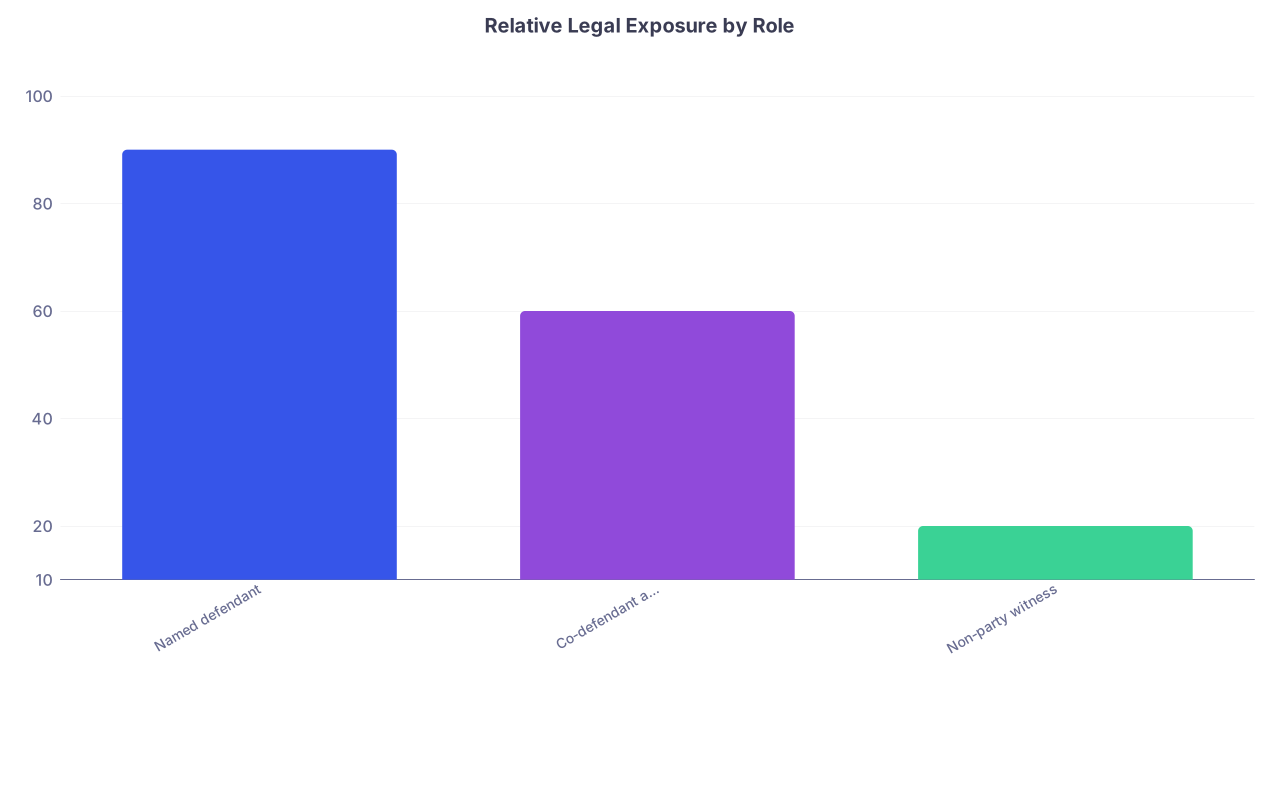
| Category | Value |
|---|---|
| Named defendant | 90 |
| Co-defendant among many | 60 |
| Non-party witness | 20 |
(That’s conceptual exposure, not a scientific metric, but you get the idea.)
3. Treat prep like studying for an OSCE, not a moral judgment
You are learning:
- The record
- The plaintiff’s story
- How to answer surgically, not emotionally
It’s a skill. Not a referendum on whether you deserve to wear a white coat.
What Actually Happens After the Deposition
Your brain probably stops the movie at “I bomb the deposition and my life ends.” But life continues.
Realistic paths after your deposition:
- Plaintiff’s attorney realizes the case is weaker than they hoped → case gets dropped or settles low
- Case continues to expert review / more discovery
- There’s a mediation somewhere down the line
- A tiny fraction go to trial, years later
You:
- Go back to work the next day
- Stop waking up every night about the exact wording of one answer
- Maybe get scheduled for a follow-up meeting with your lawyer
- Maybe never hear anything substantive for months
You’ll probably carry some emotional residue. That’s normal. But the acute terror dulls.
Tiny, Unsexy Things You Can Do That Actually Help
Nothing glamorous. Just boring, protective habits.
- Keep your documentation decent going forward. Future-you will thank you.
- If a bad outcome happens, debrief, but don’t “edit” the chart retroactively. Late entries need to be clearly marked as late.
- Pay attention when risk management or GME does sessions about malpractice. They’re usually better than you think.
- Check that you understand your malpractice coverage: occurrence vs claims-made, limits, tail coverage when you leave. Even as a trainee, knowing this calms some of the money panic.

| Step | Description |
|---|---|
| Step 1 | Adverse Event |
| Step 2 | Complaint Filed |
| Step 3 | Insurer Assigns Attorney |
| Step 4 | Discovery and Depositions |
| Step 5 | Case Dropped or Low Settlement |
| Step 6 | Mediation or Settlement |
| Step 7 | Trial |
| Step 8 | Case Closed |
| Step 9 | Case Strength? |
FAQ: The 6 Questions You’re Probably Still Too Anxious to Ask Out Loud
1. Can I lose my medical license just because of one malpractice case?
Extremely unlikely. State medical boards care more about:
- Repeated negligent behavior
- Substance diversion
- Criminal conduct
- Dishonesty
A single malpractice case, especially from residency, does not usually trigger license revocation. Could a really bad pattern of behavior plus a major case lead to board scrutiny? Yes. But that’s not the default outcome.
2. Do residency or fellowship programs see every lawsuit I’m involved in?
Not automatically. Internal QA reviews are usually confidential. NPDB reports are about payments, not “this person was involved in a lawsuit as a resident once.” When you apply to jobs or privileges, you’ll be asked to disclose malpractice history, and they may run NPDB queries. One case, honestly explained, is not a dealbreaker for most reasonable programs.
3. What if I say something wrong in my deposition? Can I fix it?
You can’t just “take it back,” but:
- There’s usually a transcript you can review later for minor corrections (spelling, obvious errors)
- At trial (if it ever goes that far), your attorney can help you clarify or explain ambiguous answers
- Your defense attorney is there during the deposition to object to problematic questions and sometimes coach you during breaks
Is it ideal to misspeak? No. Is one awkward answer the end of everything? Also no.
4. Am I allowed to be coached by my attorney? Isn’t that dishonest?
Preparation isn’t dishonesty. You’re not rehearsing lies; you’re learning:
- How to answer truthfully without speculating
- How to avoid traps in vague or leading questions
- How to stay within your actual knowledge and memory
Everyone in the legal system knows witnesses need prep. The only unethical line is lying. Don’t cross that. Everything else is skill-building.
5. Will my malpractice insurance actually cover me as a resident, or am I secretly exposed?
If you’re in an accredited training program in the US, you almost certainly have coverage through:
- The hospital/health system
- The university
- Occasionally a state liability system
You can (and should) ask GME:
- What are our malpractice limits per claim?
- Is it occurrence or claims-made?
- Do I have tail automatically when I leave?
You’re not being annoying by asking. You’re being smart.
6. Is it better to settle quickly so it “goes away,” or fight to clear my name?
Your ego wants to “fight.” Your nervous system wants it to “go away yesterday.” The reality:
- Settlement decisions are made by the insurer, with input from you and your attorney
- Sometimes settling is rational, risk-averse, and not an admission that you’re a terrible doctor
- Sometimes the defense genuinely believes the case is strong and worth fighting
You can absolutely tell your lawyer your preferences and concerns. But don’t let pride alone drive this. Malpractice litigation is a financial and risk game, not a purity test of your worth.
Open your email right now and find the last message from risk management or your malpractice carrier. Create a simple one-page document for yourself with: your policy type, limits, and your contact at the insurance company or risk office. Having that info in one place won’t erase the fear of depositions—but it will stop your brain from jumping straight to “I’m alone and I’ll be ruined” the next time a legal-looking email pops up.