
Scared of Being Sued: How Much Malpractice Insurance Do I Really Need?
What actually happens if you get hit with a $3 million lawsuit and your malpractice policy only covers $1 million per claim?
That’s the nightmare scenario, right? Not the vague “malpractice is scary” thing, but the specific: judge bangs the gavel, verdict is bigger than your coverage, and suddenly you’re imagining losing your house, your savings, your future.
If your brain is spiraling there, you’re not crazy. I’ve watched residents and new attendings obsessively Google “malpractice tail”, “limits per claim vs aggregate”, “can they take my house” at 2 a.m. between shifts. You’re in good company.
Let’s talk about how much malpractice insurance you actually need — not the fluffy “ask a professional” non-answer, but real numbers, real risk, and what’s actually plausible vs what’s just your anxiety screaming.
First: What Does “$1M / $3M” Actually Mean?
This is the part no one explains clearly and then you feel dumb for asking. Don’t. Most people pretend they know.
Typical malpractice limits are written like this:
- $1M / $3M
- $2M / $4M
- $500k / $1.5M
That’s per-claim / per-year aggregate.
So for a $1M / $3M policy:
- The insurer will pay up to $1,000,000 for any single claim
- Over all claims combined in a single policy year, they will pay up to $3,000,000 total
If you get one lawsuit in a year: max $1M.
Three separate lawsuits that each settle at $1M in the same year: you hit your $3M annual cap.
Now the question your brain is asking:
“So what happens if the jury says I owe $2M and my limit is $1M per claim?”
Short answer:
- Insurance pays up to your limit.
- Theoretically, the rest is on you.
- Practically, it’s more complicated and usually less catastrophic than the nightmare in your head.
We’ll get there.
How Much Do Most Doctors Actually Carry?
Let’s set some benchmarks so you’re not deciding in a vacuum.
| Setting / Role | Common Limits (per claim / per year) |
|---|---|
| Resident/Fellow (hospital-paid) | $1M / $3M |
| Academic attending (hospital-employed) | $1M / $3M or $2M / $4M |
| Community hospital-employed | $1M / $3M |
| Private practice (low-risk specialty) | $1M / $3M or $2M / $4M |
| Private practice (high-risk specialty) | $2M / $4M or higher |
In a lot of states, $1M / $3M is the default “standard” limit. Hospitals and large groups often negotiate that into their credentialing rules.
So if you’re worrying, “Am I insane if I don’t carry $5M / $10M?”, you’re already seeing the answer: most people don’t. Even people doing high-risk things like OB or neurosurgery aren’t routinely running around with $10M policies.
But that still leaves the real question: is $1M / $3M enough for me?
Your Worst-Case Scenario Brain vs Reality
Let’s be honest: your inner monologue sounds like this:
“What if:
- I miss a diagnosis, the patient dies, and the jury is furious?
- News cameras, angry family, sympathetic plaintiff… They award $10 million.
- My policy covers $1M. Do I lose everything? Do they garnish my wages forever? Can I even practice?”
I’ve watched this spiral play out so many times.
Here’s what actually tends to happen in the real world:
Most cases settle within policy limits.
Plaintiff attorneys are not idiots. They usually target the policy limits, because that’s the money that’s easiest to collect. If you have $1M, they’re very motivated to settle for something like $800k–$1M instead of rolling the dice at trial where you might win or they might get less or spend years appealing.Truly massive “runaway” verdicts are rare, and often reduced.
Yes, you see the eye-watering headlines: $20M, $35M, $50M verdict.
Behind the scenes: appeals, remittiturs (judge reducing the award), structured settlements, confidential resolutions. The final number that actually changes hands is often way lower than the headline figure.Plaintiff lawyers follow the money.
They want the insurance check, not your old Corolla and 407-page PSLF paperwork. They generally don’t want to chase personal assets that may be protected anyway or cost a ton in legal wrangling.
Are there exceptions where a verdict goes well above the limits and there’s personal exposure? Yes. Rare, but not fictional. It’s just not the default outcome.
How Bad Is It If the Verdict Is Higher Than Your Limits?
This is the heart of the anxiety. Let’s talk about the doomsday version honestly.
Say your policy is $1M / $3M. You go to trial. Jury says: $3M judgment against you.
What can happen, in theory:
- Insurer pays $1M (your per-claim limit).
- There’s $2M left unpaid.
- That “excess judgment” is legally your problem.
Now, what happens to you depends on:
- Your state’s laws about homestead protection, retirement account protection, wage garnishment limits
- Your actual net worth (not your student loans — your real assets)
- Whether the plaintiff will chase that excess judgment or negotiate it down
Here’s the part almost no one tells anxious residents:
If you’re a young physician with huge loans and minimal assets, you are not some giant pot of money. You’re… complicated and expensive to chase.
Yes, it’s scary on paper. But a plaintiff attorney deciding whether to keep sinking years of effort trying to squeeze personal money out of a new attending with $300k in loans and modest savings? Not nearly as attractive as just taking the sure insurance payout.
When huge personal assets are at stake (paid-off house in a state with weak protections, big brokerage account, multiple properties), the anxiety about excess verdicts starts to make more sense. But a ton of residents and new attendings are catastrophizing like they’re all secret millionaires. They’re not.
So How Much Do You Actually Need?
This is where you want a straight answer, not “it depends”. So I’m going to be as direct as possible, with the understanding that yes, states differ, carriers differ, blah blah.
For Residents and Fellows
If your hospital or program provides $1M / $3M occurrence coverage (or claims-made with tail covered), that’s usually:
- Standard
- Reasonable
- Not something you can easily change anyway
You being a PGY-2 and trying to buy an extra umbrella malpractice policy on top? Overkill, 99% of the time. If you’re moonlighting, though, that’s different — your moonlighting contract needs explicit malpractice coverage, often with similar limits.
For Hospital-Employed Attendings
Most hospital-employed physicians are on:
- $1M / $3M or sometimes $2M / $4M, with the institution owning the policy.
You generally:
- Don’t pick the limits yourself
- Should read the contract to see if the hospital covers tail if you leave
- Should stop mentally punishing yourself for not manually upgrading the limit the hospital already standardized across the whole medical staff
If you’re not personally paying the premium, your control is limited. And that’s okay.
For Private Practice / Independent Contractors
This is where you actually make choices, and your anxiety explodes.
Common starting point for most low/moderate-risk outpatient-only specialties:
- $1M / $3M as a floor
- $2M / $4M if you’re in a highly litigious area or doing more invasive stuff/procedures
Very rough, opinionated rule of thumb:
Outpatient psych, derm (no big procedures), allergy, primary care without OB:
I’d be comfortable at $1M / $3M, seriously consider $2M / $4M if cost difference is small.Hospital medicine, ED, anesthesia, surgery, OB/GYN, neurosurgery, interventional cardiology, etc.:
I’d aim for at least $1M / $3M, strongly consider $2M / $4M, and see what’s “normal” in your area.
Here’s a visual just to ground this:
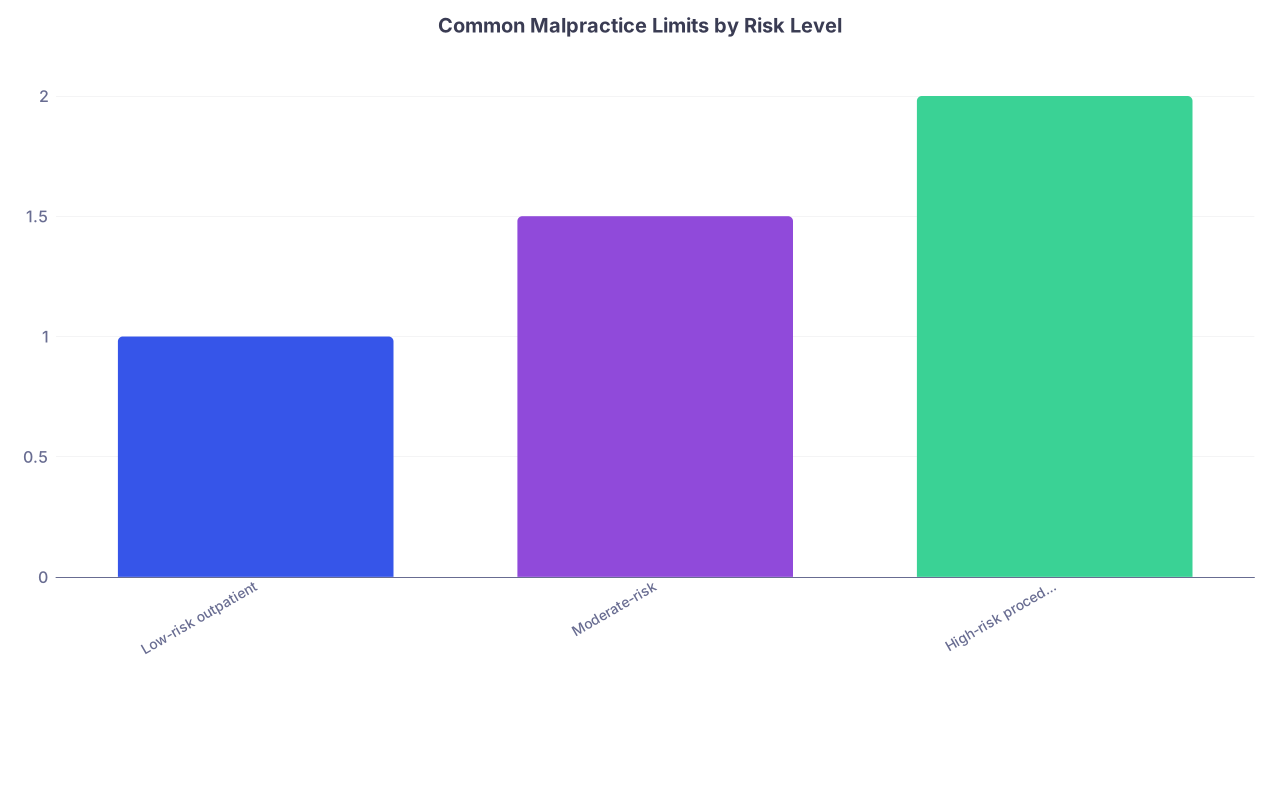
| Category | Value |
|---|---|
| Low-risk outpatient | 1 |
| Moderate-risk | 1.5 |
| High-risk procedural | 2 |
(Values are rough “typical per-claim limit in millions,” not a law of nature.)
If you’re losing sleep, and the jump from $1M / $3M to $2M / $4M is a few thousand a year, there is absolutely a mental health argument for buying the higher limit just so you can stop obsessively checking forums at night.
Claims-Made, Tail, Occurrence: The Part Everyone Hates
You can’t talk about “how much” without making sure you’re not missing the time question.
Very fast, no fluff:
Occurrence policy
Covers any incident that happened during the policy year, no matter when they sue you.
You don’t need tail. More expensive annually.Claims-made policy
Covers claims that are made while the policy is active, for incidents after the retroactive date.
When you leave that job or switch carriers, you need tail (or the new carrier to provide “prior acts” coverage).
The nightmare scenario here isn’t “not enough limit,” it’s “no coverage at all because I didn’t have tail.”
I’ve seen early-career docs genuinely not understand tail, leave a job, and then find out later that:
- They were supposed to buy their own tail (tens of thousands of dollars)
- They didn’t
- A claim shows up for care they provided years earlier
That’s… bad. That’s “uninsured” bad.
If your anxiety is loud, spend as much energy understanding who pays tail as you do arguing with yourself about $1M vs $2M limits.
How to Decide Without Going Insane
Let me be blunt: you’re never going to get a perfect, airtight guarantee that “nothing bad can ever happen.” That’s not what insurance does. That’s not what medicine is.
But you can make a rational, defensible choice that matches your real risk and lets you sleep.
Here’s a simple mental framework:
What do similar docs in my setting carry?
If every hospitalist in your region is on $1M / $3M and credentialing is based on that, you’re not wildly under-insured compared to peers.How much do I actually own that’s exposed?
Renting, heavy student debt, minimal savings, retirement accounts mostly protected under law?
Your “worst-case” real-world exposure is lower than your anxiety is telling you.What is my actual risk profile?
- High-risk OB vs outpatient derm is not the same universe.
- If you’re regularly doing things that can cause catastrophic injury/death, higher limits make more sense.
What does the price jump look like?
Ask your broker:- “Quote me $1M / $3M and $2M / $4M. What’s the annual difference?”
If the difference is small and your brain is spinning out nightly, paying for more coverage purely as anxiety protection is completely reasonable.
- “Quote me $1M / $3M and $2M / $4M. What’s the annual difference?”
Am I clear on tail coverage?
- Does my employer pay tail? In writing?
- If not, how much would my tail likely cost?
Not knowing this is way more dangerous than whether your limit is $1M vs $2M.
Here’s a quick, honest snapshot:

Malpractice vs Personal Assets: Can They Take My House?
This is the next catastrophic thought: “They’ll take my house. I’ll be bankrupt. I’ll never recover.”
Reality: it depends insanely heavily on your state laws.
Some states (like Florida, Texas) have strong homestead protections, meaning your primary residence is very hard to touch. Others are weaker. Retirement accounts are often heavily protected. Some states cap wage garnishment. It’s messy.
If you’re seriously worried:
- Talk to a local attorney who knows both malpractice and asset protection.
- Ask very specific questions:
“If I get a judgment above my malpractice limits, what personal assets are realistically at risk here in [state]?”
You’ll probably discover that:
- A good chunk of your “net worth” is either legally protected or, practically, not worth the fight to chase.
- You’re catastrophizing based on some generalized horror story that doesn’t even match your state’s rules.
I’ve seen docs rearrange assets (e.g., pay down primary residence, use certain retirement vehicles) for extra reassurance. That’s a different, often smarter way to handle long-term fear than just buying comically high malpractice limits you don’t need.
The Hidden Risk: Bad Contracts and Gaps
What actually freaks me out more than “$1M vs $2M” is seeing people sign contracts where:
- The employer provides claims-made coverage but you pay for tail
- Tail can be 2–3x your annual premium
- If you leave after 2–3 years as a new attending, they stick you with a giant tail bill you weren’t expecting
Or worse:
- Moonlighting without clear written malpractice coverage
- Assuming your main policy covers a side gig (it probably doesn’t)
This is where a simple timeline view can help you see the bigger picture:
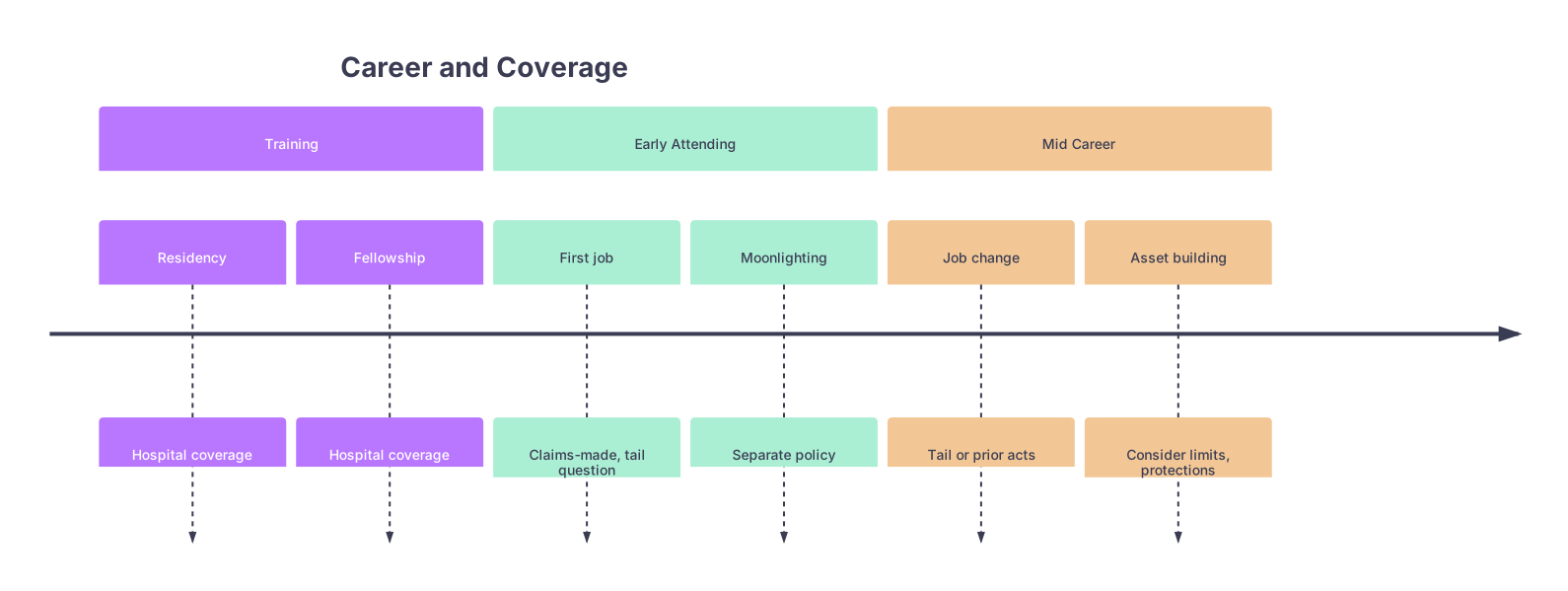
| Period | Event |
|---|---|
| Training - Residency | Hospital coverage |
| Training - Fellowship | Hospital coverage |
| Early Attending - First job | Claims-made, tail question |
| Early Attending - Moonlighting | Separate policy |
| Mid Career - Job change | Tail or prior acts |
| Mid Career - Asset building | Consider limits, protections |
If you want somewhere to channel your anxiety productively, focus on:
- Getting contract language reviewed
- Understanding tail
- Making sure every clinical thing you do is explicitly covered by some policy
That has more real-world impact than obsessing over another extra million in limits.
Quick Reality Check vs Your Anxiety
Let me pull this together as straight as I can:
- No, you are probably not under-insured if you have $1M / $3M as a resident or hospital-employed attending.
- Yes, if you’re in a high-risk specialty — especially in private practice — getting $2M / $4M or whatever is standard in your area is reasonable and not paranoid.
- No, the default outcome of being sued is not “lose everything and live under a bridge.” The vast majority of cases resolve within policy limits, and plaintiff attorneys aren’t dying to chase your personal checking account.
- Yes, you should be more worried about gaps in coverage and tail than about a theoretical $20M verdict landing exactly on your head with no reduction or settlement.
One more helpful comparison:
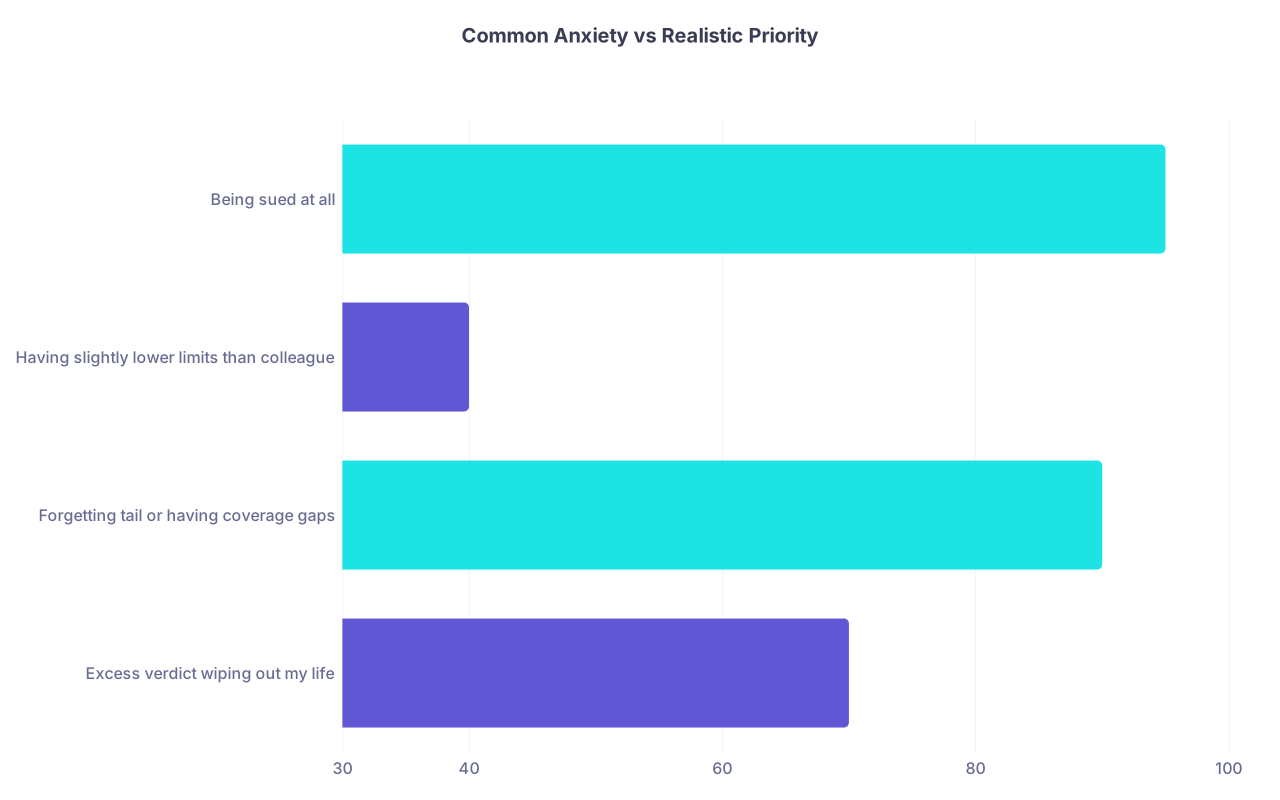
| Category | Value |
|---|---|
| Excess verdict wiping out my life | 70 |
| Forgetting tail or having coverage gaps | 90 |
| Having slightly lower limits than colleague | 40 |
| Being sued at all | 95 |
(Values are “how much people should worry” out of 100, not science — just perspective. Tail and gaps should scare you more than micro-differences in limits.)
When to Get Professional Help (And What to Ask)
You do not need to become an insurance actuary to survive this. But you also shouldn’t blindly sign whatever your broker suggests.
Talk to:
A malpractice-focused broker and ask:
- “What is standard coverage in my specialty and region?”
- “Show me quotes for $1M / $3M and $2M / $4M. What’s the actual difference?”
- “Is this claims-made or occurrence? Who’s paying for tail if I leave?”
Optionally, a local attorney if you have real assets or are in a super-litigious state:
- “If I had a judgment above my policy limits, what could they realistically touch?”
- “Are there simple asset protection strategies I should do now as a new attending?”
You’re not asking them to erase risk. You’re asking them to right-size it.
Final Takeaways (So Your Brain Can Calm Down a Bit)
Three core points to walk away with:
- Standard limits like $1M / $3M are not some reckless joke. They’re what a huge chunk of physicians actually use, especially in training and hospital-employed roles.
- Your bigger real-world risks are gaps and tail, not whether your limit is $1M or $2M. Focus on making sure you’re continuously covered, and know who pays for tail.
- If higher limits are affordable and you’re genuinely losing sleep, it’s okay to buy peace of mind. Just don’t let anxiety convince you you’re one policy mistake away from guaranteed financial ruin. You’re not.