
The biggest malpractice insurance mistake mid‑career physicians make is not about limits. It is dropping or mishandling prior acts coverage and losing protection on old cases they already treated.
If you do not understand prior acts coverage and retroactive dates cold, you are one bad renewal decision away from writing a very large personal check.
Let me break this down specifically.
The Core Concepts: Prior Acts, Retro Dates, Claims-Made, Tail
You cannot talk about protecting “old cases” without nailing four terms: claims‑made, occurrence, retroactive date, and tail. Miss one, and the rest of the discussion turns into mush.
Claims‑Made vs Occurrence (why this matters for old cases)
Most physicians now are on claims‑made malpractice policies. A minority (especially some hospital-employed docs) are on occurrence policies.
Simplified:
Occurrence policy:
If the incident happened during the policy period, you are covered, no matter when the claim comes in. The policy year that covered the treatment responds, even if you have long since left practice or changed insurers.Claims‑made policy:
The policy that is in force when the claim is made responds, as long as:- The alleged incident happened after the policy’s retroactive date, and
- The policy is active (or properly extended with tail) when the claim is reported.
For protecting old cases, claims‑made is where people get hurt. Occurrence is simple: each year is self-contained. Claims‑made is not.
Retroactive Date: The “Start Line” of Coverage
The retroactive date (also called “retro date” or “prior acts date”) is a specific date printed on your declarations page. It tells the insurer:
“We will cover claims reported during this policy, as long as the underlying treatment occurred on or after this date.”
That retro date is your coverage start line. Everything before it is uninsured under that policy. Everything after it can be covered, if the claim is reported while coverage is active (or during a tail).
If your current policy says:
- Policy term: 01/01/2026–01/01/2027
- Retroactive date: 07/01/2013
Then a claim made today about a surgery you did in 2015 is potentially covered. A claim about a surgery from 2010 is not.
When you see “prior acts coverage,” it almost always means: “We will honor your earlier retro date from a previous policy and roll it into this new policy.”
Tail Coverage: The Bridge After You Stop
With claims‑made coverage, if you:
- cancel your policy,
- retire,
- switch insurers, or
- move to occurrence coverage with no prior acts,
you risk standing exposed to claims for care you already delivered.
Tail coverage (extended reporting period endorsement):
- Extends the time during which you can report claims after the policy ends
- But only for incidents that occurred between the retroactive date and the end date of that policy
Example:
Claims‑made policy with retro date 01/01/2015; policy ends 12/31/2025.
Tail endorsement purchased from 01/01/2026 onward (often “unlimited”).
A 2028 claim about a 2020 surgery? Covered.
A 2012 surgery? Still not covered—outside the retro date.
So you protect old cases in one of two ways:
- Prior acts coverage on the new policy (carry the retro date forward), or
- Tail coverage from the old insurer (freeze that period and keep it reportable).
Lose both, and all your old care is naked.
How Prior Acts Coverage Actually Works
There is a lot of mythology about prior acts. Let me strip it down to what actually happens when you change carriers or contracts.
Scenario 1: You Switch Insurers, Same Practice, Same Scope
Classic example: You are a 45‑year‑old OB/GYN, insured with Carrier A for 10 years. Practice is stable, you just want better pricing or a stronger company, so you move to Carrier B.
What matters:
- Old policy: Claims‑made, retro date 07/01/2014
- New policy: Claims‑made, effective 07/01/2024
You tell Carrier B, “I need full prior acts.” If they agree, your new declarations will say something like:
- Policy period: 07/01/2024–07/01/2025
- Retroactive date: 07/01/2014
That single line preserves a decade of exposure. Every case you did since 2014 is now under Carrier B, as long as the claim is reported while B is in force (or under B’s tail later).
If Carrier B instead sets retro date = 07/01/2024, those 10 years are lost unless you purchase a separate tail from Carrier A.
Scenario 2: You Join a Group That Provides Coverage
You were in solo practice with your own claims‑made policy. Then a hospital-employed or large group job offers “we provide malpractice.” Translation: they put you on their group policy, usually with a new retro date—the day you start employment.
Your prior solo work? Not covered by the group’s policy unless they explicitly agree to pick up your prior acts and set your retro date to match your original.
Many groups will not do that. Or they “think” they are but the documents do not reflect the old retro date.
So you must solve the prior period yourself:
- Either your new employer negotiates prior acts coverage for you (best option), or
- You buy tail from your previous carrier for all work up to the date you join the group.
If you do neither, every case from your solo years is exposed.
Scenario 3: You Leave a Group and Go Back to Solo Practice
The reverse problem. You were under the group’s claims‑made coverage, often with the policy owned by the entity, not you. You leave. They stop covering you.
Questions I ask physicians in this situation:
- Who is responsible for tail—group or you? (Check your contract. The indemnification and insurance sections.)
- Is the group willing to keep you insured for prior acts under their policy for some period?
- Will your new solo carrier pick up prior acts and match the old retro date?
Three typical outcomes:
- Group pays for tail. Done. You start your new solo policy with a fresh retro date and sleep well.
- Group refuses to pay tail, and you pay it yourself. Again, fresh retro date on new policy is fine.
- Group refuses to pay tail, you refuse or cannot afford it, and your new carrier will not provide prior acts for the group period.
That third path is how people end up losing protection on years of work.
Retroactive Dates in Detail: Where People Get Burned
The retro date looks like a small technicality. It is not. Changing it—even once—can wipe out massive exposure you thought was covered.
Reading Your Declarations Page (properly)
Every year you get a declarations page. Most physicians glance at the limits and premium and toss it.
You should systematically check:
- Policy type: Claims‑Made vs Occurrence
- Retroactive date: One date? Multiple dates by coverage type?
- Named insured: You individually, your entity, both?
- Limits: Per claim / aggregate
If you see:
- “Retroactive date: None” on a claims‑made policy, that usually means: retro date = policy effective date. No prior acts.
- A later retro date this year than last year, that is a serious red flag. Someone reset your history.
Prior Acts “Gaps” and Mistakes
Common landmines I have actually seen:
Gap during a job change
You finish with Carrier A on 06/30. New job policy with Carrier B starts 07/15. Two-week gap. A claim from care delivered on 07/05 (moonlighting, locums, or extended practice) finds no active claims‑made policy later that includes that date of occurrence within its retro period. That 07/05 case may be uncovered unless a tail or prior acts endorsement specifically included it.Misaligned retro dates among multiple states or entities
Surgeon expanding into another state; carrier adds a separate policy layer for the second state with a new retro date. Later, a claim comes from an early case in that second state, pre‑retro. No coverage on the second-state policy, and the first policy never endorsed that location/procedure.“Nose” coverage misunderstanding
Some carriers informally say, “we’ll cover your nose” (their slang for prior acts). Then the written policy comes with a fresh retro date. If you do not reconcile what the underwriter said with what the policy actually shows, you own that mistake.
Multiple Retro Dates: Different Exposures
Larger groups or complex practices sometimes have different retro dates for:
- Individual physician professional liability
- Entity coverage (the practice name)
- Ancillary professionals (NPs, PAs, CRNAs)
- Certain high‑risk procedures added later
You might have:
- Dr. Smith retro date: 01/01/2010
- Entity retro date: 01/01/2015
- OB surgery add‑on retro date: 01/01/2018
A claim from 2012 involving a system failure (scheduling, clearance, records) might trigger entity exposure. If the entity retro date is 2015, the practice itself may not have coverage for its portion of the liability. You individually do, but the group might not.
You need to know where each line starts.
Tail vs Prior Acts: When to Buy Which
Let me make this binary for you.
If you are changing carriers and the new carrier will give you a retro date that matches your original:
- Generally you do not need tail from the old carrier.
- The exposure is effectively transferred to the new policy.
If the new carrier refuses to provide prior acts (or only partially):
- You must protect the uncovered period with a tail from the old carrier.
| Feature | Tail Coverage (Old Policy) | Prior Acts (New Policy) |
|---|---|---|
| What it extends | Time to report claims | Time period of covered incidents |
| Who issues it | Old insurer | New insurer |
| Protects old cases? | Yes, within old retro–end window | Yes, if retro date matches original |
| Needed when changing carriers? | Only if new carrier will not match retro date | Yes, if you want to avoid tail cost |
Cost and Negotiation Reality
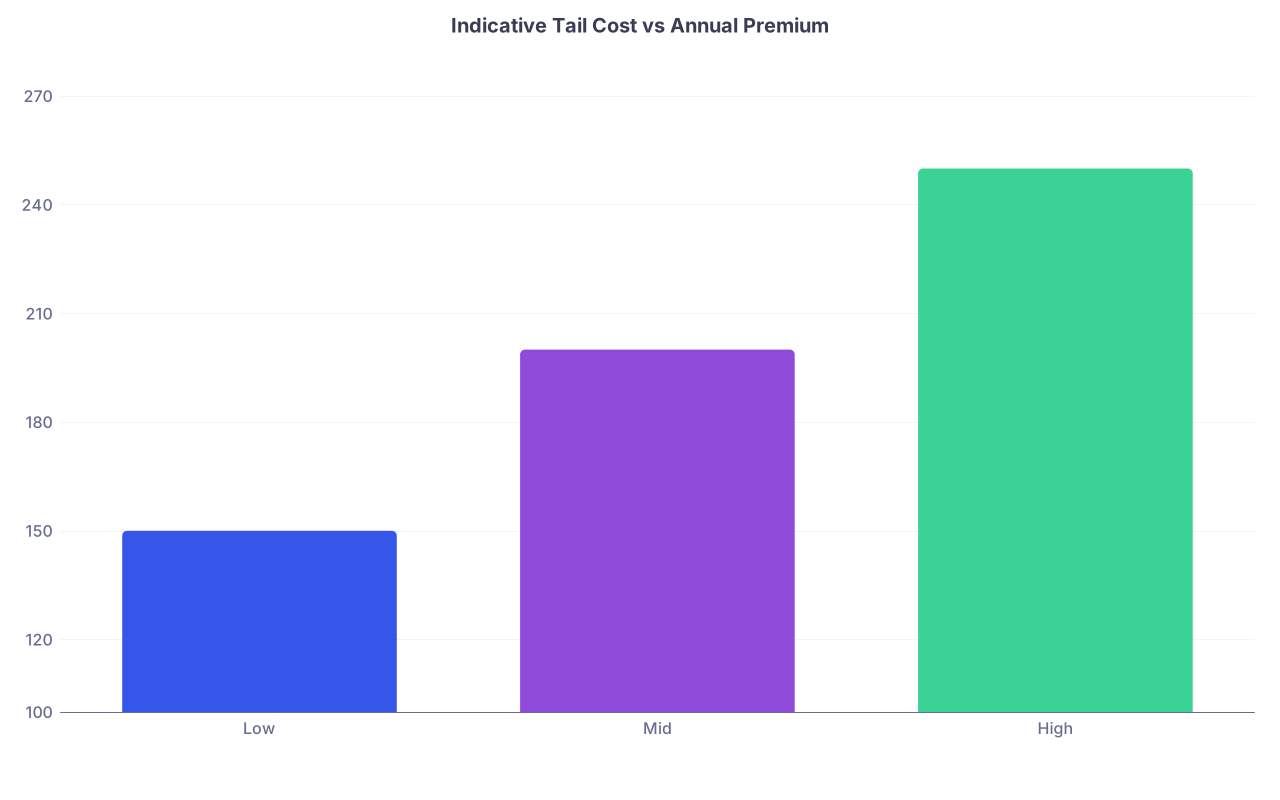
Tail is not cheap. Typical range: 150–250% of the last annual premium, sometimes more in high‑risk specialties (OB/GYN, neurosurgery, interventional cards).
So if your premium is $40,000/year, tail can easily be $60,000–$100,000+.
| Category | Value |
|---|---|
| Low | 150 |
| Mid | 200 |
| High | 250 |
That is why prior acts coverage is so attractive. You dodge a six‑figure tail bill. But you must get it in writing as a retro date on the new policy, not just a marketing promise.
A few nuances:
- Some carriers offer free tail at retirement if certain conditions are met (age, number of years continuously insured, permanent cessation of practice). If you qualify, that is extremely valuable.
- Some employment contracts state: “Physician is responsible for tail upon termination.” That is not negotiable if you sign it and walk away uninterested. You need to address that when you still have leverage—before you join.
- Occasionally, a new employer will agree to cover the cost of your prior tail as a signing benefit. That should be spelled out explicitly and timed with your carrier’s tail offer deadlines.
Practical Risk Scenarios: How Old Cases Slip Through
It helps to see how this plays out in real life, not just in legalese.
Scenario A: The Laparoscopic Cholecystectomy from 6 Years Ago
You did a lap chole in 2019. Patient had a bile duct injury. They did not sue immediately. Complaints simmered. You moved states in 2022, changed carriers, did not get prior acts, and did not purchase tail because “nothing had ever happened.”
2026: demand letter arrives.
- New carrier policy retro date: 01/01/2022
- Old retro date: 01/01/2014
- No tail purchased
The 2019 incident is:
- After your old retro date, so if old policy were still open, it would have covered it.
- Before your new retro date, so new carrier will deny.
- Outside any tail, because you decided to “take the risk” and skip it.
You are personally exposed.
Scenario B: The Pediatric Group Breakup
Pediatrician in a 6‑doc group. The group policy is claims‑made, retro 01/01/2012. Contract says:
- If physician leaves voluntarily, physician pays for individual tail.
- If terminated without cause, group covers tail.
You leave voluntarily in 2025 for a hospital job. Nobody reads the contract. No tail purchased. Hospital employs you, puts you on an occurrence policy starting 2025—no prior acts.
Three years later, a case arises from a missed meningitis diagnosis in 2023. The group might still have entity coverage for that time. But your personal coverage for that incident ended when you left, and no tail was activated. The hospital policy has no prior acts.
You will have an ugly conversation with your former group, their carrier, and your attorney about whether anyone will defend you. You are now relying on goodwill and policy ambiguity instead of simple contractual protection.
Scenario C: The Part‑Time Locums Work
Hospitalist does locums six weekends a year while employed full‑time elsewhere. The full‑time job provides claims‑made coverage, retro 07/01/2018. Locums company also provides coverage, but only on an occurrence form for the locums shifts.
Later, you leave the full‑time job and buy a simple claims‑made policy for your new private practice with a new retro date 01/01/2026. You do not buy tail for the old job because your agent says, “you have continuous coverage now.”
Problem:
A claim comes in from 2021 for inpatient care you provided under the old full‑time job.
- Old job: no tail purchased.
- New practice policy: retro 2026, so 2021 work is excluded.
- Locums occurrence policy: irrelevant for that case; it only covered specific locums shifts.
Your “continuous coverage” was an illusion. Retro date changed. Old job period is stranded.
How to Audit and Protect Your Old Cases
Here is how I walk physicians through a practical protection audit. This is not theory. This is the checklist you should actually pull up with your documents in front of you.
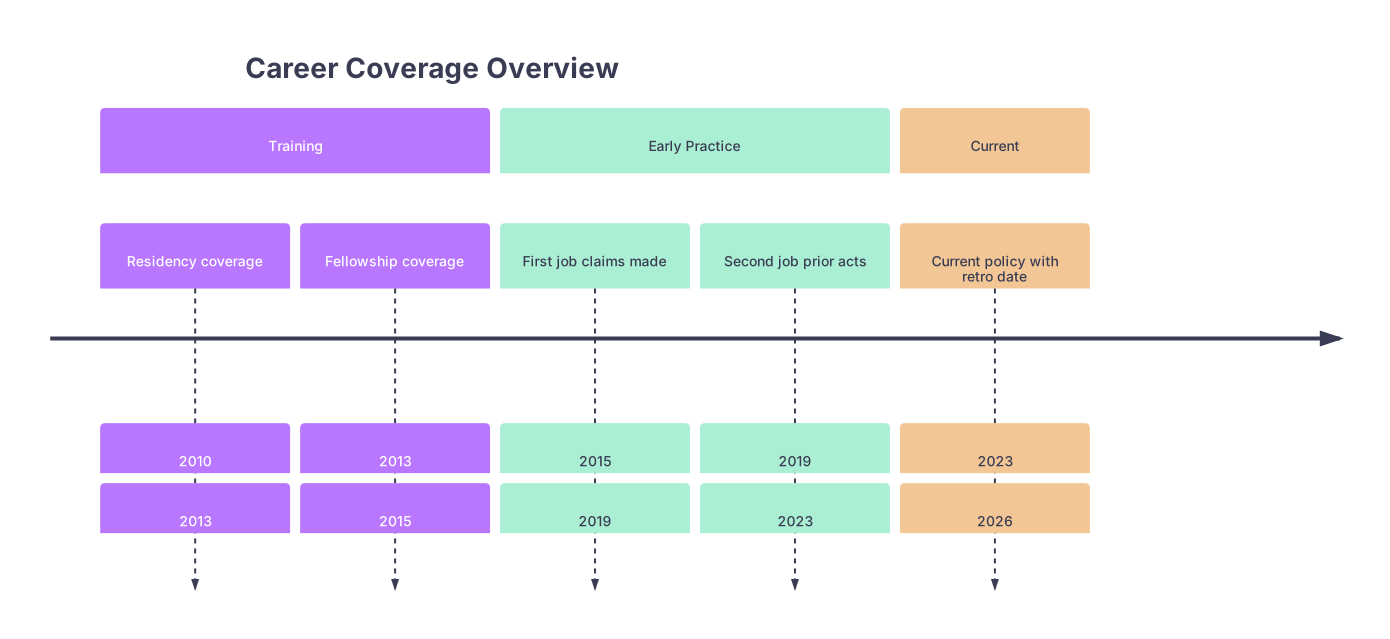
Step 1: Assemble Your Coverage Timeline
Create a simple timeline from residency to today:
- Each position (residency, fellowships, jobs, solo practice, locums)
- Start and end dates
- Who provided coverage (carrier name, or employer-provided, or locums pool)
- Policy type (claims‑made vs occurrence)
- Retroactive date for each claims‑made policy
- Whether a tail was purchased when coverage ended
It usually spans 10–30 years. Most physicians have gaps in their memory after 4–5 changes. Do the hard work of digging up old policies or letting your broker help.
| Period | Event |
|---|---|
| Training - Residency coverage | 2010 |
| Training - Fellowship coverage | 2013 |
| Early Practice - First job claims made | 2015 |
| Early Practice - Second job prior acts | 2019 |
| Current - Current policy with retro date | 2023 |
Step 2: Match Retro Dates and End Dates
For each period:
- If coverage was occurrence, that segment is self‑contained. Old cases from that timeframe remain covered by that year’s policy.
- If coverage was claims‑made, ask:
- What is the retro date?
- When did that coverage end?
- Was tail purchased? Or was there a subsequent policy that picked up prior acts and preserved that retro date?
You are hunting for any period where:
- You stopped a claims‑made policy,
- Did not buy tail, and
- Did not start a new policy with a retro date reaching back to cover the whole earlier period.
That is where old cases are naked.
Step 3: Identify High‑Exposure Zones
Not all years are equal. Prioritize:
- High‑risk specialties or procedures (OB, bariatric, spine, interventional, high‑acuity ED)
- High‑volume periods
- Times when you changed scope: added OB, added surgery, started doing injections, etc.
- Jurisdictions with longer statutes of limitations and discovery rules, especially for minors
For example:
- A pediatrician who saw neonates from 2015–2020 in State X with long tolling for minors has exposure for years after the last visit.
- An orthopedist doing spine fusions with hardware from 2016–2022 may see hardware failure or infection claims many years later.
If any of those high‑risk years overlap with a questionable retro/tail situation, you fix those first.
Step 4: Repair What You Can
If you discover a true gap—claims‑made period, no tail, no current prior acts extending that far back—you have limited options, but not zero.
Potential steps:
- Ask your current carrier if they are willing to issue a retro date revision to pick up earlier years (this usually involves underwriting review and a substantial premium adjustment).
- Approach the prior carrier and ask about a late tail (extended reporting) purchase. Technically, many carriers set strict deadlines, but some will make exceptions with conditions.
- Explore stand‑alone prior acts or supplemental coverage through a specialty broker. This market is thin and expensive, but for catastrophic risk years, it may be better than nothing.
Do not expect miracles. But you would be surprised how often a carrier would rather collect premium and button up exposure than leave a physician fully uncovered and adversarial.
Financial and Legal Angles You Cannot Ignore
This conversation lives at the intersection of law and finance. Both matter.
Statutes of Limitations and Discovery Rules
Every state has:
- A statute of limitations: how long after the injury the patient has to file, and
- A statute of repose or discovery rule: special rules for when the clock starts, especially for minors or late-discovered injuries.
You do not need to memorize each state’s law, but you must understand directionally:
- Pediatric cases can be brought a decade or more after initial care in many states (because the clock can start at majority).
- Foreign body, delayed diagnosis, and some cancer claims can also present years later.
So when you consider whether it is “worth” buying tail or paying extra to preserve a broader retro date, you base that on:
- How long reasonably significant claims may still be brought, and
- The severity potential of your field.
Contractual Risk Allocation
Your employment contract and partnership agreements often say explicitly:
- Who owns the policy
- Who pays premiums
- Who pays tail on termination, with or without cause
- Whether the group will maintain coverage for prior acts for departing partners
You need to read it like a lawyer, not like a physician trying to get through page 11. Two phrases I watch closely:
- “Physician shall be responsible for any costs associated with continuing, extended reporting, or tail coverage…”
- “Group shall maintain claims‑made coverage for incidents arising during the period of physician employment…”
These drive real dollars. A 2‑year contract that ends with you on the hook for $90,000 in tail changes the economics of the job.
Practice Sales, Mergers, and Entity Exposure
When a practice is sold or merged:
- The buyer may demand proof that the seller has either:
- Adequate tail coverage for prior activities, or
- A carrier willing to carry prior acts into the combined entity policy.
If you are the seller and you skimped on prior acts or delayed tail purchase, it can literally kill the deal or come out of your sale price.
Putting It All Together: Operating Rules for Protecting Old Cases
Let me condense this into operating rules you can actually follow. Not slogans—actions.
Never change carriers or jobs without verifying how your retro date will be handled in writing.
That means your new declarations page should show a retro date equal to your earliest relevant start of practice, or you should have a tail for periods not included.Do not rely on “continuous coverage” as a concept.
Continuous coverage is meaningless if the retro date changes. You can have 20 years of uninterrupted premiums paid and still lose protection on 15 of them if someone reset the retro date five years ago.Treat tail cost as part of your compensation math from day one.
If an employer says, “You pay tail if you leave,” mentally discount your compensation by a pro‑rated share of the likely tail. Then negotiate.Audit your own career coverage timeline now, not at retirement.
Catching a gap 2 years after it opens is much easier to fix than 12 years later when a lawsuit finally arrives.Use a malpractice‑savvy broker or attorney; do not DIY complex switches.
This is one of those areas where you really can do everything right clinically and still get destroyed by a technicality in a contract you misunderstood.
Quick Summary: The Non‑Negotiables
Three points to remember:
Your retroactive date is the key to protecting old cases. If that date is later than when you started practice, some of your old work is uncovered unless there is a tail backing it up.
Prior acts coverage and tail coverage are interchangeable tools for the same job. Either your new policy honors your old retro date (prior acts), or your old policy extends reporting for that period (tail). Between the two, there should be no exposed years.
Every job change, carrier switch, or practice sale is a malpractice event. Treat it with the same seriousness you give to a high‑risk procedure: clear plan, documented coverage, and no assumptions.
Get those right, and your past cases stop being a financial landmine and become what they should be—part of your career history, not your future liability.