
You are sitting in your new office on a Thursday evening. HR just emailed you a PDF titled “Certificate of Insurance” with a declaration page attached. Your credentialing packet is due tomorrow, your hospital wants proof of limits, and your group’s practice manager just said, “You looked it over, right? Looks fine?”
You scroll through the document and see:
- Named Insured
- Retroactive Date
- Claims-Made
- Shared Limit Endorsement
- Tail Coverage: See Endorsements
You understand about two of those. But you are about to stake your license, your finances, and your future on what is written on that one page.
Let me walk through this like I would with a new attending who just joined a private group. Line by line. What each item actually means on the ground. And where people get burned.
1. What the Declaration Page Really Is (and Why It Matters)
The declaration page (“dec page”) is the executive summary of your malpractice policy. If the rest of the policy is the 60-page contract, the dec page is the cover sheet the jury will see first when the plaintiff’s attorney asks, “Doctor, what coverage did you carry?”
It tells you, at a glance:
- Who is insured
- What type of coverage you have (claims-made vs occurrence)
- The limits of liability (per claim and aggregate)
- The policy period and retroactive date
- Where you are covered (jurisdictions)
- What kind of work is covered
If you only ever read one page of your malpractice policy, it should be this one. But you need to understand each line like you understand an ABG. Misread one number, and you are in trouble.
2. Top Block: Insurer, Policy Number, and Policy Period
This is usually the header. People skip it. Mistake.
Insurer Name and Type
You will see something like:
- MedPro Group
- The Doctors Company
- State Volunteer Mutual Insurance Company
- XYZ Risk Retention Group
You want to know:
- Is this an admitted carrier in your state or a surplus lines / non-admitted carrier?
- Is this a physician-owned mutual, a commercial carrier, or a risk retention group (RRG)?
Admitted carriers are regulated by the state insurance department and your state guaranty fund may protect you if the company fails. Non-admitted carriers and many RRGs are not backed by the guaranty fund. If your group stuck you with a shaky RRG, that has real risk.
If the dec page lists “XYZ Risk Retention Group, domiciled in Vermont, eligible for purchase in [your state] under Risk Retention Act,” your coverage may be cheaper but less stable. I have watched RRGs go insolvent mid-career. It is not fun to clean up.
Policy Number
Looks like a throwaway. It is not. This number:
- Is what your hospital and credentialing departments use to verify coverage
- Is what goes on COI requests
- Is what you quote when there is a claim or a legal hold
You do not need to memorize it, but you need to know where it lives. Screenshot the dec page and file it with your other legal/financial documents.
Policy Period
You will see something like:
- Effective Date: 07/01/2025
- Expiration Date: 07/01/2026
This is the window during which:
- For claims-made: you must both perform the service and have the claim reported (unless you have tail or prior acts / retro coverage)
- For occurrence: you must perform the service during this period (claim can be filed later)
We will come back to this when we talk about retro dates and tail.
3. Named Insured, Additional Insureds, and “Who is Actually Covered”
This is where a lot of employed physicians get surprised.
Named Insured
Look for a line that says:
- Named Insured: John A. Smith, MD
or - Named Insured: Premier Cardiology Associates, LLC
If only the entity is listed, and your name appears nowhere else, you are likely an insured “by endorsement” or via a schedule attached to the policy. That is not inherently bad, but you need written proof you are included.
Ideally, you see:
- Named Insured: John A. Smith, MD
- DBA / Entity: Premier Cardiology Associates, LLC
or you see a clear schedule of insured physicians attached, with your exact legal name and designation (MD, DO, DPM, etc).
Possible landmine: Being “covered under the group’s policy” verbally, but not properly scheduled as an insured. I have watched plaintiffs’ attorneys try to argue the individual was not an insured or had different limits.
Individual vs Shared Coverage
Some dec pages are explicit:
- Coverage Type: Individual
or - Coverage Type: Shared Limit with Group
If you see “Shared Limits” or “Shared Aggregate,” it means your per-claim and aggregate limits may be shared with other physicians under the same policy. If your partner has three big cases that hit the policy in one year, the remaining aggregate for you may be smaller.
That matters.
| Feature | Individual Policy | Shared Group Limit |
|---|---|---|
| Per-claim limit | $1M per physician | $1M shared per incident |
| Annual aggregate | $3M per physician | $3M total for the whole group |
| Impact of partner's claims | No direct effect | Reduces remaining aggregate |
4. Coverage Type: Claims-Made vs Occurrence
This line decides whether you are going to buy a tail policy later. Read it carefully.
You will see one of:
- Coverage Form: Claims-Made
- Coverage Form: Occurrence
Claims-Made
Most physicians today, especially in high-risk specialties, are on claims-made policies. On the dec page it might look like:
- Policy Type: Claims-Made
- Retroactive Date: 07/01/2020
- The service must be performed after the retroactive date
- The claim must be reported while the policy (or tail / extended reporting period) is in force
If you leave the job or switch carriers, you either:
- Buy tail from the old carrier, or
- Get the new carrier to cover your prior acts back to your original retro date
Ignore this and you can have a multi-year gap where you are totally naked.
Occurrence
Occurrence coverage says:
- If the incident occurred during the policy period, you are covered — even if the claim is filed years later
On the dec page:
- Policy Type: Occurrence
- No retroactive date line
Occurrence policies are more expensive annually. But you typically do not need tail when you leave. Many large hospital systems stopped offering true occurrence policies years ago because of cost.
If your dec page says “Occurrence,” but there is also a retroactive date, stop. You are likely misreading, or this is a hybrid or some marketing nonsense. Traditional occurrence policies do not have retro dates.
5. The Retroactive Date: The Most Dangerous Single Line
On a claims-made dec page you will see:
- Retroactive Date: 07/01/2020
That date is the line in the sand. For anything you did before that date, the policy does not respond. Example:
- You started practice in 2018
- You bought your own policy in 2020 with retro date 07/01/2020
- A 2019 case surfaces in 2026
If there is no prior policy covering 2019, and your current policy’s retro is 2020, you have zero coverage for that claim. None. That is how people lose houses.
Common traps:
Switching employers
You move from Hospital A to Group B. Group B’s agent sets up a new claims-made policy with retro date = your hire date. They never pick up prior acts. Your years at Hospital A become uncovered unless Hospital A maintained tail / extended reporting for you.Switching carriers
Your group changes carriers for lower premium. New carrier sets a retro date at the effective date of the new policy instead of your original career start date. Huge problem.
What you want to see when you switch carriers mid-career:
- Original policy: Retroactive Date 07/01/2015
- New policy dec page: Retroactive Date 07/01/2015
That is continuity. Anything else, I would challenge in writing.
6. Limits of Liability: Per Claim and Aggregate
This is the number your hospital privileging form usually asks for.
You will see something like:
- Each Claim (Per Incident): $1,000,000
- Annual Aggregate: $3,000,000
Or $2M / $4M, or $500k / $1.5M. Depends on state norms and specialty.
Per Claim (Per Occurrence) Limit
This is the maximum the insurer will pay for any single claim, including:
- Indemnity (settlement / judgment)
- Often certain defense costs, depending on whether defense is inside or outside limits
If your limit is $1M and a jury returns a $3M verdict, the insurer cuts a check for $1M. Plaintiff can go after you personally for the remaining $2M. In reality, many plaintiffs’ attorneys will settle at the limit to avoid that mess, but not always.
Aggregate Limit
This is the total the insurer will pay for all claims during the policy year. If your limit is $3M aggregate, and you have three separate $1M payouts in one year, there is nothing left for a fourth claim.
Shared aggregate policies spread that $3M across every doctor on the policy. You do not want to be partner number six in a group that just went through a bad run.
Defense Inside vs Outside Limits
This often is not spelled out cleanly on the dec page. Sometimes you see:
- Coverage includes defense costs outside the limits
or conversely:
- Defense costs are included within the limits of liability
Defense-outside-limits is better. If defense costs erode your limits, a prolonged, expensive defense can eat into that $1M before you even get to settlement.
If the dec page is silent, check the policy wording.
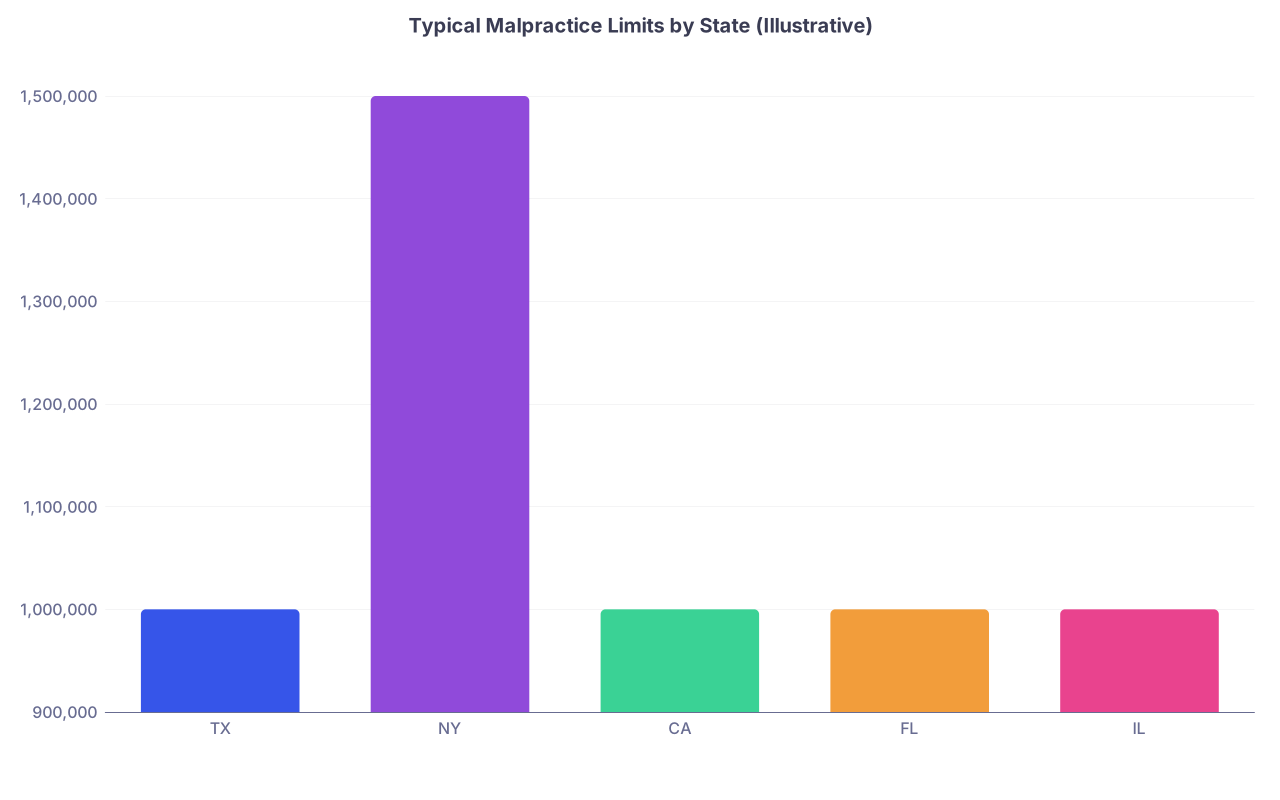
| Category | Value |
|---|---|
| TX | 1000000 |
| NY | 1500000 |
| CA | 1000000 |
| FL | 1000000 |
| IL | 1000000 |
7. Deductibles, Self-Insured Retentions, and Your Skin in the Game
Many individual physician policies have no deductible. But group policies and high-risk practices often do.
Dec page examples:
- Deductible: $0
- Deductible: $25,000 per claim
- Self-Insured Retention (SIR): $250,000 per claim
Deductible vs SIR are not identical, but the practical upshot for you:
- Deductible: Insurer pays first and then bills back the deductible to the policyholder
- SIR: Policyholder pays the first layer; insurer kicks in above that amount
If you are an employee, you want in writing who is responsible for the deductible or SIR. Buried in your employment contract HR may have slipped in “physician is responsible for malpractice deductible up to X per claim.” I have seen it.
Check: if your dec page lists a $100k SIR, and your contract does not explicitly say the group pays it, you are exposed.
8. Covered Jurisdictions and Scope of Practice
Territory (Where You Are Covered)
Dec page may list:
- Coverage Territory: United States of America, its territories, and Canada
or - Coverage Territory: State of [X] only
Telemedicine has complicated this. If you are reading studies across state lines, doing tele-ICU, or licensed in multiple states, you must confirm the policy territory. Dec page sometimes has a short line, with more detail in an endorsement attached.
Red flag: You practice in multiple states, but dec page lists only one. Fix that before a claim, not after.
Specialty / Class Code
There is often a line like:
- Classification: Internal Medicine – Hospitalist
- Classification Code: 321 – Obstetrics / Gynecology – Surgery
- Insured Specialty: Diagnostic Radiology
Premium, underwriting, and in some cases coverage hinge on this classification. If your dec page says “Internal Medicine – No Procedures” and you are regularly doing moderate sedation, central lines, or endoscopy, that mismatch becomes a problem.
I have witnessed carriers deny coverage or reserve their rights when the doc’s actual practice was far outside the listed classification.
If your practice changes (e.g., you start doing interventional pain procedures), the dec page and underlying policy must be updated. You notify the carrier, they update classification, they adjust premium. Annoying, but necessary.
9. Endorsements: Where the Traps Hide
At the bottom or on a separate page you see:
- Endorsements Attached:
- Prior Acts Coverage
- Locum Tenens Coverage
- Shared Limits Endorsement
- Exclusion – Obstetrical Services
- Extended Reporting (Tail) Endorsement
Endorsements modify the main policy. They can add coverage or carve it out. The dec page often lists them by number or short name only, which is infuriating but standard.
A few common ones you should not gloss over:
Prior Acts (Nose Coverage) Endorsement
If you switched from Carrier A to Carrier B, you want an endorsement that says something like:
- This policy provides coverage for professional services rendered on or after 07/01/2017, the retroactive date shown, regardless of when this policy incepts.
That is your prior acts coverage. It allows the new carrier to handle claims from years back, as long as they are after the retro date and reported while the new policy is active.
If there is no such endorsement and the dec page’s retro date is recent, ask questions.
Tail (Extended Reporting Period) Endorsement
If you have left a job and purchased tail, the tail itself will have a dec page. It will say:
- Type: Extended Reporting Endorsement
- Reporting Period: Unlimited
- Retroactive Date: [Original retro date]
- Effective: 07/01/2026 to Unlimited
Your tail dec page is the document you will be asked to produce ten years from now when a late case surfaces. Keep it like you keep your diploma.
If you think your employer “took care of your tail,” you should see your name and retro date on a tail endorsement or continuation certificate. If you do not see it, you should not assume anything.
Exclusions (The Silent Killers)
Endorsements with words like “Exclusion,” “Limitation,” or “Restriction” are alarms. For example:
- Exclusion: Bariatric Surgery
- Exclusion: Obstetrical Services
- Exclusion: Invasive Procedures
If your practice touches anything that smells like the excluded item, you are skating without coverage. I have seen ER docs with policies excluding “Obstetrical services including labor management.” Unsurprisingly, L&D calls them all the time.
If the dec page references such an exclusion, pull the full text of that endorsement and read every line.
10. Claims-Made Traps: Tail, Switching Jobs, and Gaps
Let us pull some of this together with real-world scenarios.
Scenario 1: Leaving a Group, No Tail Purchased
You are an employed surgeon on a claims-made policy:
- Retro date: 08/01/2019
- You leave: 08/01/2025
- Group refuses to buy tail; your contract is silent on who pays
If you do not personally buy tail, coverage ceases 08/01/2025. A case from 2024 that gets filed in 2026? No coverage. The dec page from your old policy will show an expiration date of 08/01/2025, and no tail endorsement.
When you join the new hospital, they may give you coverage only “for professional services rendered on or after 08/01/2025.” That language appears on the dec page via the retro date. Your 2019–2025 window is naked unless someone bought a tail.
Scenario 2: Switching Carriers but Keeping Retro Date
You are a hospitalist, originally with Carrier A:
- Policy A: Claims-Made
- Retro date: 07/01/2018
Your group switches to Carrier B in 2023. The dec page for Carrier B should show:
- Retroactive Date: 07/01/2018
If it instead shows 07/01/2023, that is a problem. That means Carrier B will only cover services occurring after 07/01/2023. Everything before 2023 either needs tail from Carrier A or prior acts endorsement in B. The retro date on the dec page is the tell.
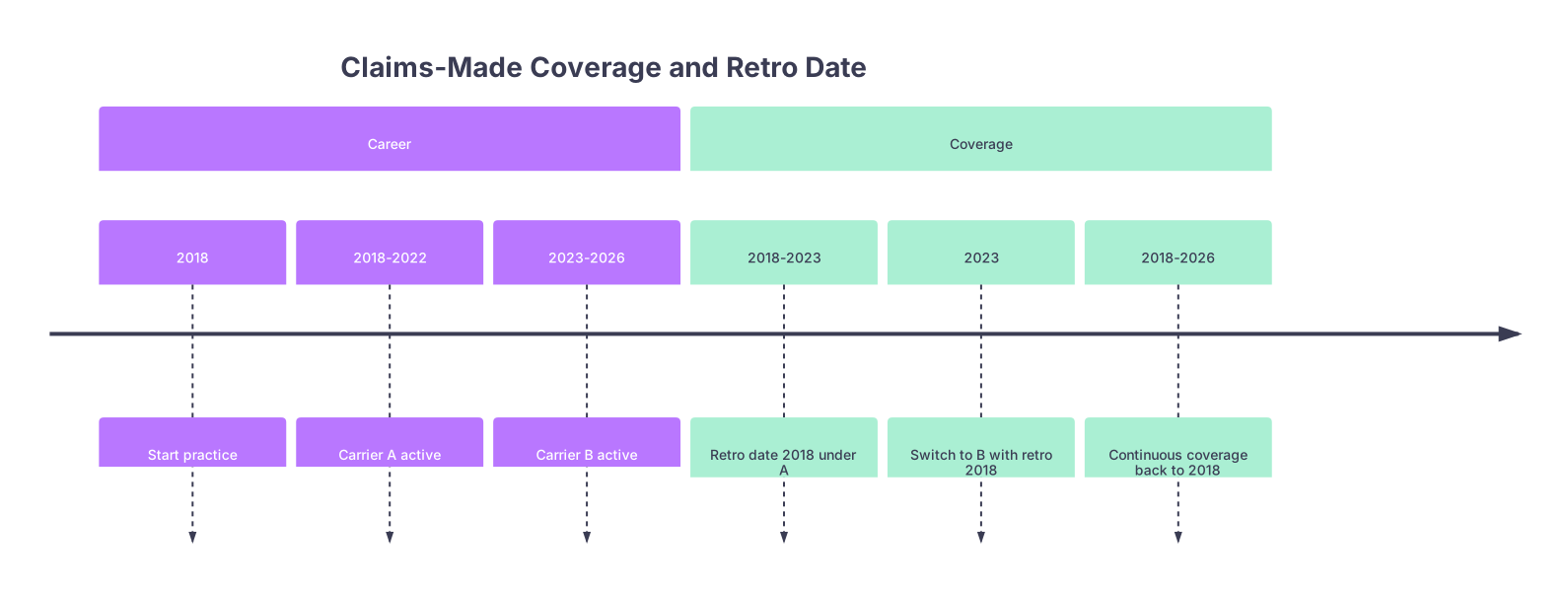
| Period | Event |
|---|---|
| Career - 2018 | Start practice |
| Career - 2018-2022 | Carrier A active |
| Career - 2023-2026 | Carrier B active |
| Coverage - 2018-2023 | Retro date 2018 under A |
| Coverage - 2023 | Switch to B with retro 2018 |
| Coverage - 2018-2026 | Continuous coverage back to 2018 |
11. Reading the COI vs the Full Dec Page
Hospitals and credentialing committees often accept a “Certificate of Insurance” (COI). That is a one-page summary usually generated by the agent. It is useful, but not gospel.
Differences:
- COI is evidence of coverage, not the contract
- Dec page is part of the contract itself
Things COIs often omit or oversimplify:
- Exact retroactive date
- Defense inside vs outside limits
- Specific exclusions
- Deductible or SIR structure
If there is a discrepancy between COI and dec page, the dec page and underlying policy win. I have seen COIs list wrong limits or wrong effective dates. When in doubt, you want the actual dec page issued by the carrier, not just an agent’s COI.
12. Key Lines to Check Before You Sign a Contract
Let me be blunt. Before you sign an employment agreement, you should demand to see:
- A sample or current dec page for the policy you will be on
- Any tail or extended reporting endorsement if they claim they provide it after separation
And then, on that dec page, you verify:
Coverage Type: Claims-Made or Occurrence
Retroactive Date:
- If you are early-career with no prior coverage, it can match your hire date
- If you are mid-career with prior coverage, either they:
- Agree in writing to pay for your prior tail, or
- Show a retro date that matches your original start in practice
Limits of Liability:
- Do they meet hospital minimums (often $1M/$3M)?
- Are they individual or shared across the group?
Deductible / SIR:
- Is there one?
- If yes, does your contract explicitly say the employer pays it?
Named Insured and your status:
- Are you individually named or scheduled?
- Is your entity (if you have one) covered too?
Endorsements:
- Any major exclusions that conflict with what they expect you to do?
- Any prior acts or tail endorsements that actually match what is being promised?
You can review this in 10 minutes once you have done it once or twice. It is not complicated; it is just unfamiliar.
13. Quick Example: Walking Through a Sample Dec Page
Let’s build a simplified sample and decode it.
- Carrier: MedSecure Mutual Insurance Company
- Policy Number: MP-2025-123456
- Named Insured: Sarah K. Lee, MD
- Practice Entity: Lee Rheumatology, PLLC (Additional Named Insured)
- Policy Type: Claims-Made
- Policy Period: 01/01/2025 – 01/01/2026
- Retroactive Date: 07/01/2020
- Limits of Liability: $1,000,000 Each Claim / $3,000,000 Aggregate
- Deductible: $0
- Coverage Territory: United States
- Classification: Rheumatology – Office and Hospital
- Endorsements:
- Prior Acts Coverage – Effective 07/01/2020
- Locum Tenens Coverage
- Exclusion – Obstetrical Services
What I see, line by line:
- Good: Individual named insured and her entity covered
- Claims-made with retro date 07/01/2020: covers back to mid-2020
- If she started practice 07/01/2020, perfect; if she started 2018, I’d ask where 2018–2020 is covered
- Limits are standard and likely acceptable to most hospitals
- Deductible is zero, so she is not paying out of pocket per claim
- Territory is broad enough for multistate telemedicine (assuming licenses exist)
- Specialty classification matches what she actually does; if she starts doing infusion center procedures with sedation, I’d confirm if still within class
- OB exclusion is irrelevant to rheumatology; harmless
Now imagine the same dec page but:
- Retroactive Date: 01/01/2025
- Endorsements: None involving prior acts
If she has been practicing since 2020, she now has a four-and-a-half-year gap in coverage. That is how an “it looks fine” dec page becomes a disaster.
14. Putting It All Together
Most physicians treat the declaration page like boilerplate. Skim it, forward to HR, move on. That is a mistake.
You should be able to look at a dec page and quickly answer:
- Do I know exactly from what date forward I am covered?
- Do I know whether my coverage follows me after I leave (tail or occurrence)?
- Do I know my limits, and whether I share them with anyone?
- Is anyone quietly shifting deductibles or self-insured layers onto me?
- Is the policy aligned with what I actually do and where I actually do it?
If any of those answers are “I think so, but I am not sure,” then you do not really understand your dec page yet.
Key Takeaways
- The retroactive date on a claims-made declaration page is the hinge. If it moves forward when you change jobs or carriers and no tail is bought, you are uncovered for your prior years.
- Do not rely on verbal assurances. Confirm coverage type, limits (and whether they are shared), deductibles, and exclusions directly on the dec page and associated endorsements.
- Before signing an employment contract, insist on seeing the actual dec page you will be under, and make sure what it says about coverage, tail, and responsibility for deductibles matches what is in your agreement.