
The most dangerous thing about moonlighting is not the clinical risk. It is thinking you’re covered when you’re absolutely not.
If you’re moonlighting and you’re not 100% sure who is insuring that work, for how much, and under what conditions, you’re playing liability roulette. Let’s fix that.
Step 1: Ask the Only Question That Matters First
Forget the fine print for a second. Start here:
Who is the named insured for my moonlighting work?
There are only three realistic answers:
- The hospital/group/locums company you’re moonlighting for
- Your residency program / training institution
- You personally (you bought your own moonlighting policy)
If you cannot point to a document that clearly shows which of those three is true, assume you are not covered until proven otherwise.
Do this today:
- Pull your residency contract and GME malpractice policy summary
- Pull your moonlighting contract (or offer letter, or PRN agreement)
- Ask for a Certificate of Insurance (COI) from whoever says they’re covering you
No COI = no reliable coverage. I’ve seen residents told “Yeah, you’re covered under the hospital’s policy” and then discover that policy only covers employed physicians, not independent moonlighters.
Step 2: Understand the 3 Most Common Coverage Setups
Most moonlighting arrangements fall into one of these buckets:
| Setup Type | Who Usually Covers You | Risk Level |
|---|---|---|
| In-house hospital moonlighting | Hospital or system policy | Lower (if in writing) |
| Outside moonlighting as resident | Separate employer policy | Medium–high |
| Independent 1099 / locums moonlighting | Locums company or your own policy | High if assumed, not verified |
Let’s walk them quickly.
1. In-house moonlighting (same hospital/system)
Example: You’re an IM resident picking up extra shifts as a hospitalist in the same hospital.
Possible coverage setups:
- You’re covered by the hospital’s main malpractice policy as a “moonlighting physician”
- You’re covered under the residency program’s malpractice only if:
- The work is approved internal moonlighting
- The hours stay within GME limits
- The scope matches your training level
Red flag I see all the time: Policy says “coverage only applies to activities within the scope of an approved educational program.” Pure service moonlighting does not qualify. Residents find this out when legal reviews the claim. Not before.
2. Outside moonlighting (different hospital/clinic)
Example: You’re an EM resident moonlighting at a rural ED unaffiliated with your program.
Here’s the rule: your residency malpractice almost never follows you off-site for non-educational work. If someone tells you otherwise, get it in writing from risk management, not a verbal “yeah, it should be fine.”
Coverage usually has to come from:
- The outside hospital/clinic employing you
- A locums agency placing you there
- Your own individual moonlighting policy
If that outside site says, “We’ll credential you under our policy, no problem” — that’s not enough. You want a COI with:
- Your name
- Limits of liability
- Whether it is claims-made or occurrence
- Policy period
3. 1099 / independent contractor moonlighting
This is where people really get burned.
You’re paid on a 1099 as an “independent contractor.” That phrase should immediately make you ask: “Who is providing malpractice coverage for this work?”
Common setups:
- Locums company provides malpractice (often claims-made, sometimes bare minimum limits)
- Group provides malpractice for partners/ICs
- No coverage provided — you’re expected to buy your own
If your contract says something like “Physician shall maintain malpractice insurance at his/her own expense,” that means it’s YOUR job to secure coverage. If you don’t, you’re effectively uninsured.
Step 3: Verify the 6 Key Pieces of Coverage
Once you know who is supposed to cover your moonlighting work, you need to know what that coverage actually looks like.
Here’s what to check. Not guess. Check.
1. Type of policy: Claims-made vs Occurrence
This matters more than most residents realize.
- Occurrence: Covers incidents that happen during the policy period, no matter when the claim is filed. No tail needed. Better for simplicity.
- Claims-made: Covers claims filed while the policy is active, for incidents after the retro date. If a claim comes in after the policy ends, you’re naked unless you have tail coverage.
Most employer-provided coverage for moonlighting is claims-made.
So ask directly:
“Is the malpractice coverage for my moonlighting work claims-made or occurrence?”
If it’s claims-made, follow-up questions:
- Who is responsible for tail coverage if I leave?
- Will you provide written confirmation of tail coverage at termination?
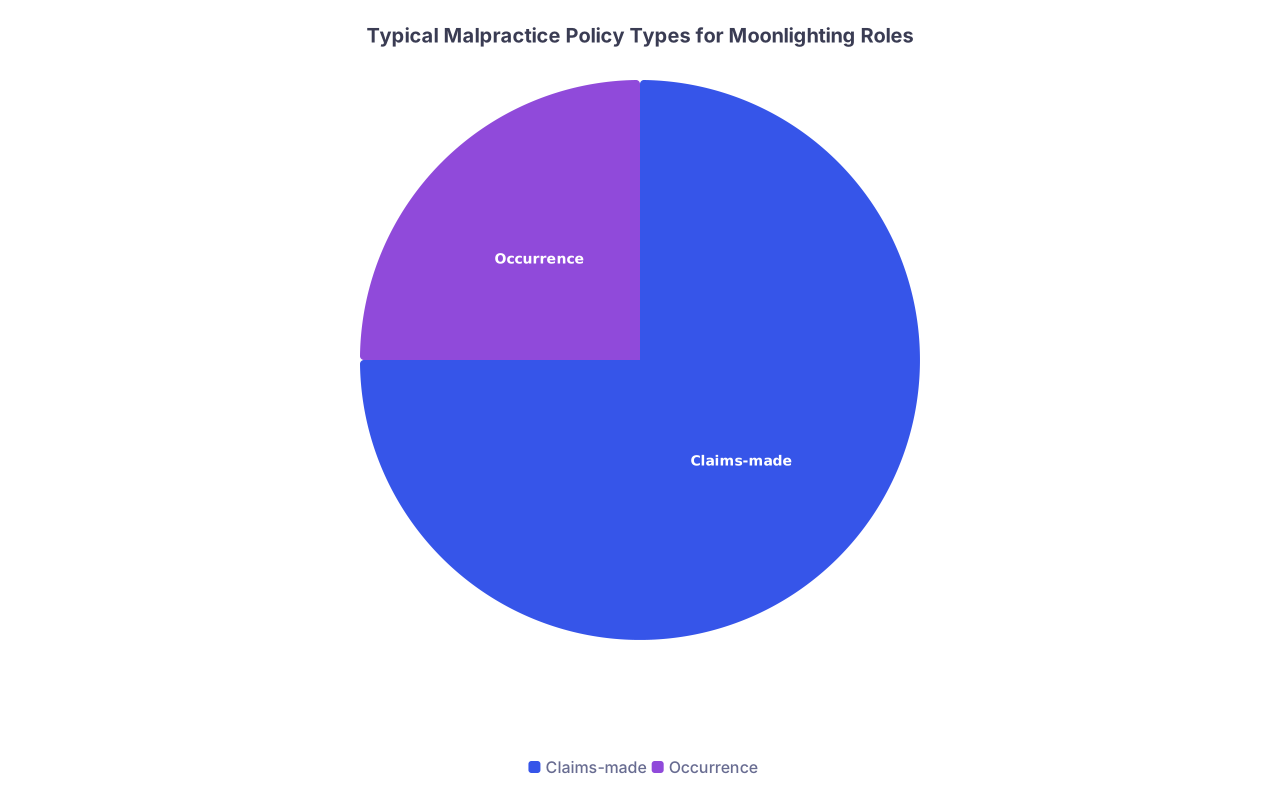
| Category | Value |
|---|---|
| Claims-made | 75 |
| Occurrence | 25 |
2. Limits of liability
You’ll see something like:
- $1M / $3M (common)
- $2M / $4M (more generous)
- $500k / $1.5M (tight, in some rural/community settings)
First number = per claim
Second number = per policy year aggregate
You want to know:
- Are the limits shared with a group (bad) or individual to you (better)?
- Are the limits in line with typical coverage in that state and specialty?
If you’re doing high-risk work (OB, EM, surgery) on low limits, understand that you personally can be targeted beyond those policy limits.
3. Named insured and additional insured
Look at the COI or policy:
- Are you explicitly named?
- Or are you just assumed as “any provider” under a broad group policy?
Best case: You are either the named insured or you have written confirmation that moonlighting physicians are covered as part of the group policy, with no exclusion for residents, trainees, or independent contractors.
4. Scope of practice and location
Policies are not magic blankets. They’re constrained.
You need to know:
- Are you covered at every physical location you’re working?
- Are you covered for the exact role you’re performing? (hospitalist vs ICU vs urgent care vs telemedicine)
- Any explicit exclusions that might apply? (e.g., “no OB coverage,” “no procedures beyond X,” “no telehealth out of state”)
Common failure: IM resident starts moonlighting in an ICU as “moonlighting hospitalist” but then regularly manages vents and central lines beyond what the policy considers normal scope. When things go bad, the insurer looks for any reason to deny or limit.
5. Time frame and retroactive date
For claims-made coverage, check:
- Policy start and end dates
- Retroactive date (the date from which the policy will cover incidents)
If you change moonlighting gigs:
- Does the new policy pick up your old retro date?
- Or do you need tail for the old one?
Do not assume “the hospital will take care of it.” Some will. Many won’t. And tail can be brutally expensive — often 1.5–2x the annual premium.
6. Who pays for tail coverage?
This is the question almost no resident asks, and then they’re stunned at the bill.
If your moonlighting coverage is:
- Claims-made
- And not provided by your main future employer (e.g., new attending job)
Then someone has to buy tail if you want protection for later-filed claims.
Look in your contract for phrases like:
- “Employer shall provide tail coverage upon termination” (good)
- “Physician shall be solely responsible for securing and paying for tail coverage” (you’re paying)
- “Each party responsible for its own tail” (you, again)
Step 4: Spot the “You Think You’re Covered but You’re Not” Traps
Here are the most common traps I’ve seen in real life:
Trap 1: “Our residency malpractice covers you everywhere.”
Reality: Residency malpractice almost always restricts coverage to approved educational activities. Moonlighting usually is excluded.
Trap 2: “The group has malpractice, so you’re fine.”
Reality: Some group policies cover only partners or W-2 employees. 1099 docs are expected to bring their own.
Trap 3: “You’re under our coverage as long as you’re credentialed.”
Reality: Being credentialed ≠ being insured. They’re related but not the same. Always confirm with risk/HR and get a COI.
Trap 4: “Everyone else here just uses the hospital’s policy.”
Reality: “Everyone else” is not a legal guarantee. If it’s not in writing, assume nothing.
Trap 5: “We offer malpractice, but no tail.”
Reality: That’s a time bomb. Claims will come in years later. If there’s no tail and you did high-risk work, that’s on you.
Step 5: How to Actually Confirm Coverage (Script Included)
If you’re not a natural confrontation person, use a script. Email is best so you have documentation.
Send this to:
- The moonlighting site’s medical director or HR
- Or the locums recruiter
- Or your program director / GME office for internal moonlighting
Here’s a template you can tweak:
Hi [Name],
I want to confirm the details of malpractice coverage for my moonlighting role at [site].
- Who is the malpractice carrier, and am I specifically covered under that policy?
- What are the policy limits, and is it claims-made or occurrence?
- If it is claims-made, who is responsible for tail coverage when I leave?
- Are there any restrictions on locations, procedures, or scope of practice that would affect my coverage?
Could you please send a current Certificate of Insurance reflecting this coverage and confirming my inclusion under the policy?
Thank you,
[Your Name]
If they dodge, delay, or send vague answers, that’s a red flag. At minimum, stop picking up shifts until you get clarity.
Step 6: When You Should Strongly Consider Your Own Policy
Sometimes the cleanest solution is: buy your own moonlighting malpractice policy.
You should seriously consider this if:
- You’re doing multiple moonlighting gigs across different sites
- You’re 1099 with no clear employer-provided coverage
- You’re in higher-risk fields (EM, OB, surgery, anesthesia)
- You don’t trust that tail will be handled correctly by others
- You want one consistent policy that follows you regardless of gig
Typical setup:
- Claims-made policy with a retro date you keep renewing
- Limits like $1M / $3M (or higher depending on state/specialty)
- Optional tail if you ever stop moonlighting
Yes, it costs money. But compare that to your future earnings and the cost of a single uncovered lawsuit. It is not even close.
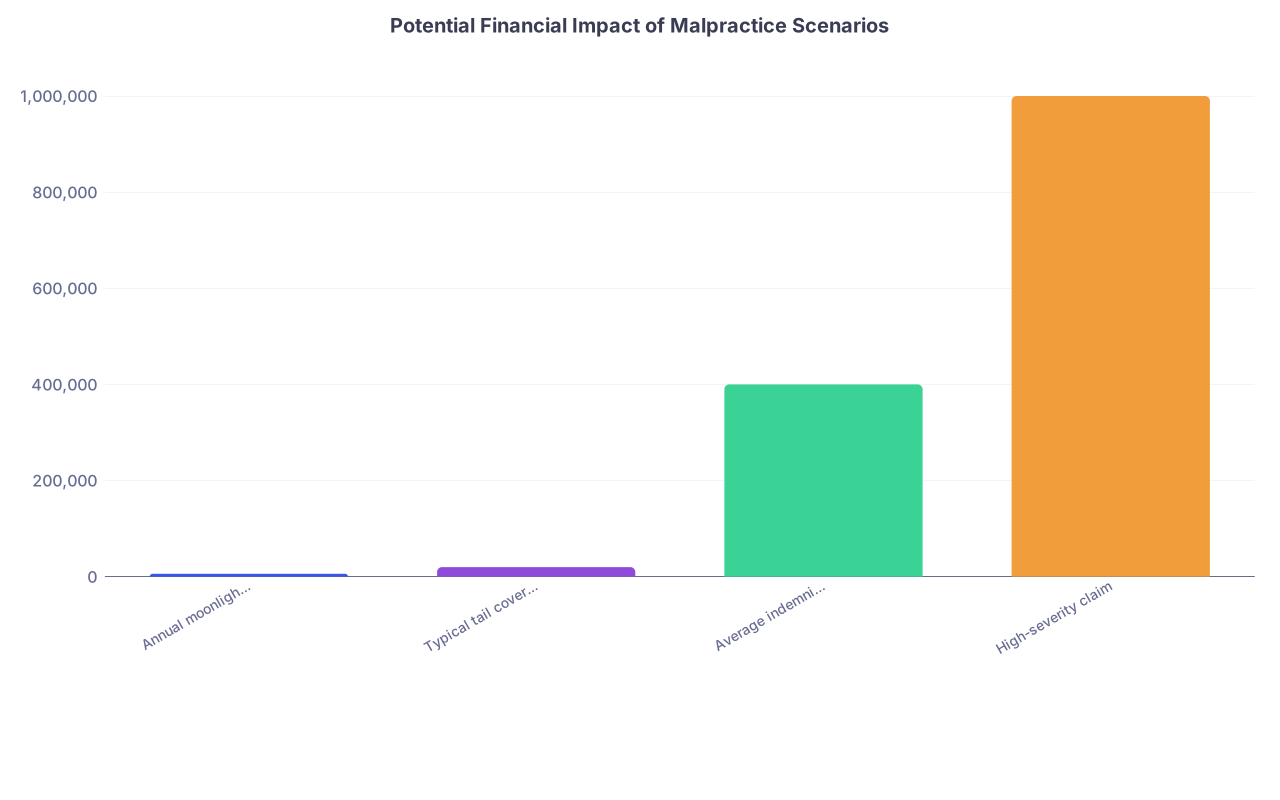
| Category | Value |
|---|---|
| Annual moonlighting premium | 6000 |
| Typical tail coverage | 20000 |
| Average indemnity payment | 400000 |
| High-severity claim | 1000000 |
Quick Decision Flow: Are You Really Covered?
Here’s a simple mental checklist.
- Do you have a written document saying who covers your moonlighting work?
- Do you have a Certificate of Insurance with your name on it (or explicit written confirmation you’re covered under the group policy)?
- Do you know:
- Claims-made vs occurrence?
- Policy limits?
- Who pays for tail?
- Any scope/location restrictions?
If the answer to any of those is “no,” you do not know that you’re covered. You’re hoping.
And hope is a lousy legal strategy.
FAQs
1. Does my residency malpractice insurance automatically cover all moonlighting?
No. In fact, it usually does not. Residency malpractice is designed to cover:
- Activities within your approved training program
- At approved sites
- Under appropriate supervision (for certain procedures/levels)
Pure service moonlighting — like solo ED shifts, cross-coverage on wards, or weekend urgent care — is almost always outside that scope unless explicitly approved and written into your program’s coverage policy. Always check with GME or risk management in writing.
2. If the hospital tells me I’m covered, is that enough?
Verbal assurance is worthless in a lawsuit. You need:
- Written confirmation (email is fine)
- Ideally, a Certificate of Insurance showing:
- Carrier
- Limits
- Type of policy
- Policy period
- Your name or your inclusion under the group
If an administrator says, “Yeah, you’re covered under our policy,” your reply should be, “Great, please send me the COI and confirm in writing that my moonlighting shifts are included.”
3. What happens if I worked moonlighting shifts and later find out I wasn’t covered?
This is ugly, but it happens.
If a claim arises from that uncovered period:
- The plaintiff can go after:
- You personally
- The site (sometimes they’re vicariously liable)
- Any co-defendants (e.g., supervising docs, hospital)
The hospital may or may not step in to defend you. They’re not obligated if you were never included under their policy. You may end up needing your own defense counsel and be personally on the hook for judgments above any partial coverage.
If you realize the gap early and no claim has occurred yet, talk to a malpractice broker or attorney about whether you can secure prior acts coverage (not always possible) or at least prevent making the same mistake going forward.
4. How do I evaluate if the limits for my moonlighting are “enough”?
Look at:
- Your specialty (higher risk = you want higher limits)
- State norms (some states commonly use $1M / $3M, others $2M / $4M)
- Whether limits are shared or individual
If you’re an EM resident moonlighting in a busy ED with $500k / $1.5M shared limits among multiple docs, that’s thin. You may be technically covered, but if a catastrophic case hits, you’re exposed above those limits.
A malpractice broker who works with physicians can tell you what’s typical for your specialty and region in about 5 minutes. Use them.
5. What’s the one step I should take today to be sure about my moonlighting coverage?
Today: Request a Certificate of Insurance and written confirmation of coverage for your moonlighting role.
Email your moonlighting site (or locums recruiter) and your GME office if it’s internal moonlighting. Ask:
- Am I covered?
- Under what policy?
- With what limits?
- Claims-made or occurrence?
- Who pays for tail?
Then open your moonlighting contract and highlight anything related to “insurance,” “malpractice,” or “professional liability.” If those two sources don’t line up, you’ve found a problem you can fix before it becomes a lawsuit.
Open your moonlighting contract right now and your email inbox. If you can’t lay your hands on a COI and a clear answer on tail coverage within the next week, treat that as a serious gap and close it before your next shift.