The default advice about malpractice for residents—“your hospital covers you, you’re fine”—is dangerously oversimplified.
You probably don’t need to panic-buy your own policy tomorrow. But you absolutely do need to understand where your hospital coverage stops, because the gaps are real and they can bite you years after residency.
Let’s go straight at the core question.
The Short Answer: Usually No, Sometimes Yes, But Always “Know Your Gaps”
For most residents in standard ACGME programs, doing only approved clinical work inside their training, the hospital’s malpractice policy is enough.
You typically do not need to buy your own individual malpractice policy for your day‑to‑day residency work.
Where people get into trouble is:
- Moonlighting (especially off-site or unsupervised)
- Telemedicine gigs
- Working at non-hospital clinics or urgent cares
- Rotations at outside sites with unclear coverage
- Volunteer work (free clinics, health fairs, mission trips)
- Future lawsuits after you leave a program with bad tail coverage
Here’s the rule of thumb I use with residents:
- If you’re doing clinical work as part of your residency and on the official schedule/rotation, you’re probably covered by the program’s policy.
- The second you step outside that lane—for money, telehealth, moonlighting, or side gigs—you should assume you’re not covered until you see proof in writing.
So the real question isn’t “Do I need personal malpractice insurance?”
It’s: “What am I doing (or planning to do) that my hospital’s policy doesn’t fully protect?”
Let’s break it down.
What Your Hospital Coverage Actually Does (and Doesn’t) Do
Most residency programs provide malpractice coverage under one of two structures:
| Coverage Type | What Residents Usually Get |
|---|---|
| Form | Claims-made or occurrence |
| Limits per Claim | Around $1M per claim |
| Annual Aggregate | Around $3M per year |
| Applies To | Approved, supervised training activities |
| Cost to You | $0 (paid by hospital/program) |
What’s usually covered
If you’re in good standing and working within your residency program:
- Patient care on your assigned inpatient units
- Clinic visits in program-approved continuity clinics
- ED shifts and ICU rotations in your schedule
- Most affiliated training sites listed by your GME office
- Occasionally approved internal moonlighting that’s explicitly covered
The coverage normally includes:
- Defense costs (lawyers, experts, depositions)
- Settlements and judgments (up to policy limits)
- Licensing board defense (varies—this is often a weak spot)
For 90% of residents, 90% of the time, this is all you need—for your training work.
Where the cracks start to show
Here’s where residents often discover the “you’re not actually covered” problem:
Off-site moonlighting at an unaffiliated hospital or clinic
Many residents pick up shifts at community hospitals, urgent cares, telemedicine companies, or even med spas. Your residency policy will almost never cover that. You either rely on the site’s coverage—or you need your own.“Kind of affiliated” but not really
You rotate at a community site that “works with” your program, but they’re not directly under your main hospital’s umbrella. Coverage can be murky. Some sites cover you; some expect the academic center to cover; occasionally everyone assumes someone else is doing it.Volunteer or mission work
Free clinics, sports physicals at schools, medical mission trips abroad. Sometimes they have a group policy. Sometimes they don’t. “Good Samaritan” laws are not a substitute for real malpractice coverage in these scenarios.Post-residency claims
If your hospital uses a claims-made policy and doesn’t provide adequate tail coverage, a lawsuit filed 3 years after residency for care you provided as a PGY-3 can become your personal financial nightmare.Side telemedicine gigs
A lot of residents sign with telehealth platforms that say “we cover you.” Some do, some don’t, and some have policy limits that are laughably low or exclude high-risk claims.
That’s where personal malpractice insurance becomes something you seriously consider.
When Residents Should Strongly Consider Personal Malpractice Insurance
Let me be blunt: if you’re doing any clinical work that generates income outside your standard residency job, you need one of two things:
- Clear written proof of malpractice coverage from the moonlighting site/telehealth company/clinic
- Or your own individual malpractice policy
If you don’t have either, you’re gambling with your future income for the sake of saving a few hundred bucks.
Situations where I’d tell a resident “Get your own policy”
You should talk seriously to an insurance broker about a personal policy if:
You’re doing independent or off-site moonlighting
Example:- ED moonlighting at a rural hospital that’s not your training site
- Night shifts at a community urgent care as the only provider
- Hospitalist coverage for a small community facility on weekends
If the site provides coverage, ask for the policy details in writing. If they don’t—or if it’s weak—you buy your own.
You do telemedicine for pay
Telehealth companies sometimes cover you, sometimes don’t, and sometimes only cover certain types of claims. If the contract is vague, I assume that’s intentional. I want a separate policy with clear limits and my name on it.You’re doing repeated volunteer/mission work with real clinical risk
One-off health fair blood pressure checks? Fine.
Performing procedures, prescribing meds, managing acute issues repeatedly outside the U.S. or at home? I want coverage specifically for that.Your program uses claims-made coverage and doesn’t guarantee tail after training
This is less common for residents, but it happens. If those “old” residency cases come back as lawsuits and there’s no tail, plaintiffs will come after whoever they can. That can be you.You’re in a high-risk specialty and already moonlighting heavily before graduation
EM, OB/GYN, surgery, anesthesia, ICU folks who are doing substantial moonlighting might want personal coverage as a bridge into attending life, especially if they’re planning locums or multiple part-time gigs right after residency.
How much does a personal policy cost for residents?
Not attending prices, thankfully.
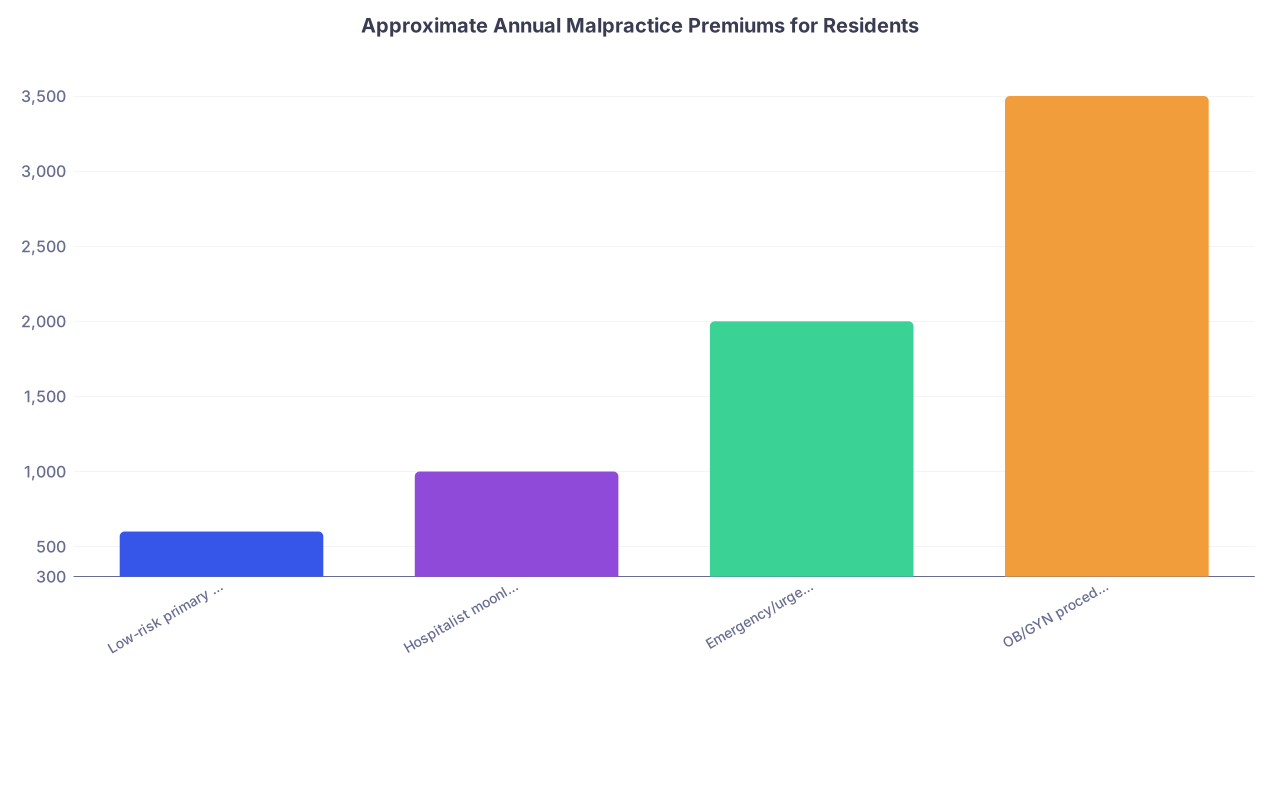
Typical resident personal malpractice policies (for moonlighting or side work) might look like:
| Category | Value |
|---|---|
| Low-risk primary care | 600 |
| Hospitalist moonlighting | 1000 |
| Emergency/urgent care | 2000 |
| OB/GYN procedures | 3500 |
These are ballpark numbers, but they give you an idea. For many residents, a reasonable moonlighting policy can be under $1,500/year. Annoying, yes. Life-ruining? No.
On the other hand, one uncovered lawsuit absolutely can be life-ruining.
Claims-Made vs Occurrence: The Tail Problem You Can’t Ignore
This part gets technical fast, but it matters. The type of malpractice policy behind your residency coverage determines what happens when you leave.
Two major types:
- Occurrence coverage – Covers events that occurred during the policy period, no matter when the claim is filed. No tail needed.
- Claims-made coverage – Covers claims that are reported while the policy is active. When you leave, you usually need tail coverage to cover future claims for old cases.
For residents:
- Many large academic centers use occurrence or have institutional tail. Safer.
- Some smaller systems or community programs use claims-made and may or may not fully cover tail when you leave.
Here’s what you want to know from your GME office or risk management:
| Question | What You Want to Hear |
|---|---|
| Policy type? | Occurrence or claims-made with paid tail |
| Tail coverage after graduation? | Yes, fully covered by institution |
| Coverage at all ACGME-approved sites? | Yes, explicitly included |
| Internal moonlighting covered? | Yes, if approved in writing |
| External moonlighting covered? | No (you need separate coverage) |
If they say: “We use claims-made coverage, and tail is only provided for those here more than X years,” or “Tail is not guaranteed,” that’s a red flag. That’s when you ask an insurance pro what supplemental coverage or later tail you might need.
How to Audit Your Own Coverage in 30 Minutes
Most residents have no idea what’s actually in their malpractice policy. They just assume “the hospital has it.” That’s not enough.
Here’s a quick, no-BS process to see if you’re exposed.

| Step | Description |
|---|---|
| Step 1 | List all clinical work |
| Step 2 | Ask GME for policy summary |
| Step 3 | Moonlighting or side work |
| Step 4 | Usually covered |
| Step 5 | Confirm written coverage from site |
| Step 6 | Review limits and terms |
| Step 7 | Get personal malpractice policy |
| Step 8 | Part of residency schedule |
| Step 9 | Outside site or telemed? |
| Step 10 | Does site provide coverage in writing? |
Step-by-step:
Write down every type of clinical work you do
Not just “resident on wards.” Include:- Internal moonlighting
- External moonlighting
- Volunteer/mission work
- Any telehealth, consulting, or procedure work
For each one, label: “Residency duty” or “Side work”
If it’s not on your official rotation/approved moonlighting list, treat it as side work.Get your program’s malpractice summary in writing
From GME, HR, or risk management:- Policy type
- Limits (per claim and aggregate)
- Sites covered
- Fellow/resident status
- Tail coverage rules
For each side gig, demand written proof of coverage
From the site or company:- Are you personally covered?
- What are the limits?
- Is it claims-made or occurrence?
- Do they provide tail if claims-made?
Anything that’s not clearly covered? That’s your signal to look at a personal policy.
This 30-minute audit is more protection for your future than half the “wellness” lectures you’re forced to attend.
How Personal Malpractice Works for Residents
If you decide you need personal coverage, it’s not that complicated.
You generally choose:
- Policy type – Usually claims-made for residents, but you can ask about occurrence if available.
- Limits – Common: $1M per claim / $3M aggregate, sometimes higher for high-risk work.
- Scope – Restricted to specific settings or broad “professional services” language.
You’ll give the insurer:
- Your specialty and PGY level
- Types of work you’ll be doing (moonlighting, telehealth, urgent care, etc.)
- Locations and states you’ll practice in
- Estimated hours or shifts per month
They price the policy based on risk. If you’re doing low-risk primary care telehealth consults, that’s different from solo OB call at a rural hospital.
All this is why you don’t buy malpractice from a random website form without talking to a human. You want someone who’s seen resident claims before and can say, “This clause will screw you, let’s fix it.”
FAQ: Residents and Personal Malpractice Insurance
1. If my attending is supervising, am I automatically covered under their malpractice policy?
No. Their policy covers them. Your coverage comes either from the hospital/program policy or your own. You’re usually covered under the hospital’s group policy when acting within your training role, but you’re not automatically protected just because an attending is involved. If you’re moonlighting or doing side work, you cannot assume you’re covered under an attending’s individual policy.
2. Does Good Samaritan law protect me if I’m volunteering at a free clinic or sports event?
Not reliably. Good Samaritan protections are narrow and vary by state. They’re often designed for emergencies where you jump in to help unexpectedly, not scheduled volunteer clinics where you’re essentially functioning as the doctor on duty. If you’re regularly providing care in any organized setting, I want to see an actual malpractice policy, not just blind faith in Good Samaritan statutes.
3. My program says “You’re covered everywhere for residency activities.” Is that good enough?
It’s a start, but I’d still ask for the actual coverage summary and list of included sites. “Everywhere” sometimes mysteriously excludes certain contracted clinics, telemedicine arrangements, or loosely affiliated sites. At minimum, make sure your most common external rotations and GME-approved moonlighting locations are explicitly named or clearly within scope.
4. If I never moonlight, is there any reason to buy personal malpractice as a resident?
For most people, no. If you’re doing nothing but standard, approved residency work at covered sites and your program has solid tail coverage, a personal policy during residency is usually unnecessary. The exception would be if you’re in a program with sketchy or limited coverage, or in a country/setting where institutional coverage is minimal. In a typical U.S. ACGME program with standard coverage, I wouldn’t bother.
5. What’s the single most important step I should take about malpractice as a resident?
Today: email your GME office or risk management and ask for (1) a written summary of your malpractice coverage, (2) whether the policy is occurrence or claims-made, and (3) whether tail coverage is fully provided when you leave. Then list any current or planned moonlighting or side work and write next to each one either “covered in writing” or “no proof of coverage.” Anything in that second category? That’s where you either stop doing it or talk to an insurance broker about getting your own policy.
Open your email right now and send that three-line request to your GME office. You’ll know more about your real risk in 48 hours than most residents figure out in three years.