
It’s July 1st. Your name just switched from “PGY-3” (or “Fellow”) to “Attending” in the EHR. You’re logging orders under your own NPI. No safety net initials above yours.
The clinic’s overbooked, the hospital credentialing office keeps emailing you about “proof of coverage,” and your group admin just slid a 40-page malpractice policy PDF into your inbox with, “You’re covered, no worries.”
You sign. You don’t really read.
And that’s how almost every new attending walks straight past the tripwires that only show up 3–5 years later—after a bad outcome, a board complaint, or a letter from a plaintiff’s firm that starts with “We are writing regarding your care of…”
Let me walk you through the stuff the risk management talks around, the brokers gloss over, and most senior attendings only admit over a beer, off the record.
1. The First Rule: Your “Coverage” Is Not What You Think It Is
Everyone tells you: “Don’t worry, you’re covered under the group policy.”
What that usually means: “You are an additional insured on our policy, controlled by our lawyers, with limits that may or may not be enough for you personally.”
Most new attendings think malpractice works like health insurance: you have it or you don’t. Binary. In reality, there are fault lines baked into the policy itself.
Here’s the core split nobody actually explains:
| Feature | Claims-Made | Occurrence |
|---|---|---|
| Trigger for coverage | When claim is *made* | When care was *provided* |
| Need for tail insurance | Yes (usually) | No |
| Premium early on | Cheaper | More expensive |
| Switching jobs risk | High if no tail | Low |
| Common in | Private groups, hospital-employed | Older contracts, some large systems |
You sign your first job contract. It says “claims-made coverage, $1M/$3M limits, tail responsibility: physician.” You probably nod and move on.
Here’s what that really means in plain English:
- Every year your policy renews, it covers claims that are reported that year, for care you provided since the policy’s retroactive date.
- When you leave the job, the coverage clock stops. And a patient you saw in year 2 who sues you in year 6? You’re naked. Unless you buy tail.
And tail is where young attendings get ambushed.
2. Tail Coverage: The $60,000 Surprise You Don’t Discover Until Resignation Day
Let me be very direct: the fastest way I’ve seen new attendings get financially screwed is tail coverage.
You finish fellowship. You join a hospitalist group. They’re “like family.” Then two years later they cut your RVU rate, you get burned out, and you accept a better offer across town.
Then HR drops the line:
“Per your contract, you are responsible for purchasing tail coverage.”
You call the broker. They quote you 150–250% of your last annual premium. For many specialties—EM, OB/GYN, surg subs—that can easily land around $40–90k, due in a lump sum.
You weren’t warned. You didn’t plan for it. And no, you generally can’t finance it over 20 years.
This is the part attendings talk about in hushed tones in the workroom.
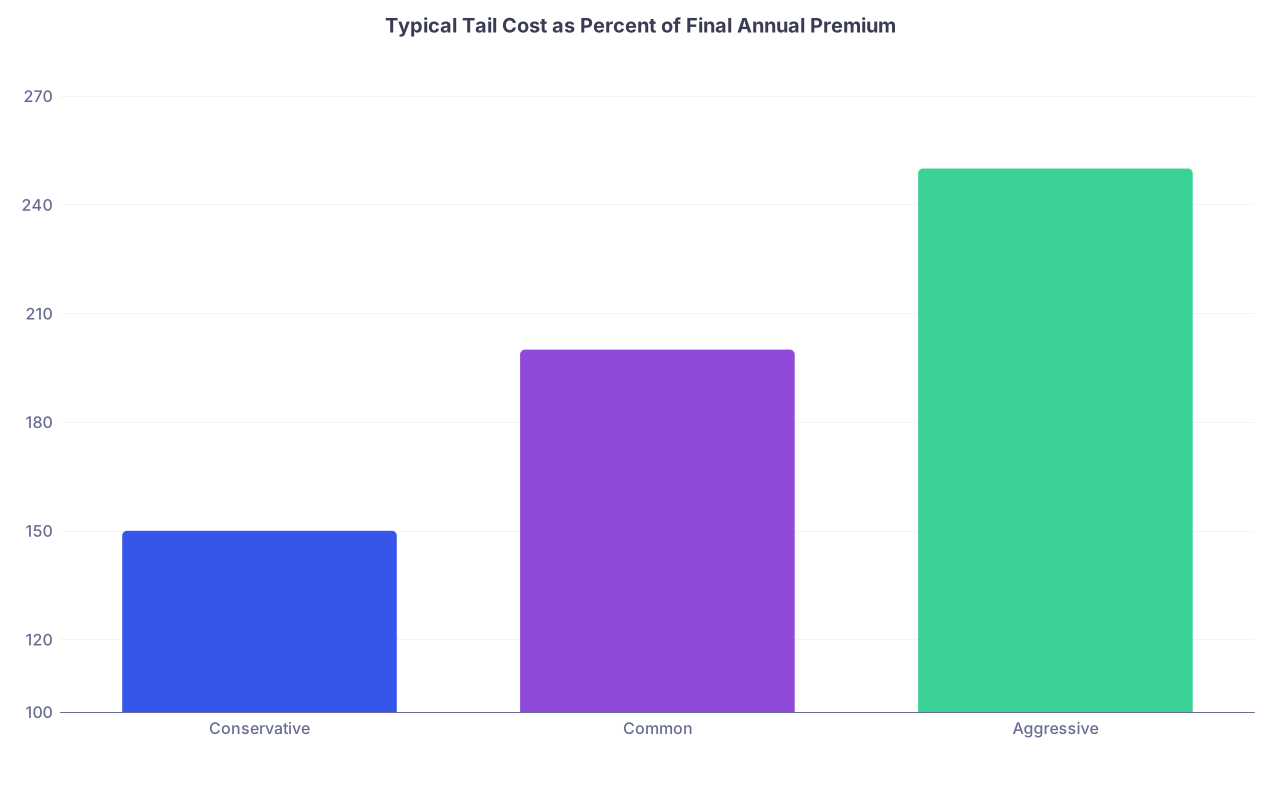
| Category | Value |
|---|---|
| Conservative | 150 |
| Common | 200 |
| Aggressive | 250 |
Here’s the actual unwritten rule:
You do not sign your first attending contract without understanding exactly who pays tail, and under what conditions.
Common traps I’ve literally seen:
- Tail is “shared” unless you are terminated “for cause” – and “for cause” is defined in such vague language they can hang you with it if they want to.
- Tail is covered only if you stay X years. If you leave at 4 years and the forgiveness cliff is 5 years, you’re writing that check.
- Hospital promises “nose coverage” (taking over prior acts) only if you’re coming from an independent practice, not if you’re leaving another hospital-employed position.
You want, in writing:
- Who buys tail if you leave voluntarily
- Who buys tail if they non-renew you without cause
- Who buys tail if the group dissolves or sells to a private equity roll-up
- What happens if you move from their policy to an employed hospital system policy
This is boring, unsexy contract language—until it’s six figures.
3. The Defense Hierarchy: Whose Interests Actually Come First
Nobody tells you this when you’re new: when a big case hits, you are not automatically the main client.
If you’re part of a large group, or hospital-employed, the named insured is typically:
- Hospital / health system
- Large group entity
- “Employed physicians and other providers” as additional insureds
You’re an afterthought in the structure, and it shows when money’s on the line.
What happens in a high-exposure OB case, or a catastrophic EM miss with permanent disability? The carrier and hospital’s risk management meet first. Without you. They decide what’s “global best outcome.”
Sometimes that aligns with you. Sometimes it doesn’t.
This is how you get:
- “We’re going to settle this one.” You want your name cleared; the hospital wants to eliminate verdict risk. Carrier cares about financial exposure and reputation, not your psyche.
- “No, we’re not offering that number.” You’re terrified of trial. Plaintiff offers a manageable settlement. The carrier gambles they can win, or at least do better at trial.
- Multiple defendants, one pot of money. You and another doc are pointing at each other. The carrier assigns one lawyer to cover both of you because it’s “efficient.” That lawyer technically represents both clients with potentially conflicting narratives.
I’ve sat in meetings where admin literally said, “Worst case we pay above policy limits. We can absorb it. But a plaintiff verdict here is going to drag our name through the local paper for months—settle it.”
You need to understand:
You have the right to independent counsel when your interests diverge from the institution’s.
Most new attendings don’t know that. They just nod when hospital counsel says, “We’ll take care of everything.”
Sometimes they do. Sometimes they don’t.
4. Limits, Stacking, and the Multi-Defendant Squeeze
You see “$1M / $3M” in your contract and feel reassured. Looks like a big number.
Reality: those are paper numbers. And in a multi-defendant suit, they get ugly fast.
$1M / $3M usually means:
- Up to $1 million per claim
- Up to $3 million total per policy year, for all claims combined, for that policy (not just you personally)
Now imagine a typical bad outcome:
- Hospital named
- Group named
- You named
- Maybe an NP or PA named
- Sometimes the surgeon, anesthesiologist, radiologist too
Here’s where new attendings get blindsided:
- There might be a shared limit for the entire group. So that $1M is split across all co-defendants under that policy.
- If there are multiple claims in the same year (e.g., another suit against your group), you’re burning through the annual aggregate.
And if a verdict exceeds the limit? On paper, that’s “excess verdict.” In practice, it becomes a negotiation: sometimes the plaintiff accepts policy limits, sometimes the institution kicks in above, sometimes plaintiffs go after personal assets (rare but not mythical, especially in states unfriendly to physicians’ asset protection).
The unwritten rule here:
You should know if your limits are shared, stacked, or per-provider.
Ask your broker or risk manager:
- Are my limits individual or shared?
- What’s the aggregate for the group / entity?
- Have there been any big payouts from this policy in the last few years?
If they get defensive or vague, that’s your answer.
5. The “Hidden” Gaps: What Your Policy Actually Doesn’t Cover
You think malpractice is a big tent that covers any legal trouble connected to medicine. Not even close.
Every policy has exclusions and carve-outs the size of a truck. Some of the big ones that surprise new attendings:
- Board complaints and licensure actions – Often not covered, or only minimally. You need a separate “administrative defense” rider or policy.
- Hospital peer review / MEC hearings – Internal process, not always covered. Yet the consequences (loss of privileges, NPDB report) can be career-ending.
- Criminal allegations – You’re on your own. Think diversion, fraud investigations, patient abuse allegations.
- HIPAA breaches – Sometimes covered under a separate “cyber” or privacy policy, not standard malpractice.
- Employment disputes – Wrongful termination, discrimination, harassment claims. Totally different policy world.
Here’s the dirty little secret: new attendings only find out about these exclusions after something bad happens and they call the carrier expecting a lawyer to appear like Batman.
Sometimes they’re told, “We don’t handle that.” And the meter starts running with a private attorney instead.
You want to at least ask:
- Does this policy include licensure board defense? Up to what limit?
- Are internal hospital proceedings covered (MEC, summary suspension)?
- Is deposition-only representation covered when you’re not a named defendant?
Even if you don’t buy extra coverage right away, you shouldn’t be surprised later.
6. Documentation, but Not the Way They Taught You in Residency
Everyone parrots, “Good documentation is your best malpractice defense.” True, but incomplete.
Let me tell you what defense attorneys actually say in the prep room.
A few real lines I’ve heard:
- “This note is impressive but unreadable to a jury.”
- “You documented every lab but didn’t clearly say what you thought was happening.”
- “You sound arrogant here. Juries hate that.”
- “Why did you write this angry paragraph about the nurse? Now the whole thing looks dysfunctional.”
New attendings often go wrong in two directions:
- Over-legalizing their notes – Every chart turns into a manifesto. That actually makes you look calculated and defensive.
- Being casual / snarky – “Patient refusing to listen,” “difficult family,” “demanding narcotics.” When a plaintiff attorney reads that out loud in a courtroom, it sounds awful.
What defense attorneys quietly love:
- A clearly stated differential and why you prioritized one diagnosis over another.
- Documented shared decision-making: “Discussed risk of X, Y. Patient preferred conservative approach.”
- A quick note about follow-up instructions and return precautions.
- Evidence you actually read and acted on abnormal results.
What they hate: copying and pasting the same review of systems and exam down the entire admission while the story in the labs, vitals, and imaging is obviously changing. That’s where plaintiff experts feast.
The unwritten rule: document like you expect a future jury of non-medical people to read it out loud. Not your co-resident. Not the sub-I. The jury.
7. The Reality of Getting Sued: Timelines, Tactics, and How It Affects You
Here’s what doesn’t get taught: what actually happens once your name lands on a complaint.
So you’re a fourth-year attending. You get the letter.
At first, it’s numbing. Then shame. Then anger. Then chronic, low-grade dread. It sits there, background noise, for years.
You call risk management. They notify the carrier. You’re assigned a lawyer. Then the real timeline kicks in:
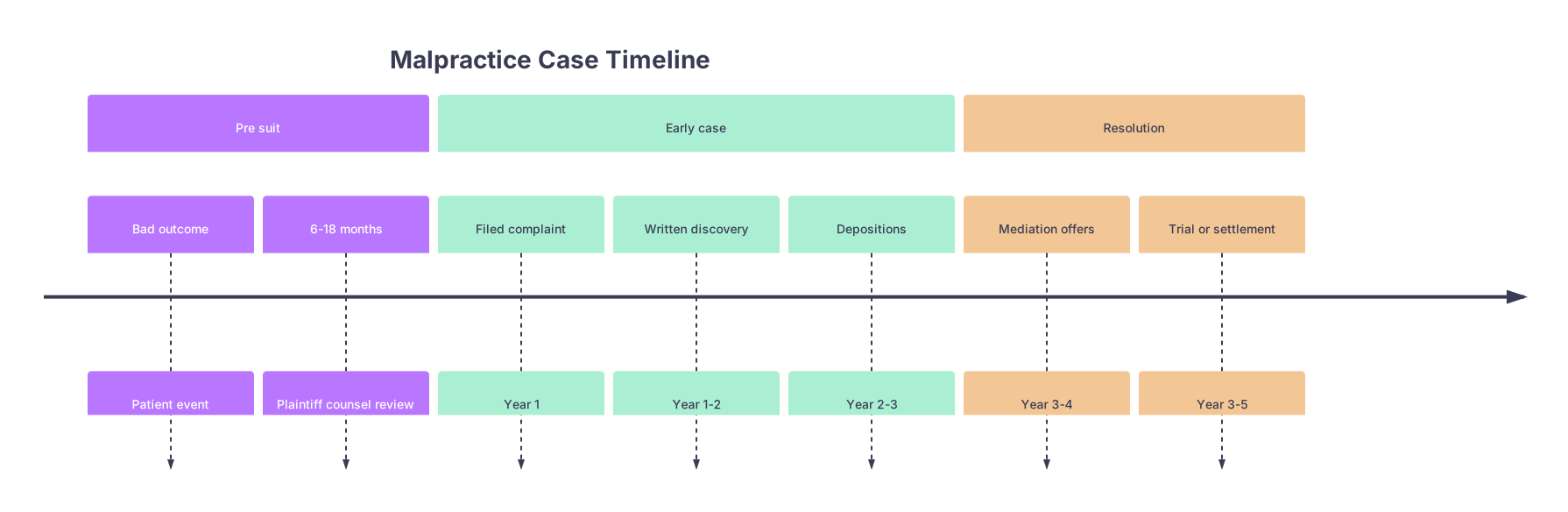
| Period | Event |
|---|---|
| Pre suit - Bad outcome | Patient event |
| Pre suit - 6-18 months | Plaintiff counsel review |
| Early case - Filed complaint | Year 1 |
| Early case - Written discovery | Year 1-2 |
| Early case - Depositions | Year 2-3 |
| Resolution - Mediation offers | Year 3-4 |
| Resolution - Trial or settlement | Year 3-5 |
You’re dealing with this case long after you barely remember the patient. Long after you’ve switched jobs or had another kid or moved states.
The unwritten rules once you are a defendant:
- Do not alter the chart. Ever. Audit trails exist. Alterations get you destroyed on the stand and can blow up your defense.
- Do not play amateur sleuth. Don’t call the nurse. Don’t email colleagues saying, “Remember that case?” All discoverable.
- Do not talk about the case casually in the physician lounge. Other than your lawyer and spouse (in most states, with some privilege), assume everyone else is a future witness.
- You’re not as important to the case as you think you are—and that will both relieve and insult you. A lot of the battle is about system issues, institutional policies, and expert spin.
Also: plaintiff attorneys know new attendings are vulnerable, insecure, and often naive in depositions. They will push your buttons. They want you defensive, angry, or arrogant on transcript. Your own attorney will spend a lot of time just getting you to shut up and answer only what’s asked.
I’ve watched plenty of smart young docs talk themselves into trouble in deposition because they wanted to explain instead of simply respond.
8. Employment Transitions: The Quiet Risk Moments Nobody Flags
There are two especially dangerous times for malpractice exposure in a young attending’s career:
- Right after residency / fellowship – You’re green, less supervised, and often overloaded. Your early cases become lawsuit fodder just as your career starts.
- When changing jobs or insurance carriers – This is where coverage gaps open.
Classic nightmare scenario:
- You start at Hospital A on a claims-made policy.
- After 3 years, you switch to Hospital B, who provides occurrence coverage going forward.
- Nobody buys tail on the old claims-made policy.
- Year 5: a patient from year 2, at Hospital A, files suit.
- Old policy is inactive. New policy only covers events after you started there. You’re in a no man’s land.
Your defense? “Administrative oversight.” The plaintiff’s not going to care.
The behind-the-scenes truth: risk managers and carriers know this happens all the time when physicians move quickly between jobs. And when they can shift responsibility (“your old employer should have handled that”), they will.
So every time you change jobs, you need three things in black and white:
- Are my prior acts covered at the new job? (nose coverage)
- Is the old employer buying tail? If not, am I?
- What’s the retroactive date on my new policy?
If HR says, “Our lawyers handle all that,” you ask again. Nicely. In email.
9. Personal Asset Protection: The Thing You Only Think About After a Scare
Most attending physicians ignore asset protection until they get sued. That’s backwards.
No, most malpractice claims will not pierce your policy limits. No, plaintiff attorneys don’t usually chase individual homes and retirement accounts if the policy money is enough and the institution has deeper pockets.
But “usually” isn’t how you plan a 30-year career.
The unwritten part: most attorneys who specialize in asset protection say the time to structure things is before you have a whiff of a claim. Once there’s a bad outcome or pre-suit letter, moving money around can look like fraudulent transfer.
Basic moves most savvy attendings quietly make in their first 3–5 years:
- Maxing out asset-protected accounts in your state (401k, 403b, some IRAs, cash value life insurance in a few states).
- Titling the primary residence in a way that’s more protected (tenancy by the entirety, homestead, etc., depending on state law).
- Keeping speculative stuff (risky real estate, side businesses) at arm’s length in LLCs.
Your malpractice carrier doesn’t care about any of that. Your hospital doesn’t bring it up. They’re focused on their exposure, not the house you bought on a hill.
You should at least have a one-hour conversation with a local asset-protection-savvy attorney early in your attending life. Not when a sheriff’s deputy is serving you papers.
10. The Psychological Side: Careers Quietly Warped by Fear of Litigation
I’ve watched good doctors change their practice style entirely after one big case or even a scary near-miss letter.
What they won’t say out loud, but do in private:
- Admit more patients “just in case,” even when it’s low yield.
- Order more imaging than they really believe is necessary.
- Avoid high-risk procedures or patient populations entirely.
- Start thinking, “How will this look in court?” instead of “What is best for this patient?” as their first filter.
This is the unmeasured cost of malpractice culture. You will feel it whether you ever get sued or not, because you’ll absorb the anxiety of others.
You can’t fix the entire system. But you can do a few things early:
- Know your actual coverage so you’re not constantly catastrophizing.
- Get a feel for your specialty’s real claim rates and patterns, not scary anecdotes.
- Learn from actual cases in M&M and risk conferences—not just the medical errors, but the documentation and communication failures that fueled them.
Attending life feels very different when you’re not walking around with a vague, free-floating fear of some policy you never read.
FAQs: The Stuff New Attendings Ask Once They’ve Already Signed
1. I already signed a contract making me responsible for tail. Am I screwed?
Not automatically. You can sometimes renegotiate tail responsibility when:
- Your value to the group has clearly increased
- They’re recruiting you for a leadership role
- The group is being acquired and the buyer is offering nose coverage
Even if the contract’s signed, you can ask for an amendment or side letter. Worst case, at least start planning financially for that tail bill instead of being blindsided.
2. Should I pay extra for my own separate malpractice policy on top of my employer’s?
Usually no, unless you’re moonlighting, doing side consulting, or practicing in a setting your employer policy doesn’t touch. You don’t want overlapping carriers fighting over who’s primary in a claim.
What you should consider paying extra for is:
- Licensure board defense coverage
- Employment practices coverage if you’re an owner or partner
- A personal umbrella policy for non-medical liability (separate world, but underrated)
3. Will a malpractice suit automatically end my career?
No. It will hurt. It will keep you up at night. But in most specialties, a lawsuit is almost a rite of passage over 20–30 years.
End-of-career events are more often:
- Multiple suits with clear patterns of bad care
- A big NPDB report after loss of privileges
- Substance abuse or criminal issues
A single case, even with a settlement, is survivable if you learn from it and don’t implode psychologically.
4. How much should I worry about my name being in the NPDB?
Enough to understand how it works. Very few residents actually know the triggers.
NPDB reports get filed for:
- Certain malpractice payments
- Adverse privileging actions lasting longer than a defined period
- Licensure restrictions and revocations
Hospitals, boards, and some employers query it. Patients, generally, do not. One report is not ideal, but it’s not an instant blacklisting. Multiple or serious reports are what really close doors.
5. If I’m ever sued, should I talk directly to the patient or family to “clear things up”?
No. Once there’s a hint of litigation—demand letter, attorney contact, or filed complaint—you stay silent outside of formal channels. Anything you say can be twisted and used against you.
The time to have honest, empathic conversations is before lawyers are involved—when it’s still about trust, disclosure, and good care. After that, you let counsel handle it, no matter how much you want to fix it yourself.
Key takeaways:
- Malpractice coverage is not “you have it or you don’t.” Claims-made vs occurrence, tail, limits, and shared coverage all matter—read them like your future self is counting on it.
- Your employer’s interests and your interests align until they don’t. Learn when to ask for independent counsel and how your policy really treats you.
- The smartest move you can make as a new attending is boring: understand your contract, your coverage, and your exposure before your name ever shows up on a complaint.