
You are sitting at your kitchen table at 10:30 p.m., contract packet open, cursor blinking on the e-sign line. The recruiter said, “Our malpractice is excellent. Occurrence coverage. Very comprehensive.” HR sent you a 35-page PDF attached to your employment agreement and said, “Legalese, but standard.”
You flick through it, see phrases like “claims-made,” “tail endorsement,” “hammer clause,” and your eyes start to glaze. You are tempted to trust them and just sign.
Do not.
This is one of the few documents that can ruin your life years after you leave a job. You need a method, not vibes.
What follows is the line-by-line protocol I use when I review malpractice policies for physicians. We will go through:
- What to gather before you start
- How to dissect the policy section by section
- The exact phrases and clauses that should trigger your “stop and negotiate” reflex
- Red-line questions to send back to HR, the broker, or your lawyer
You are not trying to become an insurance attorney tonight. You are trying to avoid getting destroyed later when a claim hits.
Step 1: Get All the Documents You Actually Need
Most physicians make their first mistake before they even start reading. They do not have the full picture.
Ask for all of this in writing:
- Full malpractice policy form (not just a “summary of benefits”)
- All endorsements/riders (these modify coverage and are often where the bad stuff hides)
- Declarations page (“dec page”) – the one-page summary with limits, named insured, retro date
- Your employment contract sections on malpractice (who pays, what type, what happens at termination)
- Any separate tail coverage agreement or offer, if they are talking about tail
If the practice says, “We do not have the full policy; the broker handles that,” response is:
“Please request the full current policy and all endorsements from the broker. I cannot agree until I have reviewed it.”
If they resist, that is a signal. Either they do not understand what they are offering you, or they are hoping you do not understand it.
Step 2: Start With the Declarations Page – Snapshot of the Deal
The declarations page is the summary. If this looks wrong, the rest does not matter.
Key items you will see:
- Named insured
- Policy type: claims-made vs occurrence
- Limits of liability (often “$1M / $3M” or similar)
- Retroactive date (for claims-made)
- Policy period (dates)
- Insurer name and rating
- Any listed endorsements
Here is how I would read it, line-by-line.
1. Named Insured
You want to know:
- Are you personally a named insured, or only the entity (e.g., “ABC Medical Group, P.C.”)?
- Are you listed separately anywhere as an “additional insured” or “covered provider”?
If only the group is named and there is no schedule of providers, you ask:
“Please confirm where I am listed as a covered provider and whether I am an additional insured under this policy. Send the schedule of insured providers.”
If they cannot show it, assume you are not properly covered until proven otherwise.
2. Policy Type: Claims-Made vs Occurrence
This affects everything.
You should see clear language like:
- “Form: Claims-Made Professional Liability”
- or “Form: Occurrence Professional Liability”
If you see “claims-made,” your brain should immediately go to: tail coverage, retroactive date, and who pays.
If you see “occurrence,” better for you. Claims that arise from work done during the policy period are covered even if the claim is made years later.
If the type is not clearly stated, ask the broker directly. Do not guess.
3. Limits of Liability
Usually written as per-claim / aggregate.
Typical combos: $1M/$3M, $2M/$4M, etc.
You need to know two things:
- Do these limits apply per provider, or are they shared by all providers under one policy?
- Is there a deductible or self-insured retention that you might be responsible for?
Ask in writing:
“Are the limits of liability $1M/$3M per provider or shared among all covered providers? Please specify in writing.”
Shared limits in a big group = risk that you walk into a policy year where someone else’s large claim has already eaten the aggregate.
4. Retroactive Date (Claims-Made Only)
If “Retroactive Date: None” – that likely means no prior acts coverage. Very bad if you are switching from another job.
You want:
- A retroactive date that goes back to your first day doing covered work for that entity (or earlier if they are giving you prior acts).
- That same retro date to be preserved year after year as long as you stay.
If the retro date is the start of this new policy year, and you have worked there before, you ask:
“My start date with the practice was [date]. Please confirm in writing that my retroactive date will be [that date] to ensure continuous prior acts coverage.”
No retro = you are naked for any old patient that sues you later.
Step 3: Read the Insuring Agreement – What’s Actually Covered
Now go to the main body of the policy. Find the section titled “Insuring Agreement,” “Coverage,” or similar. This is where the company says: “We will pay when X happens.”
You want to confirm 5 things:
What triggers coverage?
- Claims-made: “We will pay for claims first made against the insured during the policy period and reported to us during the policy period…”
- Occurrence: “We will pay for bodily injury that occurs during the policy period…”
Who is an insured?
Look for a definition like:- “You, the named insured”
- “Any physician employed by the named insured while acting within the scope of their duties”
- “Independent contractors” – sometimes excluded, sometimes included only by specific endorsement
Confirm that “physician,” “health care provider,” or “professional” explicitly covers your role and specialty.
What activities are covered?
- Clinical care in defined settings?
- Telemedicine?
- Procedures?
- Supervising residents / APPs?
- Committee work? Research?
If the policy limits you to “office-based practice” and you are doing procedures or hospital work, that is a mismatch. Not a theoretical problem – I have seen carriers deny when the actual scope was broader than the declared practice.
Defense costs: inside vs outside limits
Find the language on defense:- “Defense costs are in addition to the limits of liability” = better
- “Defense costs are included within the limits of liability” = your legal fees eat into your liability limits
If defense is inside the limits, a big case can burn hundreds of thousands in legal fees and leave less for indemnity.
Consent to settle clause
You want phrasing like:- “We will not settle any claim without the written consent of the insured.”
Then look for the hammer clause (more on that later). Many policies say you “consent,” but if you refuse, you pay for it.
Step 4: Exclusions – Where the Landmines Hide
Do not skim exclusions. This is where insurers take back what they pretended to give.
Common exclusions you will see:
- Criminal acts, intentional harm
- Sexual misconduct
- Work outside your scope of practice
- Work outside the described specialty or location
- Research, device trials, or experimental procedures
- Administrative roles, board positions
- Work for other employers or moonlighting
You need to read each exclusion and ask yourself: “Does my real life ever touch this?”
Watch for these problem spots:
Location-based exclusions
Example: “Coverage applies only to services rendered at locations scheduled to the policy.”If you moonlight at a second hospital or cover a rural ER occasionally under the same job, that may not be a “scheduled location.” You need:
- Either a separate policy for moonlighting, or
- This policy explicitly extended via endorsement.
Procedural exclusions
Some policies for, say, internal medicine will explicitly exclude certain procedures:- Endoscopy
- Sedation
- Obstetric care
Compare this to your real privileges. If you ever do what they excluded – you are uncovered during the highest-risk parts of your job.
Telemedicine / virtual care
Many older policies or lazy brokers forget this. Look for language that either:- Explicitly includes telemedicine and cross-state care, or
- Explicitly excludes it or ties it to your license jurisdiction only.
If you are doing telehealth across state lines, this needs to be spelled out. Do not assume.
Step 5: Claims-Made Specifics – Tail, Nose, and Retro
If the policy is claims-made, this is where people get financially burned. Your employment contract and the policy need to align.
1. Understand the Timeline
Use this mental model:
- Retro date: earliest date of covered services
- Policy period: when the policy is active
- Claim made date: when the patient/files/plaintiff sues or sends a demand
- Tail (extended reporting): time after the policy ends during which you can still report claims for past work
No tail = you are uninsured for late claims, even if the incident happened while you were employed.
2. Find the “Extended Reporting Period” Section
Look for language like: “Extended Reporting Period,” “ERP,” or “Tail Coverage.”
You want to know:
- Is tail automatically included at termination? (Almost never, but check.)
- Is it available for purchase? Under what conditions?
- How long is the tail? (1 year, 3 years, unlimited?)
- What does it cost?
Typical hints in the policy:
- “The insured may purchase an extended reporting endorsement within 30 days of policy cancellation…”
- “The premium for the extended reporting period shall be X% of the annual premium.”
Then match this to your employment contract:
- Does the contract say who pays for tail?
- Does it define the length and scope of tail?
- Is it triggered only on certain types of termination (for cause vs without cause vs resignation)?
If the contract says you pay tail and the policy language says tail costs “up to 200% of annual premium,” run the numbers. A $25,000 annual premium becomes a $50,000 bill after you leave. Not fireworks you want.
| Scenario | Tail Cost (as % of Annual Premium) |
|---|---|
| 1-year tail | 75–100% |
| 3-year tail | 125–175% |
| Unlimited tail | 175–250% |
| Free tail (death/disab.) | 0% (if policy includes this) |
Step 6: The “Consent to Settle” and Hammer Clause – Protecting Your Name
Find the section on “Settlement” or “Consent to Settle.”
Ideal language:
- “We will not settle any claim without your written consent.”
Now keep reading. There is often a second paragraph like:
- “If you refuse to consent to a settlement recommended by us, our liability shall not exceed the amount for which the claim could have been settled plus defense costs incurred up to the date of your refusal.”
That second sentence is the hammer clause. It basically says:
“If we want to settle for $300,000 and you say no, and the case goes to trial and we lose $1,000,000, we only pay $300,000 plus the prior defense cost. You are on the hook for the rest.”
Real life translation: you are “free” to protect your reputation, in theory. In practice, you will be forced to agree to settlements to avoid financial ruin.
What to do:
- Ask if the policy has a soft hammer clause instead (carrier and insured split any excess judgment 50/50 or some negotiated percentage).
- Negotiate with the employer to cover any amount above the hammer limit if you reasonably refuse a settlement that would materially damage your career (e.g., NPDB report, board issues).
You may not win on this, but you should understand exactly how much control you truly have.
Step 7: Defense-Related Details – Who Defends You and How
Now go to “Defense and Settlement” and related sections.
Check:
Duty to defend vs reimbursement
- “We have the duty to defend any claim…” = better. They hire and pay defense counsel.
- “We will reimburse defense costs…” = you may be forced to front some costs or manage billing chaos.
Choice of counsel
Does the policy give the insurer full control to pick counsel? Usually, yes.
Ask the broker for examples: “Which firm defends physicians in my specialty in this region?” If they are using a bargain-basement firm with no med-mal depth, that is a red flag.Coverage for board complaints and investigations
This is separate from malpractice suits. Look for language like:- “We will pay up to $X per proceeding for defense of disciplinary actions, licensing board investigations, or peer-review actions.”
If this is missing or capped at something laughable like $2,500, you may want a separate policy for license defense.
Coverage for depositions only
Are you covered when you are named as a non-party deponent? Some policies include “deposition representation” if you are dragged into cases not directly against you. That matters.
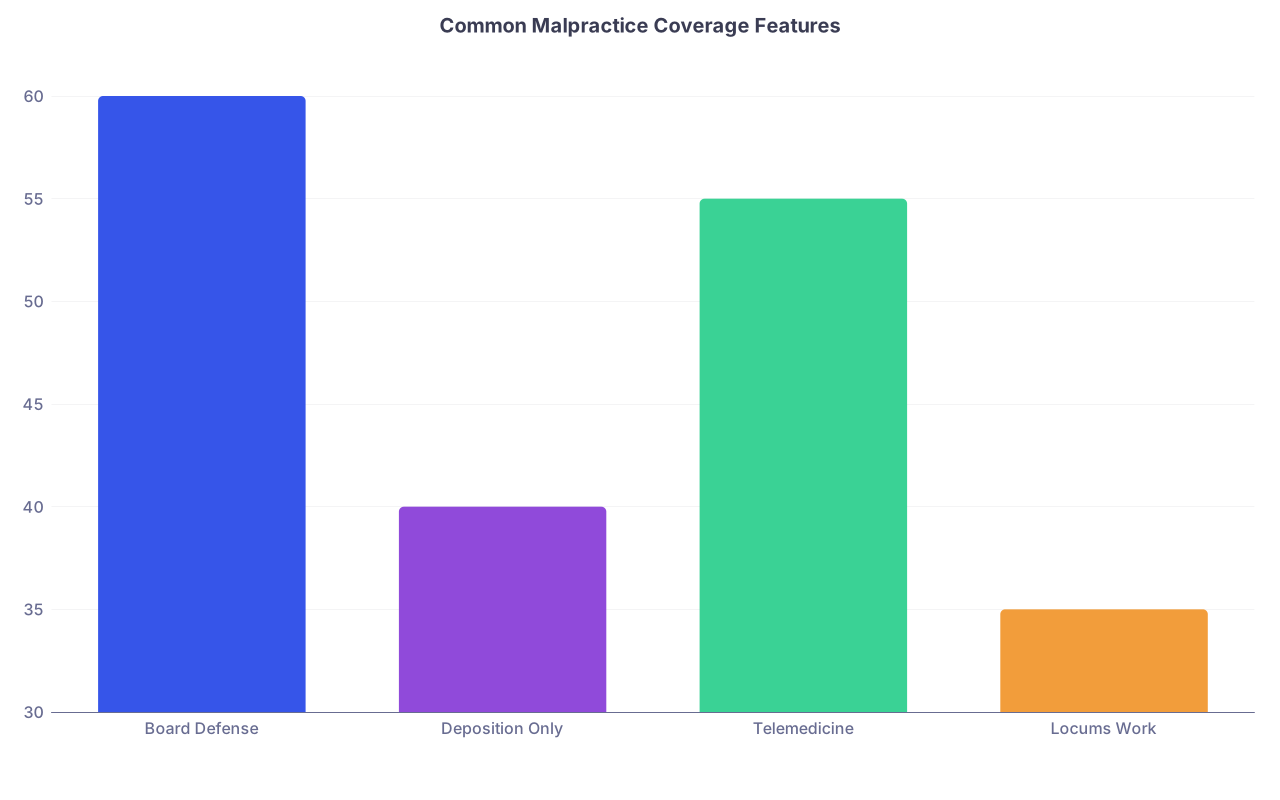
| Category | Value |
|---|---|
| Board Defense | 60 |
| Deposition Only | 40 |
| Telemedicine | 55 |
| Locums Work | 35 |
Step 8: Employment Contract vs Policy – Resolve the Mismatches
You cannot just look at the insurance policy in isolation. The malpractice section of your employment contract controls who pays and what you are promised.
Open both documents side-by-side. For each of these topics, compare and reconcile.
1. Type of Coverage Promised vs Provided
Contract might say: “Employer will provide occurrence-based malpractice coverage.”
Policy might show: “Claims-made.”
That is not a minor discrepancy. You either:
- Insist they honor the contract and change the policy or
- Amend the contract to correctly state “claims-made” with employer-paid tail.
Same for coverage limits. If contract promises $2M/$4M and the dec page shows $1M/$3M, that needs to be fixed in writing before you sign.
2. Who Owns and Pays for Tail
Find contract language like:
- “In the event of termination, employee shall be responsible for purchasing tail coverage…”
- or “Employer shall purchase tail coverage for physician upon termination except if physician is terminated for cause…”
You then match this to the policy’s tail section:
- Confirm tail exists.
- Confirm estimated cost.
- Confirm timeframes to elect tail.
Then you push back on any obviously abusive structure. For example:
- You join a high-risk surgical position with a $32,000 annual premium.
- Contract says you pay for unlimited tail on any termination, for any reason.
- Policy says unlimited tail cost is 200% of annual. That is a $64,000 bill if they let you go at year 2.
You ask for one of the following:
- Employer pays 100% of tail regardless of reason.
- Employer pays a proportion of tail based on years of service (e.g., 25% per year, fully vested by year 4).
- Employer covers tail if they terminate you without cause or you leave for defined “good cause.”
Step 9: Special Situations – Moonlighting, Locums, Side Gigs
If you are doing anything beyond the main job, you must not assume it is automatically covered.
Ask yourself:
- Do I moonlight in an ED, urgent care, SNF, or telehealth platform?
- Do I have any separate LLC or consulting relationship?
- Do I serve on any boards or committees where I give clinical input?
Then check:
- Does the primary policy exclude work for “any other employer or entity” not named?
- Are there location restrictions (see earlier)?
- Are you trying to stack multiple policies that might point fingers at each other?
For moonlighting and locums, the safest protocol:
- Separate malpractice policy for each distinct employer or engagement unless the primary policy explicitly covers that work in writing.
- Written confirmation from both insurers if there is any overlap.

| Step | Description |
|---|---|
| Step 1 | Collect All Documents |
| Step 2 | Review Declarations Page |
| Step 3 | Check Insuring Agreement |
| Step 4 | Scan Exclusions |
| Step 5 | Analyze Tail and Retro Date |
| Step 6 | Confirm Occurrence Terms |
| Step 7 | Compare to Employment Contract |
| Step 8 | Check Defense and Settlement Terms |
| Step 9 | Identify Gaps and Red Flags |
| Step 10 | Negotiate Changes or Get Legal Review |
| Step 11 | Claims Made Policy |
Step 10: Red Flags That Should Stop You Cold
Some issues are negotiable. Some mean you should seriously reconsider the job.
These are the ones that, in my view, are unacceptable or require major renegotiation:
- You are not named anywhere as a covered provider.
- Policy is claims-made, contract says you pay tail, and tail is not capped or estimated.
- Retro date does not go back to your start date with the group.
- Defense costs inside limits, plus low limits (e.g., $1M/$1M) in a high-risk specialty.
- Broad exclusions that conflict with your real practice (procedures, telemedicine, certain locations).
- Hammer clause with no protection from the employer for excess above the recommended settlement.
- No coverage or laughably low limits for board/licensing defense.
- Employer refuses to provide full policy and endorsements.
You do not “hope” these get better later. You solve them before you sign or you walk.
How to Push Back: Concrete Questions and Phrases
You do not have to sound like an insurance lawyer to negotiate. You just need clear, specific asks.
Here are templates you can adapt and send to HR or the broker:
- On tail coverage cost and responsibility
“The policy is claims-made and states that tail coverage may cost up to 200% of the annual premium. The employment agreement currently assigns tail cost entirely to me.
Given the potential size of this obligation, I am requesting that the group either:
- Cover 100% of tail in all termination scenarios, or
- Cover tail on a vesting schedule of 25% per year, fully vested at 4 years of service.
Please confirm in writing which structure you can agree to, and provide an estimated current annual premium for my position so I can understand the real numbers.”
- On retroactive date
“The declarations page lists a retroactive date of [date] that does not match my anticipated start date of [date].
Please confirm that my individual retroactive date will be [start date] so that all services provided during my employment are covered, and send updated documents reflecting this.”
- On occurrence vs claims-made mismatch
“Section X of the employment agreement specifies occurrence-based malpractice coverage, but the policy provided is claims-made.
Please clarify whether the practice will obtain occurrence coverage as stated, or amend the contract to correctly describe claims-made coverage with employer-paid tail upon termination.”
- On telemedicine and additional locations
“My clinical duties will include telemedicine and coverage at [location]. The policy appears to limit coverage to scheduled locations and does not clearly include telemedicine.
Please provide an endorsement or written confirmation from the carrier that my telemedicine work and services at [location] are fully covered under this policy.”
You do not need perfect legal phrasing. You just need the issues in writing.
Putting It All Together: A Line-by-Line Review Checklist
When you actually sit down with the policy, go through in this order and write notes in the margin:
Declarations Page
- Named insured and your status
- Policy type (claims-made vs occurrence)
- Limits of liability (per provider vs shared)
- Retroactive date (if claims-made)
- Policy period
- Insurer rating (A.M. Best “A-” or better is my lower bound)
Definitions / Insuring Agreement
- Who is an “insured”
- What constitutes a “claim”
- What activities and locations are covered
- Claims-made vs occurrence trigger language
Exclusions
- Any mismatch with your real-world practice
- Location, procedure, telehealth exclusions
- Other employment / moonlighting exclusions
Defense and Settlement
- Duty to defend
- Defense inside vs outside limits
- Consent to settle and hammer clause specifics
- Coverage for board/licensing defense and limits
- Deposition-only representation
Claims-Made Provisions (if applicable)
- Extended reporting period (tail) options
- Tail cost range or formula
- Time window to elect tail
- Free tail for death/disablement/retirement?
Endorsements
- Any modifications that narrow coverage
- Specialty-specific or procedure-specific language
- Any arbitration/venue clauses that disadvantage you
Employment Contract Cross-Check
- Who pays premiums
- Who pays tail, and when
- Promised limits and type vs actual policy
- Termination scenarios and malpractice implications
Document every concern as a numbered list and send it back as a single, organized email. It is far easier for legal/HR to respond to “Here are 7 specific issues” than to vague anxiety.
Your Next Step – Tonight
Do one concrete thing, not ten theoretical ones.
Right now, before you forget:
- Open the malpractice policy PDF you have (or your employment contract if that is all you have).
- Go straight to the first page looking for:
- Policy type (claims-made vs occurrence)
- Limits of liability
- Retroactive date
Circle or highlight those three items. If any of them are missing, unclear, or do not match what you were told, send a short email tonight:
“I am reviewing the malpractice arrangements. Please send me the full malpractice policy (including endorsements) and the declarations page so I can confirm the coverage type, limits, and retroactive date. I cannot finalize my decision without that information.”
You are not being difficult. You are doing the bare minimum to protect your license, your finances, and your future self who might get served with a lawsuit on a random Tuesday in 2031.
Better to be slightly annoying now than catastrophically exposed later.